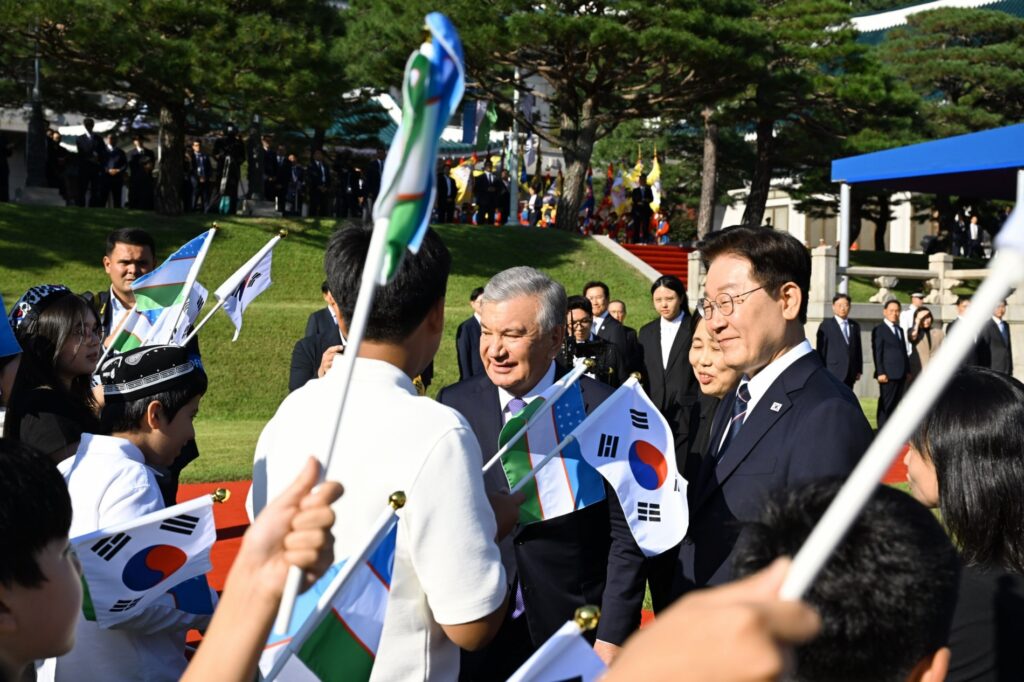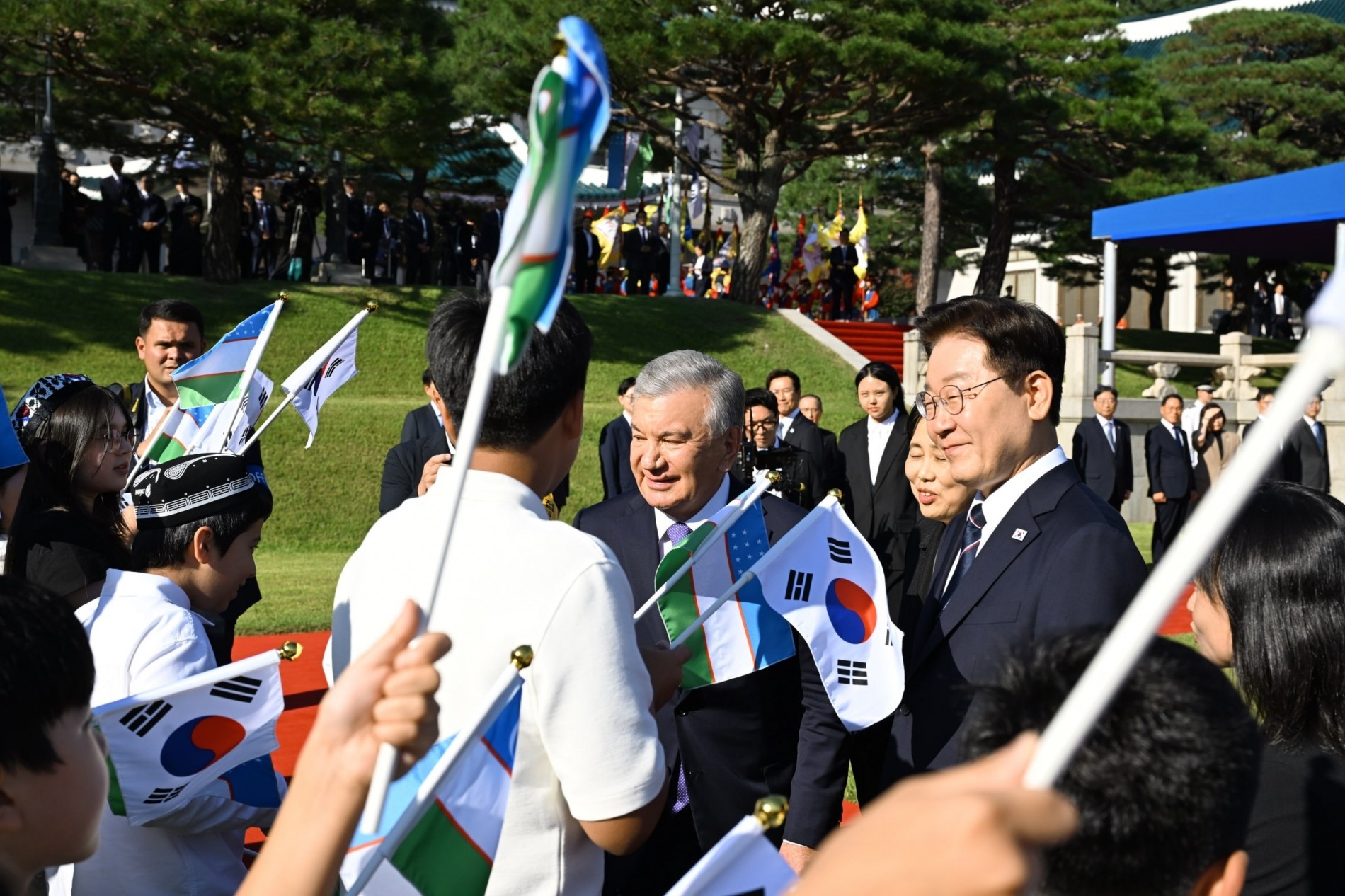
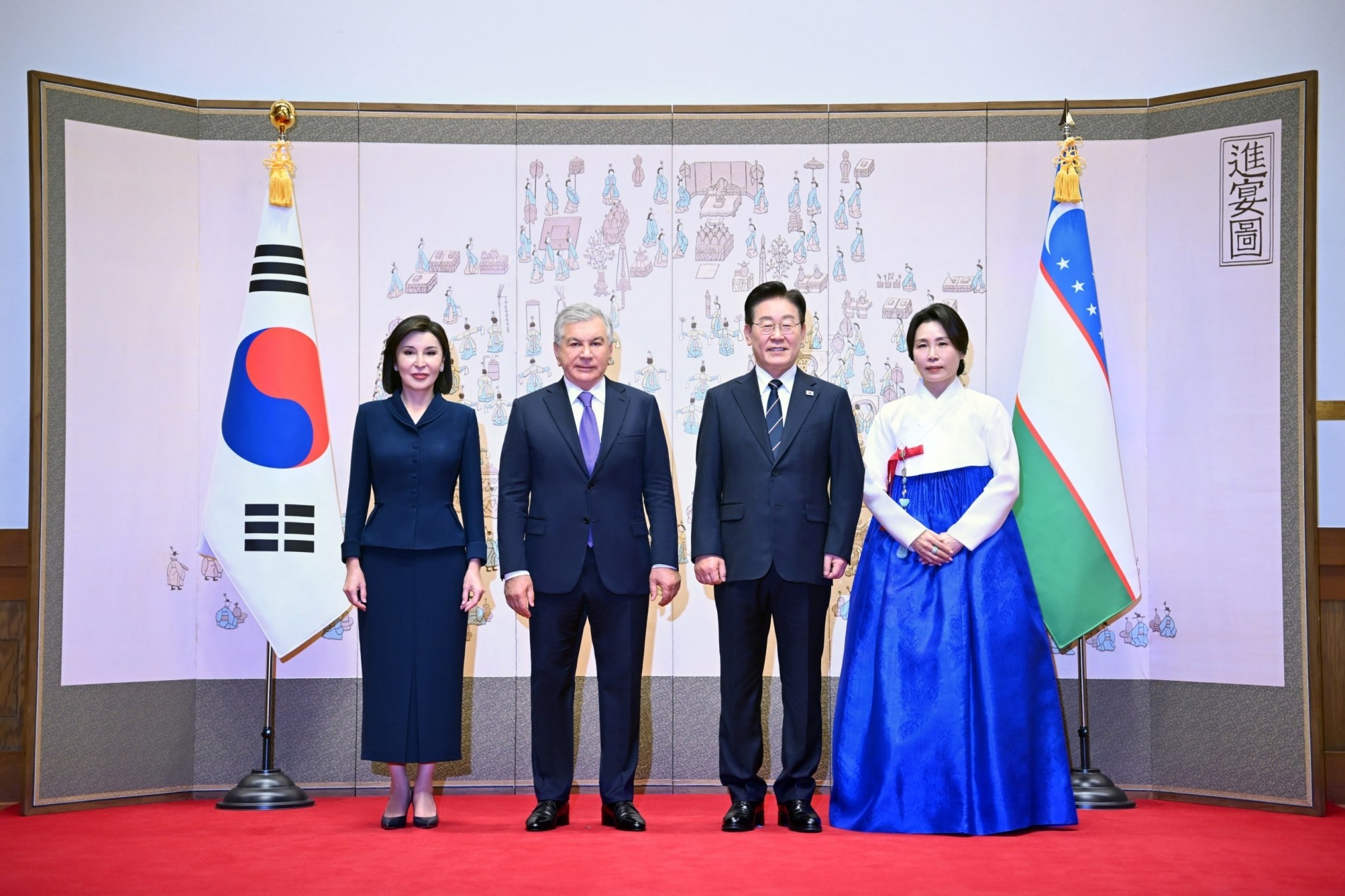
Uzbekistan and South Korea signed 13 cooperation documents during President Shavkat Mirziyoyev’s visit to Seoul on September 14, covering areas including critical minerals, artificial intelligence, rail transport and defense.
South Korean President Lee Jae Myung will host the first summit with all five Central Asian states on September 16. The five Central Asian presidents due to attend are Kazakhstan’s Kassym-Jomart Tokayev, Uzbekistan’s Shavkat Mirziyoyev, Kyrgyzstan’s Sadyr Japarov, Tajikistan’s Emomali Rahmon, and Turkmenistan’s Serdar Berdimuhamedov. Mirziyoyev’s talks opened a series of bilateral meetings running through September 16, with Kazakhstan and Turkmenistan scheduled for September 15, and Tajikistan and Kyrgyzstan the following morning.
Among the Uzbek agreements is a memorandum to launch feasibility studies under South Korea’s Economic Development Cooperation Fund on the introduction of eight high-speed train sets and the establishment of a national genome and biobank center. The projects’ scope will depend on the studies’ findings. Uzbekistan had already agreed to purchase six high-speed trains from Hyundai Rotem in 2024.
The Export-Import Bank of Korea and Uzbekistan’s investment ministry also agreed to identify potential projects and explore financing in six priority areas. These include critical minerals, AI and data centers, smart cities, an industrial complex for Korean companies, pharmaceuticals and biotechnology, and food, beauty and cultural industries.
The presidents also agreed to use the Korea–Uzbekistan Rare Metals Center as a base for strengthening cooperation across exploration, development and processing. They agreed to expand cooperation on the use of AI in manufacturing.
The package includes a defense cooperation contract involving Korea Aerospace Industries and an Uzbek counterpart. The South Korean government’s published summary did not identify the equipment or disclose the contract’s value.
The agreements build on South Korea’s established economic presence across Central Asia. Its foreign ministry identifies Kazakhstan as its largest investment destination in the region, based on investment data through 2023. Kazakhstan’s industry ministry has put bilateral industrial cooperation at 46 joint projects worth about $3.9 billion, covering Hyundai and Kia vehicle production, Hyundai trucks and buses, ferroalloys and Samsung home appliances.
Hyundai Trans Kazakhstan, part of Kazakhstan’s Astana Motors, produced 52,040 vehicles in Almaty in 2025, while Kia Qazaqstan began operating in Kostanay late that year, according to TCA’s reporting on Kazakhstan’s automotive industry. Korean companies are also involved in transport infrastructure and urban development. A Turkish–South Korean consortium secured the Big Almaty Ring Road public-private partnership, while South Korean partners are involved in the planned K Smart City district at Alatau.
South Korean companies have participated in major industrial projects in Turkmenistan, including the Kiyanly gas chemical complex and gas processing facilities at the Galkynysh field. Daewoo Engineering & Construction is working on a mineral fertilizer production complex in Turkmenabat, where South Korea’s ambassador reviewed construction preparations in June. Turkmenistan’s foreign ministry has also highlighted Korean participation in transport infrastructure and shipbuilding.
In Kyrgyzstan, South Korea has provided technical assistance to the textile sector and committed funding for a five-year digital-transformation program starting in 2026. The two governments are also examining potential cooperation involving Kyrgyzstan’s antimony and tungsten resources.
Industry ministers from South Korea and all five Central Asian countries met in Seoul on September 14. Participants agreed to expand cooperation on critical-mineral supply chains, industrial infrastructure and factory modernization, including greater involvement by South Korean companies in regional projects.
The South Korean presidency says it wants to connect Central Asia’s mineral and energy resources with Korean exploration and processing technology to diversify supply chains. It also aims to help Korean companies participate in infrastructure and industrial projects, while expanding cooperation into AI, science, climate adaptation and water management.
South Korea is also discussing regional financing with the Asian Development Bank. As TCA reported, South Korean officials held talks with the bank on September 14 about combining its financing with Korean technology and expertise for projects in Central Asia.
The September 16 summit will elevate cooperation developed through the Korea–Central Asia Cooperation Forum, established in 2007, to heads-of-state level. A Seoul Declaration is expected to set out a longer-term framework, after which the six presidents are scheduled to attend a business summit involving around 500 government and corporate representatives.