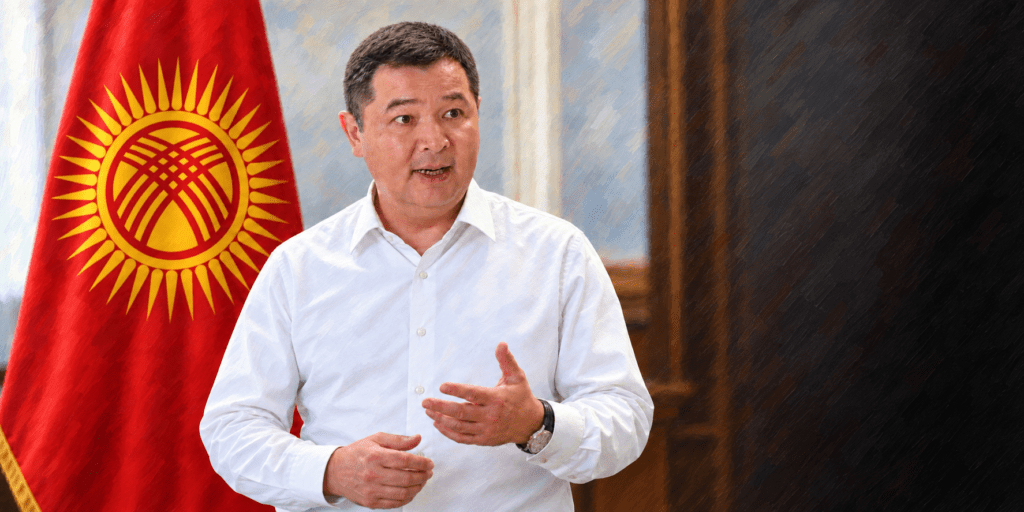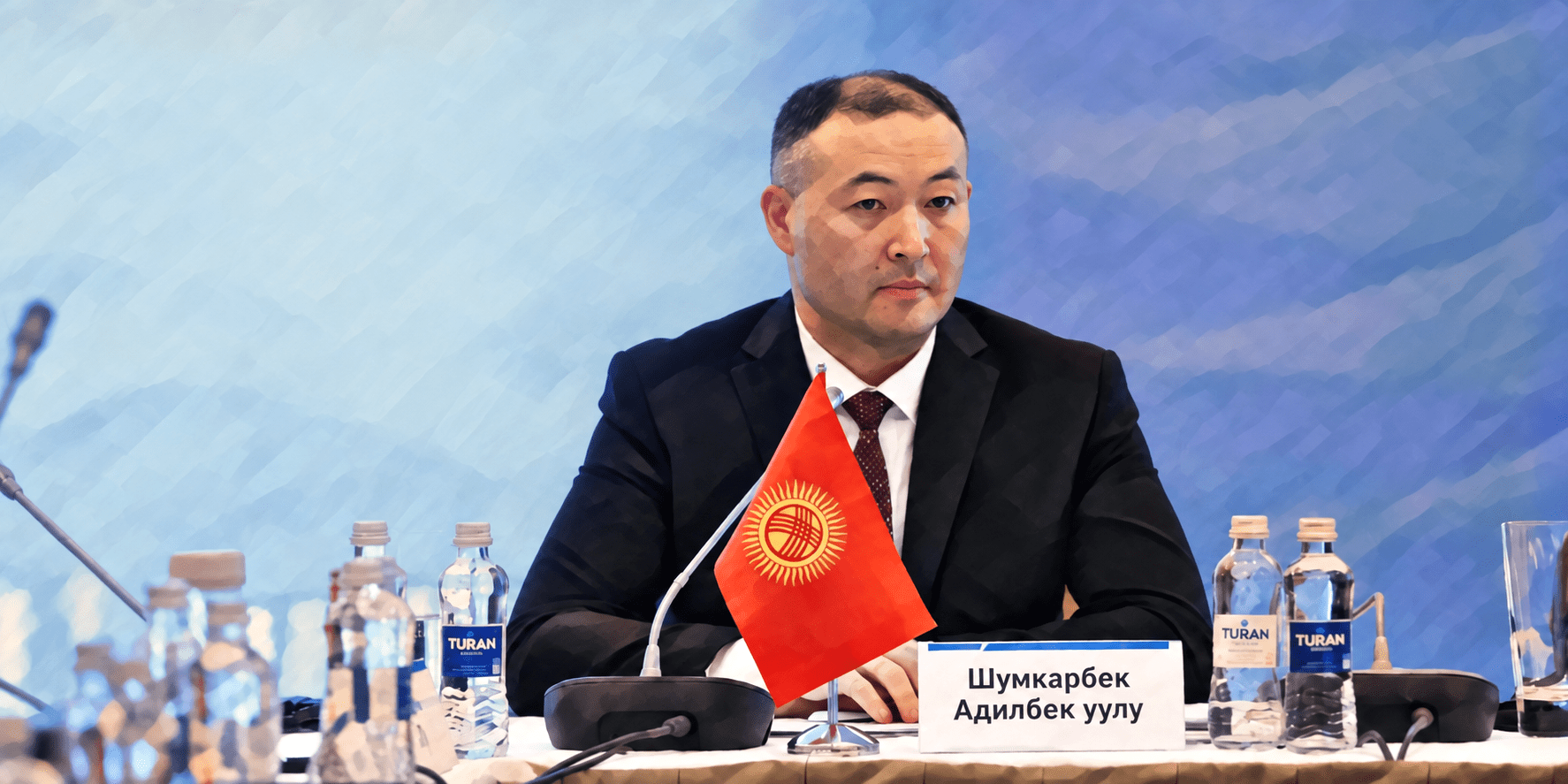
On September 15, 2026, The Times of Central Asia spoke with Shumkarbek Adilbek uulu, director of the National Institute for Strategic Initiatives (NISI) under the President of the Kyrgyz Republic. Established in its current form in 2024 through the merger of two institutes, NISI provides strategic advice to the country’s leadership and develops proposals to reduce bureaucracy. Adilbek uulu discusses Kyrgyzstan’s priorities for its 2027–2028 UN Security Council term and its approach to climate diplomacy. He also outlines NISI’s work on economic reform and digital public services, including efforts to help smaller businesses grow.
Some views expressed in this interview reflect Adilbek uulu’s personal opinions rather than the official position of NISI or the Kyrgyz government, as he notes in his answers. The English text has been lightly edited for readability.
TCA: What have been your main priorities since becoming director, and how did you come to join NISI?
Adilbek uulu: We’re focused on practical ways to drive sustainable economic growth at home: a smaller, simpler government, more room for business, and productive relations abroad that feed into our domestic agenda. By protecting our national interests, our diplomats support the domestic goal of building up the Kyrgyz Republic, nation-building if you will, without getting caught up in other countries’ ambitions.
I joined NISI in 2025 to help break through decades of bureaucratic gridlock, a real drag on economic development. Minister Ayaz Baetov brought me in. At the time, he was the Minister of Justice, Deputy Chairman of the Cabinet of Ministers, and NISI’s director, all at once. He told me NISI’s job was to give the Presidential Administration strategic advice that’s pragmatic and rooted in Kyrgyz insight. I agreed and have been working at it since. That’s our core job. Interestingly, Minister Baetov was just named Kyrgyzstan’s Permanent Representative to the UN in New York. The significance of the contribution Mr. Baetov has made to the effort to reduce bureaucracy remains to be fully assessed. I am confident it will be rated highly, as we will feel the positive impact of many of his ideas and decisions in the future.
TCA: Kyrgyzstan was recently elected a non-permanent member of the UN Security Council for 2027–2028. Will NISI be more focused on foreign policy now?
Adilbek uulu: With Kyrgyzstan on the Security Council, the government will be pulled into issues outside our usual remit, so NISI will be in even closer contact with the Ministry of Foreign Affairs.
To be clear, I don’t speak for the Foreign Ministry. I help shape strategy for our diplomats, businesspeople, and policymakers, and I track what’s happening overseas and in our neighborhood. UNSC issues will be high on our agenda, and we’ll support the MFA on long-term thinking. As one example, I just got back from the China Economic and Social Forum in Hangzhou, China. The forum focused on the environment and natural resources. I’ll be putting together a memo for the Office of the President with our observations.
TCA: How does climate vulnerability fit into NISI’s economic and security work?
Adilbek uulu: Climate directly shapes economic and security policy; these aren’t separate issues. Whatever’s causing climate change, it’s a fact that temperatures have been rising. We’re a small country heavily shaped by our neighbors and our geography. Kyrgyzstan is 94% mountainous, mostly above 1,000 meters. Our glaciers are retreating, and warming here is running at twice the global rate. Climate change directly threatens our water, agriculture, and energy security. That’s why climate resilience sits at the core of our national strategy, not on the sidelines. I articulated this point at the aforementioned forum in Hangzhou.
TCA: Kyrgyzstan regularly raises issues related to mountain ecosystems and glaciers at forums. What do you hope to achieve?
Adilbek uulu: We’re pushing for international cooperation and new financing specifically for mountainous states. We want greater recognition that our geography and outsized climate exposure deserve differentiated, even special, support. We also want more investment in hydropower and green technology, areas where our terrain gives us a genuine comparative advantage. I emphasized this matter as well in Hangzhou. President Japarov treats environment, climate, and water management as core strategic issues, not side concerns. He didn’t just rename a 4,050-meter-high mountain in Kyrgyzstan the “Peak of the Shanghai Cooperation Organization” for photo ops. The President wants climate and ecology front and center.
TCA: What priorities would you like Kyrgyzstan to pursue during its Security Council term?
Adilbek uulu: Let me repeat that these are my personal views. But I’d like to flag two things. You may recall that back in 2023, President Japarov floated a debt-for-nature swap in his UNGA speech, a pretty remarkable statement. Basically, a creditor forgives or restructures part of a country’s foreign debt, and in exchange, the debtor government, like Kyrgyzstan, commits to funding environmental conservation and natural resource management at home.
Second, we’re hosting the Bishkek+25 Global Mountain Summit next year, October 21 to 23, 2027, in Bishkek. It is a UN-linked event, capping off the UN’s “Five Years of Action for the Development of Mountain Regions.” I’d like to see debt-for-nature swaps as a specific item on the agenda there, building on what President Japarov raised at the UN.
TCA: Is NISI cautious about the pace of market reform, and what risks do you see in moving too quickly with deregulation?
Adilbek uulu: Yes, deliberately so. Moving from a command mindset to an entrepreneurial one has to happen prudently. I’m genuinely cautious about unregulated, “anything-goes” market liberalism because I’ve watched rapid deregulation and privatization in post-socialist and developing economies produce sharp inequality, asset concentration among a narrow elite, and weakened public services.
Our regulatory institutions, market structures, and social safety nets are on a maturing trajectory, but have not yet reached the depth that allows more established economies to absorb liberalization’s disruptive effects as smoothly. Move too fast, and capital drifts toward a small number of actors instead of being broadly shared, which undermines the whole point: our land, water, energy, and economic output should serve the entire population, not a privileged few.
So, I favor a gradual, sequenced approach: build institutions and social protections alongside market reforms, so we get the benefits of a more open economy without sacrificing social cohesion.
TCA: You put a lot of weight on reducing bureaucracy. What do you mean by “Next-Generation Service,” and how does NISI’s digitalization index fit into this work?
Adilbek uulu: It means putting people at the center of government. Citizens and foreign investors should know that our reforms center on transparency, audits, regulatory optimization, digitalization of services, and outsourcing where appropriate. Less bureaucracy beats more bureaucracy, and that applies to the public sector as much as the private one, with the caveat that we still need guardrails to manage what could be detrimental to the common good.
On digitalization, the goal is efficiency and interoperability. Here’s an example that also explains our “Tunduk System”: when a child is born, parents shouldn’t have to chase down people in a dozen offices while getting buried in paperwork. As that child goes through life, the government system should already be set up so parents can easily confirm that “all is in order.” Over time, that means less paperwork, fewer steps, easier access; that’s the practical goal.
TCA: Can you elaborate on what “Tunduk” means?
Adilbek uulu: Tunduk is Kyrgyzstan’s national electronic interoperability system, the government’s digital backbone connecting agencies and services, so people get better access to government. NISI also works on the policy creation and reform side, shaping how that infrastructure gets used to make services more accessible, connected, and proactive. It’s also a useful tool in the fight against corruption.
TCA: What opportunities and risks do you see in using AI in government?
Adilbek uulu: AI is a road we’re traveling right now, like every other nation. It makes government more efficient and responsive, helping small departments serve more people with smaller budgets — quality over quantity. At the same time, it raises real risks around privacy, job displacement for public workers, and the temptation to over-automate decisions that really need a human touch. We’re aware of those risks.
TCA: How does NISI support the growth of medium-sized businesses?
Adilbek uulu: Our SME sector needs to grow, plain and simple. For 25 years, we’ve been stuck at around 800 to 1,000 medium-sized enterprises. There’s been some movement lately, but not nearly enough, and too many small businesses still struggle to scale.
We built a dashboard with more granular data than I believe exists in Uzbekistan or Kazakhstan. Official statistics generally stop at the oblast level; we’re taking data collection down to the district level ourselves. The goal is to direct government support to businesses with real growth potential, not those with the right connections.
We’re also positioning NISI as an Independent Verification Agency and, with UNDP, adapting the UK’s Delivery Unit model at the district level. Greater transparency and better data can give entrepreneurs a fairer shot and give Kyrgyzstanis abroad more confidence to invest capital back home.