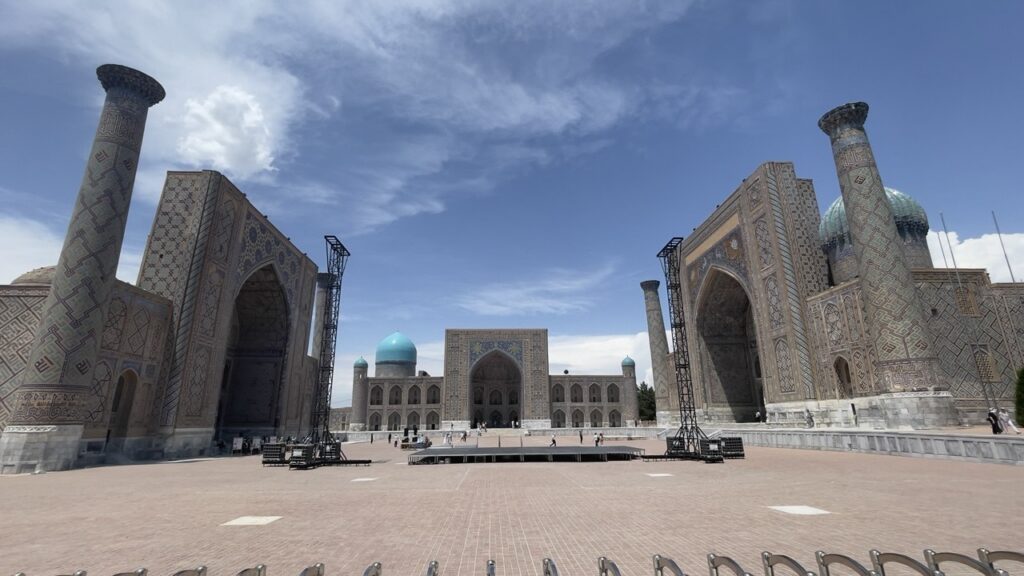
The United States and the five Central Asian republics have issued a joint statement on economic and security cooperation that makes no mention of Afghanistan, once a central concern of U.S. regional policy. The document followed the October 19 C5+1 ministerial meeting in Samarkand, Uzbekistan.
Afghanistan’s absence from the statement does not mean it has disappeared from negotiations or Washington’s strategic interests. Nevertheless, a comparison with earlier C5+1 documents reveals a shift in the published agenda. Where Washington once placed considerable importance on connecting Central Asia with South Asia through Afghanistan, the latest statement focuses on trade across the Caspian Sea and investment in the region’s minerals.
Afghanistan’s Changing Place in C5+1 Talks
In July 2021, just weeks before the Taliban retook Kabul, C5+1 participants at a conference in Tashkent explicitly supported closer trade and transport links between Central and South Asia through Afghanistan, as well as efforts to secure peace in the country. That month, the U.S., Uzbekistan, Afghanistan, and Pakistan also announced plans for a quadrilateral platform to support trade and transportation projects linking the two regions.
In July 2023, Afghanistan was the subject of a separate C5+1 special session in Astana. Officials called for an inclusive Afghan government that respected women’s rights and backed further development of transport and energy links through the country. A joint statement issued by C5+1 leaders that September described Afghanistan as an important factor in Central Asian security.
In the 2026 Samarkand statement, Afghanistan goes unmentioned even in the section on border security and terrorism. However, the October 2023 C5+1 connectivity statement had already highlighted the Trans-Caspian Trade Route, which connects Central Asia to Western markets, and also omitted Afghanistan.
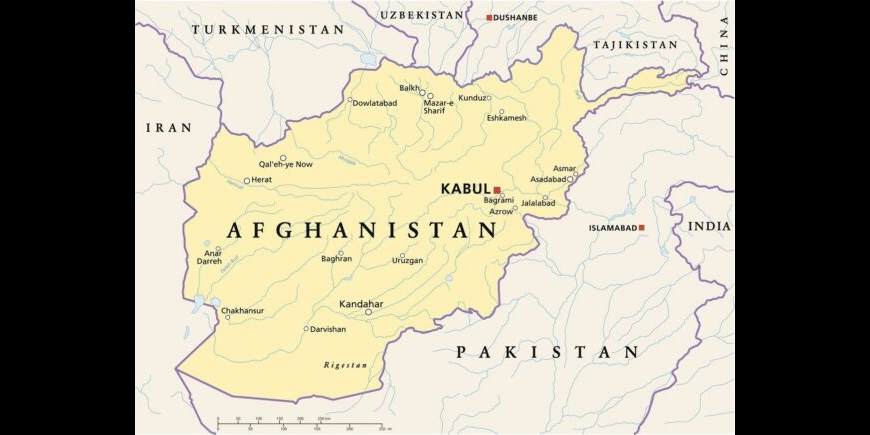
For Central Asian countries, the Afghan route remains important in practical terms. Uzbekistan is pursuing plans for a railway through Afghanistan to Pakistan, which would give it access to Indian Ocean ports. Kazakhstan is already a major supplier of food to Afghanistan, exporting around $216 million worth of flour and $122 million of wheat in the first seven months of 2026. In September, Kazakhstan and Uzbekistan also agreed with the United Arab Emirates to study a railway corridor through Afghanistan to Pakistan.
Tajikistan, Uzbekistan, and Turkmenistan all share borders with Afghanistan. Uzbekistan and Turkmenistan also face the prospect of reduced water supplies from the Amu Darya as Afghanistan builds its Qosh Tepa Canal. Afghanistan’s omission from a joint statement should therefore not be taken as a complete account of the policies of all five Central Asian states.
What Constrains Washington
One possible explanation lies in the U.S. approach to Afghanistan’s current authorities. Washington allows practical contacts with representatives of the Taliban but does not recognize the government it has formed. The movement remains designated as a Specially Designated Global Terrorist, although it is not included in the U.S. Department of State’s separate list of Foreign Terrorist Organizations.
The designation restricts dealings with the Taliban, although U.S. sanctions rules permit many commercial transactions involving Afghanistan’s governing institutions, including civilian infrastructure and transportation projects. Restrictions remain on direct financial transfers to the Taliban, subject to specified exceptions.
Washington would have to reconcile support for projects involving Afghan authorities with its policy of nonrecognition of the Taliban government and the remaining restrictions. These constraints did not, however, prevent C5+1 participants from backing transport and energy links through Afghanistan in 2023.
Pakistan is important to Central Asia’s access to Indian Ocean ports through Afghanistan. But relations between Kabul and Islamabad have deteriorated sharply. Fighting along their border in October 2025 led to the closure of major crossings, and trade disruptions continued into 2026.
An alternative route south runs through Iran and its ports. Here, the constraints arise from U.S.-Iranian relations and Washington’s sanctions policy.
Different Routes, Different Priorities
The shift in the published agenda cannot be explained solely by Washington’s relationship with Afghanistan. Central Asia has significance in its own right for U.S. economic policy, particularly as a potential source of critical minerals and a destination for American investment.
The Trans-Caspian route does not replace southern corridors. It connects different markets, and its viability depends on transit countries’ infrastructure and policies, including tariffs.
For Central Asian capitals, choosing between these routes is not necessary. Kazakhstan and Uzbekistan can develop ties with Afghanistan while participating in Trans-Caspian projects and expanding cooperation with the U.S.
Moreover, the gradual normalization of contacts with Kabul as part of routine trade and transportation activities could reduce the need to discuss Afghanistan separately at every C5+1 meeting.
Afghanistan’s absence from the Samarkand statement therefore allows for at least two interpretations. Washington may have deliberately focused on initiatives that do not require political engagement with the Taliban. Alternatively, Central Asian countries may be increasingly handling Afghan-related issues on their own, reserving the C5+1 format for projects where U.S. participation is most valuable.