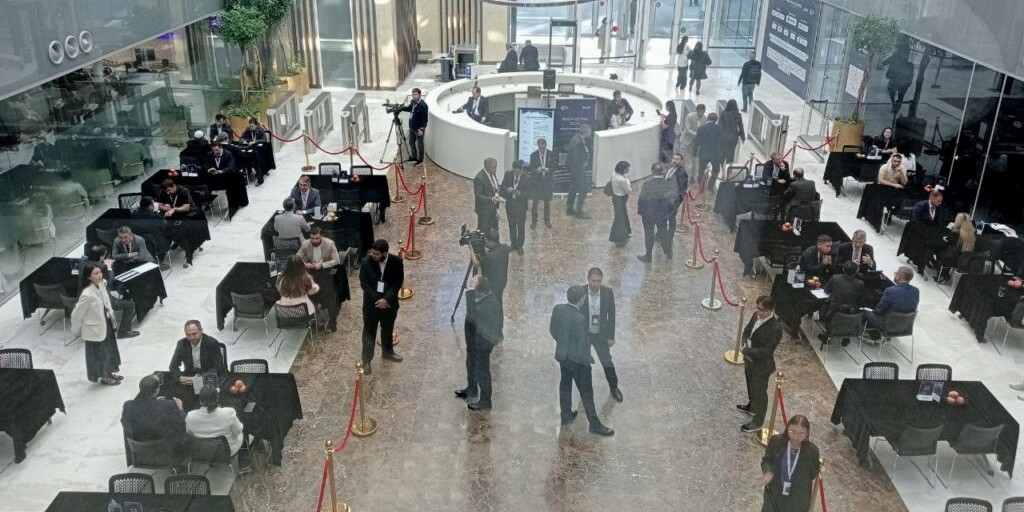
In a trading hall in Astana, BlackRock was explaining why investors have become more cautious. A few floors away, geologists were pitching 23 mining projects, while financiers debated how many megawatts the next wave of artificial intelligence will require. That was how the first day of Astana Finance Days unfolded, as Kazakhstan brought together financial groups managing more than $26 trillion in assets – and sought to show them where that money could be put to work in Central Asia. The ninth Astana Finance Days is taking place on September 9–10 at the Astana International Financial Centre (AIFC), Kazakhstan’s special financial jurisdiction with its own regulator and a court system based on English common law principles.  According to the organizers, around 8,000 participants from 90 countries registered for the forum. Institutions represented include BlackRock, Goldman Sachs, Capital Group, Brookfield, Rothschild & Co., Hong Kong Investment Corporation, and IFC Asset Management Company. The stated $26 trillion refers to the combined assets under management of participating firms worldwide – not investment pledged to Kazakhstan.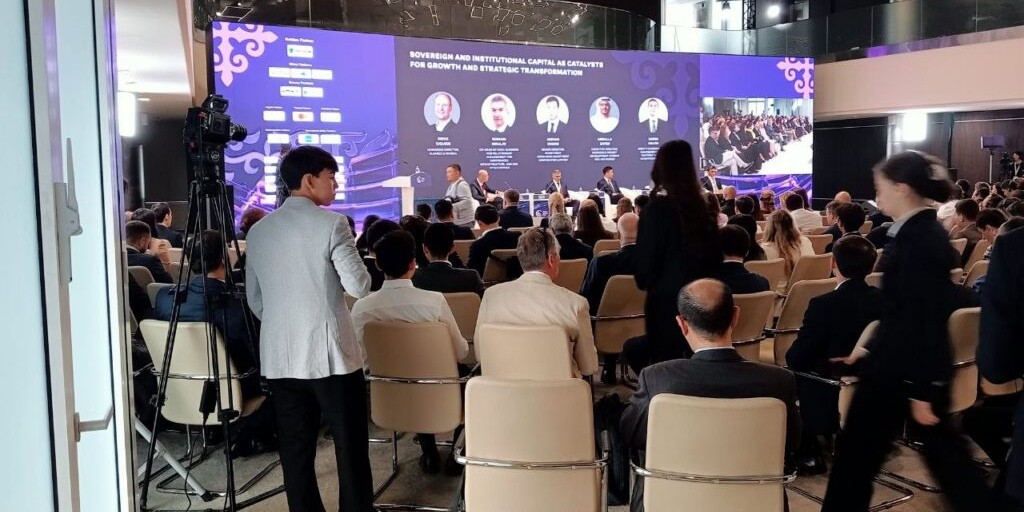
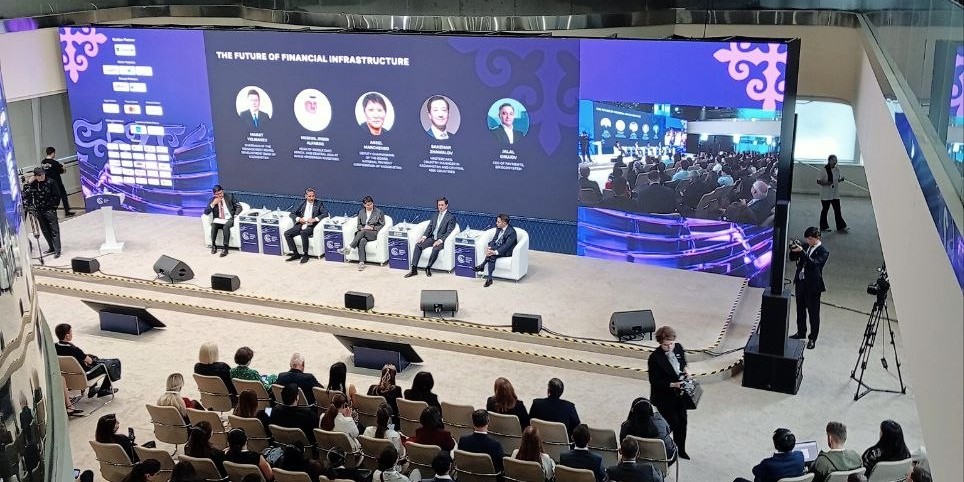 More concrete signals emerged on the sidelines. Meshal Jaber AlFaras, Janus Henderson Investors’ head of the Middle East, Africa, and Central Asia, said the investment group is considering direct investments in Kazakhstan and plans to expand its presence in the country. Janus Henderson manages around $500 billion in assets. AlFaras did not disclose potential projects or investment amounts. A New Price for Risk One of the first day’s most prominent discussions took place at the Astana International Exchange (AIX), the AIFC’s stock exchange. Ben Powell, Chief Investment Strategist for the Asia-Pacific region at the BlackRock Investment Institute, spoke about how geopolitics is reshaping capital flows. “Today, we are in a structurally new regime – moving into a more complicated world where geopolitical fragmentation is intensifying, alliances are breaking down, and international relationships are changing. Of course, this affects investors. They need to completely rethink their approaches to investing,” Powell said. Higher inflation and interest rates, he continued, are changing attitudes toward risk. For smaller emerging markets, that means greater scrutiny of currency stability, regulation, and liquidity. A few halls away, that global discussion was already turning into pitches for specific mineral projects. From the Geological Map to the Investor Fifteen companies brought 23 mining projects to Astana Finance Days. Most are still at the exploration stage. In the industry, such companies are known as juniors. They search for mineral deposits and try to demonstrate that the resources they discover can eventually be mined profitably. For an ordinary bank, the risk is high: a promising area on a geological map does not yet guarantee a working mine. At the forum, companies briefly pitched their projects before moving into individual negotiations. More than ten Kazakh and international investors and strategic partners attended the pitch session. The Junior Mining Platform, launched this spring, is intended to turn this search for capital into a permanent mechanism. Private investors take on early geological risk; as reserves are confirmed and technical uncertainty declines, larger mining groups, lenders, international financial institutions, and eventually public markets can enter the project.
  Organizers did not disclose how much funding the participating companies were seeking or whether any financing agreements were reached on the first day. According to the AIFC, about 65% of Kazakhstan’s territory remains geologically underexplored. For a country with major deposits of copper, uranium, gold, and other minerals, that means investors often have to finance the search and evaluation of deposits before they can finance extraction. Solidcore Resources added another link to that chain: processing. The company presented Ertis POX, a pressure-oxidation complex under construction in the Pavlodar region. The facility is designed to process refractory gold-bearing concentrates, including material from Solidcore’s own mines and potentially from other producers in Kazakhstan and the wider region. The project has already secured $600 million in financing from the European Bank for Reconstruction and Development and a syndicate of international commercial banks. “A Chip You Can’t Plug In” In the discussion about artificial intelligence, the unit of measurement was no longer the dollar – or even the processor. “Investing in AI Infrastructure: The Megawatt as the New Unit of Account” was the title of a presentation by Nikita Selivanov, Director of Global Markets at AGS. Behind that formula lies a physical constraint on the AI boom: buying thousands of cutting-edge processors is not enough. They have to be connected to the power grid and cooled around the clock. “A chip you can’t plug in is meaningless,” Selivanov said. By his estimate, creating one megawatt of computing capacity requires roughly $10 million to $15 million in investment. The AI investment race therefore extends far beyond processors to power plants, grids, transformers, copper, cooling systems, and data center construction. For Kazakhstan, this brings the discussion back to familiar territory: energy and raw materials. The country has major uranium reserves, plans to build nuclear power plants, and is simultaneously expanding its digital infrastructure. Selivanov pointed to the possibility of locating new power generation closer to major computing facilities. The connection between seemingly separate sessions at the forum was almost physical: new data centers need electricity; power infrastructure needs metals; and producing those metals begins with the same exploration projects being pitched to investors a few floors away. From a Concert Ticket to Grain in an Elevator At a session on tokenization, speakers initially explained a complex financial technology through the example of a concert. Alexander Kruglov, Chief Commercial Officer of Wallet in Telegram and a partner at The Open Platform, asked the audience to imagine the chain between a musician and the person sitting in the concert hall. Between them, he said, there may be six to eight intermediaries – managers, promoters, ticketing services, and venues. An artist could instead issue digital tokens in advance, with demand helping indicate which city would make sense for a concert. If necessary, the holder could then resell that right to someone else. Seh Huan Kiat, Director of FinTech at Phillip Securities, brought the discussion back to financial markets. “First, tokenization creates a new way of distributing financial products and makes assets tradable that previously were not. Second, portability. The programmability of tokens allows financial services to be used beyond individual ecosystems and changes traditional distribution chains,” he said. Seh described automation as the third shift. Stablecoins – digital tokens typically designed to track the value of a conventional currency or another reference asset – and AI agents, he said, could automate parts of the process of using and managing financial products. Kazakhstan has already found a distinctly physical commodity for this technology: grain. In June, the AIFC regulator licensed Commodity Chain to operate a platform for trading tokenized real-world assets. The first application is intended to focus on agricultural products, including grain stored at modernized elevators. In the physical world, the grain remains in storage. Sensors and other monitoring systems would track its quantity and condition, while rights linked to the commodity would receive a digital representation. The tokenized assets could then be used as collateral for short-term financing. But the technology leaves a very traditional financial risk intact: investors still need to know whether the grain is really in the elevator and what happens to the collateral if the borrower fails to repay. Five Markets Around One Table While mines, megawatts, and tokens were being discussed in the open halls, financial regulators and market participants from Kazakhstan, Kyrgyzstan, Tajikistan, Uzbekistan, and Georgia gathered around one table to confront a different problem: the relatively small size and fragmentation of their national markets. Different licenses, rules, and financial infrastructure make it harder for an investor to operate across several countries. Representatives of international financial organizations and development institutions also joined the discussion. Participants discussed regulatory cooperation, information exchange, and ways to make cross-border financial services easier. But the AIFC regulator, the Astana Financial Services Authority (AFSA), did sign a memorandum with the National Bank of Georgia. It establishes a framework for working toward mutual market access in selected areas, including capital markets and asset management, as well as cross-border listings of securities. The practical arrangements still have to be developed under the legal and regulatory requirements of both jurisdictions. Astana Finance Days continues on September 10. For more on our special coverage of Astana Finance Days, click here.