• KGS/USD = 0.01144 0%
  • KZT/USD = 0.00208 0%
  • TJS/USD = 0.10442 0.19%
  • UZS/USD = 0.00008 0%
  • TMT/USD = 0.28530 0%
  • KGS/USD = 0.01144 0%
  • KZT/USD = 0.00208 0%
  • TJS/USD = 0.10442 0.19%
  • UZS/USD = 0.00008 0%
  • TMT/USD = 0.28530 0%
  • KGS/USD = 0.01144 0%
  • KZT/USD = 0.00208 0%
  • TJS/USD = 0.10442 0.19%
  • UZS/USD = 0.00008 0%
  • TMT/USD = 0.28530 0%
  • KGS/USD = 0.01144 0%
  • KZT/USD = 0.00208 0%
  • TJS/USD = 0.10442 0.19%
  • UZS/USD = 0.00008 0%
  • TMT/USD = 0.28530 0%
  • KGS/USD = 0.01144 0%
  • KZT/USD = 0.00208 0%
  • TJS/USD = 0.10442 0.19%
  • UZS/USD = 0.00008 0%
  • TMT/USD = 0.28530 0%
  • KGS/USD = 0.01144 0%
  • KZT/USD = 0.00208 0%
  • TJS/USD = 0.10442 0.19%
  • UZS/USD = 0.00008 0%
  • TMT/USD = 0.28530 0%
  • KGS/USD = 0.01144 0%
  • KZT/USD = 0.00208 0%
  • TJS/USD = 0.10442 0.19%
  • UZS/USD = 0.00008 0%
  • TMT/USD = 0.28530 0%
  • KGS/USD = 0.01144 0%
  • KZT/USD = 0.00208 0%
  • TJS/USD = 0.10442 0.19%
  • UZS/USD = 0.00008 0%
  • TMT/USD = 0.28530 0%

Viewing results 13 - 18 of 310

Turkic States Set to Expand Mutual Trade and Strengthen Economic Integration

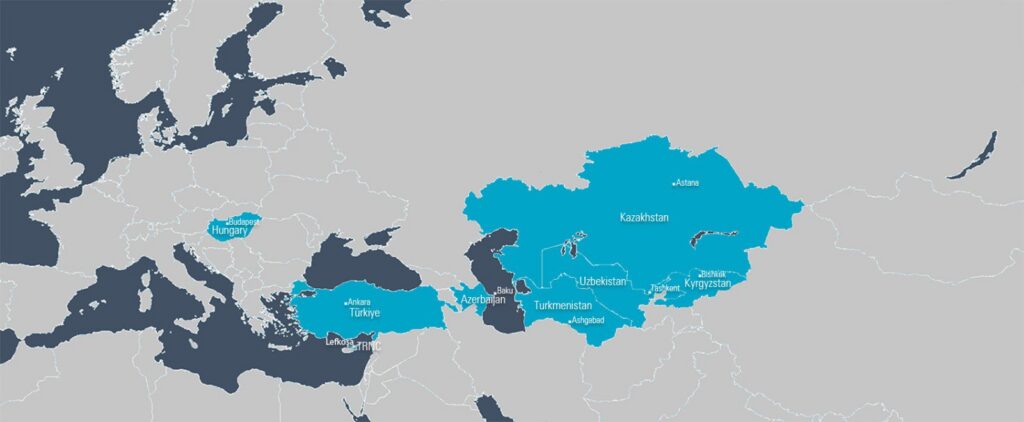
The 14th meeting of ministers responsible for economy and trade of the Organization of Turkic States (OTS) was held on February 20 in Turkistan, Kazakhstan. The gathering brought together ministerial delegations from member states to advance economic cooperation, deepen trade ties, and promote sustainable and inclusive growth across the Turkic region. Founded in 2009 to foster comprehensive cooperation among Turkic-speaking nations, the OTS includes Azerbaijan, Kazakhstan, Kyrgyzstan, Turkey, and Uzbekistan as full members. Turkmenistan, Hungary, and Northern Cyprus participate as observers. According to the OTS Secretariat, the Turkic region recorded an average economic growth rate of 6.86% in 2025, more than double the global average. Despite this performance, OTS Secretary General Kubanychbek Omuraliev called for intensified efforts to expand intra-regional trade. Omuraliev highlighted ongoing negotiations on the Agreement on Services and Investment Facilitation, describing it as a decisive step toward deeper economic integration. He also pointed to strengthened institutional mechanisms, including the Council of Central (National) Banks of the OTS, the Turkic Green Finance Council, enhanced cooperation among Financial Intelligence Units and Competition Authorities, and closer coordination between the Turkic Investment Fund and the Union of Turkic Chambers of Commerce and Industry (TCCI). Delegations discussed practical measures to increase intra-OTS trade, improve the investment climate, and enhance regional connectivity. Participants emphasized the need for coordinated policies to reduce trade barriers, support small and medium-sized enterprises, and facilitate cross-border commerce. Kazakhstan’s Deputy Minister of National Economy, Asan Darbayev, underscored the symbolism of holding the meeting in Turkistan, a historic spiritual center of the Turkic world and a key node of the ancient Silk Road. He noted that the OTS is steadily evolving from a dialogue platform into a mechanism for practical cooperation, building new value chains and expanding trade links. In 2025, mutual trade among OTS member states exceeded $11.9 billion. Kazakhstan’s largest trade volumes were with Turkey ($4.9 billion), Uzbekistan ($4.3 billion), Kyrgyzstan (nearly $2 billion), and Azerbaijan ($425 million). Investment ties are also strengthening. Between 2005 and 2025, foreign direct investment from OTS countries into Kazakhstan surpassed $6.3 billion. Over the same period, Kazakh investments in OTS economies reached $5 billion, including more than $1.3 billion in 2025 alone. The meeting concluded with the signing of a Memorandum of Understanding on Partnership in Trade and the adoption of a Roadmap for Cooperation in Economy, Trade, Investment, and Finance. As previously reported by The Times of Central Asia, in December 2025 the Board of Governors of the Turkic Investment Fund announced that the fund would begin operations in the first quarter of 2026. Headquartered in Istanbul, the Turkic Investment Fund is the first joint financial institution established by OTS member states. Its mandate is to promote economic cooperation, boost intra-regional trade, and finance major joint initiatives aimed at strengthening long-term regional integration.
Storms and Abnormal Heat: Turkmenistan Experiences Severe Weather

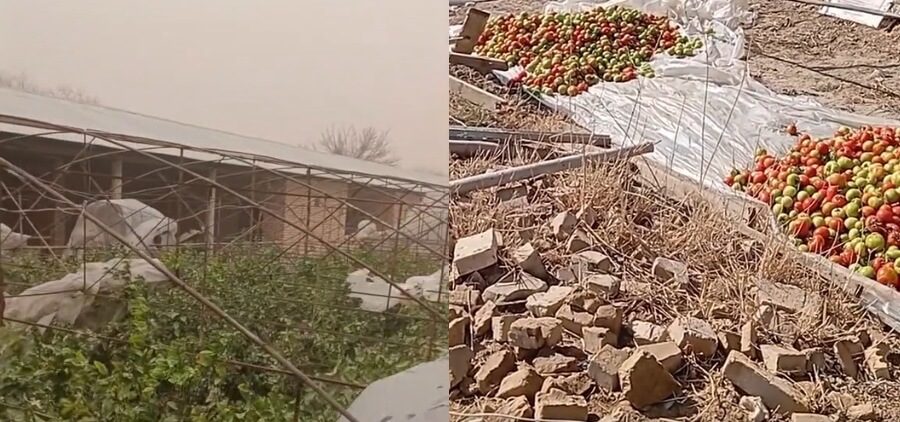
From February 20 to 22, dust storms with storm-force winds swept across Turkmenistan. The storm damaged greenhouses and crops in a number of regions, and the week was memorable not only for the destruction it caused but also for the historic temperature records it set. Strong winds hit the country on February 20. In the Akhal region, gusts reached 18-23 m/s, and in the Mary region, 17-22 m/s. On the Beaufort scale, these readings are classified as storm force. In other regions, the wind was also very strong. Dust storms broke out in the east of the country and in some parts of the Ahal region. In the town of Turkmenabat, wind speeds reached 23 m/s, and visibility was reduced to 500 meters. Similar readings were recorded in the towns of Serkhetabat and Bayramali. In the town of Mary, visibility dropped to 300 meters, and in the village of Tagta-Bazar to only 200 meters. The storm knocked down trees, damaged road signs, and affected some buildings. The most significant damage occurred in rural areas. In the Mary and Lebap region, private farms and plots were affected. The wind blew away greenhouses, and their frames collapsed directly onto the beds, destroying cucumbers, tomatoes, and other crops. Flower growers also suffered serious losses. Many had expanded their acreage and hired additional workers to prepare for the peak sales period around March 8, but the storm deprived them of their harvest and any chance of compensating for months of low demand. The region has previously faced the devastating effects of natural disasters. In 2020, a hurricane caused extensive damage in the Mary and Lebap regions, knocking down buildings and trees and claiming dozens of lives. Some families have still not recovered from those events. At the same time, despite the regular occurrence of strong winds, no effective system has been created to protect farms and the population from such phenomena. As noted by Meteozhurnal, the current weather situation is due to the northwestern intrusion of air masses. High wind speeds continued on February 23, prolonging the period of adverse conditions. The week was marked not only by storms but also by unprecedented heat. For several days, temperatures were more typical of April or May. The peak occurred on February 19, 2026.  In the city of Esenguly in the Balkan region, located in the southwest of the country on the coast of the Caspian Sea, the temperature reached 36.2°C. This is the absolute maximum in the history of meteorological observations in Turkmenistan. The previous record of 32.9°C was set in 1946 in Serakhs, Akhal region. On the same day, temperatures above 30°C were recorded in several regions. In the Balkan region, the thermometer rose to 33.4°C in the town of Etrek and 30.6°C in Makhtumkuli. In Baharden, Akhal region, it reached 33°C. Records were also broken in other cities, albeit with lower values.

Gurbanguly Berdymuhamedov’s Unannounced Visit to Florida Draws Attention

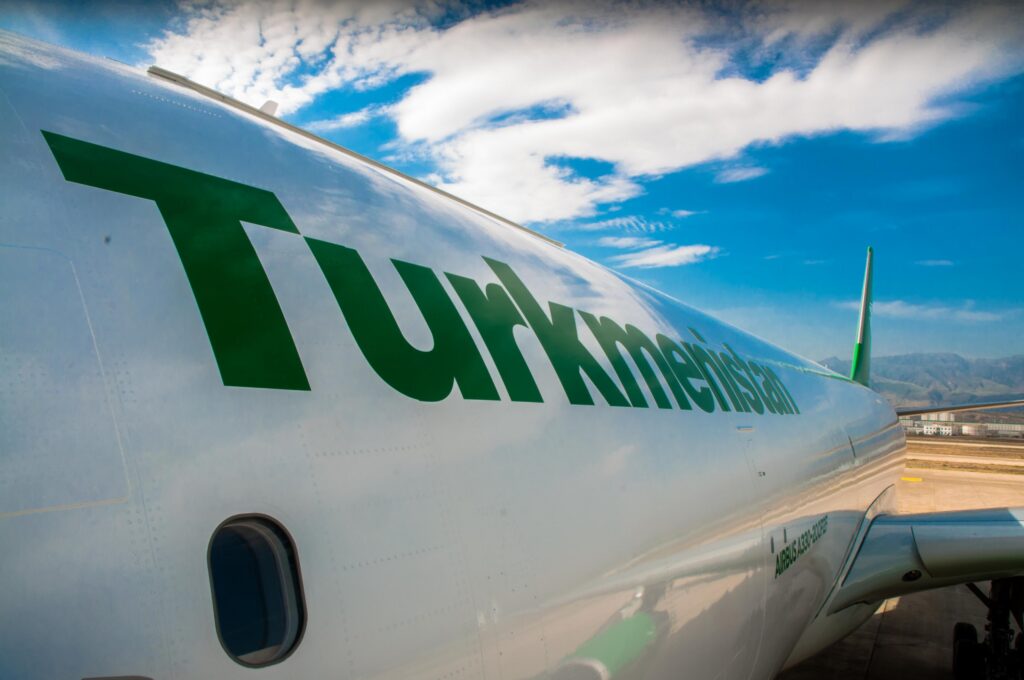
From February 16 to 18, Gurbanguly Berdymuhamedov, Turkmenistan's former president and current Chairman of the Halk Maslahaty, Turkmenistan’s highest representative body, visited the U.S. state of Florida. Turkmen state media did not disclose details of the visit’s program, limiting coverage to a brief report on the trip. Berdymuhamedov arrived at Fort Lauderdale-Hollywood International Airport aboard a government Boeing 777 (tail number EZ-A780). Local journalists and aviation observers reported possible damage to the aircraft’s horizontal stabilizer. The green-and-white liveried airliner remained parked at the airport for several days. Aaron Rosen, president of the World Affairs Council of Miami, noted that the visit coincided with renewed U.S. interest in Central Asia. According to Rosen, the region is strategically significant due to its energy resources, geopolitical location, and security considerations. He also referred to recent statements by Turkmenistan’s Foreign Ministry emphasizing the importance of dialogue with Washington to develop constructive relations. U.S. media reported that Berdymuhamedov’s trip overlapped with President Donald Trump’s weekend stay at his Mar-a-Lago residence, located approximately a 45-minute drive from Fort Lauderdale-Hollywood International Airport. Local 10 News footage showed heightened security measures and a VIP passenger boarding the Boeing 777 prior to departure. The aircraft left Florida several days later. Separately, a government Boeing 737 (tail number EZ-A700) arrived from Ashgabat, refueling in Glasgow before continuing to Florida. After a brief stop in Florida, the Boeing 737 returned to Turkmenistan, making an additional refueling stop in Munich. Turkmen authorities have not officially disclosed the purpose of Berdymuhamedov’s visit.  Turkmenistan’s current president is Serdar Berdymuhamedov, Gurbanguly Berdymuhamedov’s son.

Turkmenistan Effectively Bans Passengers from Taking Food Abroad

Since February, passengers departing from Turkmenistan’s capital Ashgabat have effectively been prohibited from taking food products out of the country. The restrictions reportedly apply to meat and fish products, canned goods and even bread. No official explanation has been provided. According to turkmen.news, a ban on the export of most food items was introduced at Ashgabat International Airport in February. The measures affect passengers flying to Turkey, the United Arab Emirates and other destinations. Controls are reportedly carried out before the main customs inspection, in the oversized baggage area. Only after this additional screening are travelers allowed to proceed to standard border control procedures. However, few passengers reportedly pass the initial check without issue. Eyewitnesses cited by the outlet say that many passengers are found carrying canned kaurma (meat preserved in fat), as well as sausages, smoked and salted fish, canned meat and fish, condensed milk, homemade preserves, vinegar and bread. Confiscated products must be left behind. Passengers accompanied by relatives are reportedly allowed to hand over the food to them. Those traveling alone are said to ask taxi drivers to return the items to their homes, while some leave bags on airport benches. There has been no official statement clarifying the situation. The Customs Service of Turkmenistan has not published any formal ban on the export of food products, except for sturgeon. Food items are also not listed among prohibited exports on the website of Turkmenistan Airlines. Sources cited by turkmen.news suggest that the tightened controls may be linked to cases in which Turkmen food products were confiscated at foreign airports, particularly in Istanbul and the Russian city of Kazan. In early February, more than 10 kilograms of honey and over 53 kilograms of meat were reportedly seized from Turkmen citizens in Kazan. A year earlier, turkmen.news reported increased scrutiny of passengers carrying food. At that time, checks were described as less systematic and, according to sources, were often accompanied by alleged demands for bribes rather than consistent enforcement of formal regulations. For many Turkmen students studying abroad, food brought from home is not only a matter of preference but also an economic necessity. Preserved products such as canned goods and kaurma can be stored for extended periods and significantly reduce living expenses. Turkmen food products are generally cheaper than comparable goods in Turkey, Russia or the United Arab Emirates.

On the Eve of Valentine’s Day: Customs of Love and Marriage in Central Asia

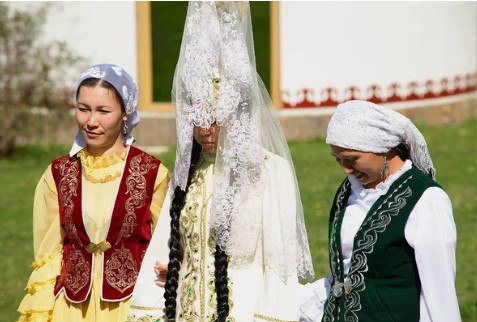
On the eve of Valentine’s Day, Central Asia is once again debating whether to celebrate the holiday or regard it as a symbol of foreign influence. Yet the region has its own rich and diverse customs related to love, matchmaking, and marriage. Accusations of Alien Influence and “Corruption” Valentine’s Day, like Halloween, spread to the former Soviet republics after the collapse of the USSR. In the first decades, young people embraced the new holidays. In recent years, however, critics have increasingly argued that commemorating a Catholic saint in a format centered on romantic love contradicts the traditions of the region’s peoples. For example, in Kazakhstan last year, deputies of the Mazhilis, the lower house of parliament, sharply criticized Valentine’s Day. Some deputies argued that it corrupts young people, promotes “free love,” and even carries “homosexual overtones.”  It is worth noting that Kazakhstan recently adopted legislation prohibiting so-called “propaganda of non-traditional sexual relations.” The Spiritual Administration of Muslims of Kazakhstan has also stated that Valentine’s Day promotes alien values and encourages promiscuity. Gratitude for Raising a Daughter Many matchmaking and marriage customs remain common across Central Asia, particularly the significant role of the bride’s and groom’s parents in ceremonies and celebrations. While traditions have evolved, many are still practiced in modern engagements and weddings. The well-known custom of paying bride price, kalym, has been preserved, though it has undergone significant change. Today, kalym varies depending on the wealth of the families. It may include apartments or cars, or it may amount to several hundred dollars. Importantly, kalym is now generally regarded as financial support for the young family and, as a rule, remains at the disposal of the bride and groom. Historically, in Kazakhstan and Kyrgyzstan, kalym was paid in livestock, and wedding celebrations could last more than a month.  One of the main Kazakh wedding rituals is the groom’s visit to the bride’s village or, in modern practice, her home. Before his first visit, the groom sends gifts to the bride’s family, known as Ilu,  an expression of gratitude for raising their daughter. In some regions of Kazakhstan, this ritual is called ana suty (“mother’s milk payment”). In the past, it included horses, camels, sheep, and riding equipment for the bride’s father. Today, it may consist of any valuable gift, and jewelry is often presented to the women in the bride’s family. The bride traditionally gives the groom a scarf as a symbol of her purity. Festivities then begin, with singing and dancing. Kazakh traditions often involve two weddings: one at the bride’s home and one at the groom’s. The bride’s farewell from her family home remains especially significant, reflecting her relatives’ wishes for her future life. Today, this ceremony is often held in a restaurant. The bride does not wear a white wedding dress at the farewell celebration but appears in an elegant outfit and a traditional headdress known as a saukele. During the farewell, the groom and his friends are subjected to playful pranks, for which they must...

Up to Eighty Persian Leopards Now Roam Turkmenistan

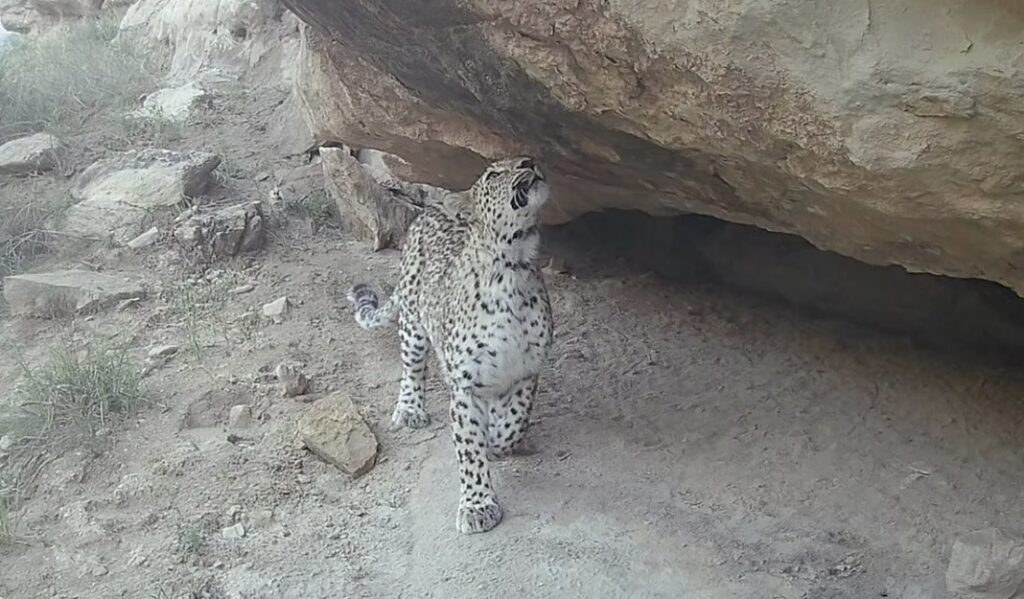
Between 60 and 80 Caucasian leopards, also known as Persian leopards, currently inhabit Turkmenistan, according to extensive monitoring conducted throughout 2025. The findings confirm not only the stable presence of this rare predator in key ecological zones but also provide encouraging signs of population recovery. A recent report by Conservation X Labs estimates Turkmenistan’s Persian leopard population at 60-80 individuals. Most breeding activity occurs within protected natural reserves, while border zones serve as critical migration corridors that support the dispersal and genetic diversity of the species. The Persian leopard is one of the largest leopard subspecies and plays a vital role in maintaining biodiversity in Turkmenistan. The majority of the national population is concentrated along the Kopetdag Mountains, near the border with Iran. Camera trap data also confirms a significant presence in the Uly-Balkan Range, an area of ecological importance. It supports the potential repopulation of the Garabogazgol region and sustains habitat connectivity with neighboring Kazakhstan. The re-confirmed presence of leopards along the southern coast of Garabogazgol is viewed as a particularly meaningful indicator of the species’ gradual return to its historical range. In 2025, monitoring efforts were significantly expanded. A wide network of camera traps was deployed across key habitats, providing more accurate and consistent long-term data. The data confirms that individual leopards have been present in the same territories over multiple years. Notably, a third breeding female has now been recorded in the Uly-Balkan mountains, an important development for the species’ viability. Conservation X Labs researchers describe the findings as “an important step in the conservation of the species,” citing improvements in habitat quality, sufficient prey availability, and the cumulative impact of long-term conservation efforts. Despite this progress, the global outlook for the Persian leopard remains fragile. Experts estimate that the total wild population numbers between 750 and 1,044 individuals, including only 450-626 adults. The majority of these leopards live in fragmented and declining habitats across the region. As such, the subspecies is listed as endangered in the IUCN Red List of Threatened Species. Turkmenistan’s leopard population thus serves as a rare example of regional recovery, underscoring the importance of continued monitoring, cross-border cooperation, and sustained habitat protection.