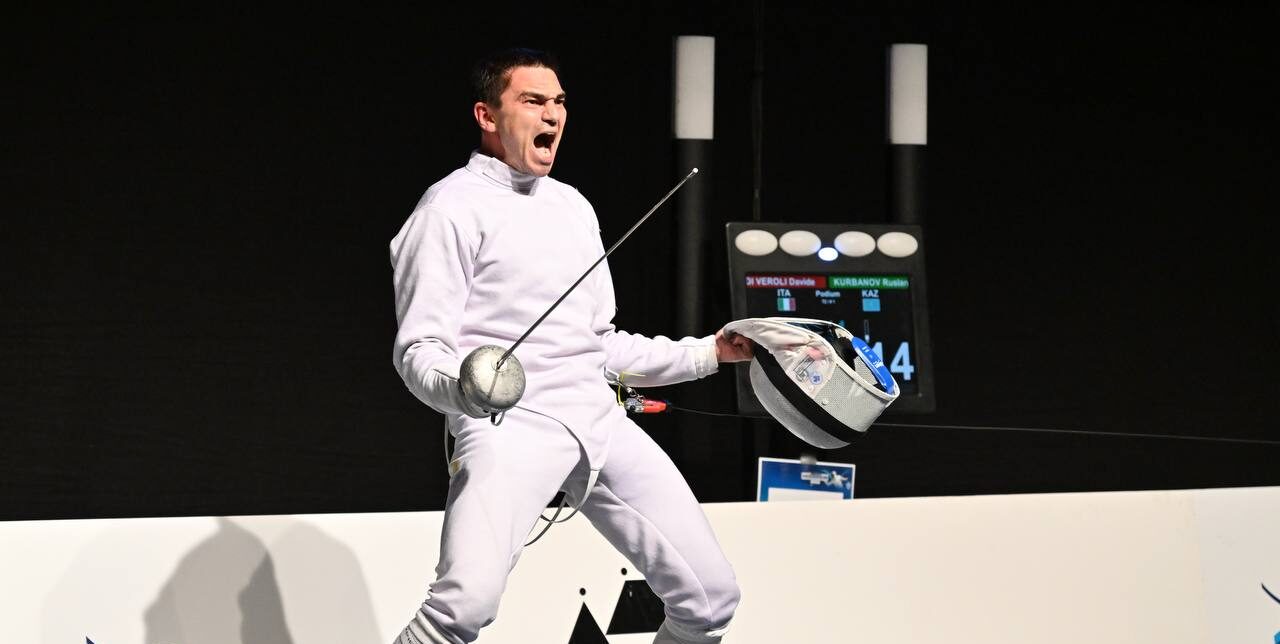
Ruslan Kurbanov is a Kazakhstani épée fencer, a Master of Sport of International Class in Kazakhstan, a World Cup medalist, a two-time World Championships bronze medalist, and a two-time Olympian. He began his journey in a children’s fencing club in Ust-Kamenogorsk and has since risen to fourth in the world rankings.
Today, he competes on the biggest stages, where a single touch can decide the outcome of a bout and the pressure from the stands can be overwhelming. In an interview with The Times of Central Asia, he explains how he handles that pressure, maintains focus amid crowd noise, and stays in control when everything is at stake.
TCA: Congratulations, you’ve already won two World Cup medals this year, gold and silver. That’s an impressive result.
Ruslan: Thank you. I’m pleased with these medals because, in reality, very few athletes can deliver consistent results across two consecutive competitions.
TCA: How did you manage it?
Ruslan: With experience, you gradually learn more about your body and how to prepare for competitions. You also become more familiar with the fencing world, you get to know many athletes, understand their strengths and weaknesses, study them, and prepare accordingly. Over time, you mature as an athlete and become more consistent. You develop a clear understanding of the level of results you are capable of.
@kazfencing.kz
TCA: You won silver in Astana. Do home conditions give you an advantage?
Ruslan: There are two sides to that. On the one hand, the advantages are obvious: you’re at home, with familiar food, climate, and time zone, all of which help you prepare in a comfortable environment. On the other hand, there is pressure. When you compete at home, people expect you to deliver your best result.
TCA: So winning a medal was a must?
Ruslan: Of course. But I also had another goal. This was the first World Cup event held in Kazakhstan, and I understood that many local spectators would attend, perhaps seeing fencing for the first time. First impressions are crucial. People either fall in love with the sport or they don’t. For me, it was important to present fencing at its best, dynamic, exciting, and worthy.
Maybe “present” is too strong a word, but I wanted people, especially children, to feel inspired, to have that spark. When kids see victories and the emotions athletes experience afterward, they start thinking, “I want that too,” and they come into the sport.
TCA: Do you think you managed to inspire them?
Ruslan: I hope so. After the final, when I stepped off the piste, many children came up to me, and parents asked for photos and autographs. It’s very rewarding to see that it resonated with someone and may have stayed with them.
TCA: You were ranked seventh in the world?
Ruslan: Now I’m fourth. After the tournament in Astana, I moved up to fourth place.
TCA: In the final, you lost only to Ukraine’s Roman Svichkar. Do they have a particularly strong school?
Ruslan: In épée, the level of competition is extremely high overall. Honestly, the entire top 100 in the world rankings consists of athletes who could potentially take first place. The level is so close that every bout is essentially 50-50, you can win or lose. Most victories come with minimal margins, 15:13, 15:12, 15:14. In fencing, it’s common for even a single touch to decide the outcome.
Ultimately, the winner is the one who is better prepared on that specific day, physically and mentally. This time, I lost by two touches, but we met last July at the World Championships, and I won by one touch. In other matches, the outcome could shift again.
TCA: Is that because you’re all at roughly the same level?
Ruslan: Yes, you could say that. It’s like two identical cars, say, two Ferraris. They’re equal in capability, but at a given moment one wins and the other loses. It comes down to nuances, condition, focus, internal factors.
TCA: You’re now ranked fourth, who are the top three? Where are the strongest fencers from?
Ruslan: First place is held by an Egyptian, second by a Hungarian, and third by a Japanese fencer. In terms of schools, it’s important to note that fencing has three disciplines: épée, sabre, and foil. I specialize in épée, where competition is particularly intense. Traditionally, the strongest countries in épée include Japan, Hungary, France, Italy, South Korea, and China. For example, at the upcoming Grand Prix in Budapest, there will be around 350 participants. Imagine 350 athletes competing for just three podium spots.
TCA: Some people consider fencing a “retro sport.” Is that a misconception?
Ruslan: Absolutely. Fencing is not a retro sport, it’s one of the oldest sports, but also one of the original Olympic disciplines, included since 1896. It is highly developed worldwide, in Europe, the Americas, and Asia, and continues to grow. For example, in Hong Kong, if I’m not mistaken, it is actually the number one sport.
TCA: Does Kazakhstan have its own fencing style?
Ruslan: Yes, definitely. We’ve always had a solid foundation, but with the arrival of new coaches, it has evolved into a mix of several major schools. From 2019 to 2024, we worked with Hungarian coach Ferenc Tóth, who brought in the best elements of the Hungarian school, one of the strongest in the world.
Hungary consistently wins Olympic medals; for example, they won gold in Paris. Fencing is very popular there, almost like boxing is in Kazakhstan. In Budapest alone, there are about 15 fencing halls, despite the city being slightly smaller than Almaty. Tóth gave us a strong foundation, and you could say we developed a Kazakh-Hungarian school.
TCA: And who is your coach now?
Ruslan: Currently, we’re working with Oleksandr Horbachuk from Ukraine. I consider him one of the best coaches in the world, if not the best. He coached Japan’s national team for 15 years and led them to top results, they were number one in both team and individual rankings and became Olympic champions.
His style is very effective: once you apply what he teaches, you see that it works. He trains us to create situations where the opponent makes mistakes, to set traps, and to gain a tactical advantage. His approach combines elements of Ukrainian and Japanese schools.
TCA: Taking the best from different cultures, that’s a very Kazakh approach, isn’t it?
Ruslan: Yes, exactly. Right now, we have a mix: a Kazakh base, Hungarian school, and the Ukrainian-Japanese approach from our current coach. We also train internationally, with European and Asian teams, including very strong Japanese athletes. We observe, learn, and take the best from everyone. It results in a universal style, much like our country, shaped by many influences.
TCA: How culturally close is fencing to Kazakhstan?
Ruslan: Our batyrs also fought with blades, so in that sense, it’s very close. Combat with bladed weapons exists in many cultures in one form or another.
TCA: What competitions stand out most in your career?
Ruslan: Recently, the Paris 2024 Olympics. They were held at the Grand Palais, a historic building in the city center with incredible architecture. The training and competition areas were separate. You don’t immediately step onto the piste, you arrive, warm up for about two hours, prepare, and only then compete.
TCA: So you don’t even see the arena beforehand?
Ruslan: Exactly. We stay in the warm-up zone, then are taken to the call room about 15 minutes before the bout. It’s a special room where athletes wait before entering, almost like gladiators before the arena.
TCA: Does the duel begin there?
Ruslan: Yes. You sit opposite your opponent, and the tension builds. You might exchange glances or even words. It becomes a mental battle. It’s crucial to maintain balance; keep the competitive aggression but remain internally calm.
TCA: What if there’s a delay?
Ruslan: It’s difficult. Your body cools down, adrenaline drops, and there’s a risk of burnout. You try to stay active, stretching, jumping but the tension remains.
TCA: What happens when you finally enter the arena?
Ruslan: When I stepped onto the piste, I saw the venue for the first time, huge, dimly lit, with bright lights focused on the strip. Then I saw the stands, massive, filled with people. I had never seen anything like it.
TCA: And you were fencing a French opponent on his home ground?
Ruslan: Yes, and he was the reigning Olympic champion from Tokyo. Everyone expected him to win again. The entire arena was cheering: “France! France!” There was incredible noise. And then there was me, a guy from Kazakhstan, with maybe 50 people shouting “Kazakhstan!”
TCA: Did that support help?
Ruslan: It did but it could also distract. I heard our fans, looked for them, saw the blue flags, got goosebumps, and realized my focus was drifting. I was thinking about the atmosphere instead of the bout.
TCA: How did you regain control?
Ruslan: I lowered my gaze and forced myself to focus only on the fight, on my opponent and what was happening in that moment.
TCA: Your success has become more visible in recent years, but this has been a long journey, right?
Ruslan: Very long. I lost at many World Championships before winning bronze in Milan in 2023. Without the right environment, it’s hard to endure that path. I always tell young athletes: surround yourself with people who support you. Otherwise, after repeated losses, you might start believing it’s not your path.
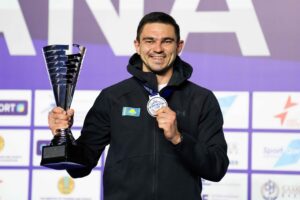
@kazfencing.kz
TCA: Did you ever feel that way?
Ruslan: All the time. Even after Paris, I thought about quitting. But when you have the right people around you, they remind you of what you’ve achieved and keep you going.
TCA: So it’s not just about character, but also about support?
Ruslan: Absolutely, especially family. People only see the results, but at home it’s different: emotional swings, intense training, six to seven hours a day, after which you’re completely exhausted. My wife, Yulia, is essentially my main support. She helps me get through difficult periods.
TCA: Do all athletes go through this?
Ruslan: Yes. After the 2023 World Championships, I went about a year and a half without individual medals. But I was focused on helping the team qualify for the Olympics. You have to understand that it’s part of the process, analyze mistakes and keep working.
TCA: Did your success help bring the World Cup to Astana?
Ruslan: It was a collective effort, the government, the federation, and the athletes. Our results helped.
TCA: Has the state increased support for fencing?
Ruslan: Yes. After strong results, World Championship bronze and Olympic qualification fencing was included among priority sports through 2028. Funding has increased for regional development, national teams, and athlete support. More athletes can now travel to competitions, and salaries for young athletes have risen.
TCA: What are the prospects for fencing in Kazakhstan?
Ruslan: I believe things will improve. Participation will grow, more training facilities will open, and support will continue. I’m confident we will win Olympic medals, which will give the sport a major boost.