• KGS/USD = 0.01144 0%
  • KZT/USD = 0.00212 0%
  • TJS/USD = 0.10456 0.19%
  • UZS/USD = 0.00008 0%
  • TMT/USD = 0.28490 0%
  • KGS/USD = 0.01144 0%
  • KZT/USD = 0.00212 0%
  • TJS/USD = 0.10456 0.19%
  • UZS/USD = 0.00008 0%
  • TMT/USD = 0.28490 0%
  • KGS/USD = 0.01144 0%
  • KZT/USD = 0.00212 0%
  • TJS/USD = 0.10456 0.19%
  • UZS/USD = 0.00008 0%
  • TMT/USD = 0.28490 0%
  • KGS/USD = 0.01144 0%
  • KZT/USD = 0.00212 0%
  • TJS/USD = 0.10456 0.19%
  • UZS/USD = 0.00008 0%
  • TMT/USD = 0.28490 0%
  • KGS/USD = 0.01144 0%
  • KZT/USD = 0.00212 0%
  • TJS/USD = 0.10456 0.19%
  • UZS/USD = 0.00008 0%
  • TMT/USD = 0.28490 0%
  • KGS/USD = 0.01144 0%
  • KZT/USD = 0.00212 0%
  • TJS/USD = 0.10456 0.19%
  • UZS/USD = 0.00008 0%
  • TMT/USD = 0.28490 0%
  • KGS/USD = 0.01144 0%
  • KZT/USD = 0.00212 0%
  • TJS/USD = 0.10456 0.19%
  • UZS/USD = 0.00008 0%
  • TMT/USD = 0.28490 0%
  • KGS/USD = 0.01144 0%
  • KZT/USD = 0.00212 0%
  • TJS/USD = 0.10456 0.19%
  • UZS/USD = 0.00008 0%
  • TMT/USD = 0.28490 0%

Kazakhstan vs. Uzbekistan: A Footballing Derby with an Uncertain Outcome

The Uzbekistan national football team has qualified for the 2026 World Cup, which will take place across three North American countries: the U.S., Canada, and Mexico. Meanwhile, one of Kazakhstan’s leading clubs, FC Kairat Almaty, continues to gain experience competing in the UEFA Champions League. Football in Central Asia has become a mirror of the region’s growing economic and political ambitions, with Uzbekistan and Kazakhstan at the forefront. Their rivalry, which dates back to the Soviet era, has adapted to this new chapter.

Kazakhstan and the Road to Europe

Matches between Almaty’s Kairat and Tashkent’s Pakhtakor were once marquee events during the Soviet era, filling stadiums and energizing fans across the republics. Following the collapse of the USSR, however, the footballing paths of these two historical rivals began to diverge.

Initially, both Kazakhstan and Uzbekistan joined the Asian Football Confederation (AFC), which includes countries from across Asia and parts of the Pacific, including former Oceania Football Confederation members such as Australia and Guam.

Kazakhstan became a full member of the AFC in 1992, followed by Uzbekistan in 1994. However, Kazakhstan soon grew disillusioned with the level of competition within the AFC and began to explore other avenues. Its early attempts to join UEFA were rebuffed in the mid-1990s. Rakhat Aliyev, then head of the Football Union of Kazakhstan and son-in-law of former President Nursultan Nazarbayev, later described the process as being dismissed “without really getting to the heart of the matter.”

Despite this, both Kazakhstan and Uzbekistan quickly showed they were a cut above most AFC members at the time. Kazakhstan won the inaugural Central Asian Cup in 1992, while Uzbekistan claimed gold at the 1994 Asian Games in Hiroshima, defeating China 4-2 in the final.

Eventually, Kazakhstan succeeded in joining UEFA. Spearheaded by Aliyev, the Football Union of Kazakhstan (FSC) lobbied hard for admission, culminating in meetings with FIFA and UEFA presidents Lennart Johansson and Joseph Blatter in Moscow in late 2000 and early 2001. The AFC issued a statement on May 10, 2001, allowing Kazakhstan to make its own decision, and five days later Johansson confirmed that UEFA would welcome Kazakhstan as its 52nd member.

“Joining UEFA has given all of us who work in football a powerful boost,” Aliyev said at the time. “We will strive to use this momentum to raise the level of our national football.”

Uzbekistan and the Central Asian Football Association

Unlike Kazakhstan, Uzbekistan chose to remain in the AFC, where it has steadily risen in prominence. In 2014, it became a founding member of the Central Asian Football Association (CAFA), a regional sub-group within the AFC. Officially operational since 2015, CAFA also includes Afghanistan, Iran, Kyrgyzstan, Tajikistan, and Turkmenistan. The organization is currently chaired by Rustam Emomali, son of Tajik President Emomali Rahmon.

Uzbekistan is ranked second in the CAFA, behind Iran, and has consistently reached the quarterfinals of the AFC Asian Cup in 2004, 2007, 2015, and 2023. Much of this success is due to sustained investment in youth development, training systems, and football infrastructure.

“Uzbekistan is the best country in Central Asia in terms of football development,” said former Kyrgyz national team coach Alexander Krestinin, who currently manages a club in Tashkent.

These efforts culminated in a historic moment: Uzbekistan qualified for the 2026 World Cup. A goalless draw with the UAE in the ninth round of the third stage of Asian qualifiers secured second place in Group A with 18 points, clinching a direct berth with a game to spare.

Though it remains to be seen how the team will perform in North America, experts widely regard this iteration of the national team as its strongest ever. Former head coach Srečko Katanec, a seasoned Slovenian tactician, spent four years building a disciplined, tactically mature squad with a strong youth foundation. Fabio Cannavaro, the former Italy captain and 2006 Ballon d’Or winner, will lead Uzbekistan at the 2026 World Cup

Key players include defender Abdokadir Khusanov, who plays for Manchester City, attacking midfielder Abbosbek Faizullaev of CSKA Moscow, Roma striker Eldor Shomurodov, and creative midfielder Oston Urunov, currently with Persepolis in Iran.

“Compared to Kazakhstan, Uzbekistan has made great strides in football development. They were the first in Central Asia to reach the World Cup, and Khusanov is now playing in the English Premier League,” noted Andrei Kanchelskis, the former Manchester United and Russia winger who has coached in both Uzbekistan and Kazakhstan. “Yes, Kazakhstan has some good players, but persistent problems hinder progress. Uzbekistan’s infrastructure is now among the best in the post-Soviet space.”

Kanchelskis’ assessment may sting for Kazakh fans, but FIFA rankings echo his sentiment. Uzbekistan currently sits at 50th in the world, while Kazakhstan lags at 114th, just ahead of Mauritania.

At least for now, this round of the Central Asian football rivalry appears to go to Uzbekistan.

Kazakhstan Meat Exports Surge in 2025

Kazakh meat producers surpassed their total 2024 export figures within the first 10 months of 2025, according to the Ministry of Agriculture.

In 2024, Kazakhstan boosted exports of processed beef by 1.4 times to more than 22,000 tons, and lamb by 2.2 times to 18,000 tons. These milestones were exceeded in 2025. Between January and October, beef exports rose 1.7 times year-on-year to reach 30,200 tons, while lamb exports increased 1.9 times to 25,500 tons.

“This growth is due to high demand for high-quality Kazakh meat from foreign partners,” the ministry stated.

In 2025, the Ministry of Agriculture implemented several measures aimed at expanding export markets and strengthening Kazakhstan’s presence in the global meat trade. Negotiations with seven countries resulted in the signing of 16 veterinary certificates. New export channels were opened for a range of products, including:

  • Milk, beef, lamb, poultry, honey, and fish to Azerbaijan
  • Live cattle to Mongolia
  • Animal feed to Morocco
  • Hides and wool of ungulates to Iran

Additionally, the European Union opened its market to Kazakhstani beekeeping products.

Efforts are also underway to expand exports to 12 more countries, including Japan, Malaysia, South Korea, the UAE, Jordan, and Pakistan. Discussions are ongoing with Saudi Arabia, Qatar, the United Kingdom, Canada, and Hong Kong regarding potential exports of dairy products, feed, and honey.

The ministry highlighted veterinary welfare as a cornerstone of Kazakhstan’s export strategy. A nationwide modernization program is currently in progress: 400 new veterinary stations have been constructed and 890 units of specialized equipment and machinery procured.

A key development is the opening of a modern veterinary laboratory in East Kazakhstan, supported by China. This facility will help unlock exports of livestock products, including cattle hides, poultry meat, and by-products, to the Chinese market. Required protocols have been signed, and Kazakh enterprises have already passed the necessary inspections.

As previously reported by The Times of Central Asia, Kazakhstan is also preparing to enter the Turkish market, where Kazakh beef prices could be roughly double those in China.

EBRD to Allocate $6 Million for Modernization of Dushanbe’s Heat Supply System

The European Bank for Reconstruction and Development (EBRD) will provide $6 million to Tajikistan for the implementation of the “Heat Supply in Dushanbe” project. The decision was approved by parliament on December 12.

According to MP Nigina Sharifzoda, the financing will comprise a $3 million grant and a $3 million loan. The funds will be used to reconstruct and expand the capital’s central heating infrastructure.

The project includes the modernization of Dushanbe’s heating networks, with the aim of ensuring reliable heat supply during the winter months. By 2028, over 500,000 residents are expected to benefit from stable heating services.

This initiative is part of an ongoing program. The initial credit line has been in place since 2021, and the current stage was formalized as an additional credit agreement. The document was signed on October 6 between the Ministry of Finance, the Dushanbe mayor’s office, the state-owned Dushanbe Heat Network company, and the EBRD.

First Deputy Minister of Finance Yusuf Majidi noted that the project is intended not only to modernize infrastructure but also to address long-standing systemic issues in the sector.

Currently, more than 43% of Dushanbe’s residential buildings, schools, kindergartens, hospitals, and businesses are connected to centralized hot water supply. By the 2025-2026 heating season, an estimated 3,300 facilities are expected to be integrated into the system.

Despite progress, challenges remain. Residents in several districts continue to report inadequate heating. A recent inspection by the Energy Supervision Agency revealed that in some heating stations, the temperature of the heat carrier was just 55°C, well below the standard 75°C.

Separately, the EBRD, in partnership with the European Union, has announced another major initiative: the modernization of Tajikistan’s electricity distribution infrastructure, with €43 million allocated for the project.

Kazakhstan’s IT Exports Grew by Almost a Third in 2025

Kazakhstan’s IT sector continued its rapid expansion in 2025, with service exports increasing by more than 30% to reach $1 billion, Deputy Prime Minister and Minister of Artificial Intelligence and Digital Development Zhaslan Madiyev announced at a year-end press conference.

At the close of 2024, Kazakhstan’s IT service exports totaled $690.7 million, a 30.5% increase over the previous year. Moreover, export volumes exceeded imports by a factor of 2.1. In 2025, exports grew by another 31%, pushing the total to the $1 billion mark, Madiyev confirmed.

A key driver behind this growth has been the Astana Hub ecosystem, which unites around 2,000 IT companies and continues to serve as the cornerstone of Kazakhstan’s digital economy. According to Madiyev, the combined revenue of Hub participants exceeded $1.5 billion in 2025, marking a 20% year-on-year increase.

“Through international hubs, more than 100 Kazakhstani startups have entered foreign markets,” said Madiyev. “The ecosystem has also produced the region’s first technology unicorn, Higgsfield.ai. To boost venture financing, the Qazaqstan Venture Group has been established with a target fund of $1 billion, of which $115 million has been raised so far.”

Kazakhstan has also advanced in several global digital rankings. Madiyev noted that the country has solidified its position in the e-Government Development Index (EGDI), currently ranking 24th, and is among the top 10 globally in the Online Services Index (OSI). The national supercomputing cluster, alem.cloud, was launched in 2025 and is now ranked 86th in the TOP500 list of the world’s most powerful supercomputers, a benchmark achievement that places Kazakhstan at the forefront of computing power in Central Asia.

In parallel, the country is advancing its artificial intelligence agenda. Kazakhstan has developed a national AI strategy and launched Qyzmet AI, a training initiative that has already covered 50,000 civil servants. Madiyev announced that AI proficiency will soon become a prerequisite for employment in the public sector.

“We are making AI training mandatory for civil servants,” he said. “In the future, a lack of AI competencies will be a barrier to entering government service.”

Kazakhstan is also laying the groundwork for integrating autonomous vehicles into its transport system. Madiyev revealed that a pilot project for unmanned vehicle technologies is in the works. Based on the outcome, national standards and minimum infrastructure requirements will be introduced to support broader deployment.

As previously reported by The Times of Central Asia, Kazakhstan is also developing a system of digital passports for intercity highways to accommodate driverless transport.

Japarov Signs Decree Stripping Ex-Leader Atambayev of State Honors

Kyrgyz President Sadyr Japarov has signed a decree revoking state awards previously granted to former President Almazbek Atambayev, including the title Hero of the Kyrgyz Republic, the Order of Manas (Second Class), the Order of Danaker, and the Dank medal. The order follows a decision by Bishkek’s Pervomaisky District Court, and authorities have been instructed to confiscate the medals and transfer them to the state awards fund, according to reports citing the presidential press service.

Atambayev, who led Kyrgyzstan from 2011 to 2017, has been at the center of long-running criminal and political disputes since leaving office. His fallout with successor, Sooronbay Jeenbekov, culminated in the 2019 Koi-Tash confrontation, when security forces tried to detain him at his residence outside Bishkek, and the clashes left a security officer dead. That episode became part of later court proceedings and deepened the elite polarization in Kyrgyz politics.

The immediate legal basis for stripping the awards is tied to a 2025 court verdict. In June, the Pervomaisky District Court sentenced Atambayev in absentia to more than eleven years in prison on charges of corruption and participating in mass unrest, along with confiscation of property and deprivation of state awards. Atambayev has remained abroad since he left Kyrgyzstan for medical treatment, and did not return for the trial proceedings.

The latest decision formalizes the court-ordered loss of honors and triggers the administrative step of retrieving medals and certificates, but it does not add a new criminal penalty beyond the existing sentence. The move is also political. State awards carry symbolic weight in Kyrgyzstan, and revocation is rare for former heads of state. By linking the decision explicitly to a court verdict, Japarov’s administration is framing it as enforcement rather than a discretionary act. For Atambayev’s supporters, it is likely to be read as another escalation in a feud that has shaped Kyrgyz politics for years.

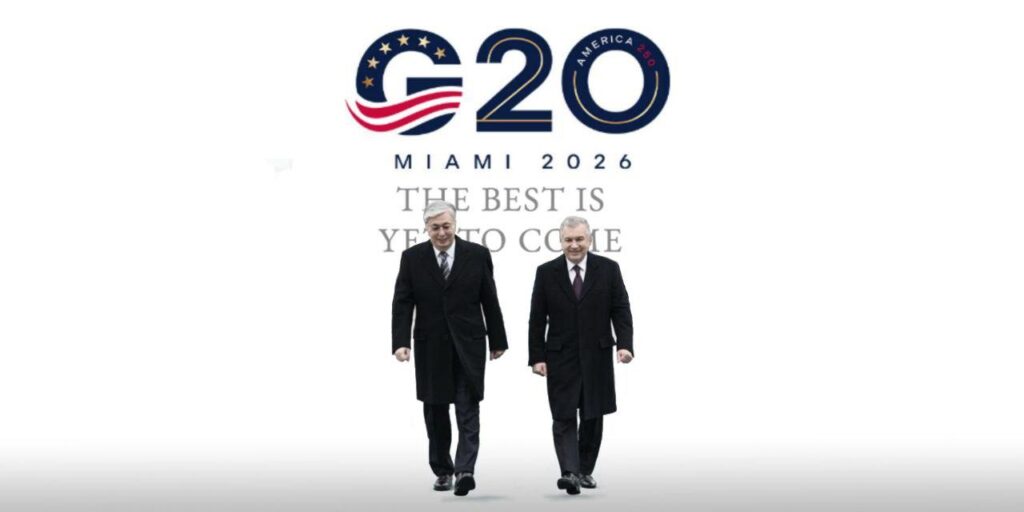
Trump’s G20 Invitations: Why Kazakhstan and Uzbekistan Matter

On December 23, President Donald Trump said he would invite Kazakhstan and Uzbekistan to attend the United States–hosted 2026 G20 summit in Miami. The meeting is planned at Trump National Doral. The announcement followed separate telephone calls with Kazakhstan’s President Kassym-Jomart Tokayev and Uzbekistan’s President Shavkat Mirziyoyev, which Trump described as focused on peace and expanded trade, and cooperation.

The G20 is a group of major economies, with membership based mainly on large nominal GDP and global economic importance, collectively representing about 85% of global GDP. Kazakhstan is ranked roughly 50th in the world by nominal GDP, at approximately $300 billion, while Uzbekistan is ranked around 62nd, with a nominal GDP of about $137–140 billion. According to Polish radio, the president of Poland stated that his country would also be on the guest list. Poland is the world’s 21st-largest economy.

The G20 is a forum, not a treaty body. Leaders’ summits include member governments and a limited number of host-selected guest countries. Invitations to Kazakhstan and Uzbekistan would place their leaders physically at the table with G20 heads of state, allowing them to be seen, heard, and recognized by other leaders, without conferring membership or a formal role in shaping the summit agenda. On average, the host invites six to seven guests. One official host-country explainer notes that guest invitations allow non-members to bring their own perspectives. For them, the significance of attending is access, not membership.

What Washington Wants and What Can Be Transacted

The host typically uses the guest invitations to signal which countries and regions they regard as priorities.

U.S. interest in Kazakhstan and Uzbekistan rests on an immediate material basis. The United States is rebuilding its nuclear-fuel supply chain away from Russian-origin material. Federal law now bans imports of certain Russian uranium products, with waivers terminating no later than January 1, 2028. U.S. agencies have been explicit that supply diversification is a policy objective. In 2024, Kazakhstan-origin material accounted for 24% of uranium delivered to U.S. owners and operators, while Uzbekistan-origin material accounted for about 9%.

Kazakhstan’s structural advantage is scale and reliability. It remains the world’s leading uranium producer, with 2024 output around 23,270 metric tons of uranium and the largest share of global mine production. Astana has also signaled an interest in moving beyond extraction toward higher value-added fuel-cycle activity. Uzbekistan’s advantage is growth potential and its fit with Western joint-venture structures. Its uranium sector has attracted major external entrants, including Orano’s South Djengeldi joint venture Nurlikum Mining with the state partner Navoiyuran to develop a new mine alongside an Itochu (Japan) minority stake.

The second instrument is the resource-focused diplomacy under the C5+1 umbrella. The State Department frames the C5+1 as organized around economy, energy, and security, within which framework it has elevated critical minerals to a dedicated track. The United States launched a C5+1 Critical Minerals Dialogue in early 2024, and subsequent U.S. statements have described it as a vehicle for geological exploration, mining, processing, and investment opportunities across the region. This framing creates a ready-made format for attaching commercial announcements to the G20 cycle, complementing both Astana’s and Tashkent’s preference to talk about projects, agreements, and investments, rather than alignments.

Thus, there is a specific practical bargaining space around a Miami summit. It is not, therefore, a question of whether Central Asia is noticed. An invitation to Miami can bring them into the room through bilateral meetings and visibility with investors and officials. It is a question of whether Kazakhstan and Uzbekistan can convert G20 access into specific outcomes, for example, in uranium supply assurance, critical minerals investment, and connectivity. These are initiatives already embedded in U.S. policy channels. The G20 provides a platform for using the summit cycle to advance their specific economic and diplomatic interests.

In practical terms, Trump’s public messaging is about peace and expanded trade, and cooperation. This political signal seems akin to an opening bid, as the formalities, including the precise modalities of participation and the summit’s calendar, get specified only later. Indeed, the location has been announced, but the final summit calendar is normally confirmed later. Astana and Tashkent will focus less on the invitation headline than on what can be attached to the G20 cycle in concrete meetings, announcements, and workstreams.

How the Central Asian Readouts Differ

Following the calls, President Trump publicly highlighted his conversations with the Central Asian leaders and the prospect of G20 guest invitations, a framing echoed in much Western reporting. Official readouts from Astana and Tashkent, however, emphasized other things. They kept any mention of a summit invitation out of the foreground, treating the telephone calls as bilateral and substantive.

In Kazakhstan’s case, reporting cited Akorda’s emphasis on a “thorough exchange of views” on the bilateral agenda and current world affairs, including the Ukrainian situation. Tokayev is quoted as stressing that the territorial issue is central and that a settlement requires compromises “in the field.” He said that Kazakhstan is ready to offer a neutral negotiation platform if needed, even though it might not formally act as a mediator. The same account notes Tokayev’s invitation for Trump to visit Kazakhstan. Astana’s narrative is policy-forward and conflict-aware. It does not treat a G20 invitation as the organizing fact of the conversation.

Uzbekistan similarly foregrounds substance rather than summit optics, highlighting a good number of bilateral prospects beyond intensified high-level contacts. These include joint multi-sector projects valued in the tens of billions of dollars, the establishment of a U.S.–Uzbekistan Business and Investment Council, work toward a joint investment fund, and a new mechanism of cooperation between Uzbekistan’s regions and U.S. states. Tashkent also explicitly points to multilateral cooperation, including the C5+1 format, and it records Mirziyoyev’s invitation for Trump to visit Uzbekistan. As with Kazakhstan, the G20 is not the headline.

This approach to the G20 meeting by Kazakhstan and Uzbekistan preserves room for maneuver. Emphasizing deliverables and ongoing channels of cooperation, it prevents the U.S. announcement from defining the two Central Asian states’ external posture. It keeps the focus on what the invitation can do for them in their own interests.

Both countries likely regard the G20 guest invitation as a meaningful opportunity to advance priority projects.

From Invitation to Outcomes

The G20 guest invitation from President Trump signals interest in commercial and strategic engagement with Kazakhstan and Uzbekistan, both of which are of growing importance to the United States. While the invitation is non-binding, it provides recognition and access that can facilitate future economic and policy cooperation.

At the summit, for Kazakhstan and Uzbekistan, the first test is whether Miami produces meetings, memoranda of understanding, or investment announcements that align with existing channels, including uranium supply diversification and the C5+1 critical-minerals track.

The second question is narrative discipline. Astana and Tashkent have avoided treating the invitation as the central fact of their calls with Trump, which suggests a preference for using the access while keeping their external posture stable. In that sense, the invitation matters most as leverage. Its value will be measured not by attendance in Miami, but by whether it produces bankable meetings, credible investment commitments, and follow-on work that persists well beyond the summit.