
• KGS/USD = 0.01144 0%
  • KZT/USD = 0.00192 -0%
  • TJS/USD = 0.10879 0.28%
  • UZS/USD = 0.00008 0%
  • TMT/USD = 0.28490 -0.28%
  • KGS/USD = 0.01144 0%
  • KZT/USD = 0.00192 -0%
  • TJS/USD = 0.10879 0.28%
  • UZS/USD = 0.00008 0%
  • TMT/USD = 0.28490 -0.28%
  • KGS/USD = 0.01144 0%
  • KZT/USD = 0.00192 -0%
  • TJS/USD = 0.10879 0.28%
  • UZS/USD = 0.00008 0%
  • TMT/USD = 0.28490 -0.28%
  • KGS/USD = 0.01144 0%
  • KZT/USD = 0.00192 -0%
  • TJS/USD = 0.10879 0.28%
  • UZS/USD = 0.00008 0%
  • TMT/USD = 0.28490 -0.28%
  • KGS/USD = 0.01144 0%
  • KZT/USD = 0.00192 -0%
  • TJS/USD = 0.10879 0.28%
  • UZS/USD = 0.00008 0%
  • TMT/USD = 0.28490 -0.28%
  • KGS/USD = 0.01144 0%
  • KZT/USD = 0.00192 -0%
  • TJS/USD = 0.10879 0.28%
  • UZS/USD = 0.00008 0%
  • TMT/USD = 0.28490 -0.28%
  • KGS/USD = 0.01144 0%
  • KZT/USD = 0.00192 -0%
  • TJS/USD = 0.10879 0.28%
  • UZS/USD = 0.00008 0%
  • TMT/USD = 0.28490 -0.28%
  • KGS/USD = 0.01144 0%
  • KZT/USD = 0.00192 -0%
  • TJS/USD = 0.10879 0.28%
  • UZS/USD = 0.00008 0%
  • TMT/USD = 0.28490 -0.28%
12 December 2025

World Bank: Poverty Falls in Kazakhstan, but Inequality and Child Poverty Persist

The World Bank has released a comprehensive report on poverty in Kazakhstan, analyzing trends from 2006 to 2021. Presented to journalists in Almaty, the report paints a detailed picture of the country’s evolving socio-economic landscape.

Defining Poverty

Poverty is broadly defined as the inability to meet basic human needs, including food, clothing, clean water, sanitation, education, and healthcare. One standard measure is the subsistence minimum set by the government.

As of 2021, the international poverty line was $3 per person per day in low-income countries. For upper-middle-income economies like Kazakhstan, the threshold was set at $8.30 per day.

@pip.worldbank.org

From Poverty to the Middle Class

Over 15 years, Kazakhstan witnessed substantial economic growth. Per capita consumption doubled, and GDP per capita rose from 548,900 to 791,300 tenge (KZT). An estimated six million people were lifted out of poverty, and the country advanced into the category of upper-middle-income economies.

The World Bank identifies three distinct phases of development:

  • 2006-2013 – Growth: Economic expansion and proactive social policies reduced poverty from 49.5% to 11.1%
  • 2014-2016 – Crisis: A sharp decline in oil prices and the devaluation of the tenge saw poverty spike to 20.2%
  • 2016-2021 – Stabilization: Economic recovery brought the poverty rate down to 8.5%

@worldbank.org

A Rising Middle Class

Between 2006 and 2021, the share of Kazakhstan’s population considered middle class increased from 26 percent to 67 percent. The World Bank defines the middle class as individuals who are neither poor nor economically vulnerable.

This growth was driven by rising incomes, pensions, and social assistance programs. However, progress began to slow after 2013 due to ongoing structural challenges, low productivity, dependence on extractive industries, and a weak private sector.

Child Poverty: An Alarming Trend

National gains have not eliminated regional disparities. In the Turkistan region, poverty rose from 14.4 percent in 2006 to 24 percent in 2021.

@worldbank.org

Demographic shifts in poverty are also concerning. The poor are increasingly younger, less educated, and from large families. Child poverty is especially acute: 13% of children live below the poverty line, comprising 40% of the country’s poor. In other words, every eighth child in Kazakhstan is living in poverty.

@worldbank.org

Consumption and Inequality

Rising consumption, measured via purchasing power parity (PPP), has been the main driver of poverty reduction. Indicators like the Big Mac Index offer accessible insights into shifts in purchasing power.

Growth in incomes, pensions, and the small and medium-sized enterprise (SME) sector also contributed, while emergency government support during the COVID-19 pandemic helped avert a sharp decline in living standards.

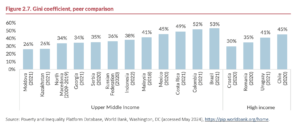
Nevertheless, inequality is on the rise. Since 2016, the Gini Index has shown a growing gap. The wealthiest 10% of Kazakhstanis now spend three times more than the poorest 10%. While this inequality remains moderate by global standards, the upward trend is cause for concern.
@worldbank.org

Looking Ahead

World Bank analysts acknowledge Kazakhstan’s progress in reducing poverty. However, they caution that traditional growth strategies have reached their limits.

To ensure sustainable development, Kazakhstan must pursue deep structural reforms: boosting productivity, fostering private sector growth, and tackling stark regional inequalities. Only through such measures can the country achieve inclusive prosperity and secure long-term well-being for all its citizens.

ALTAÏ: A Documentary Exploring Central Asia’s Water Lifelines to Start Filming

A new documentary, ALTAÏ, by acclaimed writer Cédric Gras and director Bertrand Delapierre, is set to bring global attention to the fragile ecosystems of Central Asia and the critical water issues tied to its majestic Altai Mountains. Slated for release on Ushuaïa TV in 2026, the documentary promises an in-depth exploration of the vital role these mountains play in sustaining life across the arid steppes of Kazakhstan, while addressing ecological challenges, geopolitical tensions, and the impact of climate change.

A Journey Through Kazakhstan’s Heart

Image: TCA, Ilyas Otan

The documentary follows the film crew’s expedition through Kazakhstan’s varied landscapes, beginning in its modern capital, Astana, and culminating in an ascent of Mount Belukha, the tallest peak in the Altai range. Along the way, the team will investigate how Kazakhstan is grappling with increasing water scarcity while striving to balance modernization with environmental conservation.

Central to the film’s narrative is the Irtysh River, born from the Altai glaciers, which flows through Russia, China, Mongolia, and Kazakhstan. This river has long delivered life-sustaining water to Kazakhstan’s steppes, irrigating farmlands and powering industries. Yet, as the documentary reveals, upstream diversions and glacial retreat now threaten the river’s future.

Central Asia’s Water Crisis

Image: TCA, Ilyas Otan

With Central Asia among the regions most threatened by water shortages, ALTAÏ examines the severe consequences of dwindling resources. Astana, once a Soviet outpost named Tselinograd, has been transformed into a futuristic capital fueled by the nation’s oil and gas wealth. However, this rapid expansion has brought a pressing water deficit. The Ishim River, which runs through the city, can no longer suffice, prompting the construction of the new Astana-Irtysh canal to draw water from the distant Altai region.

The documentary highlights alarming findings from hydrologists about the ecological and political pressures weighing on water management in the region. Viewers will see the extensive canal network left by the Soviet Union, such as the Irtysh-Karaganda Canal, and the vital role it continues to play in supporting industrial cities, agriculture, and the survival of the steppes.

Exploring the Altai Mountains

Image: TCA, Ilyas Otan

At the heart of the documentary will be an expedition into the Altai Mountains, a remote massif spanning Kazakhstan, China, and Russia. The mountain range is revered as the “water tower” of the region, yet its glaciers are melting at an alarming rate due to climate change. Guided by Kazakh mountaineers, the crew will travel across high valleys and visit traditional nomadic settlements that depend on the rivers fed by these glaciers.

Finally, the team will ascend Mount Belukha, the Altai’s highest peak, to examine the glacial sources of the Irtysh River, capturing breathtaking footage of this territory where the borders of Kazakhstan, China, and Russia converge. Along the way, they will discuss with locals and scientists the geopolitical tensions over water resources, as Chinese development upstream increasingly diverts flow from the Irtysh to fuel its arid regions.

Environmental and Geopolitical Themes

Image: TCA, Ilyas Otan

ALTAÏ ties the environmental struggles of Kazakhstan’s steppe to the broader geopolitical struggles of the region, underscoring the urgent need for water conservation amid rising demand and shrinking supply. It will also showcase the resilience of Kazakhstan’s people, from nomadic herders who preserve ancient traditions to engineers constructing new infrastructure to sustain growing urban centers.

Through the documentary, the filmmakers aim to inspire action and awareness about the delicate balance between human activity and nature. Beyond its focus on water issues, the film celebrates Kazakhstan’s rich biodiversity, exploring its lush summer pastures, wildlife, and cultural heritage.

Vision and Release

ALTAÏ is set to be produced by Lucien TV. The Times of Central Asia’s Ilyas Otan will serve as the production coordinator, ensuring local expertise to enhance the film’s authenticity.

Set to air on Ushuaïa TV, the French channel dedicated to environmental documentaries, ALTAÏ will debut in 2026, offering a rare opportunity for global audiences to glimpse the challenges and triumphs of a region striving to adapt to a rapidly changing world. Through its narrative of endurance, innovation, and the natural wonders of the Altai Mountains, ALTAÏ will aim to capture the profound interconnectedness between water, people, and the environment, inspiring a deeper understanding of Central Asia’s pivotal role in the global water cycle.

Artificial Intelligence to Assist Criminal Investigations in Kazakhstan

Kazakhstan has launched a pilot project to integrate artificial intelligence (AI) into law enforcement operations. The initiative, titled “Digital Assistant to the Investigator,” is being implemented by the General Prosecutor’s Office and the Ministry of Internal Affairs in a district police department in Astana.

The system was officially introduced last week, with participation from Sabit Nurlybay, Chairman of the Committee on Legal Statistics and Special Records of the General Prosecutor’s Office, and Sanjar Adilov, Deputy Minister of Internal Affairs.

Built on AI algorithms and large-scale data processing, the digital assistant is designed to support investigators by identifying connections between cases, generating predictions, and offering procedural recommendations both for conducting investigations and preventing crime.

According to a statement from the Prosecutor General’s Office, the system is divided into three main modules:

  1. Investigation Planning – Upon registration of a criminal case, the system classifies the offense, outlines an investigative strategy based on existing circumstances, and suggests relevant witnesses to question and expert examinations to conduct
  2. Testimony Processing – AI transcribes spoken testimony into text during interviews, simultaneously analyzing speech patterns and behavior to detect contradictions and inconsistencies
  3. Document Generation – Based on interview data, the system drafts investigation documents that the investigator only needs to verify and sign

The platform also generates final case documents, integrating information from the specific investigation along with relevant judicial precedents. Officials say the AI tool is expected to reduce investigation times and offload routine technical tasks from investigators.

The initiative follows Kazakhstan’s unveiling of the most powerful supercomputer in Central Asia last month, a move aimed at bolstering national digital infrastructure and AI development.

Kazakhstan’s push for AI integration aligns with findings from the International Monetary Fund, which last year ranked the country as the regional leader in AI readiness.

Bublik of Kazakhstan Wins a Grass Title Ahead of Wimbledon

Alexander Bublik wasn’t enjoying tennis.

Last year, after a mediocre performance at Wimbledon, he thought about quitting the game. The months went by, and more losses piled up. His ranking sank as low as 82 in March this year after a career-high 17 in May of 2024.

Now the 28-year-old Kazakhstani is on a roll that seems to surprise even him and it’s happening as the tennis world again converges on Wimbledon, which starts June 30. Once again, he’s confounding expectations about a player who has delighted crowds with talent, showmanship and an arsenal of trick shots but also disappointed some fans because of a perception that, at times, tennis wasn’t a top priority for him.

On Sunday, after winning the Halle grass court tournament, a tune-up for this year’s Wimbledon, Bublik celebrated in a typically ebullient style, dueling with opponent Daniil Medvedev in a champagne fight that left both players drenched. Such antics might be the norm on race car podiums, but they don’t happen much in the tradition-heavy sport of tennis.

If Bublik is pushing the limits of tennis etiquette, few people object right now. They would rather gush about his recent accomplishments. Early this month, he reached the quarterfinals at Roland Garros, his best performance in a major tournament, before falling to world No. 1 Jannik Sinner. He beat Sinner in the round of 16 on the way to the Terra Wortmann Open title in Halle, Germany, and his 6-3, 7-6(4) victory over Medvedev in the final was his first win in seven meetings with the Russian.

Bublik’s ranking rises to no. 30 on Monday.

“It’s tough to speak. I had such tough months since last Wimbledon to probably this summer,” Bublik said in an on-court interview after the final. “I was close to calling it quits after Wimbledon, because I was not enjoying it anymore.

“I promised my coach that I would stay there and keep practising, and after Wimbledon we will make a decision about whether I need to take a couple of months off before trying to come back. Now this is happening. I don’t know. Quarters at the French, winner here. I have no words.”

Things were so grim earlier this year that Bublik’s coach, Artem Suprunov, suggested they take a road trip to Las Vegas ahead of a Phoenix challenger, a tournament on the lower rung of professional tennis. The break somehow helped the struggling player, who made it to the final in Phoenix before gaining momentum heading into the summer.

Bublik, who also won the Halle tournament in 2023, was born in Russia and became a citizen of Kazakhstan in 2016 after promises of support from the tennis federation there. He has said he hates clay but then had that spectacular run at the French Open. He said he is relaxed about diet and ate a kebab before the final on Sunday.

The plan now is to “stay human” and balanced and prepare for the next weeks of competition, said Bublik, who is married with a young son.

“I cannot just take only good emotions and just, you know, fly in the clouds.”

Kazakhstani Chess Prodigy to Represent France at Age 8

At just eight years old, Iskander Zhakupov has earned a spot on the French national youth chess team. This fall, the Kazakhstani citizen will represent France at the World Championship in Almaty, Kazakhstan, and the European Championship in Budva, Montenegro. In France, non-citizen children can compete internationally under the national flag if they attend school in the country and are part of a chess club. For adults, however, citizenship is required.

Iskander was born in 2017 and is growing up to be an active and inquisitive boy. He enjoys soccer, playing guitar, solving Rubik’s Cubes, and studying math. In preschool, he was even awarded the title “Math Student of the Year.” Although both of his parents are citizens of the Republic of Kazakhstan, they currently live and work in France. His mother, Marzhan Kamardina, told The Times of Central Asia that his passion for chess began at the age of three, during the COVID-19 pandemic. At the time, his older brother was taking online chess lessons with a coach, and Iskander became fascinated while watching him play.
“In the summer of 2021, we happened to visit a science museum,” his mother recalled. “As part of a chess promotion exhibit, there were tables set up for casual play. The organizers were amazed to learn that Iskander was only four years old. By then, he already knew so much. It was the first outside confirmation of his abilities and a real discovery for us.”
Iskander soon began competing in online tournaments. During one hosted by a Kazakhstani chess school, a referee noted his use of a wide range of openings, including unconventional ones. Unlike Kazakhstan, France lacks a formal ranking system, so Iskander earns his titles through online qualifiers. He reached the equivalent of a second-level rank six months ago and will need to compete in an in-person tournament in Kazakhstan to advance to the first level.

Iskander’s first major tournament took place in 2021, when he entered the qualifying round of the French under-8 championship at just four years old, competing against children three or four years older. He competed in seven games, winning four, drawing one, and earning 4.5 points, which was enough to advance to the regional Ile-de-France Championship. As the youngest player to qualify, he received a special prize. At the time, he didn’t grasp the significance of the achievement. He was simply enjoying the game.

By age seven, Iskander had taken second place in the Ile-de-France tournament. In 2025, he became the French under-8 champion.

The 62nd French Junior Chess Championship was recently held in Vichy, drawing more than 1,800 young players from across the country. The under-8 and under-10 categories competed over five days, each playing nine intense rounds. In the final rounds, Iskander faced regional champions from all over France. He lost only one game, to a player who had earlier been defeated by someone Iskander had beaten. Both players finished with 8 points, and the outcome remained uncertain until the very end.

Iskander had been in a similar position before, when he took second place at the Ile-de-France Championship. This time, however, all of his previous opponents won their final matches, raising his Buchholz coefficient and securing him the championship title.

Of course, not every tournament has ended in victory. There have been tears, disappointments, and hard lessons. There have also been humorous moments, such as the time Iskander agreed to a draw without knowing what it meant, or when he gave up a winning position simply because his opponent politely asked, “Please?” (“Mama, she said s’il te plaît, so I said okay.”)

Each of these experiences has become part of his learning process, not only in chess but in life. Iskander’s mother believes his story can inspire both children and parents to start early without fear, to believe in a child’s potential, to support their passions, and to allow room for mistakes, learning, and growth. After all, chess is more than a game; it is a true school of life.

Meanwhile, TCA recently reported on the broader rise of Kazakhstan’s young chess stars. At last year’s Asian Youth Championship in Almaty, Kazakh players earned 12 gold, 8 silver, and 5 bronze medals across various age groups. Eight-year-old Alisha Bisaliyeva became world champion in rapid chess, and 13-year-old Ayaru Altynbek won the classical school world championship. Gold medals in classical chess at the World Cup also went to 8-year-old Rizat Ulan and 10-year-olds Nurali Bolashakov and Milana Filippova. At the 7th Western Asia Youth Championship in Kalutara, Sri Lanka, Kazakhstan’s young players claimed nine gold medals across rapid, blitz, and classical formats.

Central Asia and Israel, a Pragmatic Relationship That Never Truly Blossomed

The conflict between Israel and Iran is having both international and regional repercussions. The situation has been further inflamed by the U.S. bombing of several Iranian nuclear sites over the weekend, with Tehran responding by threatening retaliation on U.S. soil through the use of sleeper terrorist cells and the possible closure of the Strait of Hormuz, through which over a fifth of the world’s oil supply passes.

While Israel’s geographical position places it at the heart of the Middle East, Iran’s location brings the Islamic Republic into close contact with Central Asia. The consequences of the conflict are therefore likely to be felt heavily in the Central Asian region. The close relations between Tehran and the capitals of Central Asia, due in part to their geographical proximity, are often highlighted. Less explored is the nature of the relationship between Tel Aviv and Central Asia and the lines along which it has developed since the dissolution of the Soviet Union.

On both the Israeli and Central Asian sides, despite all the differences, relations began in the early 1990s, mainly based on certain mutual interests. From Israel’s point of view, relations with Central Asia would mean expanding the circle of Muslim countries with which it had friendly ties, gaining greater influence in the region, and reducing its diplomatic isolation. From the Central Asian perspective, the appeal lay in increasing the number of its international partners, coupled with a desire to access Israeli know-how in numerous fields, and the possibility, through relations with Tel Aviv, of having a privileged channel of dialogue with the United States.

More than three decades after the dissolution of the Soviet Union, relations remain good for the most part. “The positive relationship between Israel and Central Asia is driven by a combination of strategic, economic, and geopolitical factors,” Dr Zeev Levin, Coordinator of the Central Asian Research Unit at the Harry S. Truman Institute, told The Times of Central Asia. “One of the primary drivers is mutual interest in security and counterterrorism. Economically, Israel’s expertise in water management, agriculture, and technology is highly attractive to the arid, resource-seeking nations of Central Asia that aim to modernize their infrastructure and diversify their economies beyond oil and gas. Additionally, fostering ties with Israel provides a means of diversifying the foreign policy portfolios of the Central Asian republics.”

This positive relationship, however, seems to have lost momentum in recent years due to several factors. Central Asian republics have increasingly oriented towards the East, moving closer to China and other players such as South Korea, Japan, and India, or towards other partners, such as the European ones, with Italy at the forefront in this regard. As Levin points out, the relation has cooled due to several factors: “Central Asian republics did look to Israel in the first decade of independence, but in the last decade to a much lesser extent, since Turkey and China are less complicated and cheaper options. For Israel, the region was never a priority or a point of focus – it stood and still stands below many other countries and regions”.

Two years ago, Israel’s decision to open an embassy in Turkmenistan’s capital, Ashgabat, attracted international attention due to its proximity to the Iranian border. It was a move that led some to suggest that Tel Aviv’s primary interest in the region was its proximity to Iranian territory and the possibility of using it as a base for listening to what is happening in the Islamic Republic. This view is shared by Dr Robert Geist Pinfold, Lecturer in Defence Studies at King’s College London. “Proximity to Iran is Israel’s main geostrategic interest in these republics,” he told TCA. “Part of this is a denial strategy – it doesn’t want these states becoming Iranian proxies. The other part is that they are close to Iran and, therefore, a good conduit for spying and reconnaissance missions. But Israel now knows that these states won’t go all-in for Israel. Iran is simply too close and too entrenched in the region for them to abandon ties with Tehran in favor of Tel Aviv. As a result, they play a balancing act of trying to stay on good terms with both sides.”

Levin is more cautious on this point: “There were many reports of strategic military ties of Israel with Azerbaijan, but none of them addressed the Central Asian republics. Unfortunately, the activities of the Israeli embassy in Ashgabat remain limited.”

With regard to the ongoing conflict between Israel and Iran, the outcome of which is still very uncertain, it is clear that it could have a hugely significant impact on Central Asia. An example of this is the natural gas swap agreements between Iran and Turkmenistan, thanks to which the latter would be able to export its natural gas to Iraq and Turkey. There are also a plethora of initiatives on a logistical front, such as Tehran’s approval of Uzbekistan’s participation in the Chabahar Agreement in 2023.

Both Geist Pinfold and Levin believe that the conflict between Israel and Iran could have significant consequences for the Central Asian region. “All these states want to make sure the war does not spillover into their territory and as a result are trying to maintain the delicate balancing act of being on good terms with both Tehran and Tel Aviv,” Geist Pinfold told TCA. Levin, meanwhile, stressed that “if the Iranian regime falls, this will be a critical breaking point for the Central Asian republics, not only for them, but also Russia and China. Central Asia depends on Iran as a transit corridor and is interested in its stability, but at the same time has no interest in its nuclear adventures and fears its religious agenda and possible leaks into their secular systems.”

Regardless of the outcome of the war between Tel Aviv and Tehran, there is no doubt that relations between Central Asia and Iran will undergo changes, and the same can be said of relations with Israel.

