• KGS/USD = 0.01144 0%
  • KZT/USD = 0.00196 -0%
  • TJS/USD = 0.10899 -0%
  • UZS/USD = 0.00008 -0%
  • TMT/USD = 0.28490 0%
  • KGS/USD = 0.01144 0%
  • KZT/USD = 0.00196 -0%
  • TJS/USD = 0.10899 -0%
  • UZS/USD = 0.00008 -0%
  • TMT/USD = 0.28490 0%
  • KGS/USD = 0.01144 0%
  • KZT/USD = 0.00196 -0%
  • TJS/USD = 0.10899 -0%
  • UZS/USD = 0.00008 -0%
  • TMT/USD = 0.28490 0%
  • KGS/USD = 0.01144 0%
  • KZT/USD = 0.00196 -0%
  • TJS/USD = 0.10899 -0%
  • UZS/USD = 0.00008 -0%
  • TMT/USD = 0.28490 0%
  • KGS/USD = 0.01144 0%
  • KZT/USD = 0.00196 -0%
  • TJS/USD = 0.10899 -0%
  • UZS/USD = 0.00008 -0%
  • TMT/USD = 0.28490 0%
  • KGS/USD = 0.01144 0%
  • KZT/USD = 0.00196 -0%
  • TJS/USD = 0.10899 -0%
  • UZS/USD = 0.00008 -0%
  • TMT/USD = 0.28490 0%
  • KGS/USD = 0.01144 0%
  • KZT/USD = 0.00196 -0%
  • TJS/USD = 0.10899 -0%
  • UZS/USD = 0.00008 -0%
  • TMT/USD = 0.28490 0%
  • KGS/USD = 0.01144 0%
  • KZT/USD = 0.00196 -0%
  • TJS/USD = 0.10899 -0%
  • UZS/USD = 0.00008 -0%
  • TMT/USD = 0.28490 0%
08 December 2025

With Major Plant Modernization, Kyrgyzstan Seeks To End Construction Woes

Kyrgyzstan’s construction sector received a significant boost on June 16 with the launch of a new production line at the Kant cement plant, the country’s largest cement producer.

Located in the city of Kant, about 20 kilometers east of Bishkek, the plant has been in operation since 1964 and remains a cornerstone of the national construction materials industry. Its modernization was carried out in partnership with China’s Beijing Triumph Engineering and the Eurasian Development Bank, with total investments exceeding $60 million.

In 2024, the plant produced 1.156 million tons of cement. The new production line is expected to add 800,000 tons of clinker capacity annually, enhancing the plant’s output and improving cement quality to better meet domestic demand.

At the launch ceremony, President Sadyr Japarov emphasized the rapid growth of Kyrgyzstan’s construction sector, citing a surge in infrastructure development across the country. “In just the first three months of 2025, 3,300 residential buildings totaling 419,000 square meters were commissioned, 32.2% more than during the same period last year,” Japarov stated.

Despite this expansion, Kyrgyzstan has recently faced a cement shortage due to soaring demand driven by the construction of homes, schools, roads, and social infrastructure. The surge has also led to price hikes, prompting government action.

The Times of Central Asia previously reported that the Ministry of Economy and Commerce has proposed designating cement as a “socially significant good,” a status that allows the state to regulate the prices of essential materials. The ministry argued that unchecked pricing has inflated housing costs and impeded the timely completion of social projects.

The modernization of the Kant cement plant is expected to help ease these pressures by increasing supply, stabilizing prices, and supporting Kyrgyzstan’s continued infrastructure development.

China Strengthens Partnerships Across Central Asia at Landmark Summit

Chinese President Xi Jinping’s visit to Astana on June 16, ahead of the Second China-Central Asia Summit, marked a significant milestone in fostering deeper partnerships between China and Central Asia. With all of the region’s nations in attendance, the summit saw agreements signed across sectors such as energy, infrastructure, agriculture, and technology, solidifying China’s growing influence in the strategically vital region. According to Kazinform, China and the Central Asian nations are poised to finalize over 35 memorandums collectively valued at more than $17 billion during the second China-Central Asia Business Council meeting in Astana on June 17.

A Lavish Welcome and Key Agreements

Image: Akorda

Xi Jinping arrived in Astana amid unprecedented pomp and ceremony, including an honor guard, traditional dances, children in national costumes, and an escort of Kazakh Air Force fighter jets. This grand welcome highlighted the importance of the China-Kazakhstan partnership.

During talks with Kazakh President Tokayev, the two leaders oversaw agreements spanning areas such as energy, space, agriculture, intellectual property, tourism, healthcare, science, and the digital economy. Tokayev spoke about Kazakhstan’s plans to build several nuclear power plants, including one with the involvement of China National Nuclear Corporation (CNNC). Characterizing CNNC as a “reliable strategic partner,” he also emphasized Kazakhstan’s role as a supplier of natural uranium and nuclear fuel to China.

“CNNC is known worldwide for its high competence, so it will certainly occupy a worthy niche in our market,” Tokayev stated.

Infrastructure development under China’s Belt and Road Initiative (BRI) also took center stage. Plans to modernize logistics corridors, simplify customs procedures, and build new border facilities were discussed, reinforcing Kazakhstan’s role as a critical transit hub.

The bilateral meeting was preceded by joint events, where business leaders from both nations signed dozens of agreements, including a $1 billion loan from the China Development Bank to the Development Bank of Kazakhstan. Another significant agreement saw Kazakhstan partnering with CNNC, Xiamen Wanli Stone, and the Satpayev Institute of Geological Sciences to explore cross-border ore belts and uranium extraction.

Kazakhstan’s Role as a Regional Leader

Kazakhstan has become central to China’s regional strategy, a focus reinforced during Xi Jinping’s visit, where Tokayev described China as a “close friend and reliable partner.”

Kazakh Deputy Prime Minister and Minister of the National Economy, Serik Zhumangarin, meanwhile, highlighted the increasing significance of cooperation in agriculture and logistics within the region. “Central Asia is a key region for the development of dryland farming in the world. Currently, the countries of the region are actively promoting and diversifying the export of organic agricultural products to the Chinese market. Camel milk from Kazakhstan, cherries from Uzbekistan, dried fruits from Tajikistan, honey from the Kyrgyz Republic, and cotton from Turkmenistan are increasingly entering the Chinese market and are highly appreciated by consumers,” he stated.

Zhumangarin also stressed the critical role of transport infrastructure in facilitating connectivity. At present, over 80% of land transportation between China and Europe passes through Kazakhstan. “We are interested in further deepening cooperation within China’s Belt and Road Initiative. This mega-project, along with the Middle Corridor, opens up additional opportunities for unlocking the potential of the North-South and East-West corridors,” he added.

Kyrgyzstan Focuses on Technology and Trade

Image: Xinhua

Kyrgyzstan emerged as another key partner during the summit, forging agreements to establish a China–SCO Member State Artificial Intelligence Cooperation Center. Additional accords included support for Kyrgyzstan’s water management systems and measures to improve border health and quarantine processes.

President Sadyr Japarov emphasized technology, infrastructure, and agriculture as priorities, with Xi lauding the “great potential” for the two nations to scale up trade and investment and expand cooperation in emerging sectors.

Uzbekistan Advances Connectivity

Image: UzA

Uzbekistan’s agreements focused on enhancing regional connectivity, including the China-Kyrgyzstan-Uzbekistan Railway project. This initiative seeks to reduce trade costs and increase efficiency across Central Asia. Uzbekistan also expanded agricultural exports, with fruit and textiles positioned for the Chinese market.

Additionally, cooperation extends across education and culture, with initiatives like Chinese university branches and mutual training programs. Following the talks, it was announced that the protocol on bilateral negotiations for Uzbekistan’s accession to the World Trade Organization had been signed.

Tajikistan and Turkmenistan Deepen Collaboration

Image: Press service of the President of Tajikistan

At the summit, Tajikistan focused on renewable energy and agriculture, signing agreements to increase exports of dried fruits and other goods. President Emomali Rahmon praised China’s role in supporting economic resilience and infrastructure development. Investment, and economic collaboration, focusing on sectors such as industry, energy, transportation, and communications were also on the agenda, with the two highlighting that China now contributes to over 20% of Tajikistan’s foreign trade turnover.
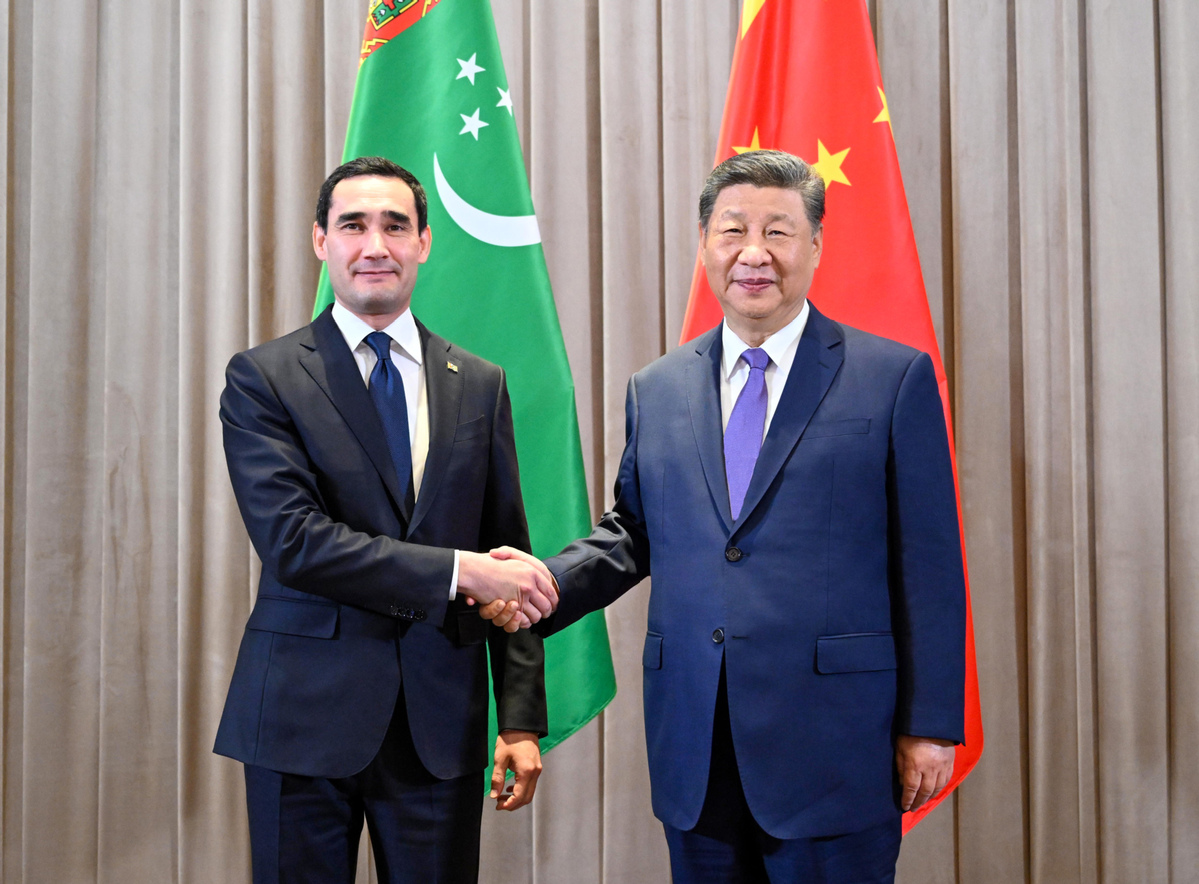
Image: Xinhua

Turkmenistan, meanwhile, attempted to capitalize on its natural gas reserves, agreeing to supply more to China and strengthen energy collaboration. President Serdar Berdimuhamedov underscored Turkmenistan’s dedication to energy security and regional stability, whilst Xi stated that China is willing to work with Turkmenistan to fully unlock the potential for cooperation between the two nations on the basis of mutual respect and “win-win collaboration.”

Insights on China’s Expanding Role

Political analyst Dosym Satpaev believes Xi’s visit underscores China’s commitment to Central Asia amid shifting global dynamics. Noting China’s concern over increased U.S. and EU engagement in Central Asia – especially in the field of critical raw materials – Satpaev suggests that Beijing is aiming to secure not only resources but also control over infrastructure related to electric vehicle production.

“China has big plans for the region,” Satpaev told Nezavisimaya Gazeta. “The goal is to deepen economic, political, and defense cooperation with Central Asian countries, especially given instability in the Middle East.”

Satpaev pointed out that China has invested about $4 billion in Iran and imports up to two million barrels of oil daily from the country. Any instability in Iran, he argues, jeopardizes China’s energy security and enhances the strategic importance of Central Asia.

Other analysts noted that Xi’s visit coincided with a G7 summit which proved testing, potentially signaling Beijing’s desire to pursue an independent global strategy.

Political commentator Gaziz Abishev observed that Kazakhstan is forging a unique partnership with China amid a broader shift in global economic power from the North Atlantic to the South China Sea.

“Kazakhstan-China relations have entered a ‘golden period.’ China’s rapid industrial growth has given it unprecedented global influence, and Kazakhstan is leveraging this while maintaining strategic autonomy.”

Abishev added that Kazakhstan is emerging as an active player in Asian integration, moving beyond its traditional role on Europe’s eastern edge. He stressed the importance of integration into regional production and infrastructure networks.

He also highlighted that over 15,000 Kazakh students are currently enrolled in Chinese universities, a trend he views not merely as educational but as strategic, fostering a generation of professionals fluent in Chinese language, culture, and economic logic.

A Shared Vision for Regional Growth

With its investments and strategic initiatives, the Second China-Central Asia Summit appears to have resulted in China solidifying its position as a driving force in Central Asia, promoting regional stability while advancing its economic and geopolitical ambitions. The summit also served to reaffirm Central Asia’s importance in global trade and set the stage for sustainable, long-term growth.

In Kazakhstan, Gender Imbalance Persists Even Among Teenagers

A recent study by Finprom.kz, conducted in partnership with the National Statistics Bureau, sheds light on how Kazakhstani citizens allocate their time across work, leisure, and household duties. The findings reveal significant gender disparities that begin in adolescence and continue into adulthood.

Unequal Distribution of Labor at Home

The study was based on data from a modular survey conducted every five years, involving approximately 12,000 respondents nationwide. Participants maintained daily activity logs, including both weekdays and weekends.

On weekdays, men in Kazakhstan work an average of 9 hours and 7 minutes, about an hour longer than women. However, when it comes to household duties and childcare, women spend more than twice as much time: 2 hours and 13 minutes compared to 48 minutes for men. The gap widens on weekends, with women spending 4 hours and 44 minutes on domestic tasks, compared to 1.5 hours for men.

Meanwhile, men spend more time on social media, television, and reading the news, around 1.5 hours on weekdays and nearly 3 hours on weekends. Women engage in these activities roughly an hour less. A similar trend appears in general leisure and relaxation time, where men again lead.

Gender Norms Form Early

Gendered patterns in domestic labor emerge as early as adolescence. Boys aged 10-14 spend about 1 hour and 6 minutes a day on household chores, while girls dedicate 1 hour and 52 minutes. Cooking accounts for a large portion of this difference, with girls spending an average of 44 minutes on meal preparation.

The study also found that parents with higher education levels spend more time with their children, regardless of employment status. Interestingly, unemployed men spend three times less time with their children than employed men, regardless of the day of the week. This correlation was not observed among women.

Despite traditional assumptions, men dedicate nearly as much time to personal care as women. On weekdays, men spend 1 hour and 17 minutes on hygiene and grooming, just 3 minutes less than women. On weekends, they spend even more: 1 hour and 40 minutes, compared to 1 hour and 29 minutes for women. Unemployed men consistently surpass women in this area.

Regional Disparities and Stress

The study highlighted notable regional differences in time use. In North Kazakhstan, residents spend about 1.5 hours daily on cooking and eating, while in Shymkent, the figure is nearly double. Shymkent residents also spend just 8 minutes a day on rest and reflection, compared to over an hour in Mangistau.

Cleaning and laundry take up 1.5 hours a day in Shymkent, one of the highest rates in the country. In contrast, residents of Astana spend just 39 minutes on these tasks.

Screen time also varies significantly. On average, Kazakhs spend 2 hours and 3 minutes daily on digital content. In North and East Kazakhstan, this climbs to 2 hours and 40 minutes. Residents of Almaty, Ulytau, and Shymkent average 2 hours and 14 minutes, while those in Kyzylorda and Mangistau spend the least, 1 hour and 17 minutes, and 1 hour and 21 minutes respectively.

A separate sociological survey by the Kazakhstan Institute for Public Development (KIPD), involving 2,400 respondents, found that 37.8% of women and 32.4% of men feel tired and overworked. Nearly one-quarter of women said they struggle with household management, compared to 16.9% of men.

“Women are more likely to experience fatigue, lack of time, and difficulty managing daily life. This highlights the need for a more equitable distribution of household responsibilities within the family,” the report’s authors concluded.

Building a Bridge of Tongues: One Uzbek Linguist’s Pursuit of Turkic Unity

For nearly five decades, Uzbek linguist Dr. Bakhtiyor Karimov has worked quietly on an ambitious vision: the creation of a shared, auxiliary language for Turkic-speaking nations. What began as a spark of inspiration on a trolleybus in 1974 became a lifelong intellectual project shaped by history, hardship, and support from prominent regional figures.

Karimov’s idea, what he calls the “Averaged Turkic Language”, was born not from political ideology but from a desire to preserve and connect cultures. “If our children cannot access the world’s knowledge in their own tongue, how can they innovate?” he once asked.

A Lifelong Vision Conceived in Silence

The concept took shape in the shadows of the Soviet Union, where Pan-Turkic ideas were taboo. Karimov and his colleague Shoahmad Mutalov developed their theories discreetly, using mathematical models to explore linguistic convergence. They coined the term “Eesopic” to mask their proposals, likening it to Aesop’s allegories.

In 1980, Karimov presented his formulas at a Turkology conference in Tashkent, illustrating affinities among Turkic languages. The room, initially confused by the mathematical display, fell silent when the implications became clear: this was about regional unity through language. The session was cut short.

Still, in 1982, their paper was quietly published under the title Language Policy Solutions for Developing Countries, disguised as a study on African and Asian contexts. This allowed Karimov’s ideas to survive Soviet censorship and enter academic circulation.

From Perestroika to Independence

The late 1980s gave Karimov space to speak more openly. He published theoretical sketches under allegorical titles and refined his proposals, ranging from grammar convergence to script reform. After Uzbekistan’s independence in 1991, he carried his vision to Kazakhstan, where he helped establish a Turkology Center and spoke of reviving Chagatai, the classical literary language once shared across Central Asia.

Despite early support, funding dried up. At one point, he suffered heart trouble during a meeting and was left unattended in a hospital corridor until a local cultural leader intervened. “I owe my heart to the Averaged Turkic Language,” he later said, reflecting on how the project had shaped every corner of his life.

Digital Revival and Regional Interest

In recent years, interest in Karimov’s ideas has quietly revived. In 2022, a Kazakh team led by Dr. Miriyev launched OzTurk, a simplified digital prototype that uses linguistic inputs from various Turkic languages to create a common vocabulary. Though limited in scope, the program demonstrated the feasibility of Karimov’s concept.

The idea has even reached Turkish media, with headlines celebrating “A Bridge of Tongues for a New Era.” Yet formal institutional backing has remained elusive.

Karimov estimates that establishing an Averaged Turkic Language Institute would require just $3 million, $500,000 from each of six Turkic states. “That’s a small price to pay for preserving our languages,” he argues.

A Broader Vision

Karimov’s ambitions extend beyond the Turkic world. In 1992, he presented a similar proposal for an Averaged Iranian Language, drawing on shared roots among Persian, Dari, Tajik, Pashto, Kurdish, and other languages. His papers were later published in a respected philological journal, gaining attention from regional linguists.

He sees both projects as part of a greater vision: a “third Renaissance” in Eurasia, where auxiliary languages rooted in local traditions can unite people without erasing their cultural identities.

A Gift to Aitmatov

In 2004, Karimov was invited to the Ala-Archa presidential residence in Bishkek, where he met the late Kyrgyz writer and diplomat Chingiz Aitmatov. Presenting the last remaining copy of his 1992 book O‘rtaturk Tili, Karimov received public praise. “You have found a way to honor both our diversity and our unity,” Aitmatov said.

Looking Ahead

Now in his later years, Karimov hopes to see the Organization of Turkic States formally adopt the project and fund an international institute. He envisions a digital platform where scholars from Bukhara, Istanbul, and Osh can contribute to a shared linguistic future.

From a scribbled formula on a Tashkent trolleybus window to pilot programs in Kazakhstan, Dr. Bakhtiyor Karimov’s idea has endured. His work reminds Central Asia that cultural unity need not come at the expense of diversity and that even the most ambitious dreams can begin with a simple idea, carried quietly for years until the world is ready to listen.

By 2022, Dr. Miriyev and a team in Kazakhstan had developed OzTurk, a pilot model based on Karimov’s ideas. It allowed users, from Bashkir economists to Tatar geographers, to input word lists and grammatical rules. The program computed a shared vocabulary and grammatical core. Though preliminary, OzTurk showed that Karimov’s model could be implemented with limited resources.

Karimov’s ambitions later expanded to include Iranian languages. In 1992, he submitted a paper on an “Averaged Iranian Language” to the annual conference at Tashkent’s Oriental Studies Institute. Initially excluded from the program, he spoke during the discussion period. “You call Persian the language of Iran,” he told colleagues, “but what of Dari, Tajik, Kurdish, Pashto, Balochi, Ossetian, Luri?” His data stunned the room. The next year, he was invited to publish two papers in Contemporary Problems in Iranian-Afghan Philology, over thirty pages articulating the theory’s ideological and mathematical underpinnings.

In 1992, Karimov brought the project to Ankara, where TIKA’s president, Ümit Arık, praised the idea and approved a Turkish-language edition. Yet the local grant officer dismissed it. “Why build an Averaged Turkic Language?” he asked. “Let everyone learn Turkish in two months.” The grant was blocked.

Karimov proposed a modest plan: a $3 million, two-year budget, $500,000 from each of six Turkic states, to fund linguists and developers. “That’s nothing compared to the cost of losing our languages,” he argued. “If a merchant wants his name enshrined in history, let him fund it.”

By 2019, Karimov’s personal copy was worn and taped at the spine. He had overseen two expanded editions, one in 2008, featuring new chapters on script reform, and a revised volume in 2019. Turkish newspapers had begun reporting on OzTurk, praising it as a “Bridge of Tongues for a New Era.”

From a spark on a trolleybus window to a comprehensive linguistic theory, Dr. Bakhtiyor Karimov’s vision remains a testament to resilience, imagination, and the enduring hope of unity through language. With political will, institutional backing, and shared commitment, Central Asia may yet witness its third Renaissance, one built on friendship, mathematics, and the belief that no culture should ever stand alone.

Biopesticide Trials in Kyrgyzstan Pave Way for Greener Locust Control

Between June 10 and 13, Kyrgyzstan conducted a national trial of biological pesticides in the northern Chuy region, marking a step forward in the country’s push toward environmentally responsible locust management. The trial was led by the Ministry of Water Resources, Agriculture and Processing Industry with support from the Food and Agriculture Organization of the United Nations (FAO), and funded by the Japan International Cooperation Agency (JICA) and FAO’s own resources.

The initiative is part of the broader “Programme to Improve National and Regional Locust Management in the Caucasus and Central Asia (CCA),” which aims to shift countries away from reliance on chemical pesticides.

According to the FAO, biopesticides, particularly those using the Metarhizium acridum fungus, are emerging as an effective, selective alternative to chemical treatments. These biological agents target locusts and grasshoppers without harming humans or non-target species such as pollinators, birds, and aquatic life.

Kyrgyzstan regularly faces locust threats from two species: the Moroccan locust and the Italian locust. Both are capable of rapid reproduction and forming large swarms that can severely damage crops and pastures.

“Biological pesticides offer a safer alternative for controlling locusts before they reach crisis levels,” said Oleg Guchgeldiyev, FAO Representative in Kyrgyzstan. “They are especially useful for fragile ecosystems. Continued testing will enhance scientific and technical capacity, paving the way for a more resilient agricultural sector.”

Field trials are a critical step toward integrating biopesticides into national locust control strategies.

The urgency of the initiative is underscored by recent government data. As previously reported by The Times of Central Asia, the Ministry of Agriculture surveyed 114,000 hectares earlier this month and found locusts present on nearly two-thirds of the land. More than 74,000 hectares have already been treated with pesticides. The infestation has been particularly severe in southern regions, where early harvest cycles and warm temperatures create ideal conditions for locust breeding.

By embracing biopesticides, Kyrgyzstan hopes to reduce environmental risks while maintaining effective pest control, balancing agricultural productivity with ecological responsibility.

Uzbekistan Allows Name Changes Following Official Gender Correction

Uzbekistan has updated its civil status regulations to allow individuals who have officially changed their gender to also change their first name, last name, and patronymic. The change follows a June 12 Cabinet of Ministers decision that amends the country’s procedures for registering personal status documents.

According to the Ministry of Justice, the update is part of broader efforts to streamline legal documentation related to marriage, family, and civil status. Under the new rules, citizens aged 18 and older, who do not have minor children, may apply to change their names via the Unified Interactive Services Portal.

The ministry clarified that the changes have been misinterpreted online as introducing broad legal provisions for gender transition. In fact, officials stressed, the amendment only affects the process of updating civil records after a gender change has already been made and recognized through medical documentation.

Previously, individuals who had changed their gender could correct key documents such as birth, death, and marriage certificates. However, name changes were restricted and typically permitted only under cultural or national naming exceptions. Under the new rules, a recognized gender transition now constitutes sufficient legal grounds for a name change, provided that a medical statement confirming the change is submitted.

The Justice Ministry also noted that each year, approximately five to six children in Uzbekistan are born with indeterminate gender characteristics. In many such cases, gender is assigned based on early medical assessments, though the child’s actual gender identity may only become clear years later, sometimes not until adolescence.

Officials cited one example involving a child born in 2008 who was initially registered as male. At age 16, medical evaluation confirmed the child was female. While her gender record was corrected in civil documents, existing laws at the time did not allow her to change her name and patronymic accordingly.

To address such legal gaps, the government passed Decision No. 362. It ensures that once a medical institution verifies a gender correction, the individual may also update their full name to reflect their gender identity. The regulation is intended to improve consistency across civil documents and prevent identity mismatches for individuals who have undergone gender transition.