• KGS/USD = 0.01144 0%
  • KZT/USD = 0.00193 -0%
  • TJS/USD = 0.10838 -0.09%
  • UZS/USD = 0.00008 0%
  • TMT/USD = 0.28490 0%
  • KGS/USD = 0.01144 0%
  • KZT/USD = 0.00193 -0%
  • TJS/USD = 0.10838 -0.09%
  • UZS/USD = 0.00008 0%
  • TMT/USD = 0.28490 0%
  • KGS/USD = 0.01144 0%
  • KZT/USD = 0.00193 -0%
  • TJS/USD = 0.10838 -0.09%
  • UZS/USD = 0.00008 0%
  • TMT/USD = 0.28490 0%
  • KGS/USD = 0.01144 0%
  • KZT/USD = 0.00193 -0%
  • TJS/USD = 0.10838 -0.09%
  • UZS/USD = 0.00008 0%
  • TMT/USD = 0.28490 0%
  • KGS/USD = 0.01144 0%
  • KZT/USD = 0.00193 -0%
  • TJS/USD = 0.10838 -0.09%
  • UZS/USD = 0.00008 0%
  • TMT/USD = 0.28490 0%
  • KGS/USD = 0.01144 0%
  • KZT/USD = 0.00193 -0%
  • TJS/USD = 0.10838 -0.09%
  • UZS/USD = 0.00008 0%
  • TMT/USD = 0.28490 0%
  • KGS/USD = 0.01144 0%
  • KZT/USD = 0.00193 -0%
  • TJS/USD = 0.10838 -0.09%
  • UZS/USD = 0.00008 0%
  • TMT/USD = 0.28490 0%
  • KGS/USD = 0.01144 0%
  • KZT/USD = 0.00193 -0%
  • TJS/USD = 0.10838 -0.09%
  • UZS/USD = 0.00008 0%
  • TMT/USD = 0.28490 0%
10 December 2025

Kyrgyzstan Begins Construction of New Jalal-Abad International Airport

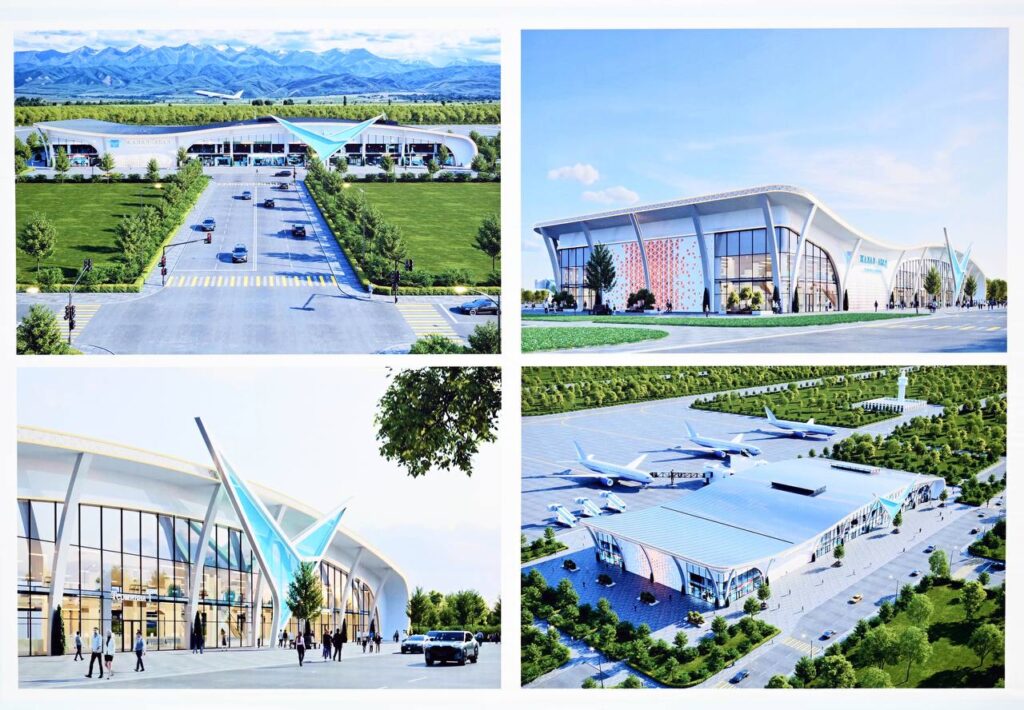
On May 13, President Sadyr Japarov laid the foundation stone for a new international airport in Jalal-Abad, Kyrgyzstan’s third-largest city.

The new airport will span over 380 hectares and include a two-story passenger terminal covering 10,000 square meters, with the capacity to handle 350 passengers per hour. Its airfield infrastructure will meet international standards, featuring a 3,800-meter runway and six aircraft parking bays. The facility will accommodate both passenger and cargo aircraft, including Boeing 737, Airbus A320, and A321 models.

Unlike a renovation of the existing facility, the project entails entirely new construction. The current Jalal-Abad airport dates back to 1938, originally serving as an airfield, with a terminal building and asphalt runway added in 1972.

Boosting Air Infrastructure

At the groundbreaking ceremony, Japarov emphasized the rising demand for both domestic and international flights, underscoring the need to expand the country’s airport infrastructure.

“Since 2021, Kyrgyzstan has increased passenger traffic by 46% and the number of flights by 31%. New aircraft have been acquired, and previously idle regional airports have resumed operations,” he said.

He also noted that the newly established Asman Airlines has restored all domestic routes, linking the capital, Bishkek, with Talas, Karakol, and Kerben. In 2024, the airline added two Canadian-made Bombardier Dash 8 Q400 short-haul aircraft to its fleet for domestic service.

Regional Impact

Japarov stated that the new Jalal-Abad International Airport would enhance logistics, trade, tourism, and investment across the Fergana Valley, a region shared by Kyrgyzstan, Tajikistan, and Uzbekistan.

This project is part of Kyrgyzstan’s broader strategy to modernize its aviation infrastructure. In February 2025, construction began on a new airport complex at Osh International Airport, located in the country’s second-largest city.

Kyrgyzstan has also recently inaugurated Karakol International Airport and Talas Airport.

Reconstruction efforts are currently underway at Issyk-Kul International Airport and Naryn Airport.

UAE Investor to Inject $1.1 Billion into Astana Aerotropolis Project

The Ministry of Transport of Kazakhstan has signed a long-term investment agreement with Terminals Astana Airport Limited, a subsidiary of UAE-based Terminals Holding, to transform Astana International Airport into a world-class Aerotropolis. The deal, valued at $1.1 billion, was formalized on May 12 during the official visit of Crown Prince Sheikh Khalid bin Mohammed bin Zayed Al Nahyan of Abu Dhabi to Kazakhstan.

Strategic Infrastructure Development

The agreement outlines a comprehensive development plan, including the construction of a second runway, a third passenger terminal, and a dedicated cargo terminal at Astana International Airport. According to the Ministry of Transport, the investor also aims to build a multifunctional Aerotropolis complex, encompassing an industrial and logistics zone, a business cluster, hotels, retail space, and logistics terminals.

An Aerotropolis is a modern urban model that integrates aviation, logistics, and commercial infrastructure to create a self-sustaining hub catering to both passengers and businesses. The concept is designed to provide short-term accommodation and consumer services in proximity to the airport, effectively transforming it into a small city.

Operational Modernization

In addition to physical infrastructure, the project includes plans to modernize the airport’s operational systems. Terminals Astana Airport Limited will upgrade the fleet of specialized airport equipment, introduce digital solutions and automation, and implement phased training and retraining programs for airport staff.

Following the restoration of municipal control over the airport in January, Astana’s local authorities extended the trust management agreement, with Terminals Astana Airport Management continuing in its role as the airport operator. Both Terminals Astana Airport Limited and the current operator are subsidiaries of Terminals Holding.

In 2024, Astana International Airport served 8.315 million passengers, an 11% increase from the previous year.

Broader Investment Context

As previously reported by The Times of Central Asia, Kazakhstan continues to attract foreign investment in its aviation infrastructure. Earlier this year, Vietnam’s Sovico Group, which owns Kazakh airline Qazaq Air, was offered the opportunity to manage an airport in the Kyzylorda region.

Russia Launches Production of Reactor Equipment for Uzbek Nuclear Project

Russia’s state nuclear corporation Rosatom has begun manufacturing reactor equipment for Uzbekistan’s first small nuclear power plant, marking a significant step in bilateral energy cooperation. The announcement was made during Energy Week in Tashkent, which runs from May 13 to 15, according to TASS.

Rosatom’s facility in Saint Petersburg has completed the first steel casting for the RITM-200N reactor unit, weighing 205 tons. The company noted that this casting marks the initial phase of reactor assembly.

Project Overview

The nuclear power plant will be built in Uzbekistan’s Jizzakh region under a contract signed on May 27, 2024. It will comprise six small modular reactors (SMRs), each with a capacity of 55 megawatts, for a combined output of 330 megawatts. Atomstroyexport, a Rosatom subsidiary, is the main contractor, with participation from several Uzbek construction firms.

The RITM-200N reactor is derived from Russia’s naval reactor technology and has been adapted for stationary, land-based use. Rosatom describes it as compact and efficient, with a design that enables accelerated construction timelines, qualities seen as key to addressing modern energy challenges.

Strategic Importance

Rosatom CEO Alexey Likhachev confirmed that all legal and contractual matters between Russia and Uzbekistan have been finalized. He added that construction could begin within a year, or potentially even sooner.

Azim Akhmadkhodjaev, head of Uzbekistan’s Atomic Energy Agency, emphasized the strategic significance of nuclear energy in reducing dependence on imported fossil fuels. He also outlined national plans to increase the share of renewable energy in Uzbekistan’s energy mix from 16% to 54% by 2030.

Energy analysts say that combining nuclear and renewable sources will help Uzbekistan meet its growing electricity needs while mitigating environmental impact.

Kazakhstan Warns of Potential Drought Impact on Western and Southern Harvests

Southern and western regions of Kazakhstan are expected to face a shortage of rainfall this summer during the critical ripening period for vegetables and fruits. Minister of Water Resources and Irrigation, Nurzhan Nurzhigitov, has urged local authorities and the Ministry of Agriculture to prepare measures for irrigating croplands.

Speaking at a government meeting, Nurzhigitov cited forecasts from Kazhydromet, Kazakhstan’s national meteorological service, supported by data from the World Meteorological Organization and the North Eurasian Climate Center. According to the forecasts, a short-term drought is expected in May in the southern part of the Kostanay region, a major grain-producing area in northern Kazakhstan. However, this will likely be alleviated by subsequent summer rains.

In contrast, the May drought in other regions is expected to persist. Areas likely to be affected include the southwestern half of West Kazakhstan and Mangistau regions, the northwestern Kyzylorda region, northern parts of the Almaty and Zhambyl regions, southern Karaganda, and various parts of the Aktobe, Atyrau, Abai, and Turkestan regions.

Nurzhigitov emphasized that the western and southern regions, located in the Zhayik and Syr Darya river basins, are particularly at risk. He warned that prolonged dry conditions could significantly disrupt the agricultural sector.

“It is necessary to develop a set of operational measures aimed at minimizing the consequences of a possible moisture deficit,” he said, highlighting especially severe concerns about water shortages in the Turkestan and Kyzylorda regions. According to Nurzhigitov, water reservoirs in the affected basin are currently at only 75% of average capacity.

As previously reported by The Times of Central Asia, Kazakhstan aims to boost its grain exports this year, with an eye on expanding deliveries to Africa.

Despite Ceasefire India-Pakistan Conflict Sends Ripples Through Central Asia

Despite a recent ceasefire agreement between India and Pakistan, renewed hostilities remain a looming threat. The latest clashes between the two nuclear-armed neighbors have direct and potentially lasting repercussions for Central Asia’s political stability and economic development.

Ceasefire Amid Escalation

Armed conflict erupted on May 7, when New Delhi launched “Operation Sindoor,” targeting what it described as terrorist infrastructure within Pakistan. The move followed a deadly terrorist attack on April 22 in Pahalgam, Jammu and Kashmir, which killed 26 people. India accused Pakistan of complicity, a charge Islamabad rejected, condemning the airstrikes as an “act of war.” Full-scale hostilities ensued for several days, raising alarms across the broader region.

By May 11, a ceasefire was brokered, though both sides warned that fighting could resume if provoked. Given the eight-decade-long volatility along their shared border, the risk of future escalations remains significant.

Whilst Pakistan credited the U.S. for facilitating the ceasefire, specifically highlighting Senator Rubio and what it described as direct intervention by President Trump, India maintained that the agreement was a result of direct communication between the Directors General of Military Operations (DGMOs). In a formal televised address, Foreign Secretary Vikram Misri emphasized that the ceasefire was a “bilateral” decision reached via military hotlines, omitting any mention of Trump or Rubio. “Both sides agreed to cease all firing and military actions on land,” Misri stated firmly, reiterating India’s stance that no third party played a role in its interactions with Pakistan.

Disruption to Tourism Flows

One immediate economic impact of the conflict has been felt in Central Asia’s tourism sector. In recent years, Kazakhstan, especially Almaty, has become an increasingly popular destination for Indian travelers, aided by a visa-free regime that permits 14-day stays. The country also hosts large numbers of Indian and Pakistani students, along with medical tourists and business travelers.

Many Indian visitors rely on budget carriers such as IndiGo, which previously operated routes from Delhi to Almaty and Tashkent using airspace over Pakistan. The closure of this airspace led to increased costs and logistical complications. IndiGo suspended flights to both cities on April 27 and 28, respectively. Should hostilities resume, these suspensions could be extended, potentially setting back Central Asia’s still-fragile tourism recovery.

Infrastructure and Trade at Risk

The geopolitical instability also jeopardizes key infrastructure projects and trade routes. Kazakhstan and Uzbekistan have both enhanced connectivity with Pakistan through distinct strategies, with Kazakhstan integrating into multilateral frameworks like the Middle Corridor and QTTA, and Uzbekistan focusing on tactical bilateral projects such as the Termez–Karachi transport corridor and Trans-Afghan Railway. Both countries aim to reduce their reliance on Russian-controlled routes while leveraging Pakistan’s ports to boost regional trade.

Political analyst Zhanat Momynkulov warns that the conflict could disrupt supply chains and raise the cost of goods across South and Central Asia. The rerouting of flights due to Pakistani airspace closures is already affecting logistics and regional connectivity.

Kazakhstan, a central player in both the Shanghai Cooperation Organization and the Belt and Road Initiative (BRI), is particularly vulnerable. Projects such as the China-Pakistan Economic Corridor (CPEC), a BRI flagship, could be delayed or derailed. Similarly, the Turkmenistan-Afghanistan-Pakistan-India (TAPI) gas pipeline faces heightened uncertainty.

Construction on the TAPI pipeline’s Serkhetabad-Herat segment began in September 2024, backed by Turkmen and Afghan officials. The 1,814-kilometer pipeline, fed by Turkmenistan’s massive Galkynysh field, is intended to diversify Turkmenistan’s gas exports and provide a stable energy source to Afghanistan. Escalating regional tensions have now cast doubt over its timely completion.

Diplomatic Tightrope for Central Asia

The conflict also places Central Asian governments in a delicate diplomatic position. Much like in the context of the war in Ukraine, regional leaders must navigate relationships with powerful and often opposing international actors.

China, a major player in Central Asia, maintains a strong military partnership with Pakistan and reportedly supplies it with advanced weaponry and satellite intelligence. According to Kazakh political analyst Adil Kaukenov, this support reflects Beijing’s broader strategic alignment with Islamabad.

At the same time, Pakistan enjoys broad backing in the Islamic world, including from Turkey, Saudi Arabia, and Azerbaijan. Conversely, India draws strength from its substantial global diaspora and robust diplomatic ties with the UAE, as well as traditional partners in the U.S., UK, and Canada. Meanwhile, Russia being a longstanding ally of India adds further complexity to the geopolitical equation.

Central Asia’s close ties with all these powers mean that any escalation could force regional states into uncomfortable diplomatic balancing acts, with consequences for both domestic and foreign policy.

Transit Ambitions: Kazakhstan Emerges as Key Link Between East and West

Kazakhstan is poised to enhance its role as a pivotal transit hub between China and Europe amid evolving global logistics dynamics, according to a recent analysis by Energyprom.kz.

China’s Role in Global Logistics

China remains the world’s largest exporter, shipping approximately 4.5 billion tons of goods annually, with 60-70% transported via maritime routes. More than one-third of global container traffic passes through Chinese ports and transit centers. However, rising geopolitical tensions and sanctions have prompted Beijing to diversify its logistics options and reduce reliance on sea routes.

The Belt and Road Initiative (BRI), which primarily traverses Kazakhstan, Russia, and Belarus, plays a crucial role in this strategy. Land routes offer shorter delivery times, typically 10-12 days compared to 30 days by sea. Alternatives bypassing Russia, such as the corridor through Kazakhstan, Iran, and Turkey, are also gaining prominence.

Kazakhstan’s Transit Potential

Kazakhstan’s strategic location enables it to serve as a vital conduit in global transport flows. The modern incarnation of the Silk Road has transformed the country into a linchpin for trade between East and West. Developing transit corridors not only boosts the national economy but also improves socio-economic conditions in border and underdeveloped regions by creating jobs and attracting investment.

Over the past 15 years, Kazakhstan has invested more than 10 trillion tenge in transit infrastructure, generating approximately 600,000 jobs. In 2023, transit cargo volumes reached 30 million tons, exceeding the target of 27.7 million tons set in the national development strategy, “Concept for the Development of the Transport and Logistics Potential of the Republic of Kazakhstan until 2030.”

The strategy aims to increase total transit volume to 35 million tons by 2030, including 2 million TEU in container traffic.

Growth in Transport Service Exports

Kazakhstan’s expanding logistics capabilities are translating into increased exports of transport services. In 2024, rail freight exports totaled US$1.3 billion, up 2.1% from the previous year. Road freight exports surged by 19.6% to US$665.7 million, while sea freight rose by 47.2% to US$64.7 million. Pipeline service exports also grew by 7.1%, despite a 1.6% decline compared to 2019 levels.

Innovation and Digitalization in Logistics

To cement its global position, Kazakhstan is investing in a smart economy by incorporating innovation and digital solutions into its logistics framework. This includes automation, artificial intelligence, blockchain technology, and the creation of integrated digital logistics hubs.

One such initiative is the Alatau Special Economic Zone (SEZ), an innovation center designed to enhance the country’s transit ecosystem.

According to the Astana International Financial Center (AIFC), the transport and logistics sector’s contribution to GDP could rise from 6.2% in 2022 to 9% by 2025.
Link to AIFC report

This digital transformation promises not only to reduce operational costs but also to generate thousands of high-skilled jobs, an essential component of Kazakhstan’s path to sustainable economic growth.