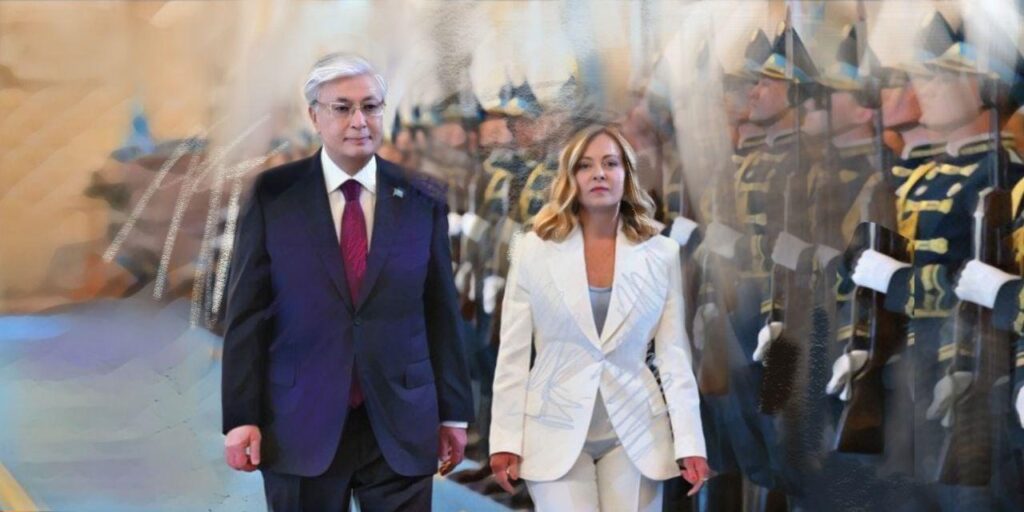
Italian Prime Minister Giorgia Meloni’s visit to Kazakhstan marks a pivotal moment in the deepening relationship between the two nations. This diplomatic mission comes on the heels of historical ties reinforced by Pope Benedict XVI’s 2022 visit to the Central Asian nation, where he met with President Kassym-Jomart Tokayev. Benedict’s trip was a testament to Kazakhstan’s role in promoting interfaith dialogue and global peace, a legacy that continues to shape its international relationships.
Now, with a new American Pope at the helm of the Vatican, Meloni has renewed Italy’s commitment to strengthening its partnership with Kazakhstan. Her meeting with Tokayev and participation in the C5+Italy Summit underline her focus on fostering collaboration in energy diversification, regional stability, and economic growth. The terms for Meloni’s arrival in Astana were set by Kazakhstan’s previous engagements with Italy, including President Kassym-Jomart Tokayev’s visit to Rome in early 2024 and his meeting with Meloni in Abu Dhabi in January 2025.
Those substantive bilateral talks set the bilateral agenda in the joint context of Italian active Eurasian diplomacy and Kazakhstan’s own strategic vision. Meloni’s direct discussions with Tokayev focused on deepening bilateral diplomatic and economic ties; expanding cooperation in energy, trade, and defense; and discussing regional security and joint training programs. As she put it prior to departing Italy, “This visit confirms the strategic value of our collaboration and the excellent level of relations between our nations.”
Kazakhstan’s geography, resource wealth, and evolving political posture since independence over a third of a century have also enabled it to craft a nuanced foreign policy balancing traditional ties with Russia and China against emerging alignments with Europe and beyond. Italy’s diplomacy, underpinned by proactive outreach and sustained by major trade and investment flows, has become Kazakhstan’s principal EU partner and third-largest global trading counterpart.
Meloni’s engagement with Kazakhstan underscores her broader strategic vision of positioning Italy as a pivotal player in the evolving geopolitical landscape. Central to this ambition is her ability to connect Italy’s foreign policy with global power structures, including her relationship with former U.S. President Donald Trump, a bond that has bolstered both her personal stature and Italy’s diplomatic leverage. This alignment, rooted in shared ideologies of nationalism and sovereignty, allows Italy to project itself as a transatlantic bridge linking Europe, the United States, and strategically critical regions like Central Asia.
Beyond energy and trade, Italy’s approach aims to institutionalize its presence in the region, as demonstrated by the simultaneous hosting of the Central Asia–Italy Summit, which builds on the “5+1” dialogue launched in 2019 and its 2024 iteration at the foreign-ministerial level. Convening this summit at the head-of-government/head-of-state level in Astana subtly underscores Kazakhstan’s linchpin role in regional coordination and Italy’s capacity to frame its engagement as a multilateral and strategic enterprise.
Meloni’s ambitions extend to securing Italy’s role in stabilizing ties with Central Asia and former Soviet states. For instance, strengthening relationships with energy-rich nations like Kazakhstan underpins her focus on energy diversification, critical for reducing Europe’s reliance on Russian gas while addressing global resource and security challenges.
If the economic cooperation can be said to have a centerpiece, this would be the cooperation between Samruk-Kazyna, Kazakhstan’s sovereign wealth fund, and Italy’s Maire engineering firm to establish a high-end industrial hub in Kazakhstan. This initiative reflects Astana’s determination to position itself as a Eurasian node in advanced production by elevating its manufacturing and technological capacity.
The energy dimension, long the cornerstone of Kazakhstan-Italy relations, was reinforced through Samruk-Kazyna’s agreement with Ansaldo Energia to produce gas turbine components domestically. This agreement bolsters Kazakhstan’s drive for industrial self-sufficiency while extending Italy’s role as a strategic energy partner. It builds on Ansaldo’s earlier commitments to supply turbines and generators for the reconstruction of Almaty’s TPP-3 power plant and collaborate on new energy projects.
The bilateral relationship was already strong, as the two countries have engaged in a wide range of joint initiatives outside these industrial ventures. There has been cooperation in defense and cybersecurity, encompassing joint training, cyber resilience exchanges, and even the possible co-production of military equipment. Kazakhstan has developed a multilayered security partnership with Italy that skillfully demonstrates its capacity to define regional security parameters.
The relationship was further strengthened when on May 28, at the Kazakhstan-Italian Business Forum — the economic backbone of this emerging partnership — ten memoranda of understanding were signed, valued at €180 million, across other sectors including mechanical engineering, petrochemicals, agri-processing, and logistics. The launch of a blockchain-driven logistics transparency initiative called the Digital Supply Chain 4.0 project and of the “Made in Kazakhstan with Italy” program illustrates Kazakhstan’s drive to integrate global value chains on its own terms as well as Italy’s diplomatic ambitions in Central Asia. The agreements enhance Kazakhstan’s key position along the Middle Corridor by bringing Italian investment to foster joint production, technology transfer, and industrial integration.
Rome’s alignment of its investments and industrial cooperation with Astana’s modernization goals enables it to embed itself within a broader Eurasian strategy. The economic ties are anchored by a new joint investment fund and the development of enhanced export risk insurance mechanisms. To Italy’s energy security considerations, long tied to Kazakhstan’s oil and gas reserves, broader goals are now added. These include securing critical raw materials, advancing the EU’s green transition, and reinforcing Europe’s autonomy amid geopolitical flux. One of the agreements included the production of certified “green” aluminum and ferroalloys by 2027.
While the immediate outcomes of Meloni’s visit are significant, their realization depends on sustained effort. Details of the Maire and Ansaldo Energia projects, operationalization of digital logistics, and concrete steps in defense cooperation will determine whether this momentum translates into lasting impact. The planned Italy–Central Asia Summit in Rome later this year presents a natural venue for assessing progress and deepening commitments.
The two countries also face shared challenges. The shrinking Caspian Sea is a shared concern for Meloni and Tokayev, as it threatens both economic and environmental stability. Italy’s energy company ENI, heavily invested in the region, faces challenges like costly dredging to maintain operations in oil fields such as Kashagan. Approximately 80% of Kazakhstan’s oil exports flow through the Caspian Pipeline Consortium, anchoring the country’s reliance on the Caspian Sea as a vital conduit for its energy sector. This dependency sharpens the shared interest of both Kazakhstan and Italy in sustaining energy production while also addressing the environmental crisis impacting the region.
Kazakhstan and Italy pursued intersecting yet distinct strategies that found practical convergence during Meloni’s visit. For Kazakhstan, the agreements advanced industrial modernization, economic diversification, and regional leadership, showcasing its capacity to attract foreign expertise on its own terms. For Italy, the partnership secured an expanded economic footprint, diversified energy sources, and a firmer position in a region where Russia, China, and Turkey increasingly shape outcomes.
The two countries’ shared vision was underlined not only in the political and economic realms but also in grappling with the shared environmental challenges of the shrinking Caspian Sea. The collaboration between Italy’s energy firm ENI and Kazakhstan’s authorities faces the dual challenge of sustaining production in fields like Kashagan while addressing the environmental crisis threatening both economic and ecological stability. These intertwined ambitions — balancing industrial growth, regional security, and environmental stewardship — reflect the evolving nature of diplomacy and partnership in a world where geopolitical challenges are increasingly complex.
Tokayev and Meloni’s rapport illustrates how pragmatic diplomacy can generate momentum even amid shifting global alliances. Their shared commitment to navigating intricate energy, environmental, and security issues underlines the capacity for bilateral relationships to evolve beyond transactional interactions. In addressing the Astana International Forum on 30 May, Meloni emphasized, “Kazakhstan and Italy stand united in forging a new strategic nexus, rooted in collaboration, innovation, and mutual growth, building bridges that transcend borders for shared prosperity and a brighter future.” While this partnership cannot resolve every geopolitical challenge, it highlights how mutual respect, shared interests, and measured leadership can forge pathways to tangible progress in a complex world.




 Sergey Kwan