• KGS/USD = 0.01144 0%
  • KZT/USD = 0.00211 0%
  • TJS/USD = 0.10454 -0.1%
  • UZS/USD = 0.00008 0%
  • TMT/USD = 0.28571 0.28%
  • KGS/USD = 0.01144 0%
  • KZT/USD = 0.00211 0%
  • TJS/USD = 0.10454 -0.1%
  • UZS/USD = 0.00008 0%
  • TMT/USD = 0.28571 0.28%
  • KGS/USD = 0.01144 0%
  • KZT/USD = 0.00211 0%
  • TJS/USD = 0.10454 -0.1%
  • UZS/USD = 0.00008 0%
  • TMT/USD = 0.28571 0.28%
  • KGS/USD = 0.01144 0%
  • KZT/USD = 0.00211 0%
  • TJS/USD = 0.10454 -0.1%
  • UZS/USD = 0.00008 0%
  • TMT/USD = 0.28571 0.28%
  • KGS/USD = 0.01144 0%
  • KZT/USD = 0.00211 0%
  • TJS/USD = 0.10454 -0.1%
  • UZS/USD = 0.00008 0%
  • TMT/USD = 0.28571 0.28%
  • KGS/USD = 0.01144 0%
  • KZT/USD = 0.00211 0%
  • TJS/USD = 0.10454 -0.1%
  • UZS/USD = 0.00008 0%
  • TMT/USD = 0.28571 0.28%
  • KGS/USD = 0.01144 0%
  • KZT/USD = 0.00211 0%
  • TJS/USD = 0.10454 -0.1%
  • UZS/USD = 0.00008 0%
  • TMT/USD = 0.28571 0.28%
  • KGS/USD = 0.01144 0%
  • KZT/USD = 0.00211 0%
  • TJS/USD = 0.10454 -0.1%
  • UZS/USD = 0.00008 0%
  • TMT/USD = 0.28571 0.28%

Kazakhstan and Uzbekistan Boost Rail Freight to 32.3 Million Tons

Kazakhstan and Uzbekistan have agreed on new measures to expand rail freight capacity as Astana works toward increasing overall transit volumes to 55 million tons.

According to Kazakhstan’s Ministry of Transport, the agreement was reached during a meeting between the transport ministers of the two countries, where they discussed further cooperation in the railway sector. The talks were held as part of Kazakhstan’s broader strategy to strengthen its role as a key transit hub in Central Asia.

Both sides emphasized the strategic importance of rail connections between Kazakhstan and Uzbekistan, describing them as central to trade growth, international transit flows, and regional transport integration. Officials also pointed to the strong potential for increasing freight volumes and improving the efficiency of logistics corridors linking the two economies.

By the end of 2025, rail freight transportation between the two countries reached 32.3 million tons, representing a 16% increase compared to 2024, the ministry said.

To maintain steady growth and achieve agreed capacity targets, the parties adopted a joint action plan focused on infrastructure development at key border crossings, including Saryagash, Oasis, and Syrdarya. The plan also provides for the completion of major railway projects, including the Darbaza-Maktaaral section.

Currently, up to 36 pairs of trains pass daily through the Saryagash crossing, with plans to increase that figure to 40. At the Oasis junction, traffic is expected to grow from two to 10 train pairs per day. Through Syrdarya, volumes are projected to reach 10 train pairs daily following the launch of the Darbaza-Maktaaral line.

During the meeting, the ministers also reviewed the synchronization of infrastructure upgrades and maintenance work, improvements to border control procedures, and measures to optimize operational coordination in order to raise overall transport efficiency.

Last month, Kazakhstan’s national railway company, Kazakhstan Temir Zholy, announced that its Jibek Joly, or Silk Road, tourist train route would be extended to Dushanbe for the first time, linking cities in Kazakhstan and Uzbekistan with Tajikistan’s capital. The inaugural journey on the expanded route is scheduled to depart from Almaty on March 20, 2026, coinciding with Nauryz celebrations across the region.
Modernization Without Dependence: Why Uzbekistan Is Deepening Ties with Washington

The recent rise in Uzbekistan-U.S. engagement is often framed as a sudden diplomatic turn, and much of the commentary has focused on what Washington hopes to gain from deeper involvement in Central Asia. Far less attention, however, has been given to what Tashkent is seeking from this relationship. From Uzbekistan’s perspective, this engagement is part of a broader national strategy to expand the country’s foreign policy options at a time when all of the major powers are competing for influence in Central Asia.

In November 2025, President Shavkat Mirziyoyev joined the other C5 leaders in Washington for a White House summit focused on economic cooperation, critical minerals, energy, and trade. By February 2026, the relationship had moved beyond talks and into financing and project design, with new agreements involving the U.S. International Development Finance Corporation and EXIM, alongside a new critical minerals framework.

From Uzbekistan’s side, the core objective is straightforward. Tashkent wants to modernize rapidly without risking becoming overdependent on any single external investor. That means using U.S. interest as leverage and in tandem with, not as a replacement for ties with Russia or China. Washington is courting the region because it wants access to minerals and supply chains that reduce reliance on China and limit exposure to sanctioned or geopolitically sensitive suppliers. Uzbekistan is well aware of this and is using that demand to strengthen its bargaining position for financing, technology, and industrial upgrading. In other words, Uzbekistan is positioning itself as a strategic production and transit partner.

The direction of cooperation is revealing. The February 2026 U.S.-Uzbekistan critical minerals pact prioritizes the full-value chain from exploration and extraction to processing, and even proposes a joint investment holding company. This signals that Tashkent is aiming beyond raw-material exports. It wants to break from the post-Soviet pattern of shipping resources while others capture refining, technology, and margins. If it can secure processing capacity, infrastructure, and long-term financing, the deal becomes an instrument of industrial policy.

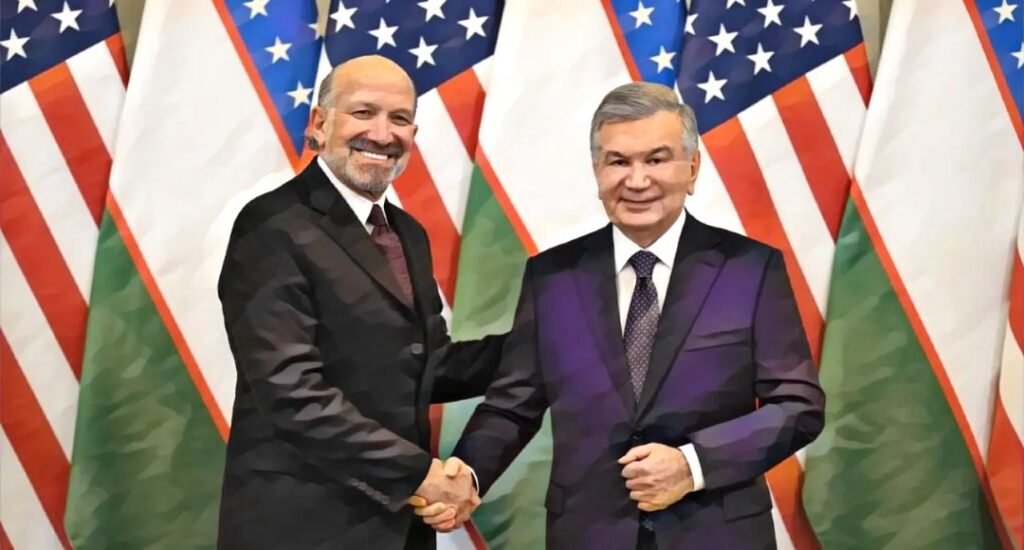
The second objective is finance and implementation capacity. President Mirziyoyev also held separate bilateral meetings with the U.S. Secretary of Commerce, Howard Lutnick, and other senior U.S. trade officials. The meetings focused on an investment platform, business council coordination, and support for large industrial and infrastructure projects. EXIM also publicly described the new framework as a way to convert earlier commitments into financing solutions for energy, aviation, critical minerals, and advanced technologies.

The third objective is trade normalization and market access. A bipartisan Senate effort has introduced legislation to repeal Jackson-Vanik restrictions for Central Asian states, and President Mirziyoyev raised U.S. support for Uzbekistan’s WTO accession and stronger cooperation under the U.S.–Central Asia Trade and Investment Framework Agreement (TIFA). These measures shape the legal and trade environment that ultimately determines investor confidence. Uzbekistan is trying to make the relationship durable by embedding it in institutions.

The move also serves a domestic political economy logic. President Mirziyoyev’s government has spent years presenting itself as reformist, investment-friendly, and open for business. Deeper engagement with the United States strengthens that narrative both at home and abroad. The Uzbek presidency has highlighted that bilateral trade has passed $1 billion and that around 340 U.S. companies operate in the country, while also pointing to a three-year economic cooperation program and sectoral projects in energy, transport, agriculture, and IT. The leadership wants to show that reforms are producing major partnerships and that Uzbekistan is becoming a serious player in global supply chains.

At the regional level, Tashkent is also using U.S. engagement to advance its leadership ambitions in Central Asia. Uzbekistan is seeking not only bilateral gains from Washington but a stronger role as a regional agenda-setter. President Mirziyoyev’s push for deeper regional institutionalization, including proposals for a “Community of Central Asia,” serves the same goal. U.S. interest in the C5 format gives Tashkent more room to maneuver on regional integration, supply chain coordination, and diplomatic coordination without appearing to tilt decisively away from Moscow or Beijing. Engagement with Washington, therefore, serves a regional strategy for Uzbekistan, not just a bilateral one.

There are limits and risks. U.S. policy can be highly transactional, and Tashkent has seen this before; it will not assume Washington’s attention is permanent. Implementation gaps are also common in large cross-border infrastructure and industrial deals. Many of the agreements signed so far establish frameworks, heads of terms, and financing pathways, but execution will determine their impact. Meanwhile, Central Asian states remain closely tied to Russia, while China retains strong commercial influence. Tashkent’s challenge is to deepen ties with the United States without forcing a binary choice.

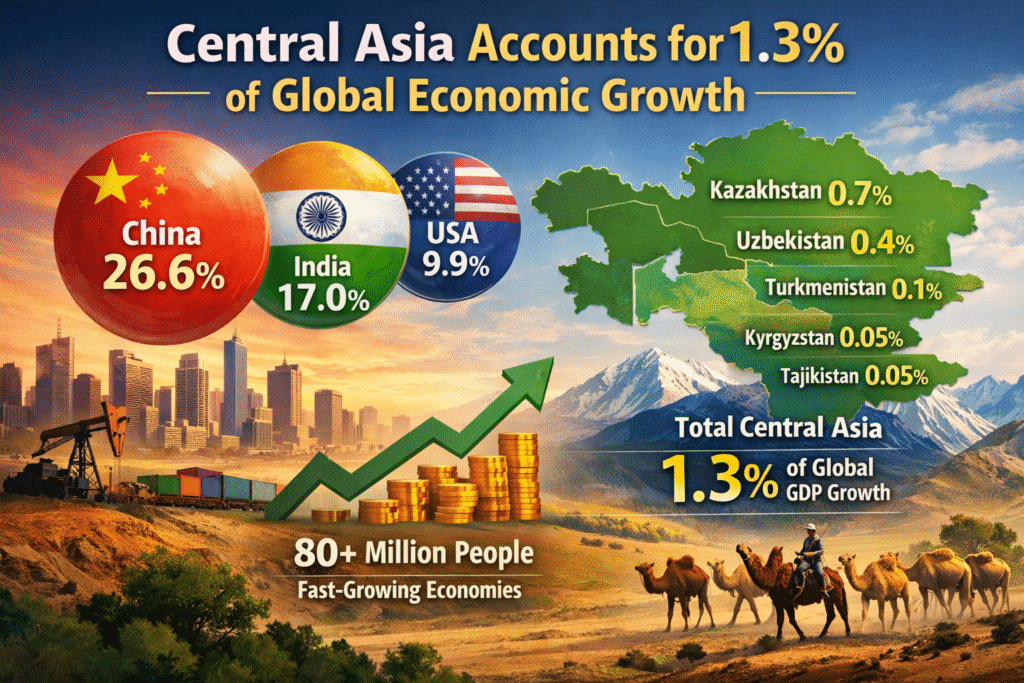
Central Asia Accounts for 1.3% of Global Economic Growth

A recent study by Visual Capitalist, based on projections from the International Monetary Fund, maps who is powering global growth in 2026. The analysis highlights heavyweights like China, which accounts for 26.6% of global GDP growth, India at 17.0%, and the United States at 9.9%. Together, these three economies account for roughly 53–54% of global economic expansion, underscoring their scale and sustained growth momentum.

Yet beneath those headline figures lies a quieter but strategically important development: Central Asia is steadily increasing its contribution to global economic growth.

According to the study, Kazakhstan is set to contribute 0.7% of total global GDP growth in 2026, making it the clear regional anchor. Uzbekistan adds 0.4%. Turkmenistan will contribute 0.1%, while both Kyrgyzstan and Tajikistan will account for approximately 0.05% each.

Taken together, this amounts to a 1.3% share of global GDP growth. While modest in absolute terms, the figure is notable given the region’s scale. With a population of over 80 million—comparable to Germany and Turkey—Central Asia’s aggregate contribution compares with these mid-sized advanced economies, which account for roughly 0.9% and 2.2% of global growth respectively. Moreover, with projected average annual growth exceeding 6%, Central Asian economies are expanding faster than much of Europe and other mature markets, reinforcing their rising relative contribution to global economic momentum.

Uzbek Janitor Awarded for Saving Child from Seventh-Floor Fall in St. Petersburg

A janitor from Uzbekistan who saved a seven-year-old boy from a seventh-floor fall in St. Petersburg has been awarded state and public honors following the dramatic rescue.

The Times of Central Asia reported yesterday that the incident took place on Petrozavodskaya Street, where the child was seen standing on the ledge outside an open window. Moments later, the boy lost his balance and fell. A janitor identified as Khayrullo, a native of Uzbekistan, was working near the building at the time. He noticed the danger and moved closer. As the child fell headfirst, Khayrullo caught him midair and held him tightly against his body, absorbing much of the impact.

According to a presidential decree, President Shavkat Mirziyoyev awarded Khayrullo Saydullayevich Ibadullayev the Jasorat medal for bravery. The decree stated that he acted in an emergency situation, risking his own life and health to save the child and demonstrating courage and selflessness.

Russian media also reported on the recognition. Margarita Simonyan, editor-in-chief of the television network RT, announced on X that the 38-year-old Uzbek citizen had received the fourth Tigran Keosayan Award for his heroism. The award, established by Simonyan, is presented to individuals who demonstrate bravery and dedication, particularly in protecting children and vulnerable people.

In addition to the honor, Ibadullayev will receive a monetary prize of one million rubles, equivalent to approximately $13 000.

The child survived the fall and was hospitalized. Doctors described his condition as stable.

Reporter Christopher Wren, Member of 1974 Team That Found Climbers´ Bodies on Lenin Peak, Has Died 

Christopher S. Wren, a journalist for The New York Times who was part of a 1974 American expedition that discovered the bodies of seven Soviet women climbers on Lenin Peak, on today’s border between Kyrgyzstan and Tajikistan, has died at the age of 89.

Wren died at home in Vermont on February 15, the newspaper reported, quoting his daughter Celia Wren. The journalist reported extensively from the Soviet Union and China during the Cold War, as well as other regions, and his report on the discovery of what he called “one of the worst tragedies in modern mountaineering” was among his most dramatic dispatches.

Wren, an experienced mountaineer, was with a team that found the bodies of the all-female Soviet group on Lenin Peak, a 7,134-meter mountain in what was then part of the Soviet Union. Many international climbers had gathered there that year at a time when the Cold War dominated global politics.

The body of an eighth Soviet climber was found after Wren and his teammates left the site.

“The Soviet press did not report the deaths of the country’s best women climbers until after I had returned to Moscow and revealed the disaster in The New York Times,” Wren wrote in his 1990 book The End of the Line: The Failure of Communism in the Soviet Union and China.

Usually accessed from the Kyrgyz side, Lenin Peak is not the highest mountain in Kyrgyzstan, nor is it considered the most technically difficult. Russian climber Natalia Nagovitsina and an Italian friend, Luca Sinigaglia, died last year on Pobeda Peak, the country’s highest mountain at 7,439 meters above sea level.

Kyrgyzstan’s Mountaineering and Sport Climbing Federation says Lenin Peak is popular among “beginner climbers.”

The peak, the federation says, “is one of the most accessible 7000s in the world for climbing, one of the five world peaks in terms of popularity, and its base camp – Achyk-Tash – is the most convenient in terms of infrastructure accessibility among peaks of this height.”

Infrastructure and communications at the mountain were more basic half a century ago, and the perils of high altitude, the cold, winds and storms are significant.

In 1974, Russian expedition leader Elvira Shatayeva and her party got into trouble in a storm as they descended from the summit. In radio calls, she told base camp that they were dying and, according to Wren’s book, her last words were: “Please forgive us. We love you. Goodbye.”

Heading toward the summit after the storm cleared, Wren and his group found the bodies of the stranded Soviet women.

“A body is stretched on the snow before us. With a chill of recognition, I know it is Elvira Shatayeva, the women’s team leader with whom I sat and talked one evening several weeks earlier,” Wren wrote in a 1974 article.

The Soviet media blamed the storm for the disaster. But Wren said he wondered if more transparency and communication among climbing teams at Lenin Peak, despite heightened tension and rivalry between the superpowers, could have prevented it.

“Everyone lamented the worst weather in the Pamirs in a quarter century,” he wrote in his book. “No one said anything about the obstinacy of the Soviet bureaucracy.”


American AI Company to Help Kazakhstan Develop University Admissions Exam

Kazakhstan’s Ministry of Science and Higher Education and the AI-based education company ETS say they are developing a new university admissions exam, the Admissions Insight Test (AIT), as part of a partnership launched in November 2025 to modernize the country’s national admissions system.

Officials say the test is also meant to support the international recognition of results in future.

“The Admissions Insight Test represents a decisive step forward for Kazakhstan’s higher education system,” said Sayasat Nurbek, Kazakhstan’s Minister of Science and Higher Education. “By building this new admissions exam in partnership with ETS, we are strengthening trust, fairness, and global alignment in how students enter our universities. This work positions Kazakhstan to lead in education innovation while ensuring our students are prepared for success in a rapidly changing, international, and AI-driven world.”

ETS, which is headquartered in Princeton, New Jersey with offices worldwide, said the AIT would be modular. “Subject Modules” would align with the school curriculum and a student’s intended field of study. Separate “Skills Based Tests” would measure critical thinking, academic writing and research skills, communication, quantitative and digital literacy, and creative or design thinking. 

The ETS Research Institute is expected to work alongside Kazakhstan’s education leaders and National Testing Center specialists, using AI and advanced analytics to streamline development and deepen the insights universities get from results.

Kazakhstan already uses nationwide testing as a central gateway into university, and policymakers have linked admissions changes to a broader push to become a regional education hub.

“Around the world, governments are rethinking how education systems measure readiness for the future and they are turning to ETS because trust, rigor, and global expertise matter,” said Kadriye Ercikan, Senior Vice President of Global Research at ETS. “Our work with Kazakhstan reflects the same responsibility we bring to partnerships with education systems worldwide: applying the strongest measurement science, responsible innovation, and AI-enabled approaches to help countries build assessment systems that are fair, credible, and internationally respected.”

The project sits alongside Kazakhstan’s higher education transformation and its decision to join OpenAI’s Education for Countries program as officials look to prepare students for an AI-shaped economy.