By Arindam Banik and Muhtor Nasirov
The world is currently grappling with the devastating impact of climate change, as rising temperatures have become an undeniable reality. In January 2024, the global temperature exceeded normal levels for the second consecutive month, pushing the global average temperature over the 1.5-degree threshold for the first time. Many human activities, such as unplanned water use, excessive groundwater extraction, and climate change, are thought to be contributing to this situation. One poignant example is the case of the Aral Sea in Central Asia. This once breathtaking and teeming endorheic lake, nestled between Kazakhstan and Uzbekistan, was not just a body of water. It was a symbol of life, a testament to the beauty and resilience of nature. Its azure waters and diverse marine life were a source of sustenance and livelihood for the region’s people.
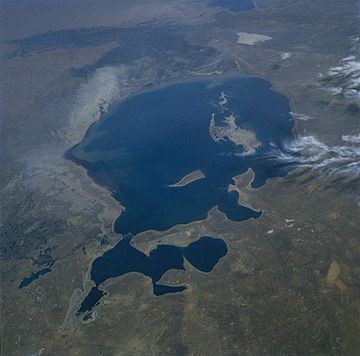
It was a vibrant ecosystem, nourished by the almost entire flow of the two main rivers, the Amu Darya and the Syr Darya, in the upstream region of Central Asia. Interestingly, the Amu Darya River used to flow into the Caspian Sea through Uzboy Channel. However, a significant shift occurred during human settlement when the flow of these rivers was redirected into the Aral Sea, marking a crucial turning point in the region’s hydrological history. Despite its former glory as the third-largest lake in the world, covering an area of 68,000 km2 (26,300 sq miles), the Aral Sea began shrinking in the 1960s after the rivers that fed it were diverted to support large-scale irrigation for cotton production intended for export.
The irrigated area in the Aral Sea Basin has now expanded to eight million hectares. By 2007, it had decreased to only 10 percent of its original size, dividing into four lakes. By 2009, the southeastern lake had vanished, and the southwestern lake had shrunk to a thin strip at the western edge of the former southern sea. In the following years, occasional water flows partially replenished the southeastern lake. In August 2014, NASA satellite images revealed that the eastern basin of the Aral Sea had completely dried up, leading to the formation of the Aralkum Desert. This dramatic change has severely impacted the ecology, risking the survival of numerous fish subspecies and three endemic sturgeon species. The loss of these species disrupts the natural balance and affects the livelihoods of the local communities that depend on fishing. The herring, sand smelt, and gobies were the first planktivorous fish in the lake, and their decline led to the lake’s zooplankton population collapse.
Consequently, the herring and sand-smelt populations have not recovered. Except for the carp, snakehead, and possibly the pipefish, all introduced species survived the lake’s shrinkage and increased salinity. In an attempt to revive fisheries, the European flounder was introduced. This situation is urgent as the delicate balance of this ecosystem is on the verge of collapse. The region’s once-prosperous fishing industry has been devastated, leading to unemployment and economic hardship. Additionally, the diverted Syr Darya River water now irrigates about two million hectares of farmland in the Ferghana Valley. The Aral Sea region is heavily polluted, resulting in serious public health problems.
The water management challenge in Central Asia is complex due to conflicting interests between upstream and downstream countries. Upstream countries like Kyrgyzstan and Tajikistan have abundant water resources and want to release more water in winter for hydropower generation. On the other hand, downstream countries like Uzbekistan, Turkmenistan, and Kazakhstan, with fewer internal water resources, prefer water from transboundary rivers to be released primarily in summer for irrigation and to avoid winter flooding. This clash of interests underscores the intricate nature of the water management challenge in the region.
The extensive transboundary water infrastructure in Central Asia distinguishes the basins from other contested international basins, reflecting the region’s shared history as Soviet republics until 1991. The Soviet Union constructed large dams and reservoirs in Kyrgyzstan and Tajikistan to store water for summer irrigation releases in Uzbekistan, Kazakhstan, and Turkmenistan, with hydropower generation as a secondary objective due to the availability of cheap energy.
After the Soviet Union dissolved, rising energy prices led to changes in the release of water from reservoirs. Upstream countries began prioritising hydropower production, causing a shift in water release patterns from mainly in summer to more in winter, negatively impacting downstream countries. They now face reduced water availability for irrigation and uncontrolled winter flooding. Additionally, upstream countries plan to build new dams and expand irrigated agriculture, which downstream countries oppose as they fear further limitations to their water access and increased vulnerability to shortages.
More than two decades after the disintegration of the Soviet Union, the five states of the Aral Sea Basin face the challenge of restoring a sustainable equilibrium while offering development opportunities for an increasing population. Central Asian countries experiencing water scarcity might face severe water crises by 2030. In inadequate regional economic cooperation, particularly water and energy integration, they can find themselves in absolute freshwater scarcity by 2050.
Water resources use in the region demonstrates high growth rates due to demographic factors, industrial and agricultural development, and irrigation. Central Asian countries, primarily in the Aral Sea basin, are notable for their socio-economic development that unfolds amidst the complete depletion of their water resources, i.e. water use exceeds available resources, and this trend will determine the nature of inter-state relations of the region’s countries. It should also be noted that by 2030-2050, the region’s governments will reach the limits of irrigated land expansion because of its limited availability.
Several noteworthy initiatives warrant special attention in this context. For instance, countries like Kyrgyzstan, Uzbekistan, and Kazakhstan recently agreed on a roadmap for constructing the Kambarata-1 hydropower plant. Similarly, the International Fund for Saving the Aral Sea (IFAS) highlights that analytical reviews enable the creation of a comprehensive assessment of the water situation in the Amu Darya and Syr Darya river basins and their respective sites. This includes planned and actual indicators on reservoir volumes, inflows, releases, water withdrawals, and the disparities between planned and actual indicators regarding water availability for withdrawal.
Resolving this significant crisis necessitates the development of a regional infrastructure that integrates all sectors of the economy. This infrastructure should be founded on the principles of responsible water usage and facilitate the allocation of water resources required to restore the Aral Sea. Considering the substantial financial resources needed, which the Aral Sea Basin countries currently lack, it is crucial to establish an infrastructure fund with the involvement of the world’s industrialised nations.
Surprisingly, despite the region’s dwindling water and irrigation resources, each country’s national strategies and programs envision further water usage for irrigation and hydropower. In light of this, a cohesive regional water policy should aim to balance water resource utilisation and enhance the area’s ecological conditions. Sustainable water management is thus imperative and will require coordinated political action from all the states involved. To address this promptly, policymakers could consider initiatives such as diversifying the agricultural sector to reduce water consumption and waste, exploring groundwater, placing less emphasis on surface water, and promoting widespread adoption of drip irrigation systems.
Arindam Banik is an Indian economist, and Muhtor Nasirov is a professor at Samarkand State University