The Times of Central Asia was delighted to interview Chingiz Arziev, CEO of AIRUN a Kyrgyzstan-based company developing AI infrastructure for the Kyrgyz language.
AIRUN’s technology includes a large language model, speech recognition, text-to-speech tools, AI translation, and digital avatars designed for use in government, education, media, business, and public services.
Chingiz Arziev spoke to TCA about the challenge of building AI for a low-resource language, why digital sovereignty matters for Kyrgyzstan, and how the company hopes to take its experience to other countries facing similar language and technology challenges.
TCA: To begin with, can you tell us a little about yourself: where you grew up, what you studied, and how you first became interested in technology?
Chingiz Arziev: I was born and raised in Bishkek, Kyrgyzstan.
My interest in technology started very early. Around the age of nine, I discovered design software: Photoshop, Illustrator, and CorelDRAW. I was not only learning how to use them, but also comparing their interfaces and trying to understand what made one product more intuitive than another.
At around 14, I became interested in motion design, 3D graphics, and digital sculpting. I studied Adobe After Effects, Blender, and ZBrush. Whatever software I was learning, I was always interested in the same thing: user experience. Already by the age of 16, I had started learning HTML and CSS to begin building websites and landing pages. Looking back, the common thread has always been understanding how technology works and how it can solve real problems for people.
TCA: Was there a particular moment when you realized that artificial intelligence could become a serious field for you personally?
Chingiz Arziev: I have always been drawn to advanced engineering and emerging technologies. In 2015, I became deeply involved in the blockchain space. The architectures, protocols, and decentralized systems being developed at the time felt completely new and inspiring.
But even that did not compare to what happened during the AI boom of 2022.
I still remember the day I sent my first prompt to ChatGPT. For me, that was the moment everything changed. I immediately saw the direction technology would take over the next 20 years.
After that, I spoke about artificial intelligence everywhere. I talked about how AI would transform industries, reshape professions, automate routine work, and fundamentally change the labor market. Many friends and colleagues thought I was exaggerating.
But I had spent years following companies such as Boston Dynamics, Tesla, Unitree, and DJI. Because of that, I saw a broader picture. Artificial intelligence would not develop in isolation. It would advance alongside robotics, autonomous systems, and automation.
After sending that first prompt to ChatGPT, I knew I wanted to dedicate my career to artificial intelligence.
TCA: How did the idea for AIRUN first come about, and what problem were you trying to solve?
Chingiz Arziev: For countries with low-resource languages, the need for sovereign AI has existed for a long time.
The challenge was never the idea itself. The challenge was execution, expertise, infrastructure, and trust. Kyrgyzstan had demand for advanced AI solutions in the Kyrgyz language, but there was no technology capable of delivering them at the required level.
Around that time, I met my investor, who is also the director of BDigital, a technology company specializing in cloud solutions, artificial intelligence, cybersecurity, robotic process automation, and microservices architecture. He believed we could build a large-scale AI core fully trained for the Kyrgyz language and adapted to the realities of our country.
Today, we have solved many of the key challenges involved in developing AI for Kyrgyz. According to our internal benchmarks, AIRUN demonstrates stronger performance in Kyrgyz-language tasks than major open-source models available today.
For me, however, the most important achievement is not the model itself. What matters most is that Kyrgyzstan now possesses the expertise, engineering knowledge, infrastructure, datasets, and practical experience required to build sovereign AI systems from the ground up.
Sovereign AI is not only a technological issue. It is also about digital independence, language preservation, national security, local expertise, and the ability to determine your own technological future.
TCA: Did you imagine AIRUN from the beginning as a Kyrgyz AI company with national ambitions?
Chingiz Arziev: From the very beginning, we understood that AIRUN was a project of national importance.
We saw its potential to become Kyrgyzstan’s leading language AI platform and a foundation for the country’s future AI infrastructure.
We wanted to prove that world-class technology can be developed in Kyrgyzstan by local engineers and researchers. There is still a perception in many parts of the world that advanced technology can only be created in Silicon Valley, Europe, or a handful of major technology hubs. We wanted to challenge that assumption.
That is why we viewed AIRUN as a national project from day one. We believed we were building something much larger than a single AI product. We were building a technological foundation that could support government services, business automation, education, media, and digital transformation across the country.
TCA: Kyrgyzstan is not usually the first country people mention when they talk about global AI. Did that make the challenge harder?
Chingiz Arziev: Both are true. On one hand, Kyrgyzstan has never been widely known for producing global technology products or advanced AI systems. That became a major source of motivation for us. We wanted to demonstrate that Kyrgyzstan can participate in the global AI movement not only as a consumer of technology but also as a creator.
On the other hand, it definitely created challenges. When we first started building AIRUN, many hardware suppliers, technology partners, and international vendors were skeptical. A team from Kyrgyzstan claiming it was building a national language model and sovereign AI infrastructure did not immediately sound convincing to everyone.
Over time, however, we proved that AIRUN was not just an ambitious idea. It became a real AI company with working products, active deployments, government integrations, enterprise customers, and a growing ecosystem of AI technologies built specifically for the Kyrgyz language.
TCA: What does it mean to build AI infrastructure for the Kyrgyz language as something connected to identity, education, and the future of the country?
Chingiz Arziev: For our team, it means building true technological sovereignty for Kyrgyzstan.
We already have a four-year development roadmap that includes expanding our AI ecosystem, building domestic GPU infrastructure, developing sovereign AI solutions for government, business, and citizens, and strengthening Kyrgyzstan’s position in artificial intelligence.
Today, we are working with the Ministry of Culture and the Ministry of Education on initiatives related to language learning, educational content creation, and preserving the Kyrgyz language in the digital world.
For me personally, one of the most important goals is ensuring that the Kyrgyz language exists not only in textbooks and official documents, but also in modern technologies, AI systems, digital services, and the global internet.
Languages that are absent from digital platforms gradually lose influence and relevance. That is why building national AI infrastructure is not only a technology project. It is also an investment in education, culture, identity, and the future of the country.
TCA: What makes building AI for Kyrgyz different from building AI for English, Russian, or other widely used languages?
Chingiz Arziev: The biggest challenge is data. Kyrgyzstan is a relatively small country, and the amount of Kyrgyz-language content available online is extremely limited compared to major global languages.
I often explain it with a simple example. Imagine you are the parent of a 10-year-old child. Other children have access to enormous libraries, thousands of books, and the world’s best teachers. Your child has only 10 books. The problem is not that you are a bad parent. The problem is that there are no additional books available.
That is the reality for developers working with low-resource languages. Modern large language models are trained on enormous volumes of information collected over decades. Languages like English have virtually unlimited digital resources. Languages such as Kyrgyz do not.
That is why we had to invest significant effort in collecting and preparing enough data to train AIRUN.
TCA: What has been the most difficult technical challenge so far data, computing power, talent, funding, or something else?
Chingiz Arziev: Honestly, we faced all of those challenges at the same time.
The first challenge was assembling the team. I built it person by person, and I truly believe we managed to bring together some of the best specialists in the country.
The second challenge was computing power. When we started building AIRUN, access to the infrastructure required to train large AI models was extremely limited, and it remains a challenge today. Building sovereign AI requires significant computing resources, especially for countries developing their own national AI infrastructure.
The final challenge was data. After finding a team and securing computing resources, we discovered that there was effectively no ready-made dataset for AI training in Kyrgyzstan. There was no large language corpus, no properly annotated data, and no existing foundation for training a national AI model.
As a result, we created a dedicated data team. We collected and processed publicly available Kyrgyz-language content and prepared it for AI training. Today, AIRUN operates on what we believe is the largest Kyrgyz-language dataset in the country.
TCA: Start-ups often have to survive a long period before the outside world begins to take them seriously. What were the hardest moments in AIRUN’s early development?
Chingiz Arziev: Every stage was difficult.
One of our engineers likes to say: “Training AI is always a lottery.” You never know exactly how a model will behave after training or what results it will ultimately produce.
When we started, there were many things we simply did not know yet. But one principle has always guided our team: nobody is criticized for not knowing something. We sit down, study the problem together, and find a solution.
Over time, the entire team grew. Our engineers grew. I grew as a CEO.
The biggest change is that AIRUN is no longer an idea or an early-stage initiative. Today, it is a company with real deployments, real customers, and active projects in government and business.
TCA: Have you raised investment or attracted support from partners?
Chingiz Arziev: At the moment, we are growing through our own resources and revenue. At the same time, we remain open to future investment rounds.
Attracting investment has become significantly easier because potential investors can see not only our vision, but also real products already being used by major businesses and government institutions. When you have active deployments and real customers, many questions answer themselves.
TCA: What kind of support has AIRUN received from the government, universities, the private sector, or international organizations?
Chingiz Arziev: Today, we actively work with government institutions. One of our first partners was the Jogorku Kenesh, the parliament of the Kyrgyz Republic, and we are grateful to the speaker and the parliamentary team for their trust and support.
Together with parliament, we launched AIRUN Kairyluu, a digital public reception system. Previously, citizens had to write appeals, requests, and complaints themselves. Today, a person can simply describe a problem in Kyrgyz by voice, and AIRUN automatically converts that speech into a properly formatted official document ready for submission to a government institution. This makes communication between citizens and the state simpler and more accessible.
We are also supported by the Kyrgyz State Medical Academy. At the moment, we are working on implementing our solutions in other government institutions, including the Bishkek Mayor’s Office.
Overall, we operate across government, business, and consumer sectors. Our goal is simple: by the end of the year, we want Kyrgyzstan to have its own AI solutions across key industries and move significantly closer to technological sovereignty.
As for support, we do not need any special conditions. The greatest support for domestic AI developers is adoption. When government agencies, universities, municipalities, and businesses begin using local technologies in their daily operations, products evolve, and the country builds its own technological expertise.
TCA: How would you describe Kyrgyzstan’s start-up scene today?
Chingiz Arziev: In my opinion, Kyrgyzstan has a great deal of talent. Our developers, engineers, and entrepreneurs study at leading universities around the world and work for major international companies. That speaks to the quality of human capital in the country.
The key challenge today is creating more opportunities within Kyrgyzstan for that talent to realize its potential. The more interesting technology projects, strong companies, and ambitious challenges we create, the more specialists will see opportunities for growth while remaining connected to the global market.
TCA: Do you see AIRUN as focused mainly on Kyrgyzstan, or could the technology eventually be useful for other Central Asian languages and markets?
Chingiz Arziev: We built AIRUN from the beginning with the understanding that these technologies could be useful far beyond Kyrgyzstan.
Today, we are in discussions with Georgia, Azerbaijan, the Czech Republic, and Estonia. The reason is simple: the challenge of language sovereignty is not unique to Central Asia. Very few countries possess their own national AI models and maintain full control over their data, technologies, and infrastructure.
While building AIRUN, we developed much more than a Kyrgyz AI core. We created a methodology for building such systems, from data collection and language corpus development to model training, deployment, and operation.
For us, security is particularly important. National data should remain within the country, and AI models should operate in the interests of governments, businesses, and citizens without dependence on external platforms or providers.
TCA: In practical terms, where do you hope people will first encounter AIRUN’s technology?
Chingiz Arziev: AIRUN can be used to create solutions for government, business, and citizens.
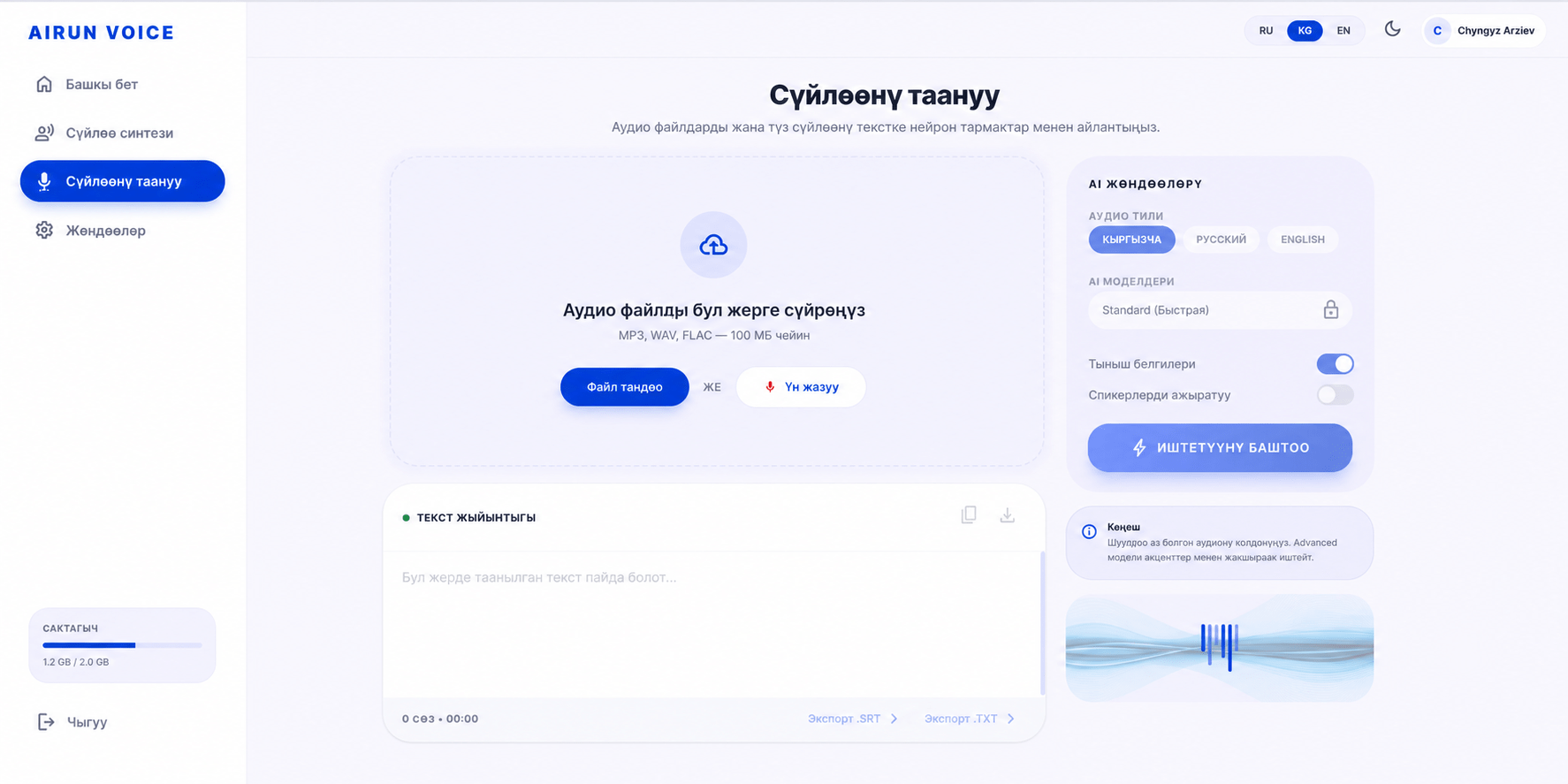
Today, AIRUN includes its own large language model, a ChatGPT-like system for the Kyrgyz language, automatic speech recognition, text-to-speech, AI translation, and digital avatars.
AIRUN already powers chatbots, voice assistants, and customer-service automation systems for banks and other large organizations.
In the public sector, AIRUN Kairyluu is already operating in the Jogorku Kenesh and is preparing for deployment in the Bishkek Mayor’s Office.
Another important area is media technology. Together with Ethnomedia, a local streaming platform, we are implementing an automated subtitle generation and translation system for Kyrgyz-language content. The solution is already attracting interest from television channels and media companies.
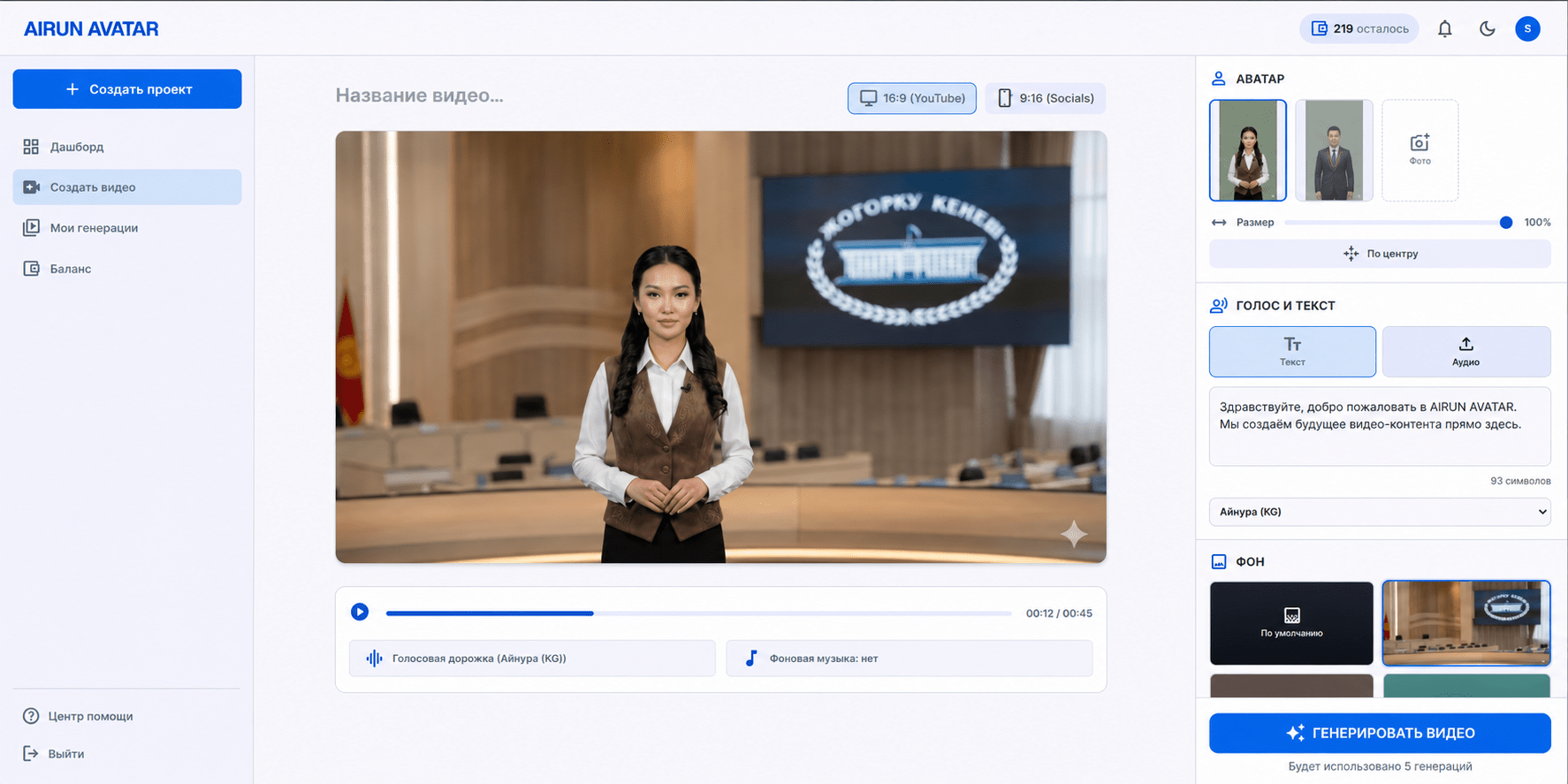
AIRUN also develops digital avatars. The digital presenters Myrza and Aiym, currently used by the Jogorku Kenesh, were created using AIRUN technologies.
We also plan to introduce technologies that will allow students to learn programming in Kyrgyz, helping more young people enter the IT sector.
Our goal is not to create a single product. AIRUN is a foundational language infrastructure and technology platform that can support government services, educational solutions, voice technologies, media products, and next-generation AI systems.
TCA: If AIRUN succeeds, what could Kyrgyzstan’s technology sector look like in five or 10 years?
Chingiz Arziev: At AIRUN, we genuinely believe that Kyrgyzstan can become a country associated with advanced artificial intelligence solutions.
Over the next five years, we plan to establish a dedicated AI laboratory where new specialists, engineers, and researchers can be trained and developed. For us, it is important not only to create technologies but also to nurture the people who will continue developing them in the future.
If we succeed, the benefits will extend far beyond AIRUN itself. The entire country will benefit. And that is the Kyrgyzstan we want to show to the world.