Kazakhstan is preparing for the next phase of its railway expansion. Alongside the major lines already under construction, the authorities are considering new routes and upgrades to existing sections intended to increase network capacity, serve industrial producers, and accommodate growing transit volumes.
Implementing those plans will require substantial investment. Some projects may be financed by the state, while others are expected to rely on private capital, international financial institutions, and public-private partnerships.
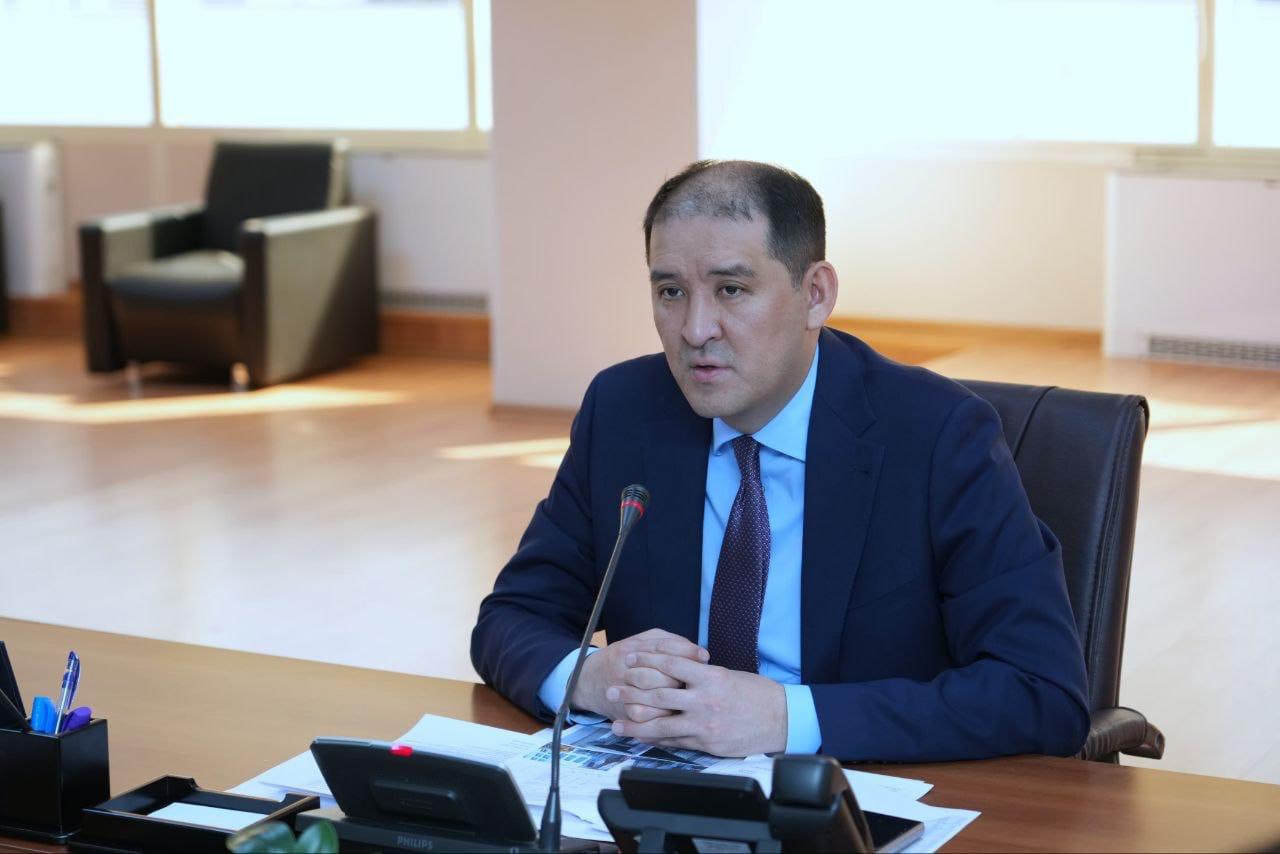
Kazakhstan’s Vice Minister of Transport, Zhanibek Taizhanov, spoke to The Times of Central Asia about construction deadlines, proposed new routes, and whether the country’s railway priorities are beginning to shift.
TCA: Kazakhstan is building several major railway projects at the same time. When are the main lines expected to be completed?
Zhanibek Taizhanov: The Moyynty-Kyzylzhar and Darbaza-Maktaaral railway lines are scheduled to enter operation by the end of this year. Construction of the Bakhty-Ayagoz line is expected to be completed by the end of 2027. In addition, trial train operations began on the Almaty bypass line in December last year.
The authorities previously instructed the Transport Ministry and Kazakhstan Temir Zholy to launch the Moyynty-Kyzylzhar and Darbaza-Maktaaral lines by the end of 2026 and commission Bakhty-Ayagoz by the end of 2027.
TCA: The government has called for preparations for the next stage of railway development. Which projects is the ministry considering, and what needs are they intended to address?
Zhanibek Taizhanov: The Ministry of Transport, together with Kazakhstan Temir Zholy and the relevant government agencies, has been tasked with examining the next phase of railway infrastructure development, taking into account projected growth in freight flows, transit traffic, and the economy’s long-term needs.
The projects under consideration include the construction of second tracks on the Arys-Kazaly section. The project is intended to increase the capacity and carrying capability of one of the key sections of the railway network, support sustained freight growth, and improve transport services for the country’s southern and western regions; construction of the Inderbor-Uralsk railway to improve regional connectivity, make freight transportation more efficient, and create additional opportunities for the industrial and logistics development of western Kazakhstan; modernization of the Kyzylzhar-Shubarkol-Yesil section, which would increase the capacity of a route used to transport coal and mining products and improve logistics for industrial enterprises; modernization of the Inderbor-Makat railway section to improve the transportation of oil, gas, and industrial cargo and develop transport infrastructure in the western regions; and development of railway infrastructure in the Karagaily industrial zone in the Karaganda Region to serve existing and planned production facilities, attract investment, and support the region’s industrial development.
These projects are being examined because the railway network needs to develop in step with growing domestic, export, and transit freight volumes. Their implementation would increase infrastructure capacity, meet the needs of industry and logistics, and create additional conditions for the socioeconomic development of the regions.
TCA: Existing projects largely expand transit and export routes, while many of the proposed lines are linked to industrial enterprises. Does this signal a change in the sector’s priorities?
Zhanibek Taizhanov: This does not represent a change in the railway sector’s development priorities. Transit, support for export transportation, and the transport needs of industrial growth are complementary elements of state transport policy.
Recent and current projects, including the second tracks on the Dostyk-Moyynty section, the Moyynty-Kyzylzhar and Bakhty-Ayagoz railway lines, and the Almaty station bypass, are intended to increase the capacity of international transport corridors and further develop the country’s transit potential.
The proposed projects are focused on the needs of the economy, including major industrial enterprises and new production sites.
Railway infrastructure is therefore being developed with both the growth of international transit and export traffic and the needs of the domestic economy in mind. This approach is consistent with the objectives of economic diversification, industrial development, increased production of higher-value-added goods, and greater competitiveness for domestic enterprises.
The railway network is regarded as one of the key instruments for sustainable economic growth, expanded export opportunities, and improved transport connectivity between Kazakhstan’s industrial regions.
TCA: Financing such an ambitious railway expansion will require substantial investment. What funding sources is the ministry considering?
Zhanibek Taizhanov: Funding for the new railway projects is expected to come from several sources, including the state budget, investment programs of Kazakhstan Temir Zholy, private investment, public-private partnerships, and loans from international financial institutions and development banks.
Particular emphasis is being placed on attracting off-budget financing, which is expected to become the primary source of funding for a significant share of future infrastructure projects.
The ministry is developing a portfolio of major transport projects, improving public-private partnership mechanisms, working closely with international financial institutions and prospective investors, and taking steps to improve the investment climate by reducing administrative barriers. The continued development of international transport corridors and Kazakhstan’s transit potential also strengthens the country’s investment appeal.
TCA: How do you distinguish between projects that should be financed by the state and those that are expected to attract private investors?
Zhanibek Taizhanov: The main differences lie in financing mechanisms, the allocation of risks, and the expected sources of investment returns.
Projects financed by the state are generally of strategic importance but do not always generate rapid commercial returns. In such cases, the government assumes the main investment costs and risks because these projects create long-term economic and public benefits. They include projects aimed at improving regional connectivity, strengthening Kazakhstan’s transit role, and eliminating infrastructure bottlenecks.
Projects involving private investors are expected to have a stable freight base and clear commercial potential. In these cases, investors assume part of the financial risk, while the government provides the necessary institutional and regulatory framework.
This is why projects such as the Inderbor-Uralsk railway, the modernization of the Inderbor-Makat and Kyzylzhar-Shubarkol-Yesil sections, and the development of railway infrastructure for the Karagaily industrial zone are viewed as commercially viable opportunities supported by forecast freight volumes from mining, metallurgy, oil and gas, and processing industries.
To attract private investment, Kazakhstan offers a broad range of support measures, including public-private partnership mechanisms, long-term investment agreements, tax and customs incentives, access to land and engineering infrastructure, state co-financing and guarantee mechanisms, improvements to tariff regulation, and a “one-stop shop” system for major investment projects.
The government intends to maintain a balance between public funding and private capital. National trunk railway projects will generally remain the responsibility of the state, while infrastructure directly linked to industrial enterprises and production clusters is increasingly seen as an area for public-private cooperation.
This approach does not reduce the state’s role. Instead, it allows public resources to be concentrated on strategic infrastructure while accelerating projects capable of generating sustainable economic returns.
TCA: Does railway expansion also include upgrades to supporting infrastructure, or is the focus limited to building new lines?
Zhanibek Taizhanov: Railway development is being implemented on a comprehensive basis. It includes not only the construction of new lines and increased capacity on existing routes, but also modernization of station infrastructure, improvements to traffic management, communications and signaling systems, and measures to improve operational efficiency.
In addition, Kazakhstan is continuing its nationwide railway station modernization program aimed at improving passenger services, accessibility, and the technical condition of station facilities.
TCA: What technologies will play the biggest role in Kazakhstan’s next generation of railway projects?
Zhanibek Taizhanov: Modern engineering and digital technologies will be a key component of future railway projects.
Among the solutions under consideration are: advanced signaling, interlocking, and traffic-control systems; digital train-traffic and freight-management technologies; automated dispatch-control systems; modern infrastructure monitoring and diagnostic tools; Building Information Modeling (BIM) technologies for project design; energy-efficient power-supply and infrastructure-management solutions; and digital platforms for freight and logistics management.
These technologies are expected to improve railway safety, increase network capacity, enhance infrastructure reliability, and make railway operations more efficient.
TCA: Kazakhstan’s planned railway expansion covers regions with very different climates and geological conditions. What are the main engineering challenges?
Zhanibek Taizhanov: Every region presents its own natural, climatic, and engineering characteristics, all of which are taken into account during the design stage.
In central Kazakhstan, including the Karaganda Region, the principal challenges are the vast distances between settlements, construction logistics, and the need to provide supporting engineering infrastructure.
In the Atyrau Region, engineers must take into account complex geological conditions in certain areas, highly mineralized soils, and the requirements of operating infrastructure in a sharply continental climate.
In Turkistan and Kyzylorda regions, high summer temperatures, strong winds, local hydrological conditions, and significant seasonal temperature fluctuations all influence project design.
Modern engineering and construction technologies make it possible to address these challenges during the planning stage, helping ensure the reliability and long-term safety of new railway infrastructure.
TCA: Large-scale railway construction will also require significant human resources. Has the ministry already estimated workforce requirements?
Zhanibek Taizhanov: The demand for labor, equipment, and other resources is assessed individually for each project during the preparation of feasibility studies and detailed engineering documentation.
Several projects remain in the pre-design stage, meaning final workforce estimates will be refined as project documentation is completed.
Major infrastructure projects are expected to rely primarily on domestic contractors, engineering specialists, and skilled workers.
Particular attention is being paid to workforce training, professional development, cooperation with specialized educational institutions, and ensuring the sector has the qualified personnel needed to deliver Kazakhstan’s long-term railway development program.