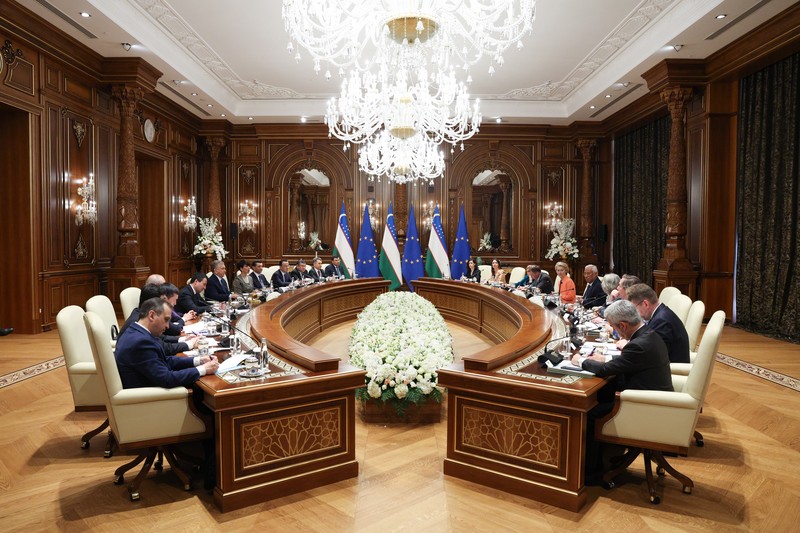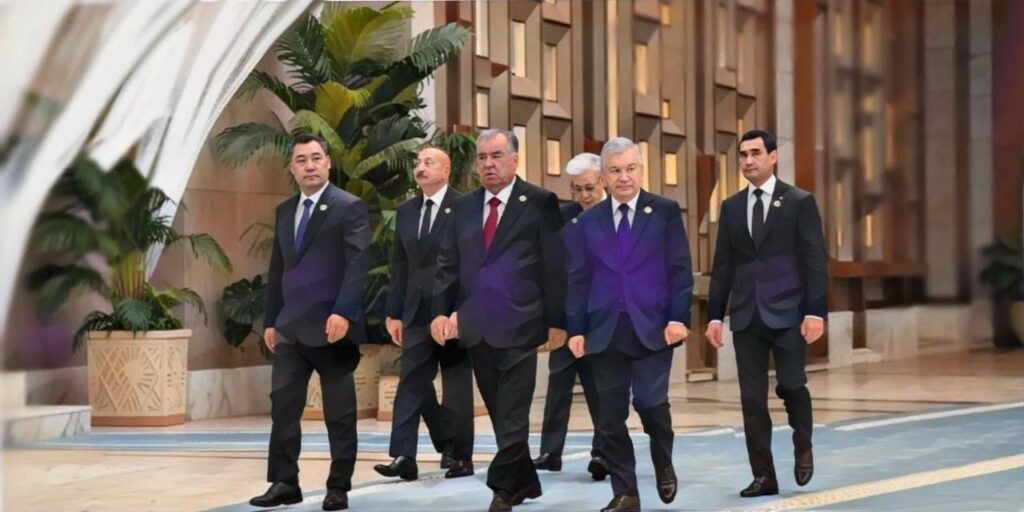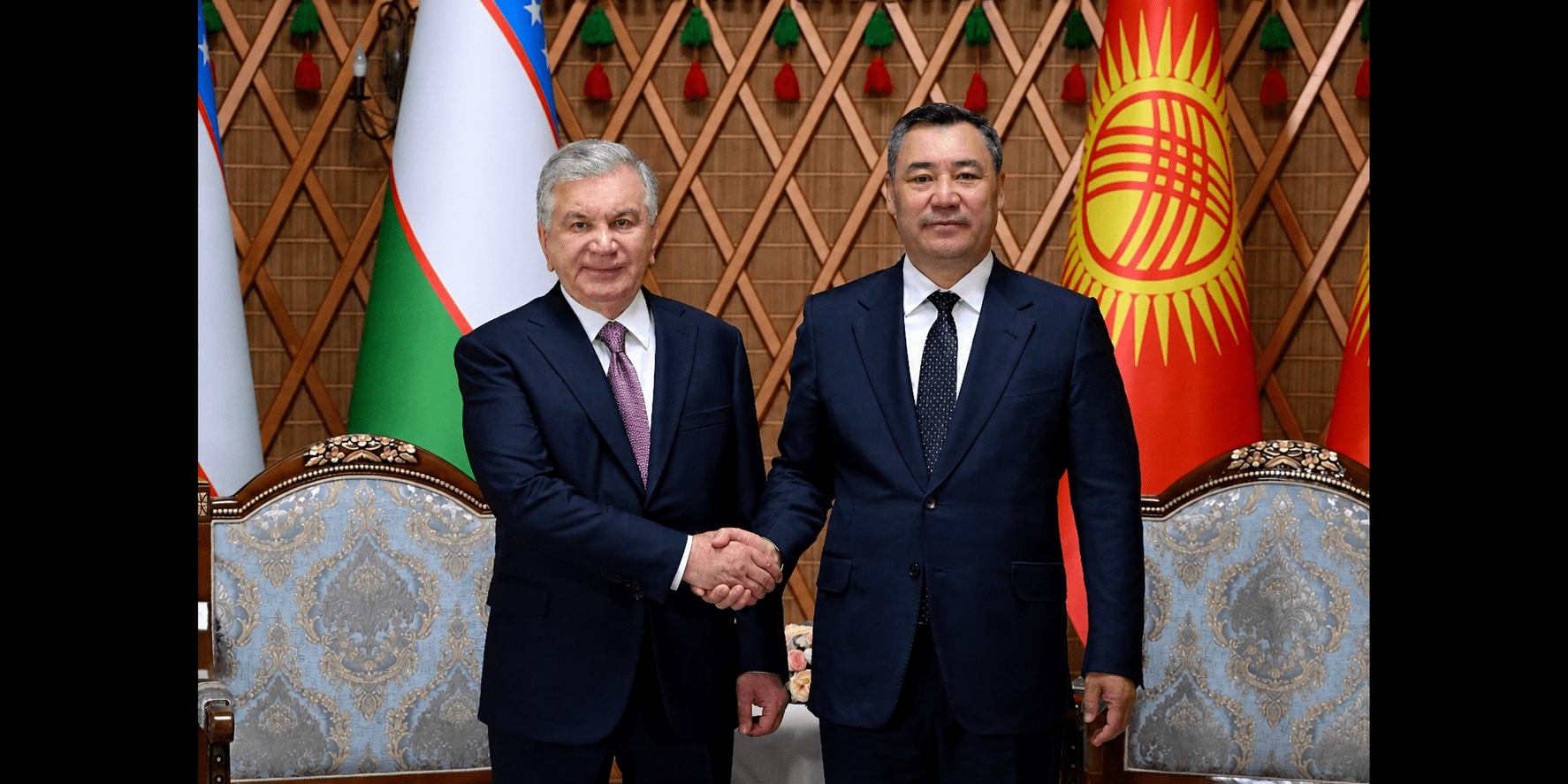
Kyrgyz President Sadyr Japarov and Uzbek President Shavkat Mirziyoyev met on July 30 on the shores of Kyrgyzstan’s Lake Issyk-Kul, in Cholpon Ata, to sign the Treaty on Allied Relations. It was much more than business as usual.
In their press conference, the leaders largely set aside the diplomatic boilerplate and expressions of mutual approbation that usually attend such summits. Instead, the meeting focused on putting a decisive end to mutual Kyrgyz-Uzbek grievances and rivalry, opting for dialogue over confrontation, stability over tension, and partnership over the quest for primacy in their bilateral relationship.
Without ceding any of their sovereignty, they stressed that teamwork and shared responsibility—not the pursuit of great-power patronage or one-upmanship—are the surest way to advance common interests. Japarov, like Mirziyoyev, made clear that strategic-level collaboration always trumps short-term transactional gains.
One of the biggest takeaways from the Japarov–Mirziyoyev summit was the confident demeanor and optimism with which they spoke about the future of Kyrgyz-Uzbek relations. Veering from his scripted notes and speaking in Russian to the press, Mirziyoyev said: “What an atmosphere we have today [here in Kyrgyzstan]. Look at what we’re doing today— we’re making history. This alliance — all of this will remain in history forever and ever.” Friendship, mutual respect, and hard work will produce “dynamic development” and “steady economic growth,” leading to “the well-being of peoples.”
Business Development and Ahead of Schedule
Once dismissed as an engineer’s pipedream or a financier’s nightmare, Japarov and Mirziyoyev said they’re staying the course on building strategic connectivity, energy, and water infrastructure, singling out the China–Kyrgyzstan–Uzbekistan railway and the Kambarata-1 Hydropower Plant (HPP), projects that some considered unrealistic.
The leaders made it plain that this railway will deliver huge benefits. As Mirziyoyev put it: “We will work together non-stop to develop trade and logistics infrastructure along this railway route.”
Beyond offering transit times faster than the northern routes, the China–Kyrgyzstan–Uzbekistan railway will boost tourism and bring Kyrgyzstan and Uzbekistan hundreds of millions of dollars in transit revenue. Most importantly, it will unlock untapped economic resources, fueling new jobs, businesses, and logistics hubs along the corridor.
After the Japarov-Mirziyoyev meetings, The Times of Central Asia spoke with Akramjon Nematov, First Deputy Director of Uzbekistan’s Institute for Strategic and Regional Studies. Having been on site, he noted that the numbers and progress on the ground speak louder than any words or communiqués: “Construction is active at 83 of 107 planned sites on the Kyrgyz line, with over 10,000 workers and 7,000 units of heavy machinery deployed. Crews are drilling 26 tunnels through the Tian Shan, with over 13.5 kilometers of the main tunnel already cut, while 38 of 50 bridges are underway. The pace is staggering. I’ve watched this railway move Kyrgyz-Uzbek relations from friction to cooperation – and I measure progress not in words, but in cubic meters of earth moved.”
China has committed to supplying most of the capital and engineering capacity. The project carries a total capitalization of roughly $4.7 billion, structured as a $2.3 billion, 35-year debt tranche from China—extended directly to the special purpose joint venture and serviced from project cash flows—alongside a matching $2.3 billion equity contribution. China holds 51% of the equity, with Kyrgyzstan and Uzbekistan each holding a 24.5% stake.
Nematov explains that “Uzbekistan and Kyrgyzstan’s relationship with China is built on a shared pursuit of mutually beneficial outcomes.”
Open.kg reports that, following his meeting with Mirziyoyev, Japarov revealed in Bishkek on August 13 that Moscow has accepted the necessity of the China–Kyrgyzstan–Uzbekistan railway project. That may surprise some observers, but Kyrgyzstan and Uzbekistan, as longtime practitioners of a clear-eyed, non-ideological, multi-vector foreign policy, have a realistic sense of what Moscow is about.
As Japarov put it, the signing of the Treaty on Allied Relations is “a historic decision” that “cements the level of trust we have achieved, gives our relations a new political and legal foundation, and opens a long-term agenda for joint development.”
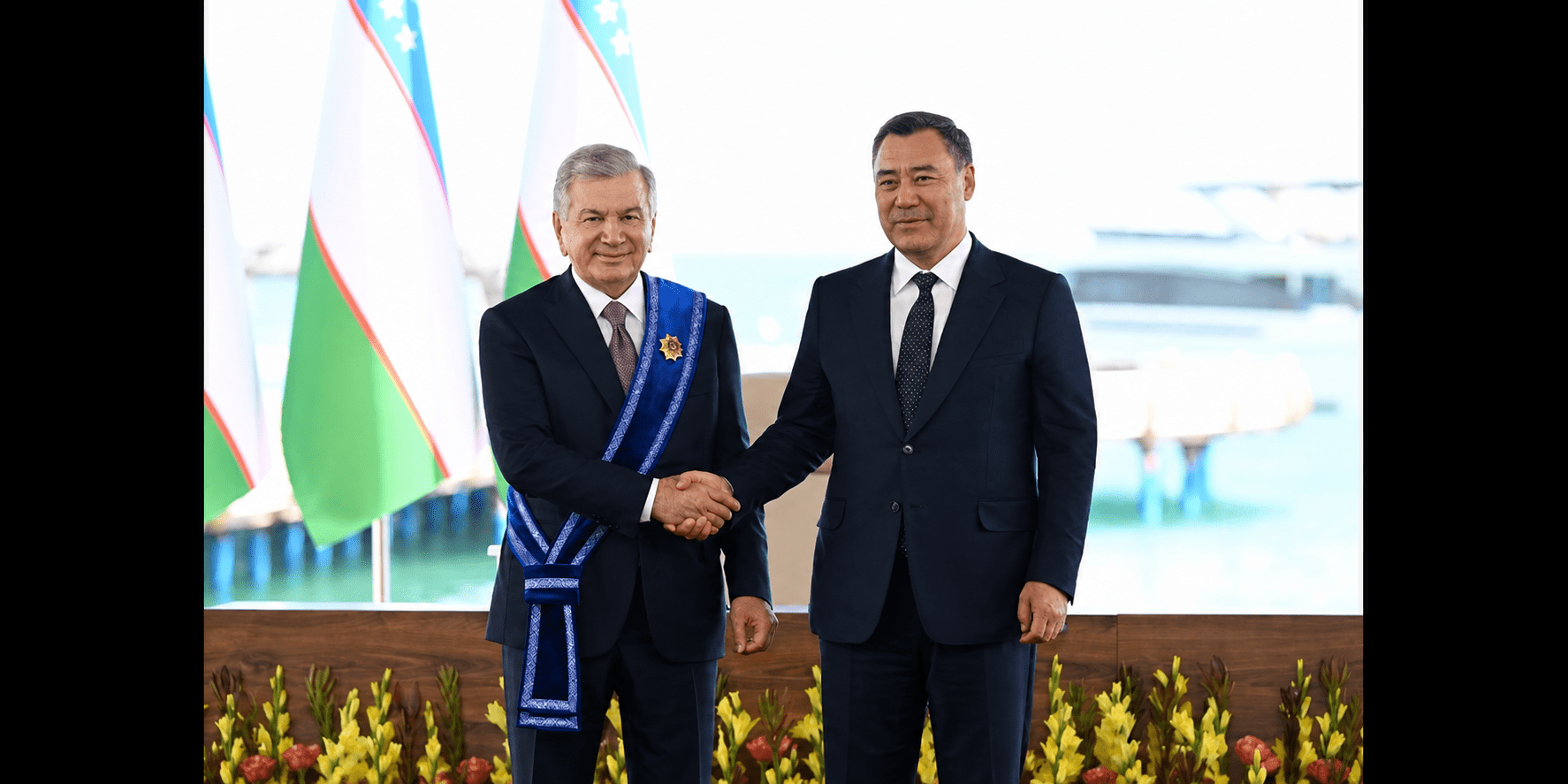
Image: Office of the President of Uzbekistan
After Japarov awarded the Order of Manas to the President of Uzbekistan, Mirziyoyev stated that, “Years of effort, grounded in mutual goodwill, have allowed us to resolve our issues. We have pursued the highest level of diplomacy, and we’ve elevated our cooperation to an alliance. What does this tell us? That we’ve gone through many stages of hard, difficult work, and now we’ve achieved the goal of truly being allies.” That’s what smart diplomacy is.
Kyrgyzstan and Uzbekistan aren’t choosing sides—they’re choosing each other, leaving Great Game thinking to those who have trouble thinking otherwise. For this reason, the China–Kyrgyzstan–Uzbekistan railway project is bound to continue to move forward, barring force majeure and external meddling.
The views expressed in this article are those of the author and do not necessarily reflect the official policy or position of the publication, its affiliates, or any other organizations mentioned.