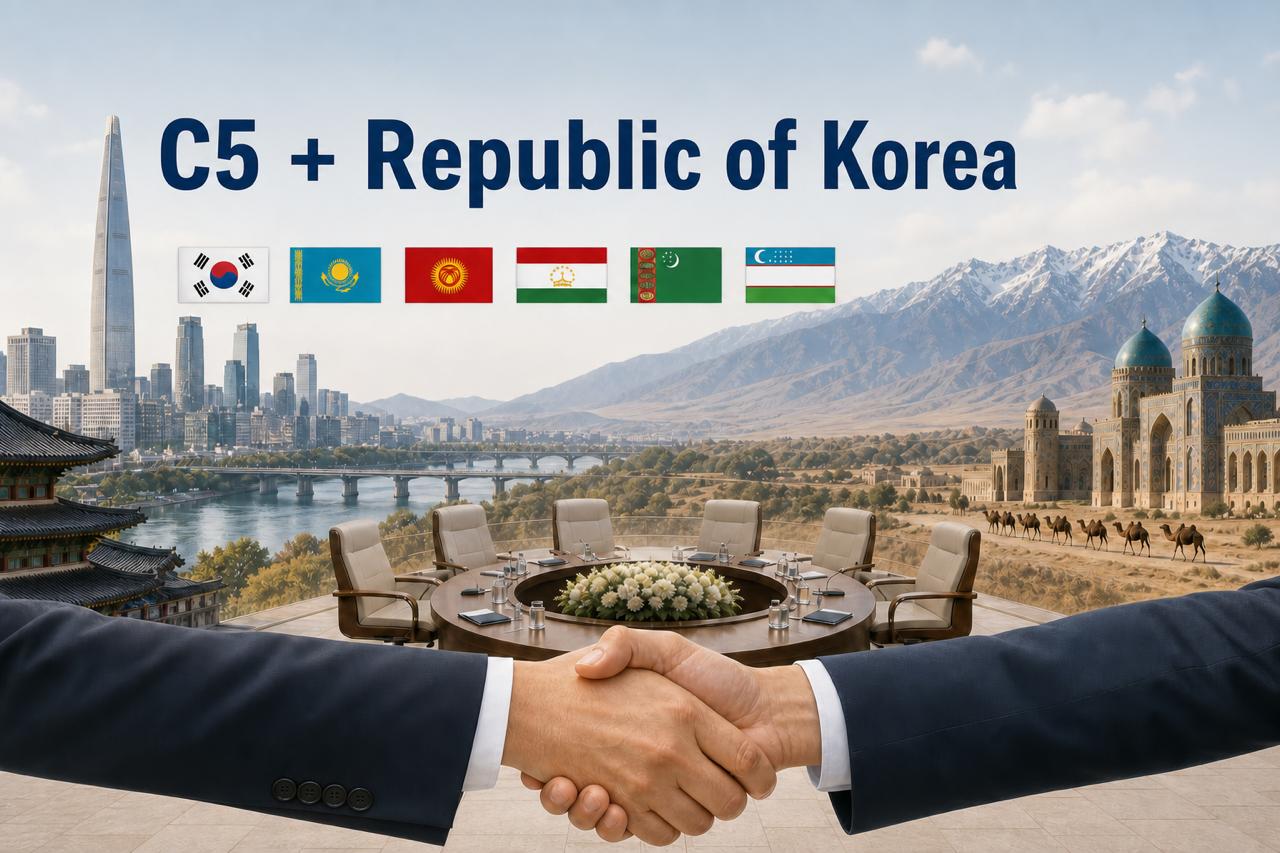
The first summit of Central Asian and Republic of Korea leaders will take place in Seoul on September 16-17. Behind the diplomatic novelty of the meeting is a highly practical agenda: South Korea is seeking more resilient sources of critical minerals and new manufacturing partnerships, while Central Asian countries are looking for technologies and investment to process raw materials within the region.
The summit continues a trend that has taken shape in recent years. Central Asia is building relations with major external partners through regional formats while preserving national sovereignty and avoiding the creation of supranational institutions. This approach is already being used in relations with the European Union, China, the Gulf states, Japan, and India.
Relations with Seoul have long developed along a similar model. The Central Asia – Republic of Korea Cooperation Forum has existed since 2007, but meetings have so far taken place below the level of heads of state. The September summit will elevate this mechanism to the presidential level for the first time.
Preparations have been underway for several months. Meetings between representatives of the five Central Asian countries and the Republic of Korea have focused on industrial cooperation, supply chains, critical minerals, artificial intelligence, and digital manufacturing. South Korea’s Ministry of Trade, Industry and Resources has also proposed establishing a regular C5+Korea Industry Ministers’ Meeting. A business summit is expected to take place in Seoul alongside the leaders’ summit.
For South Korea, interest in the region is closely tied to the structure of its own economy. The country is a major producer of semiconductors, batteries, automobiles, and electronics, but depends on imports for many types of mineral resources. Central Asia has globally significant reserves and production of uranium, chromite, and antimony, as well as substantial copper resources.
The Korean government already describes Central Asia as an important partner in strengthening strategic mineral supply chains. In December 2025, Korea’s Ministry of Trade, Industry and Resources identified critical minerals, energy, and industrial projects among the main areas for cooperation with the region.
Preparations for the summit show that Seoul is looking for specific projects in individual countries. With Tajikistan, discussions focus on the country’s gold, silver, and antimony resources. The first Korea-Tajikistan Minerals Forum was held in Seoul in August. With Kyrgyzstan, Seoul is discussing cooperation on antimony and tungsten.
With Uzbekistan, talks cover critical minerals, artificial intelligence, digital manufacturing, and industrial complexes. At a roundtable in June, Korean companies operating in Uzbekistan raised concerns with South Korean officials over investment conditions, permits and approvals, and infrastructure.
For Kazakhstan, one of the central issues is also the shift from supplying raw materials toward processing them domestically. Kazakhstan’s Deputy Foreign Minister Arman Isagaliyev told The Times of Central Asia that digitalization and artificial intelligence, industrial cooperation, critical minerals, and green energy could become new drivers of cooperation.
“We see significant potential in introducing advanced Korean technologies and digital solutions in industry, energy, transport, and urban management,” Isagaliyev said.
According to him, cooperation on critical minerals should extend into deeper stages of production.
“In particular, in the field of critical minerals, it is important to develop cooperation in deep processing and the production of high-value-added products. This will create a foundation for sustainable supply chains linking Central Asia and the Republic of Korea, and will allow us to take our partnership to a qualitatively new level,” the deputy minister said.
This approach is consistent with a debate underway in South Korea itself. At events devoted to preparations for the summit, experts have called for moving beyond simply purchasing resources and toward joint processing, localized production, and technology value chains within Central Asia. Potential instruments include joint investment funds, industrial sites, and projects involving private businesses.
Relations between Kazakhstan and the Republic of Korea also have a distinct historical and humanitarian foundation. Following the Soviet deportation of ethnic Koreans from the Russian Far East in 1937, Kazakhstan received around 100,000 people. The Korean community went on to become one of the country’s prominent diasporas.
These ties are gaining a new practical dimension. In August, Kazakhstan was included in South Korea’s Employment Permit System (EPS), which provides regulated access for foreign workers to the Republic of Korea’s labor market. Organized recruitment of workers from Kazakhstan is expected to begin once the necessary procedures have been completed.
The question of how relevant South Korea’s experience is for Central Asia extends beyond individual investments. Professor German Kim, one of the founders of the school of Korean studies in Central Asia and director of the Institute for Asian Studies, told TCA that South Korea’s economic transformation resulted from a combination of political, international, economic, social, and cultural factors.
After the Korean War, the country pursued industrialization, exports, support for major national companies, and the development of human capital. Kim argues, however, that this model cannot simply be transplanted to modern Kazakhstan: the conditions under which South Korea pursued its rapid modernization were substantially different.
“Kazakhstan should therefore study not so much the Korean model of the past as the modern mechanisms for supporting talented young people, startups, venture capital, and technology entrepreneurship,” Kim said. “The most important lesson from Korea is the state’s ability to create conditions in which education, entrepreneurial initiative, and technology become drivers of development,” he added.
Kim also sees potential for expertise to flow in the opposite direction. In some areas of digitalization and financial services, Kazakhstan has accumulated experience of its own that could potentially be of interest to the Republic of Korea. This broadens the model of cooperation beyond the traditional formula of “Korean technology in exchange for Central Asian raw materials.”
That will be one of the central questions at the first summit. South Korea needs reliable supply chains and new industrial partners. Central Asia is interested in investment, technology, and processing raw materials within the region.
Preparations for the meeting show that the sides have already identified several specific areas – critical minerals, industry, artificial intelligence, energy, and supply chains for discussion. The outcome of the summit will depend on how many of these areas translate into projects, financing, and implementation timelines.
For Central Asia, the meeting will also be another test of regional coordination. The five countries are increasingly engaging major external players through a common format. The Seoul summit will show whether this approach gives the region greater leverage to secure joint processing, investment, and technology transfer rather than predominantly raw-material-based cooperation.