NVIDIA is expanding its partnerships in Kazakhstan as the country draws on its energy resources, engineering talent, and industrial base to develop AI computing facilities and deploy advanced technology in mining, manufacturing, robotics, and other industries. Kazakhtelecom has already installed NVIDIA processors, while much larger projects involving Firebird and Freedom Holding are under development.
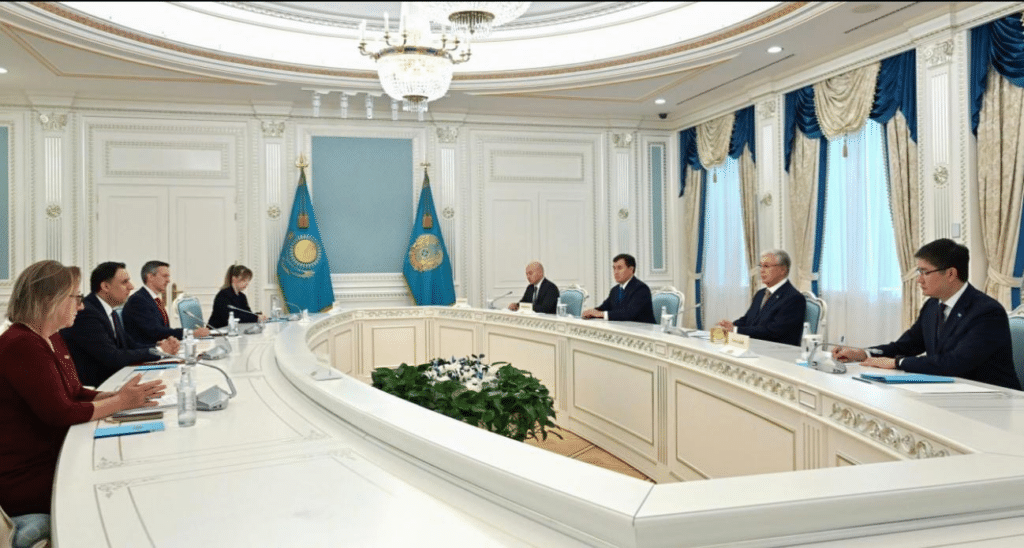
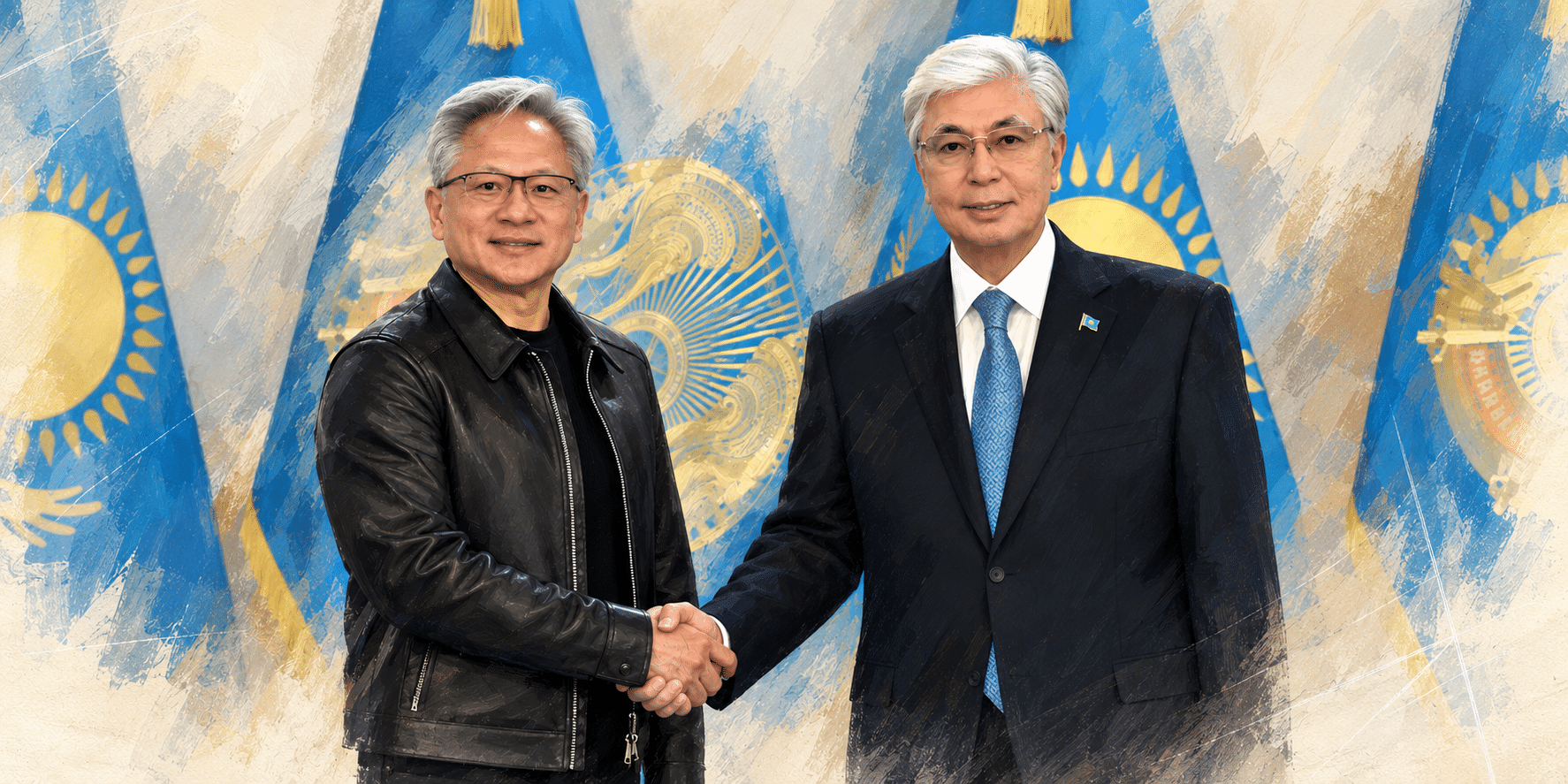
On October 23, NVIDIA founder and CEO Jensen Huang made his first visit to Kazakhstan, at the invitation of Deputy Prime Minister Zhaslan Madiyev. Huang met President Kassym-Jomart Tokayev and discussed computing investment, robotics, and technology development with government and business leaders.
“I commend you for declaring your nation an AI nation,” Huang told Tokayev during their meeting at the Akorda presidential palace.
Tokayev described AI and digitalization as national priorities, noting that 2026 had been declared the Year of Digitalization and Artificial Intelligence. He said Huang’s visit would strengthen cooperation with NVIDIA and welcomed its partnership with Higgsfield, a San Francisco-based AI video and image-generation company co-founded by Kazakh entrepreneur Yerzat Dulat.
Huang highlighted partnerships with Kazakhtelecom and Firebird AI KZ and proposed developing Kazakhstan as a global hub for physical AI. Tokayev awarded Huang the Order of Dostyk, First Class, a senior state honor also conferred on former Singaporean Prime Minister Lee Hsien Loong and Italian President Sergio Mattarella.
Robotics and Industrial AI
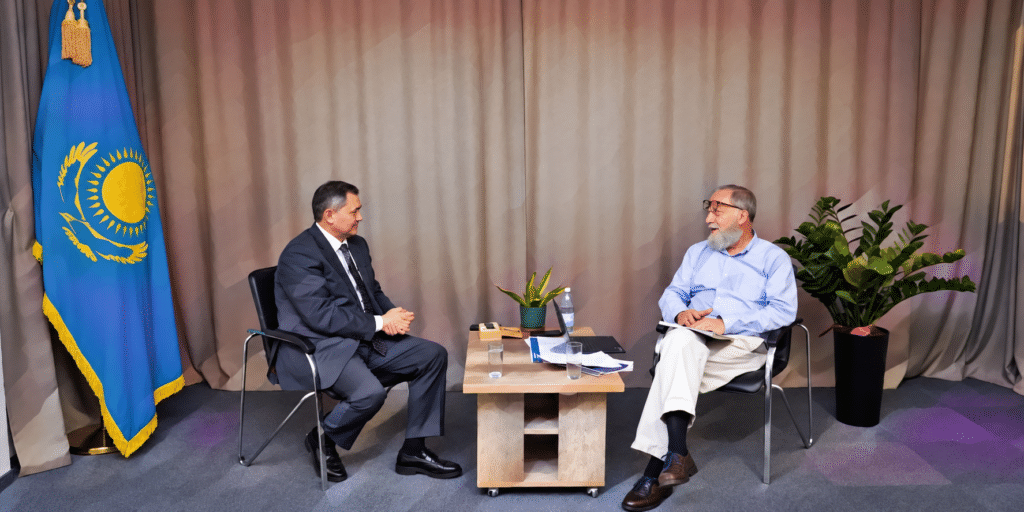
At Astana’s alem.ai center, Huang joined Deputy Prime Minister and Minister of Artificial Intelligence and Digital Development Zhaslan Madiyev for a fireside discussion on the country’s AI strategy.
Madiyev said Kazakhstan’s energy resources, industrial base, and engineers could support the development of physical AI, which enables robots and autonomous machines to operate in the real world. He said Kazakhstan wanted to test and deploy these systems in industrial settings and build companies capable of competing internationally.
In an earlier TCA interview, Madiyev said operational data from Kazakhstan’s mines and factories could be used to develop industrial AI systems.
“Instead of just exporting energy, in the future, you could transform energy into intelligence and export intelligence,” Huang said. Madiyev also emphasized AI that understands the Kazakh language and cultural context.
Freedom Holding presented plans for digital replicas of Almaty and Astana that could be used to train and test autonomous robots in simulated city environments using NVIDIA technology.
Separately, inDrive, Pony.ai, and NVIDIA signed a memorandum of understanding to explore autonomous ride-hailing in Kazakhstan. Astana is the proposed first market, subject to feasibility assessments and an agreement with the Kazakh government.
AI Computing Infrastructure
Freedom Holding CEO Timur Turlov met Huang at alem.ai to discuss the company’s infrastructure plans. Turlov said Freedom was placing an order for its first NVIDIA B300 computing cluster, with a public GPU cloud for businesses and developers planned for 2027.
The Turlov-backed Akashi data center campus in Astana is under construction, with a planned capacity of up to 100 megawatts and first-phase commercial operations scheduled for 2027. On October 19, the Eurasian Development Bank announced that it had signed an agreement with AKASHI Data Center PLC to provide $31.2 million in project financing.
In November 2025, Freedom announced plans for a $2 billion sovereign AI hub with Kazakhstan’s AI ministry. Under the proposal, described as nonbinding in the company’s August 2026 filing, Freedom would serve as the principal financing and implementation partner.
Kazakhtelecom CEO Bagdat Musin presented Data Center Valley in Ekibastuz to Huang, outlining the project’s infrastructure and power supply.
According to NVIDIA, Kazakhtelecom has deployed 400 H200 and 480 B300 graphics processing units in Astana and Almaty.
Firebird signed an investment agreement with Kazakhstan at a ceremony at Akorda attended by co-founder and CEO Razmig Hovaghimian. NVIDIA said Firebird had secured a U.S. export license for 45,000 Grace Blackwell GPUs. Its first phase is under construction with Kazakhtelecom at Data Center Valley, targeting a commercial launch in the third quarter of 2027.
Under the previously reported arrangement, Kazakhtelecom would provide power, cooling, and telecommunications infrastructure, while Firebird’s Kazakh unit would finance the computing hardware and related systems.
Higgsfield and AI Education
Higgsfield announced on October 23 that NVIDIA and investment firm TCV had joined an extension of its Series B funding round. The announcement did not disclose the size of their investments.
The financing follows an August round that raised $400 million at a $5.4 billion valuation.
During the visit, Huang met Dulat. The company’s other co-founders are CEO Alex Mashrabov and Mahi de Silva. Higgsfield maintains ties to Kazakhstan through Astana Hub.
ARC Aero presented its work in autonomous aviation, while QazTWIN and Astana Dynamics showcased industrial digital twins and robotic inspection. He also saw projects from DeepInfra in cloud computing, MiraiTech in wearable technology, and Blockchair in blockchain analytics.
Huang met TUMO Astana and Tomorrow School students, as well as winners of the HackAlem AI competition. Science and Higher Education Minister Sayasat Nurbek participated in the Tomorrow School meeting, where Huang was briefed on Qazaq AI Research University and its AI training initiatives.
In a recent TCA interview, Nurbek emphasized teaching students to use AI while preserving independent judgment and critical thinking.
Astana Hub CEO Magzhan Madiyev presented Startup City, a digital platform bringing together startup support, education, laboratories, venture financing, and international partnerships. The visit concluded Kazakhstan’s AI Month program.