Kazakhstan has formally asked Russia to restore oil deliveries to Germany through the Druzhba pipeline after a six-month suspension. Russia suspended transit on May 1, citing unspecified technical constraints. Energy Minister Yerlan Akkenzhenov said on November 4 that he had delivered the request personally.
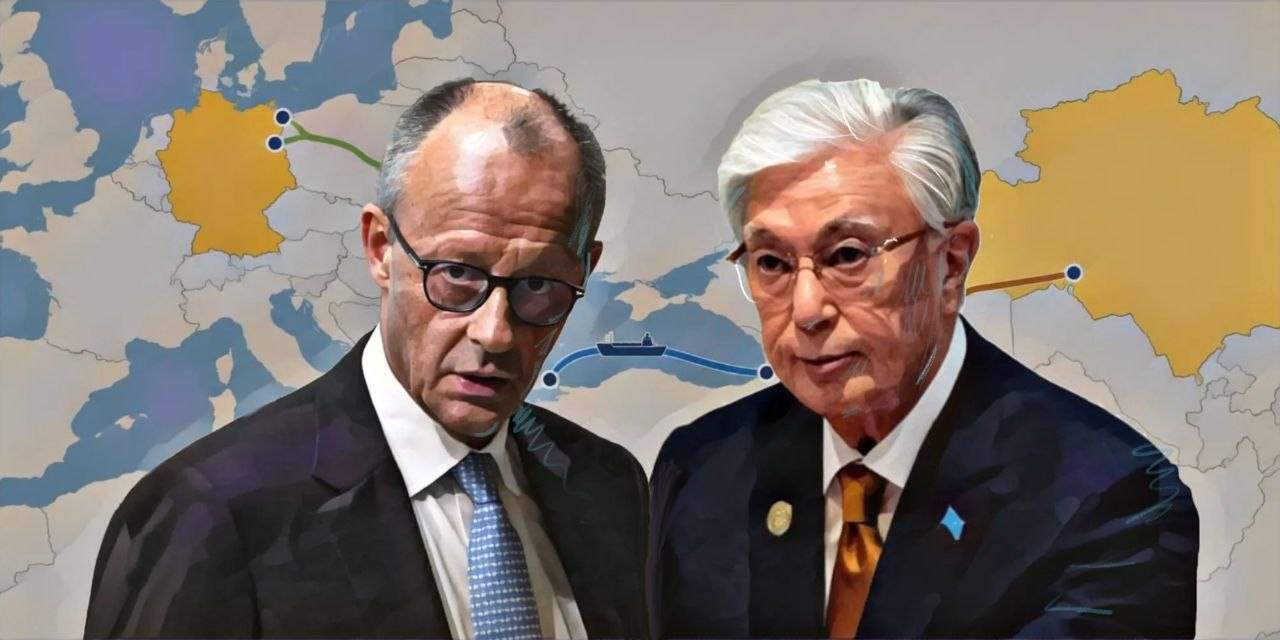
President Kassym-Jomart Tokayev and Chancellor Friedrich Merz had discussed increasing Kazakhstan’s oil supplies to Germany at their September 29 meeting in Berlin. Merz described Kazakhstani crude as a means of diversifying supplies after Germany stopped buying Russian oil. On November 6, Kazakhstan’s Energy Ministry said no deliveries to Germany were planned via Druzhba for November or December, but resumption could be considered if the unspecified technical restrictions were resolved and transport conditions secured.
Germany imported about 10.3 million metric tons of crude from Kazakhstan in 2025, according to UN Comtrade data. Kazakhstan’s Energy Ministry puts deliveries through Druzhba to the PCK refinery at Schwedt at 2.1 million tons that year. Druzhba therefore accounts for only part of Germany’s oil trade with Kazakhstan. Restoring Druzhba deliveries and developing additional routes would strengthen Kazakhstan’s access to European markets and give German buyers more options during disruptions. That shared interest gives Berlin a reason to consider helping finance the capacity needed to make this trade more reliable.
Purchase Commitments and Transport Access
In October 2025, KazMunayGas (KMG) extended its supply agreement with Rosneft Deutschland through the end of 2026. The contract provided for monthly deliveries from Karachaganak Petroleum Operating resources to rise from 100,000 to 130,000 tons; KMG also reported supplies from other fields. Russia’s Druzhba suspension followed in May 2026, despite that purchasing commitment. Any additional purchase commitments by German buyers would need corresponding arrangements for transit.
Kazakhstani oil also travels across the Caspian Sea to Baku and onward through the Baku–Tbilisi–Ceyhan (BTC) pipeline. KMG’s annual report identifies work with Azerbaijan’s state oil company, SOCAR, to reduce tariffs, make charges transparent, and assess how Kazakhstani crude affects the Azeri Light blend. Renewed talks on higher volumes were reported in November. Negotiations over tariffs and crude quality would condition the delivered price of Kazakhstani oil for German buyers.
Longer purchase agreements could support investment if producers undertake to supply the oil and if operators reserve the capacity to carry it. Lenders could assess whether the expected revenues would cover the facilities’ costs and how long repayment would take. Contracts would then have to establish who pays for unused capacity and bears losses from interrupted deliveries.
The German government’s trusteeship over Rosneft Deutschland and RN Refining & Marketing, exercised through the Bundesnetzagentur, was extended indefinitely in February 2026. This gives Berlin a role on the purchasing side: it could encourage the companies to negotiate longer supply commitments with Kazakhstani producers. It could bring not only buyers and producers but also operators into these negotiations.
At the receiving end, Germany has budgeted €400 million for 2025–2029 to improve the Rostock–Schwedt pipeline and the port of Rostock and make the adaptations needed to process non-Russian crudes from Kazakhstan and other suppliers. Nevertheless, the Finance Ministry’s June 2026 monitoring report stated that no funds had been spent under the program in 2025. It also noted delays in the European Commission’s process for approving state aid.
Schwedt’s access to Polish pipeline capacity depends on other refineries’ requirements and the terms agreed with the operators. In August, the German government estimated the capacity of Poland’s Gdańsk–Płock pipeline at about 30 million tons annually. Actual utilization figures remain commercially confidential. The line supplies Płock and connects to the Druzhba network serving the refineries at Schwedt, on the border with Poland, and Leuna, in the former East Germany. Berlin could help negotiate access with Warsaw, but securing capacity at the European end would still leave Kazakhstan’s export constraints to be resolved.
The Limits of Public Financing
KfW IPEX-Bank, the international project and export finance subsidiary of Germany’s state-owned development bank Kreditanstalt für Wiederaufbau, offers suppliers working capital through pre-export financing against future commodity revenues. KfW’s September 2026 guidelines permit such trade finance to include crude oil sales within portfolio limits. However, its ordinary financing rules exclude crude oil pipelines and terminals.
Germany’s untied loan guarantee scheme applies separate criteria governing which raw materials may receive support. Crude oil is normally excluded here because Germany considers supplies obtainable through a functioning global market without additional state backing to secure access. The scheme therefore already takes the availability of replacement crude into account when assessing the need for state backing.
The EU’s taxonomy sets criteria for determining which economic activities qualify as environmentally sustainable. Activities outside that classification can still receive financing. Germany has drawn on the taxonomy’s criteria, alongside International Energy Agency scenarios, to develop its own rules governing eligibility for export guarantees. The EU’s Trans-European Networks for Energy (TEN-E) framework separately excludes new oil infrastructure from its own support arrangements.
If financial support qualifies as state aid, Germany would normally have to notify the European Commission and obtain approval before implementation, unless an applicable exemption or existing authorization covers the measure. Selective advantages granted to companies through state resources can constitute state aid if they distort or threaten to distort competition and affect trade between EU member states. Support provided on ordinary market terms may not constitute aid.
KfW’s guidelines permit exceptions to its ordinary financing restrictions for certain federally mandated transactions. They also allow exceptions for financing explicitly requested by the responsible ministry on behalf of the federal government. Such financing would remain subject to the EU requirements applicable to the transaction.
The Case for Public Support
The case for German support rests on the value of additional transport capacity during disruptions. Kazakhstani oil shipped across the Caspian Sea to Baku and through BTC to Ceyhan could reach Gdańsk or Rostock by tanker, then continue by pipeline to Schwedt. This would provide an additional supply route without transiting Russian territory. Kazakhstani oil transported via the Caspian Pipeline Consortium route and then by tanker from Novorossiysk to those ports would still rely on Russian transit.
On October 28, PCK said replacement crude supplies had been secured despite the interruption of Druzhba deliveries from Kazakhstan. Management reported that the refinery was operating above 86% of capacity. The cost of the replacement oil was not disclosed.
Refiners like PCK need to weigh any reduced risk of disruption against potentially higher delivery costs and the length of purchase commitments. Long-term contracts could support investment but limit a refinery’s freedom to switch suppliers. Financial guarantees could cover specified losses or borrowing risks, but they cannot ensure physical delivery. Buyers would also have to examine the vulnerabilities of any alternative supply route.
A route that remained open during disruptions elsewhere could improve European supply security, even if refiners normally had less expensive purchasing options. Such a route could also serve European buyers outside Germany. Berlin could seek joint commitments under which buyers reserved transport capacity while participating governments shared the cost of making it available. Financial contributions could be linked to that reserved capacity, and agreements could specify access rights to it during disruptions.
Germany could therefore encourage longer purchase commitments, help negotiate transit access, or support a specific transport investment where financing rules permitted. Commitments from companies and other participating governments would establish how much of the cost and risk they were prepared to bear. Berlin would then have to judge whether more secure supplies for German buyers and more reliable market access for Kazakhstan justified its own financial exposure, taking account of the alternative supplies available and the disruption risks remaining along the proposed route.