Almaty long combined Kazakhstan’s political and commercial functions and established itself as Central Asia’s leading business center. After Astana became Kazakhstan’s capital, the two cities developed increasingly complementary roles, with Almaty remaining the region’s largest business and financial hub while Astana accumulated political, institutional and corporate weight. Kazakhstan’s updated figures put Astana’s growth at about 10% and Almaty’s at about 5%. Together, the two cities generated roughly $107 billion in 2025. Together, they have become a two-city engine anchoring much of Central Asia’s commerce.
Almaty and Astana benefit from an economic scale unmatched elsewhere in Central Asia. Kazakhstan alone accounts for more than half of the region’s GDP and roughly two-thirds of its inward FDI stock, according to TCA’s Central Asia Balance Sheet. That scale helps generate the fiscal resources needed to build and maintain the municipal infrastructure that supports business activity.
Kazakhstan also has Central Asia’s most developed capital markets. The combination of the Kazakhstan Stock Exchange (KASE) in Almaty and the Astana International Financial Centre (AIFC) and Astana International Exchange (AIX) in Astana gives companies access to equity, debt, institutional investors and financial infrastructure at a scale no other market in the region currently matches. Kazakhstan is also the only Central Asian country with an investment-grade sovereign rating, lowering the country-risk premium and helping reduce financing costs for companies and projects relative to lower-rated regional markets.
These advantages have been reinforced over decades. Almaty and Astana have long served as regional bases for major global companies, creating an established ecosystem of corporate management, finance, professional services and skilled labor. That track record, in turn, strengthens their ability to attract further investment and regional headquarters.
Tashkent and Bishkek are also growing rapidly
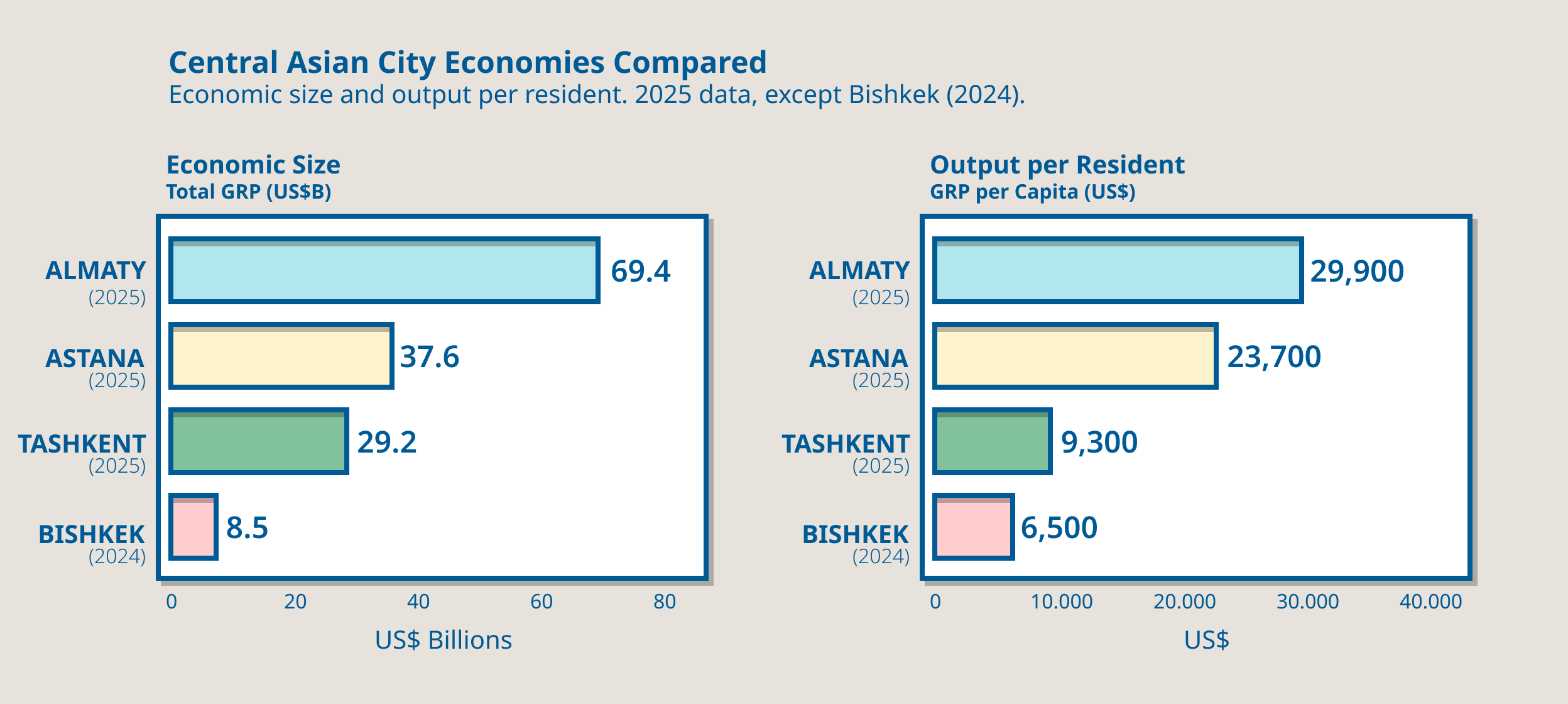
Then there is Tashkent. Uzbekistan’s political and commercial capital had an economy of about $29 billion in 2025, about 40% the size of Almaty’s and three-quarters that of Astana. Tashkent has also experienced rapid growth, with its economy growing by 11.3% in real terms in 2025, according to preliminary national figures.
Tashkent benefits from Uzbekistan’s demographic scale. The country’s population is almost twice Kazakhstan’s, giving its capital access to a much larger domestic market and labor pool. But that scale also raises the need for sustained job creation and continued investment in housing and infrastructure. If productivity and investment fail to keep pace with population growth, the demographic advantage could increasingly act as a constraint rather than help Tashkent close the gap with Almaty and Astana.
Almaty and Astana, meanwhile, generate substantially more economic output per resident. In 2025, Gross Regional Product (GRP) per capita was approximately $29,900 in Almaty and $23,700 in Astana, compared with about $9,300 in Tashkent, using reporting-year average exchange rates. These figures measure output per resident, not labor productivity, household income or living standards.
Like Tashkent, Bishkek combines the roles of political capital and principal economic center. On the reporting years used here, however, its economy is only about 30% as large. Its economy grew by 15.8% in 2024, according to Kyrgyzstan’s National Statistical Committee.
In output per resident, Bishkek also trails Tashkent. Bishkek’s per-capita GRP is about $6,500 in 2024, compared with about $9,300 for Tashkent in 2025. These figures cover different reporting years and measure economic output per resident, not labor productivity or household income.
Bishkek’s comparative advantages lie elsewhere, particularly in cost and resources. Kyrgyzstan’s 10% standard corporate profit-tax rate is below the standard rates in Kazakhstan and Uzbekistan. Its predominantly hydropower-based electricity generation provides a low-carbon energy base, with considerable potential for further development, although seasonal electricity shortages remain a constraint. Its much smaller population and economy give Bishkek a narrower domestic market and a smaller economic base from which to support infrastructure investment.
The chart below compares the GRP of the four cities, showing both total economic output and output per resident.
Note: Current-price figures are converted to US dollars at annual-average exchange rates and rounded, without adjustment for purchasing power. GRP per capita measures output per resident, not household income or labor productivity. Tashkent figures are preliminary.
Sources: Kazakhstan statistics , Uzbekistan statistics, Kyrgyzstan statistics .
Exchange rates: NBK via KTZ , Central Bank of Uzbekistan, IMF.
Can Tashkent Catch Up?
Catch-up is not simply a question of growth rates. Expanding Tashkent on the scale envisioned will require enormous amounts of capital. That capital will have to come from some combination of public funds, private investment from home and abroad, and international borrowing. Each route has constraints. At about $147 billion, Uzbekistan’s economy is less than half the size of Kazakhstan’s, its sovereign credit remains below investment grade and its capital markets are underdeveloped. Remittances rose to 14.3% of GDP in 2025, highlighting the continued importance of income earned abroad to the economy. Kazakhstan, by comparison, has a $306 billion economy, investment-grade sovereign credit and substantially larger financial and resource buffers. These are serious structural headwinds that will take many years to overcome, requiring capital-market development, labor-market reform and stronger institutions to reduce investment risk and mobilize capital on a much larger scale.
Tashkent is not on course to surpass Astana, but the gap has narrowed.
Tashkent has grown faster than Astana in recent years, but the differential narrowed sharply in 2025. Tashkent reported real GRP growth of 11.3%, compared with 10.2% for Astana, a growth differential of just 1.1 percentage points. The official figures indicate that Tashkent’s sustained recent outperformance has narrowed the relative gap, but they do not establish that such an advantage can persist long enough for the city to reach parity.
Tashkent is also expanding. Construction of New Tashkent began in 2023, with the first phase designed for 600,000 residents and the eventual city for 2 million. By 2034, 200,000 apartments are planned, alongside business, education and transport infrastructure. Residential complexes, business facilities and university campuses are already under construction.
Astana, meanwhile, is already adding substantial completed capacity. Some 2.2 million square meters of housing were completed in January–July 2026, while new transport and utility infrastructure is being built. Its master plan anticipates a population of 2.275 million by 2035, with plans for further housing, transport and infrastructure development.
In both Tashkent and Astana, the full expansion envisaged in these plans remains prospective.
Tashkent is therefore chasing a moving target. Astana’s sharp acceleration in 2025 illustrates how quickly Tashkent’s growth advantage can shrink. Closing the remaining gap would require Tashkent to sustain meaningful economic outperformance while Astana continues to expand its own economic and urban base. If that advantage fades before parity, the gap stops closing. Current city-level data therefore do not show that Tashkent is on course to overtake Astana.
Almaty is a much higher hurdle.
Tashkent’s challenge with Almaty is different. Almaty’s economy is currently more than twice as large, meaning Tashkent would need to outperform it substantially for decades to close the gap. Tashkent reported 11.3% real GRP growth in 2025, compared with Almaty’s 4.9%, a much wider differential than in the preceding years. Closing the economic-size gap would require Tashkent to sustain meaningful outperformance for decades.
Like Astana, Almaty is not standing still. Its development program and 2040 master plan envisage five key economic and urban centers, designed to spread business activity and development across the city. Revised proposals anticipate population growth to as much as 3.6 million by 2040, alongside further housing and infrastructure. Nearby Alatau City, although separately administered, is being developed as part of the wider Almaty agglomeration and could further strengthen the area’s employment, investment and economic base. Its contribution, however, sits outside the Almaty city GRP used in this comparison.
At their 2025 economic sizes, Tashkent would need to maintain an average annual relative real-GRP growth advantage of about 1.75% over Almaty for 50 years, on a compounded basis, simply to reach parity. There is little basis for assuming such an advantage could persist for that long. The OECD’s long-term economic projections likewise assume that growth in emerging-market economies slows over time as they converge with higher-income economies. If Tashkent’s advantage narrows as its economy matures, catch-up would take longer and might never occur.
Can Bishkek Overtake Tashkent?
Bishkek’s 15.8% real GRP growth in 2024 was impressive, but rapid growth from a much smaller base does not by itself establish a catch-up trajectory. Bishkek’s economy is only about 30% the size of Tashkent’s, leaving it with a relative gap broadly comparable in scale to the one Tashkent faces with Almaty, though somewhat larger. Sustained outperformance would therefore be required for many years before Bishkek could seriously challenge Tashkent’s economic scale.
Bishkek is expanding through metropolitan integration rather than a single new-city project. A 2024 administrative-territorial reform more than tripled its territory, from 12,900 to about 41,000 hectares, incorporating 24 surrounding settlements. The city has since approved a development plan through 2030, with water networks and social infrastructure already being developed in the newly incorporated areas. Its approved 2050 master plan prepares for a population approaching 2 million.
Looking forward
Almaty, Astana, Tashkent and Bishkek are all expected to expand, supported by investment, rising demand and stronger regional connections. Growth in each can create larger markets and new opportunities for the others, strengthening Central Asia as a whole.
Kazakhstan continues to build on its legacy advantages. Almaty and Astana are adding to the corporate networks, financial institutions and expertise built over decades, meaning the foundations of their economic lead are still being reinforced.
Rome was not built in a day, and neither was Kazakhstan’s business ecosystem. Central Asia’s emerging centers are rising, but so are its established leaders.