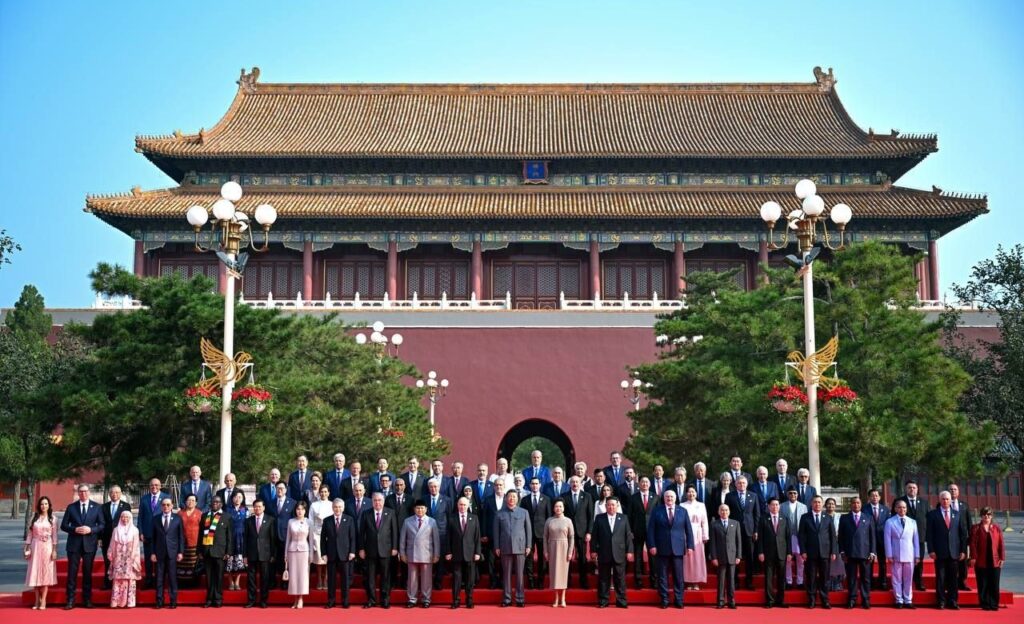
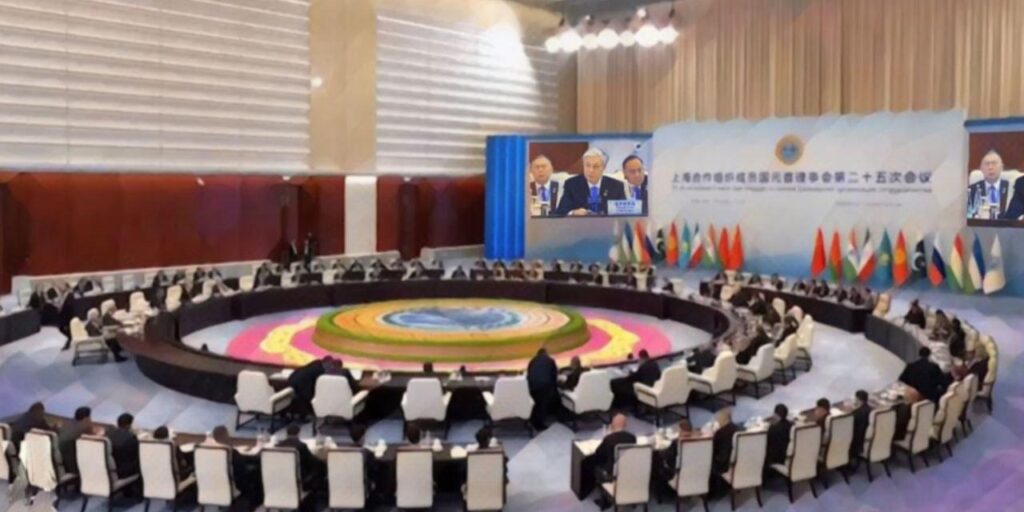
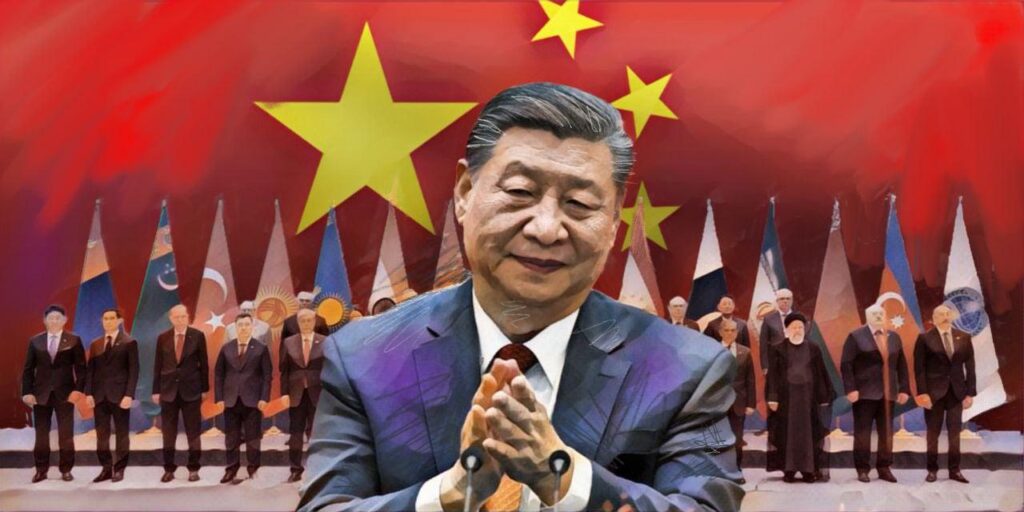
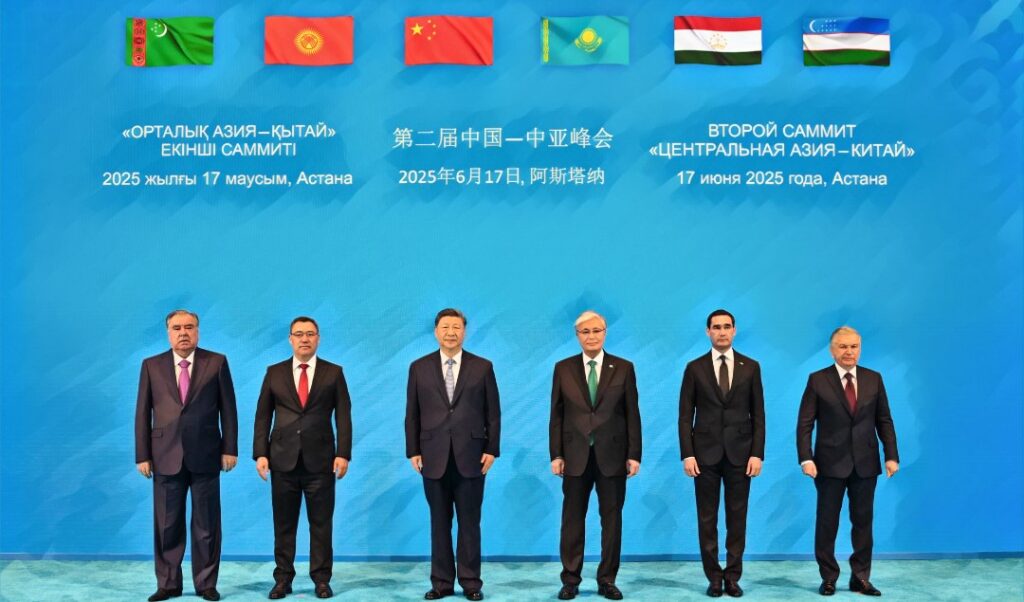
At the opening ceremony of the SCO Summit in Tianjin on August 31, Chinese President Xi Jinping, Russian President Vladimir Putin, and India’s Prime Minister Narendra Modi joined Central Asian leaders in a group photo. The Tianjin summit – China’s second time hosting the SCO and its “largest-ever” summit – was attended by all five Central Asian presidents alongside a host of key countries. In his welcome speech, Xi highlighted that the SCO now bears “greater responsibility” for safeguarding regional peace and stability, and said the summit was expected to produce a new 10-year development strategy.
Xi proposed fast-tracking an SCO development bank, pledging 2 billion yuan ($280 million) in aid plus 10 billion yuan in loans to seed the fund. Xi also urged members to oppose a “Cold War mentality” and support an inclusive, multilateral trading system in a pointed rebuke to recent U.S. tariffs.
Central Asian Leaders and Their Messages
Kazakh President Kassym-Jomart Tokayev opened the summit for his delegation, thanking Xi and praising China’s “consistent policy aimed at strengthening security, stability, economic cooperation, and cultural ties within the SCO framework.” In his address, Tokayev marked the symbolic 80th anniversaries of the end of World War II, noting the value of unity and solidarity which he said the SCO embodies. Tokayev reaffirmed Kazakhstan’s support for a multipolar world order, respect for sovereignty, and mutually beneficial trade and investment, and pledged to keep combating the “three evils” of terrorism, separatism, and extremism.
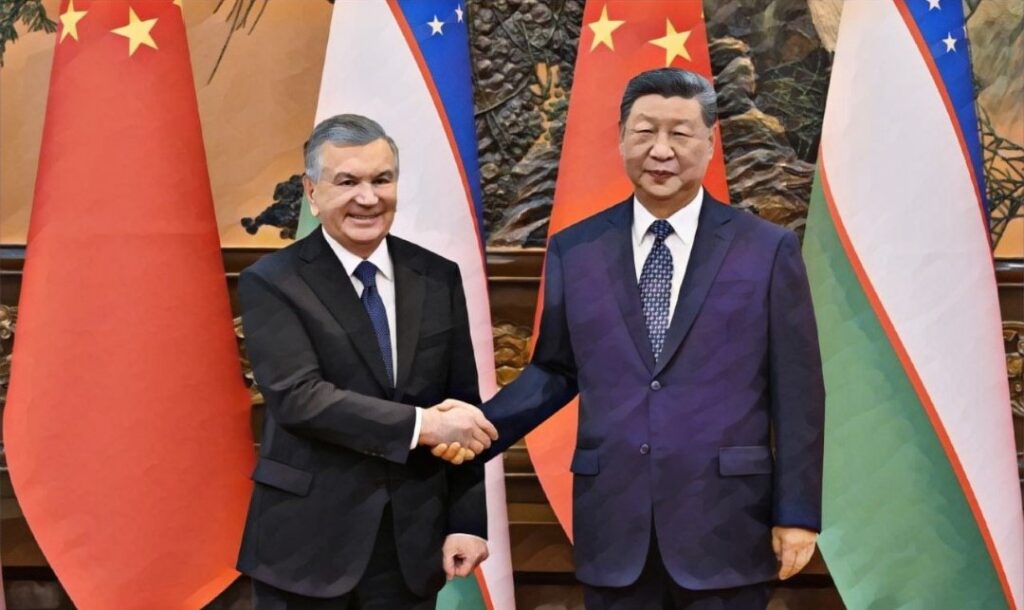
Beyond the opening remarks, Central Asian leaders used the summit to lay out their strategic priorities. Speaking at the heads-of-state meeting, President Shavkat Mirziyoyev of Uzbekistan called for further reform of SCO institutions and expansion of its dialogue partners. Mirziyoyev advocated for new cooperation mechanisms – a regional center for critical materials, a “Unified SCO Transport Space” linked to China’s Belt and Road Initiative, digital platforms, and green energy corridors – and proposed measures to boost intra-regional trade. Notably, Mirziyoyev urged the signing of an Agreement on Trade Facilitation, saying it “will give a boost to the growth of intra-regional trade within the SCO area.” In his closing remarks, he congratulated Kyrgyzstan’s Sadyr Japarov on assuming the SCO chairmanship for 2026, setting up the next summit.
Tajik President Emomali Rahmon did not address the leaders’ meeting, but in a pre-summit interview, he highlighted China’s role in the SCO, crediting China with significant investment in Tajik infrastructure and energy, and welcoming Beijing’s proposal to locate an SCO Anti-Drug Center in Dushanbe. “We are confident that the center will make tangible contributions to strengthening regional cooperation and combating illicit drug trafficking,” he stated. As a founding member, Rahmon stressed that the SCO’s top priority has long been Central Asian security and said that Tajikistan fully backs China’s Tianjin agenda, citing Beijing’s support for roads, tunnels, and power lines in Tajikistan.
The incoming 2026 chair, Sadyr Japarov of Kyrgyzstan, met with Xi on August 31, reviewing plans to deepen all-around cooperation. Xi stated that China will fully support Kyrgyzstan in taking over the rotating presidency of the SCO, while Japarov, for his part, thanked China, noting that an “amicable and close neighbor is an invaluable asset of a nation,” and pledging to back China on core issues. The two sides signed multiple bilateral agreements covering connectivity, transport, education, civil aviation, and other fields.
China and Regional Cooperation
A major theme in Tianjin was China’s deepening economic ties with Central Asia. On the sidelines, Xi and Tokayev oversaw the signing of over 20 cooperation agreements spanning energy, technology, housing, education, sports, environmental protection, and more. The deals aim to diversify trade and investment in Kazakhstan, from hydropower and chemicals to high-tech collaboration. Xi’s talks with President Japarov, meanwhile, yielded agreements on cross-border roads and renewable energy projects that tie into China’s Belt and Road connectivity strategy.
Beyond the mooted SCO development bank, China used Tianjin to roll out a new Global Governance Initiative (GGI), while Japarov backed deeper cooperation with China on clean energy, AI, and connectivity. Framed as a platform to reform multilateral institutions and promote a “more just and equitable global governance system,” the GGI is an attempt to position the SCO as a key vehicle in that role.
For the Central Asian states, deepening ties with India and Iran were also on the agenda. India’s Prime Minister Narendra Modi attended the summit – his first China visit in seven years – and held multiple bilateral talks. Addressing Modi, Xi said that China and India should be “partners, not rivals,” while Modi noted there is now an “atmosphere of peace and stability” between them, easing strains after recent trade frictions.
India also underscored its investment in Central Asia, where it is a growing trade partner of Uzbekistan and Kazakhstan. Meanwhile, Iran – now a full SCO member – was represented by President Masoud Pezeshkian. Though no new Iran-Central Asia deals have been reported, Iran’s presence reflects its long-standing ties with Tajikistan and Turkmenistan, with which it shares cultural and energy interests, respectively.
Russia’s role was also at the forefront. At the summit’s opening, Putin echoed calls for integration, for example, urging the use of national currencies in trade. Russian officials signed energy agreements with Kazakhstan and Tajikistan on the sidelines – continuing existing oil and gas ties – but official communiqués focused on global security. According to Putin, the SCO has revived “genuine multilateralism”, which, in turn, lays the “political and socio-economic groundwork for the formation of a new system of stability and security in Eurasia.”
Summit Declarations and Future Steps
By the summit’s end, the assembled leaders had approved a sweeping set of 24 documents aimed at deepening cooperation on security, economic, and cultural exchanges. A landmark joint Tianjin Declaration was issued, along with a new SCO development strategy for 2026–2035. These look to build on decisions made at the 2022 Samarkand summit and set the direction for the next decade.
Statements were also issued on current issues: commemorating the 80th anniversary of World War II’s Allied victory, and expressing unified support for an open, multilateral trading system. “The global situation remains volatile and turbulent,” Xi stated, adding in a thinly veiled reference to comments he had previously made regarding U.S. tariffs, that “We must reject bullying.” The SCO also expanded its outreach: Laos was admitted as the 15th SCO dialogue partner, underscoring the group’s move toward a Global South orientation.
Outlook: Central Asia in a Changing Order
The Tianjin summit underscored China’s diplomatic activism and Central Asia’s pivotal role. By agreeing on joint initiatives and hundreds of millions in new project funding, the summit signaled Beijing’s intent to strengthen ties in Central Asia amid global shifts.
For the region, the outcome is generally positive: Central Asian states secured closer trade and infrastructure ties with China as the SCO widens. Kazakhstan and Uzbekistan, in particular, were in the spotlight for securing new deals, while Kyrgyzstan is gearing up to host the 2026 SCO summit, aiming to build on the Tianjin agenda. The summit also cemented the SCO as a platform for Eurasian cooperation that, while once centered on security, is now increasingly pursuing economic development, reflecting its Central Asian members’ priorities.