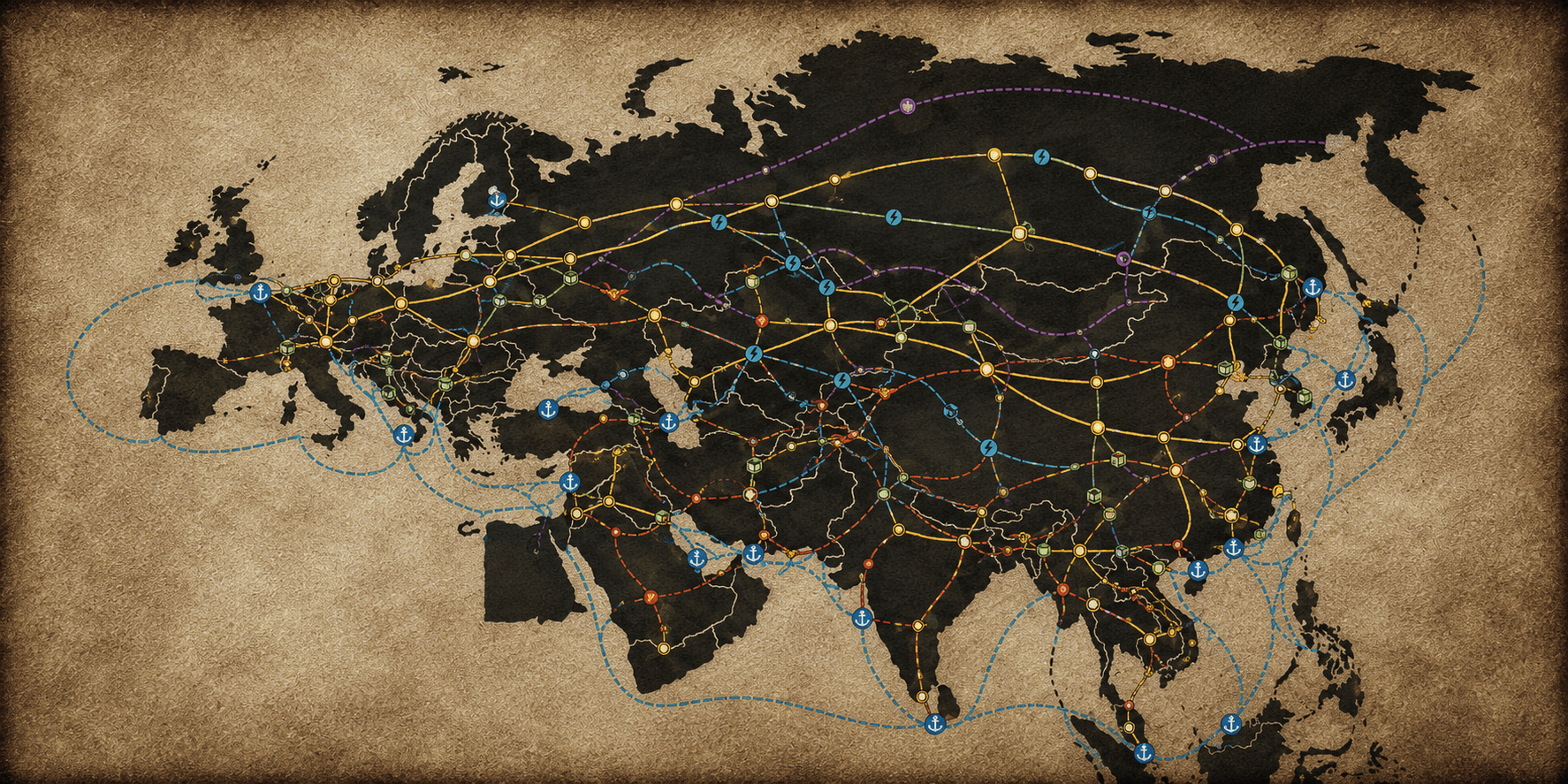
Across Eurasia, new transport corridors are usually described as instruments of rivalry: routes to bypass Russia, ports to outflank competitors, or rail links to shift influence between regions.
The conflict around Iran, the rivalry between India and Pakistan, instability in the Afghanistan-Pakistan zone, crises in the Middle East, sanctions, competition over transport routes, and growing struggles for transit influence all reinforce the image of a continent divided by political contradictions. Increasingly, this is the lens through which Eurasia is viewed.
The development of transport routes and connectivity is now often explained through the logic of rivalry. Some corridors are described as alternatives to others. Certain ports are positioned against competing ports. Routes are increasingly perceived as tools of competition, circumvention, or geopolitical influence.
The continent can also be viewed differently.
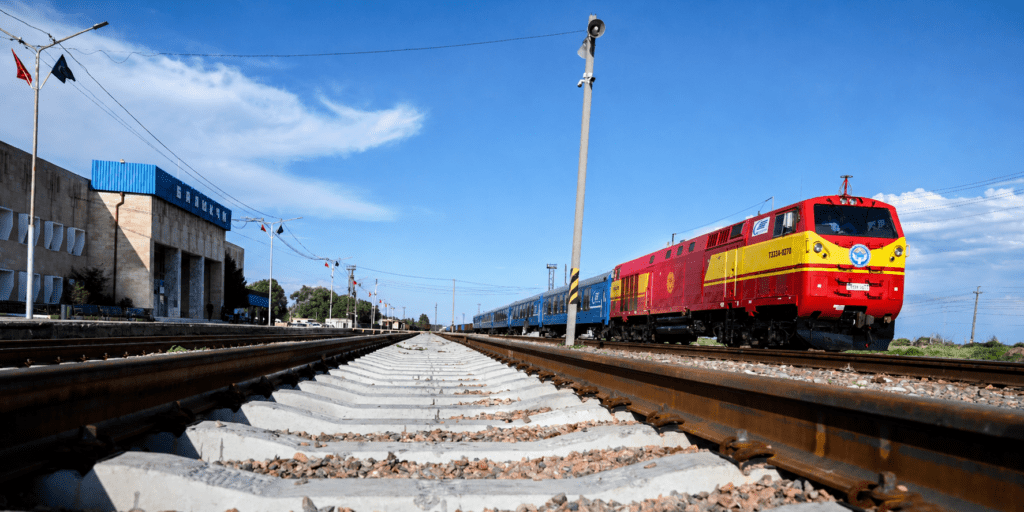
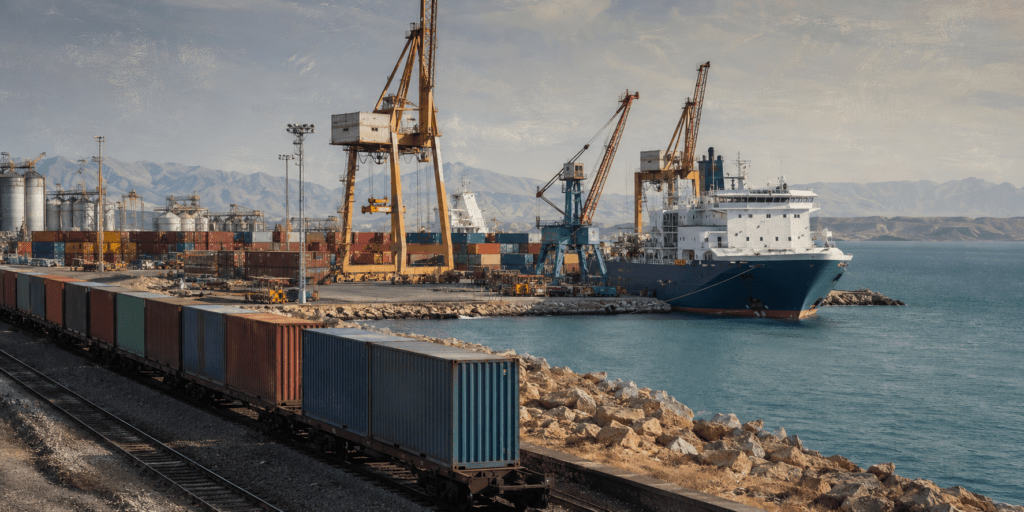
Alongside political crises, another reality is visible: the continent continues to connect itself through new routes and networks. Railways, ports, energy grids, dry ports, container corridors, digital cables, and trade chains are gradually linking spaces that only recently were seen as separate regions.
In many ways, Eurasia has always been a space of movement, exchange, and connectivity.
The Silk Road Was a Network, Not a Single Route
A recent article by News Central Asia made a simple but important observation: the Silk Road functioned because it belonged to everyone.
This idea contains one of the central lessons of Eurasian history. The Silk Road was never a single road. It was not one unified highway built according to a master plan or controlled by a single center. For centuries, the continent was connected by a vast network of caravan routes, maritime pathways, mountain passes, cities, and trade hubs through which goods, people, knowledge, and ideas circulated.
Some routes gained importance while others temporarily declined. States, empires, and commercial centers changed. New pathways emerged. Yet the network itself endured. The strength of the Silk Road lay not in one route, but in the multiplicity of connections.
When one corridor became unsafe, trade shifted elsewhere. When political conditions changed, commerce adapted to a new geography. The continental network remained flexible and multilayered.
This offers an important lesson for today’s Eurasian space as well. Many modern transport corridors did not emerge from nothing. In many respects, they follow historical logic. Railways have replaced caravan paths, dry ports have succeeded old trade hubs, and container routes continue along directions in which goods moved for centuries.
Corridors and the Logic of Rivalry
Today, most transport and economic corridors are interpreted as competing projects. Nearly every new route is framed through confrontation, alternatives, or attempts to bypass another direction.
The Middle Corridor is often described as an alternative to northern routes. The International North-South Transport Corridor is presented as a separate geo-economic axis. Trans-Afghan projects are portrayed as competitors to other links between Central and South Asia. Chabahar and Gwadar are depicted as rival ports. Even the South Caucasus transport hub is increasingly viewed through the prism of struggles over control of routes and flows.
Yet historically, Eurasia never developed through a single line of communication. For centuries, the continent evolved as a system of intersecting pathways. Some directions strengthened, others weakened, and new trade centers and routes emerged. But the network itself survived.
For this reason, many modern corridors may be better understood not as mutually exclusive projects, but as elements of an emerging continental network. The Eurasian space is simply too vast and diverse to rely sustainably on only one direction.
Two Maps of Eurasia
It is time to look differently at the map of the continent itself. If one mentally overlays two separate maps of Eurasia, an interesting contrast appears.
The first map is political. It shows conflicts, sanctions, fault lines, competing blocs, struggles for influence, and attempts to reroute trade. This is the map through which Eurasia and its subregions are often perceived today.
But there is another map. On it appear railways, ports, energy systems, dry terminals, container routes, digital cables, trade chains, and cities gradually transforming into nodes of movement across a vast interconnected space.
On this second map, the continent looks different, not as a space of division, but as a space of routes and interaction. Politics may divide territory, but infrastructure almost always seeks to connect it. This is one of the defining characteristics of the modern continent.
Both maps exist simultaneously. States continue to compete, argue, and construct new spheres of influence. Yet the logic of geography itself continues pushing the continent toward connectivity, exchange, and interaction.
The Heartland of the 21st Century
This second map also offers a different way of understanding Central Asia. More than a century ago, British geographer Halford John Mackinder proposed the concept of the Heartland, the “pivot area” whose control, in his view, opened the way to domination over the vast continental interior. The theory later became one of the foundations of classical Western geopolitics and geostrategy.
But in the 21st century, the region is increasingly acquiring a different meaning, not as a territory of control, but as a space of interaction.
Historically, Central Asia mattered not because it controlled the continent, but because it connected it. For centuries, trade routes, caravan roads, and networks of exchange linked China, the Middle East, South Asia, Russia, and Europe through the region.
Central Asia was never the periphery of Eurasian routes. It was their intersection point where roads, goods, people, languages, ideas and technologies met.
In many ways, this geographic logic remains relevant today. Modern transport projects are gradually restoring the region’s historical role as a connective space.
A Continental Network of Routes
When examining contemporary transport and economic initiatives, it becomes clear that many projects no longer exist in isolation. Gradually, they are beginning to form a broader continental system of routes.
The Middle Corridor links China, Central Asia, the Caspian region, the South Caucasus, and Europe. The International North-South Transport Corridor connects the continental interior to the Indian Ocean. Trans-Afghan projects create additional links between Central and South Asia. Caspian routes connect inland Eurasia with the Caucasus, Türkiye, and the Mediterranean. Ports in the Persian Gulf and Arabian Sea are becoming parts of wider continental logistics systems.
Viewed without habitual geopolitical assumptions or political preferences, many of these routes do not cancel one another out. Rather, they form a complementary network.
Some routes provide access to the sea. Others create overland links between regions. Some focus on container transport, while others are oriented toward energy, raw materials, food supplies, or industrial cooperation.
This multiplicity of routes is precisely what makes the system resilient. Eurasia appears to be moving not toward one dominant corridor, but toward the creation of a more flexible and diversified network.
Conflicts, rivalry, and political contradictions are not disappearing. Many projects face sanctions pressure, security concerns, infrastructure imbalances, and conflicting national interests. Yet even under these conditions, the geography of the continent itself continues pushing Eurasia toward the development of new routes, connections, and forms of interaction.
Afghanistan as a Space of Connection
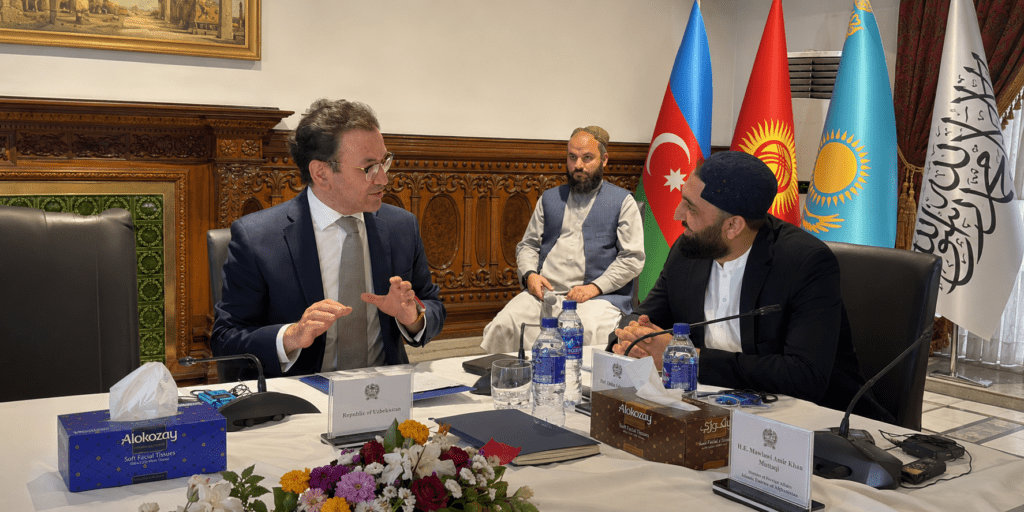
Afghanistan occupies an important place within this emerging system. For decades, the country has been viewed primarily through the lens of conflict, instability, and security concerns. That context remains significant. Nearly half a century of war effectively removed Afghanistan from the normal logic of transit and regional connectivity.
Only in recent years has the possibility re-emerged of viewing Afghanistan as a bridge between Central and South Asia.
Historically, Afghanistan was never an isolated space. For centuries, trade routes linking Central Asia, India, Iran, and the Middle East crossed the territory of present-day Afghanistan. Cities in the region formed part of a larger network of exchange, caravan trade, and cultural interaction.
Today, Afghanistan’s geography pushes it toward becoming a connecting space between regions. This is why major transport and economic integration projects in Central and South Asia continue to return to the Afghan direction, despite political risk.
Trans-Afghan railways, energy projects and trade routes linking Central Asia with Indian Ocean ports are gradually creating a spatial logic in which Afghanistan is viewed not only as a zone of risk, but also as a potential junction between Central and South Asia.
A vast distance remains between potential and realization. Yet the geography of the continent continues pushing routes toward connection.
This is why the idea of connectivity through Afghanistan continues to return to the regional agenda despite political crises and shifting international circumstances.
Eurasia as a Space of Movement
Certainly, Eurasia remains a space of competing interests, crises, and rivalry. States will continue competing for influence, routes, and economic advantages. But perhaps the modern continent can no longer be explained solely through that prism.
Alongside conflicts, another process is unfolding: the expansion of routes, trade, and interregional connections. Railways, energy projects, ports, dry terminals, digital cables, and supply chains are gradually linking spaces that only recently seemed separate from one another.
In many ways, the continent is once again revealing its historical nature, not as a space of isolation, but as a space of movement.
This is why it is becoming increasingly important to look at Eurasia not only through a political map, but also through a map of routes, connections, and interaction.
Behind the complexity of modern geopolitics lies a simple geographic truth: sustainable routes emerge where there is room for coexistence, not only competition.
The views expressed in this article are those of the author and do not necessarily reflect the official policy or position of the publication, its affiliates, or any other organizations mentioned.