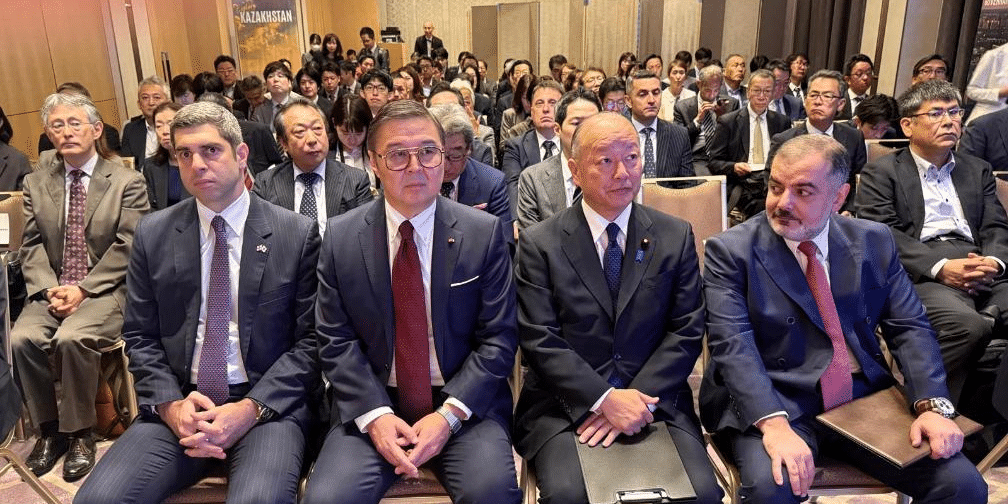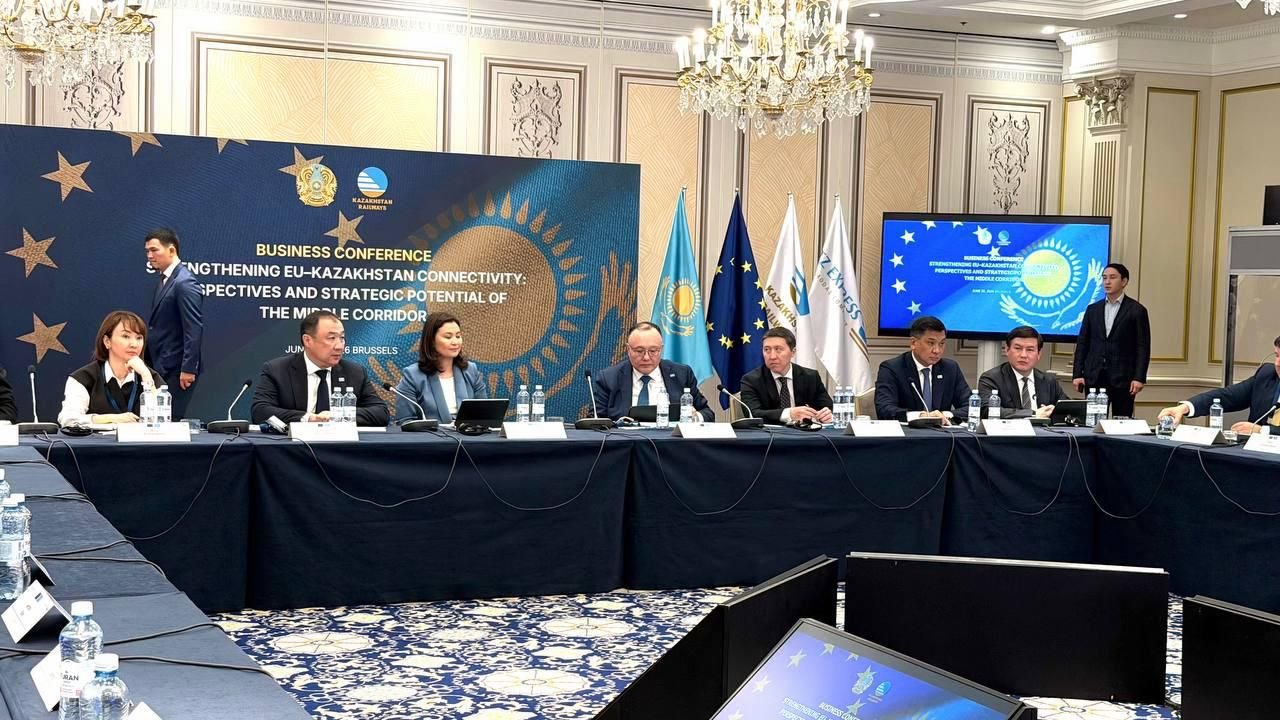
Kazakhstan and its European partners unveiled four transport deals worth a combined $462 million on June 22, giving President Kassym-Jomart Tokayev’s visit to Belgium a concrete outcome on Eurasian connectivity. The package was presented at the business conference “Strengthening EU-Kazakhstan Connectivity: Perspectives and Strategic Potential of the Middle Corridor.”
The Trans-Caspian International Transport Route, also known as the Middle Corridor, is a multimodal transport corridor linking China and Europe through Central Asia and the South Caucasus, offering an alternative to routes that pass through Russia.
The conference was organized by Kazakhstan Temir Zholy, Kazakhstan’s national railway operator, and brought together representatives of the European Commission, the European Parliament, international financial institutions, and major European transport and logistics companies, including DHL Global Forwarding, Alstom, DB Cargo, HHLA International, Rhenus Logistics, Hellmann Worldwide Logistics, Ahlers Logistics, and A.P. Moller-Maersk.
The conference focused on strategic development priorities for the Middle Corridor, including increasing the capacity of the Trans-Caspian International Transport Route, modernizing railway, port, and terminal infrastructure, digitalizing logistics processes, and developing sustainable supply chains across Eurasia.
The four documents, presented as a $462 million package, aim to strengthen transport connectivity between Europe and Asia and further develop the Trans-Caspian route.
Kazakhstan’s Ministry of Transport and SITA, a global provider of information and telecommunications solutions for the aviation industry, signed a memorandum of cooperation on the digitalization of state airports, including biometric identification.
National road operator QazAvtoZhol and the European Bank for Reconstruction and Development signed a loan agreement for the Aktobe-Ulgaisyn road project. The Aktobe-Ulgaisyn project covers a 234-kilometer section of the Western Europe-Western China corridor and is intended to improve regional and transit connectivity.
KTZ Express, a subsidiary of Kazakhstan Temir Zholy, signed an agreement with Midia Marine Terminal for a joint project in Romania’s Port of Midia. The project aims to expand Black Sea route infrastructure and improve cargo handling efficiency.
In addition, KTZ Express and A.P. Moller-Maersk agreed to cooperate on container shipping along the Trans-Caspian International Transport Route and to attract additional cargo volumes to the route.
Speaking at the conference, Kazakhstan’s Deputy Foreign Minister Arman Issetov stressed that the route has evolved far beyond a traditional transit corridor and is increasingly becoming a major geo-economic project serving the interests of both Central Asia and Europe.
He said that amid shifting global supply chains and growing demand for reliable and diversified transport routes, Kazakhstan continues to advocate for open, resilient, and mutually beneficial connectivity between East and West.
Particular attention was given to the complementarity between the Trans-Caspian International Transport Route and the European Union’s Global Gateway initiative. Under this strategy, the Trans-Caspian corridor has become a priority for strengthening sustainable connectivity between Europe and Central Asia, with Kazakhstan playing a central role as a major Eurasian transport hub.
At the Third National Workshop of the Trans-Caspian Transport Corridor Coordination Platform in Astana on June 3, EU Ambassador to Kazakhstan Aleška Simkić said: “Through our €30 million Trans-Caspian Transport support program and other projects, the European Union supports the modernization of facilities in the Port of Aktau and preparations for the complex modernization of the Beyneu-Sekseul road, while facilitating the approximation and digitalization of cross-border procedures.”
In recent years, freight volumes along the Trans-Caspian corridor have increased by more than 3.5 times, while transport times between China and Europe have been significantly reduced due to infrastructure upgrades and improvements in logistics processes.
According to Kazakhstan’s Foreign Ministry, the European Union remains Kazakhstan’s largest trade and investment partner. In 2025, bilateral trade reached $45.1 billion, while cumulative gross inflows of foreign direct investment from EU member states exceeded $200 billion.