As war, sanctions, and disruption reshape trade between Europe and Asia, Kazakhstan is trying to turn the Middle Corridor from an alternative route into a more predictable logistics system.
The route, formally known as the Trans-Caspian International Transport Route, links China and Central Asia with the Caspian Sea, the South Caucasus, Turkey, and Europe, bypassing Russia.
For Kazakhstan, the project is both economic and geopolitical. It promises faster access to foreign markets, new transit revenue, and a stronger role for the country as a logistics hub between China and Europe. However, the corridor still faces practical constraints, including port capacity on the Caspian Sea, uneven digital systems, border procedures, tariffs, and coordination between several states and operators.
The Times of Central Asia spoke with Alua Korpebayeva, Head of the Project Office for Transport and Logistics under the Presidential Administration of Kazakhstan, about what still needs to change and how Kazakhstan views the corridor’s long-term role.
TCA: Why has the Middle Corridor become more urgent for Kazakhstan and Central Asia, and how much have the war in Ukraine and tensions around Iran and the Persian Gulf changed the calculation?
Alua Korpebayeva: The government of Kazakhstan has assigned the national railway company, Kazakhstan Temir Zholy, a strategic objective of increasing total transit volumes to 55 million tons by 2026, representing a 65% increase compared to last year. This target reflects the scale of the country’s ongoing transport transformation.
Achieving this goal is closely tied to the development of the Middle Corridor. The route is especially important because it is becoming a foundation for stable and predictable supply chains in global trade.
The Middle Corridor provides Central Asian countries with an opportunity to strengthen connectivity with both Europe and China while increasing the region’s role as an independent transport and logistics hub.
Geopolitical factors have undoubtedly increased business interest in alternative routes. For Kazakhstan, however, development of the Middle Corridor is primarily part of a broader effort to expand transport capacity and improve logistical resilience.
That is precisely why deeper regional cooperation is so important. Unlocking the corridor’s full potential requires close coordination among all participants, from infrastructure modernization and tariff harmonization to end-to-end digitalization and simplified customs procedures.
The World Bank has noted that a fully functioning Middle Corridor could strengthen supply-chain resilience and, if accompanied by investment and efficiency measures, could triple freight volumes and cut transportation times in half by 2030.
TCA: Are Kazakhstan and its partners moving toward unified transit rules and tariffs along the corridor? What has already been agreed, and where do gaps remain?
Alua Korpebayeva: Work on creating unified transit rules and coordinated tariff policies is ongoing. The current focus is shifting from fragmented national tariffs toward a unified through-route pricing system across the corridor.
Within the framework of the Action Plan for Eliminating Bottlenecks along the Trans-Caspian International Transport Route, signed by the railway administrations of Kazakhstan, Azerbaijan and Georgia, the parties agreed to establish a single long-term tariff for the route.
In practical terms, this means creating more predictable pricing conditions for shippers. Clients should see not a collection of separate national tariffs, but a clear through-rate covering transportation across the entire route.
For example, active work is already underway to introduce unified tariffs along the Altynkol-Poti/Batumi route, reflecting movement toward a common tariff policy on one of the Middle Corridor’s key segments.
The immediate task is not to create a fully unified transit market overnight, but rather to gradually synchronize digital documentation, port procedures, customs cooperation, and requirements for transport operators. A unified approach is being developed incrementally through working groups and coordination among national operators.
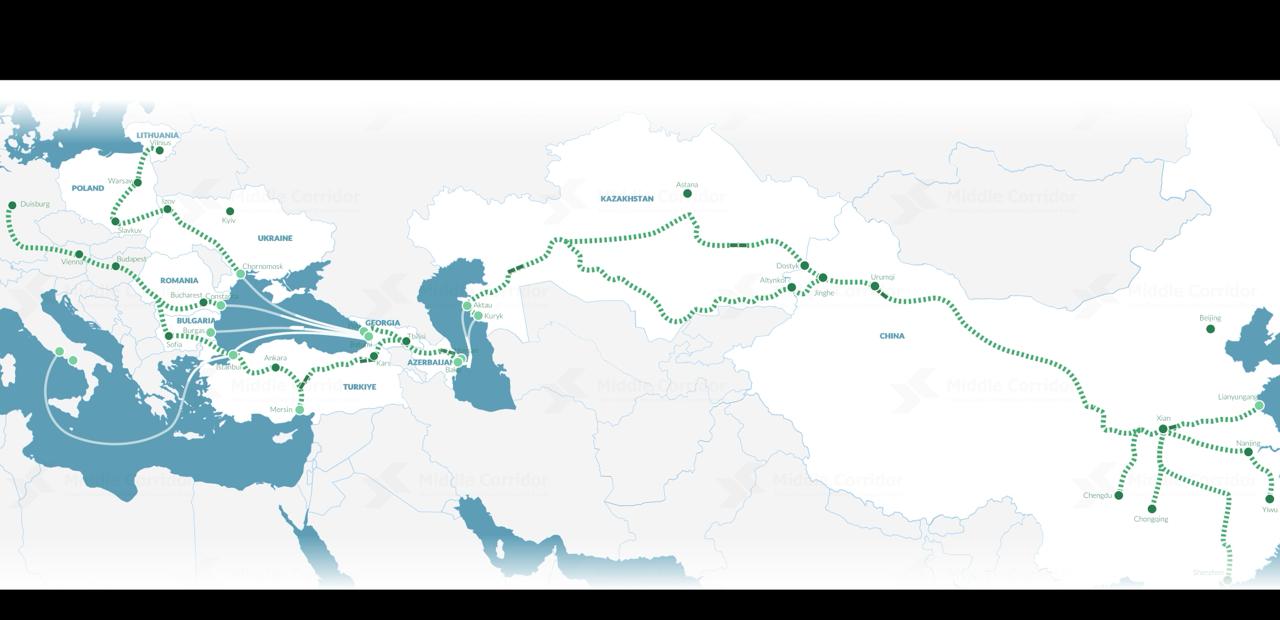
Image: t.me/middlecorridor
TCA: Does the Middle Corridor need a new coordinating body, or can existing mechanisms manage the route?
Alua Korpebayeva: At present, the International Association of the Trans-Caspian International Transport Route already operates as a coordination platform among the corridor’s main participants, railways, ports, and logistics operators.
In addition, operational coordination along the route is being strengthened through Middle Corridor Multimodal Ltd. Alongside Kazakhstan, Azerbaijan and Georgia, the Chinese side has now joined through CRCT (China Railway Container Transport Corp.), expanding coordination to include the route’s primary source of cargo flows and allowing for the development of a more integrated logistics product connecting China and Europe.
As a result, the current focus is not on creating new supranational structures, but on improving the effectiveness of existing coordination mechanisms. The main objective is to ensure predictability and competitiveness for businesses using the corridor.
Today, practical coordination and the creation of a “single logistics product” are the real priorities.
TCA: What are the main barriers to making the corridor work more smoothly, from border procedures to Caspian port capacity, and what is Kazakhstan doing to address them?
Alua Korpebayeva: The main barriers affecting the Middle Corridor are linked to the need to synchronize the multimodal transport chain and strengthen infrastructure along the entire route.
In practice, this is reflected in uneven levels of digitalization among ports and terminals, insufficient integration among transportation participants, and the need to further develop maritime and port infrastructure, including port modernization, maintaining navigable depths, and expanding the fleet.
Kazakhstan is addressing these limitations through two main approaches.
The first is operational coordination. Work is underway to integrate digital systems with Azerbaijan and Georgia for real-time data exchange and to digitize port operations through the implementation of a “Maritime Single Window” system.
The second is infrastructure development. Kazakhstan is considering acquiring additional vessels, continuing dredging work around the ports of Aktau and Kuryk, and modernizing port berthing infrastructure.
All of these measures form part of joint work being carried out by Kazakhstan, Azerbaijan and Georgia under the Action Plan for Eliminating Bottlenecks along the corridor. The goal is to reduce transit times, improve route predictability, and transform the corridor into a more competitive integrated transport product.
TCA: What single interstate step would most help turn the Middle Corridor into a global trade route, and what do Europe and the United States gain from its development?
Alua Korpebayeva: The key step is interstate synchronization of the corridor’s operating rules. This means implementing coordinated procedures among all participating countries, including digitalization of transport and customs systems, near real-time data exchange, harmonization of tariff approaches, and alignment of schedules and operational procedures at transit points.
For external partners, including Europe and the United States, development of the Middle Corridor is important because it diversifies trade routes, reduces dependence on a limited number of transit corridors, and strengthens Central Asia’s connectivity with global markets.
For Europe in particular, the corridor also offers access to new trade flows, including shipments of critical raw materials, while supporting the development of sustainable transport connectivity between Europe and Central Asia.