BISHKEK (TCA) — Kyrgyzstan’s authorities plan to introduce toll roads in the country. Charging for the use of roads will remove the financial burden from the State and will make citizens more responsible for the condition of roads, the Government believes.
Toll roads
The creation and development of a toll road network is among the main priorities of the Road Industry Development Strategy for 2016-2025. There will be 26 kilometers of toll roads in 2018 in Kyrgyzstan and 500 kilometers by 2025, the Ministry of Transport and Roads said.
The fare has not been established yet. According to the first option, tariffs will be set by a special commission. The second option provides for the construction of new roads by public-private partnerships.
The draft law on roads provides for the payment for travel on public roads but it is obligatory to have another public highway in the same direction.
The state budget allocates about 55-60% of the funds needed for repair and maintenance of the public roads. The increased length of roads requires more funds from the state budget for their repair and maintenance, the document says.
The public-private partnership will be an important tool to provide repair, rehabilitation and maintenance of roads without additional burden on the national budget.
The Kuaky—Kochkor, an alternative route for the North-South highway, can be the first toll road in the country.
North-South highway
On May 18, Prime Minister of Kyrgyzstan Sooronbai Jeenbekov checked construction of the alternative North-South road in the Naryn oblast. The construction of the 433-kilometer road was launched in 2014.
The works were divided into three phases, Minister of Transport and Roads Jamshitbek Kalilov said. The first phase included 12 kilometers of motor road in the Jumgal district, and the second phase includes 96 kilometers of the Aral—Kazarman highway.
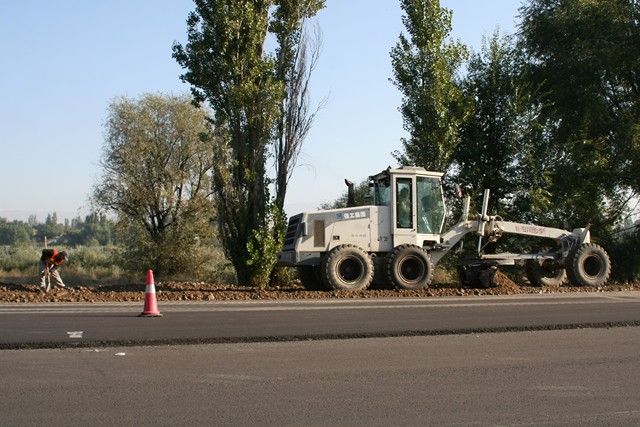
The first part of the 154-kilometer highway has been completed for a $400 million credit from the Export-Import Bank of China. The China Road and Bridge Corporation is currently carrying out construction works within the second phase of the project in the Jumgal district. The asphalt-concrete cover is laid using a new technology for the first time in Kyrgyzstan. As a result, the road’s service life will increase 1.5-fold.
The construction of the alternative road is of great importance in strengthening the transport independence of the country and facilitating internal and external transport communications. In the future, this road will be a big push in the development of the country’s economy, Jeenbekov said.
Roads deteriorating
Asphalt on the road between Bishkek and the city’s Manas Airport laid a year ago begins to deteriorate. According to Minister of Transport and Roads Jamshitbek Kalilov, in February 2017, a commission found that there were defects on the road. The contractor has to eliminate all the defects at its own expense within a year, Kalilov said.
Roads are destroyed due to traffic growth, adverse weather conditions and untimely repairs. It is necessary to increase financing of the road sector, as the volume of repair work has increased in recent years, he added.
The destruction on the Bishkek—Osh road for the last three years, mainly at the Too-Ashuu Pass, was due to extreme climatic conditions. The ministry does not apply zone design in Kyrgyzstan, and does not take into account the specifics of the construction of roads in highlands or plains.
There were cases of cracking on the asphalt concrete pavement with a road service life of less than five years. On the section from 439 km to 479 km of the Bishkek—Naryn—Torugart road, long cracks appeared after the winter frosts on the new asphalt concrete pavement. The cause of cracks was the weak bedrock at the road base.
Cracks also appeared on the Bishkek—Naryn—Torugart road in the Boom Gorge. The cause of cracks was the exceeding of the permissible load on the roadway due to the high intensity of heavy vehicles.
In both cases, the contractor has taken measures to minimize the consequences of crack formation at its own expense.
To avoid cracks in this area, it is necessary to increase the cost of the project by 50-70%, since it would be necessary to remove all unsuitable soil at the base of the road, the Transport Ministry said.
The normative service life of roads with asphalt pavement is 18 years before the first major repair with proper maintenance, which implies carrying out at least two medium repairs every four or five years. But the maintenance of roads not always meets the requirements, the Transport Ministry said.
The cost of rehabilitation of one kilometer of road is between $0.7 million and $1.3 million depending on the type of a road project and the terrain through which it passes. When comparing the cost of road construction in Kyrgyzstan and other countries, it is necessary to take into account a number of factors, in particular, the type of road and type of coverage, the cost of building materials, tax base, etc. For instance, in China the road lifespan can be up to 25 years, as even roads of regional importance have a three-layer asphalt-concrete coating and a base 1.5-times thicker than in Kyrgyzstan.
The total length of Kyrgyzstan’s roads is 34 thousand kilometers, of which 18.7 thousand kilometers are on the balance of the Ministry of Transport and Roads, 4.1 thousand kilometers are international roads, 5.4 thousand kilometers are national roads, and 9 thousand kilometers are local roads.
Quality control
This year, two mobile laboratories will be purchased to control the quality of roadways, the Ministry of Transport and Roads said. The modern equipment will promptly control the quality of the works performed by the contractor on site.
In the near future, the ministry plans to begin certification of the roads in the country. The lack of road passports greatly complicates the work of road specialists, who need exhaustive technical and other parameters of the roads of both national and internal importance.
Leader of the Respublika—Ata-Jurt parliamentary faction Omurbek Babanov suggested the Government sue companies for building low-quality roads.
The faction will draft a bill according to which tenders for road construction will have to be open, as well as contracts concluded with construction companies. Independent international audit companies should check the quality of constructed roads, Babanov added.
Nothing will change as long as the Transport Ministry itself conducts tenders and checks the quality of roads constructed. If independent international audit companies check roads they would serve for 15 years, like in other countries, the MP concluded.