Kyrgyzstan plays a central role in Central Asia’s water system and is of growing interest to China. According to figures cited by President Sadyr Japarov in April 2026, approximately 50 billion cubic meters of surface runoff are generated annually within the country. About 12 billion cubic meters are used domestically, while around 7 billion, or 14% of the total, flow to China.
Kyrgyzstan has five main water-management basins. The Issyk-Kul–Tarim management area includes both the closed Issyk-Kul basin and rivers flowing toward China, making its transboundary component a distinct area of bilateral cooperation. The Aksu River, which originates in Kyrgyzstan and feeds the Tarim River in China’s Xinjiang Uyghur Autonomous Region, is particularly important. Estimates put its contribution at 70–80% of the Tarim’s flow.
Given Xinjiang’s importance to China’s domestic stability and the Belt and Road Initiative, these shared waters have economic and long-term geopolitical significance for Beijing.
Legal and Regional Context
Kyrgyzstan and China established a strategic partnership in 2013, but no publicly available bilateral agreement specifically governs the allocation and management of their shared waters. Neither country is a party to the 1992 UNECE Convention on the Protection and Use of Transboundary Watercourses and International Lakes or the 1997 UN Convention on the Law of Non-navigational Uses of International Watercourses.
The significant asymmetry in the countries’ economic and negotiating capacities makes the absence of a dedicated water-sharing framework a potential source of vulnerability for Kyrgyzstan. Its importance could grow as water stress intensifies and economic activity in the shared basins expands.
For Central Asia, China’s involvement has broader implications. Kyrgyzstan is an upstream country whose rivers supply its downstream neighbors. Chinese participation in water infrastructure adds another external actor to a sector that has historically been one of the most sensitive areas in regional relations.
The Changing Nature of China’s Presence
China’s involvement in Kyrgyzstan’s water sector includes bilateral assistance for irrigation as well as construction contracts financed by multilateral institutions. These channels coexist, making it important to distinguish Chinese funding from work undertaken by Chinese companies.
Kyrgyzstan’s chronic electricity shortage and need to modernize its water and energy infrastructure have created opportunities for greater Chinese involvement. The upgrading of bilateral relations to a comprehensive strategic partnership in the new era in 2023 provided an additional political framework, with hydropower identified as a priority for practical cooperation. Agreements totaling more than $1 billion were signed at the Kyrgyz-Chinese business forum in Urumqi in August 2023, underscoring the broader expansion of economic ties.
Chinese companies are also winning contracts funded by international financial institutions. In September 2025, a Sinohydro Bureau 16–Sinohydro joint venture signed a contract for water-conveyance structures and the powerhouse for the second generating unit at Kambarata-2, financed by the Eurasian Fund for Stabilization and Development. The tender had been launched in 2024. The Asian Development Bank lists a $12.8 million contract dated July 2025 for an Issyk-Kul wastewater treatment plant, awarded to a joint venture involving China Road and Bridge Corporation. That contract includes three years of operation and maintenance. In August 2025, Shandong Zhongze Engineering Group signed a World Bank-financed contract worth 425.6 million soms to modernize the Nurgaziyev and Alga canals.
These contracts extend Chinese companies’ participation beyond bilateral loans and grants. They also show why the role of Chinese firms should be assessed separately from the source of project financing.
For Kyrgyzstan, the long-term return will depend on more than completed infrastructure. A central question is whether individual projects also strengthen local engineering expertise and the capacity to operate and maintain the facilities.
Key Areas of Cooperation
Irrigation was an early area of practical cooperation. A 2016 agreement provided for Chinese funding to rehabilitate six irrigation systems in four regions. More recent cooperation includes canal modernization and the supply of specialized equipment. Proposals involving drones and rainfall-inducing technology point to possible new areas of engagement, although these should be distinguished from completed infrastructure projects.
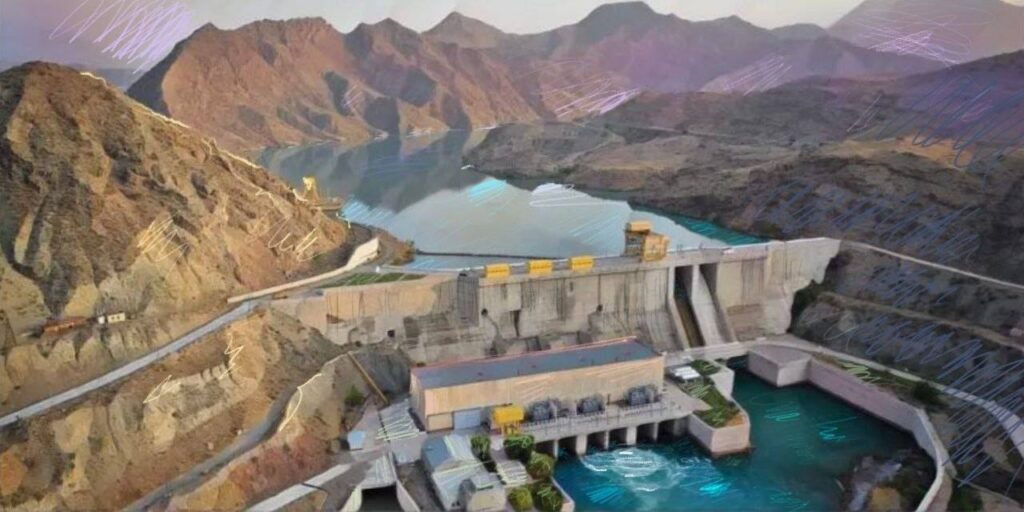
Hydropower is another critical area, accounting for most of Kyrgyzstan’s electricity generation. Yet the country uses only a small share of its estimated hydropower potential. The National Development Program through 2030 calls for expanding capacity through new large and small plants and developing other rivers to reduce dependence on the main hydropower cascade. The priorities are to cover the domestic electricity deficit and expand the potential for renewable electricity exports.
Limited domestic financing and the high cost of large hydropower plants increase the sector’s reliance on foreign investors and contractors. Chinese companies are involved at several stages of project development, from feasibility studies and design to construction. Their work also includes modernizing existing plants and supplying generating equipment.
Kyrgyzstan’s major hydropower plants are concentrated in the Naryn–Syr Darya basin, separate from rivers flowing into China’s Tarim basin. Projects on the Naryn therefore do not directly regulate flows to the Tarim. China’s downstream interests in the Tarim should therefore be considered separately from its companies’ involvement in hydropower development elsewhere in Kyrgyzstan.
A possible future opportunity is electricity exports to China through the proposed Kemin–Torugart and Datka–Torugart transmission lines. For Kyrgyzstan, this could diversify export markets and generate revenue for the sector. For China, it could provide additional renewable power in its western regions. Any export route would require careful assessment of its financial viability and Kyrgyzstan’s domestic electricity needs.
Strategic Importance for China and Kyrgyzstan
China’s involvement in Kyrgyzstan’s water infrastructure expands the market for Chinese engineering companies and strengthens economic ties. Improved infrastructure could also support economic stability in a region important to China’s western transport corridors.
This involvement does not in itself demonstrate an attempt to control Kyrgyzstan’s water resources. The available project examples are consistent with commercial and infrastructure interests. China also has an interest in stability along its western border, which gives both countries a reason to avoid water disputes.
The cumulative effect of multiple projects could nevertheless create technological dependence. Equipment choices and maintenance arrangements can shape a facility’s reliance on external suppliers for decades. Without adequate local capacity, Kyrgyzstan could remain dependent on foreign contractors for repairs and technical support.
For Kyrgyzstan, cooperation offers substantial opportunities. Infrastructure needs exceed the resources available from the national budget, while Chinese firms bring construction capacity and engineering expertise. The financing arrangements differ, however: a multilateral loan used to pay a Chinese contractor is not Chinese state financing.
Risks and Prospects
One concern is the absence of a dedicated bilateral framework for shared waters. This may attract little attention while water use does not generate acute disputes. Climate change and glacial retreat could increase pressure, alongside rising demand. Regular hydrological data exchange and joint monitoring would help both countries identify problems early and establish a basis for consultations.
A second concern is technological dependence. A “build-and-go” description cannot be applied to every contract, as the ADB-funded wastewater project’s operation and maintenance component demonstrates. The broader question is whether contracts leave Kyrgyz institutions able to manage the assets after external support ends. Provisions for local training and the transfer of operational documentation would help, as would greater participation by national subcontractors and maintenance providers.
Financial sustainability also matters. Capital-intensive hydropower projects can create long-term liabilities, especially if electricity exports or domestic demand fall short of projections. Decisions on new projects should use conservative revenue assumptions and account for the overall debt burden.
Regional coordination remains essential. New hydropower and irrigation capacity can affect downstream users, depending on the basin and operating arrangements. Chinese participation can bring additional resources, but it should complement existing mechanisms for coordinating water and energy needs. Projects that improve water efficiency could also reduce the potential for conflict.
Building Local Capacity
Chinese firms are expanding their role in Kyrgyzstan’s water infrastructure through both bilateral cooperation and contracts financed by multilateral institutions. The opportunity for Kyrgyzstan is to use this involvement to address infrastructure gaps while strengthening domestic engineering and management capacity. Its relationship with China as a downstream water user requires separate attention through cooperation on shared rivers.
The views expressed in this article are those of the author and do not necessarily reflect the official policy or position of the publication, its affiliates, or any other organizations mentioned.