The critical minerals conversation across Central Asia still too often begins in the wrong place: with what lies beneath the ground. It should begin with who controls the knowledge of what lies beneath it.
For more than a century, the resource bargain usually ran in one direction. Foreign companies arrived with the instruments, surveys, and models. Host governments arrived with the territory. The resulting terms were often shaped by information asymmetry: not only who owned the rock, but who owned the data about the rock.
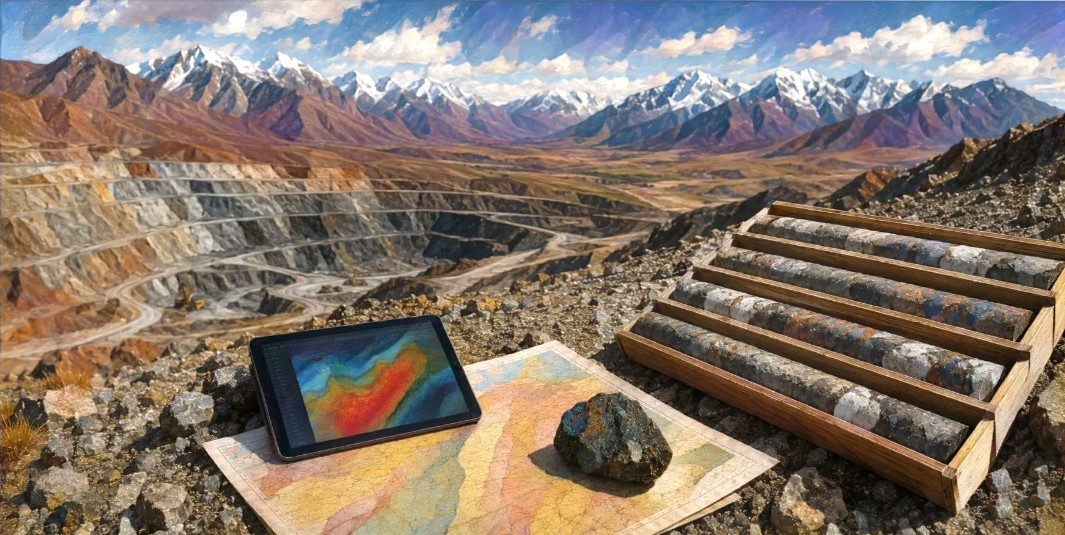
That asymmetry is easier to narrow than it used to be. Airborne geophysical surveys, satellite-based mapping, modern geochemistry, and national geological databases can now give governments a clearer picture of their mineral endowment before the first serious investor meeting. The decisive question is not simply whether data can be generated. It is who owns it, who validates it, and who is allowed to use it when concessions, joint ventures, and infrastructure commitments are being negotiated.
Capital is the reason this matters now. Critical minerals are no longer a specialist mining issue; they sit at the center of debates over energy security, electric vehicles, grid infrastructure, semiconductors, and defense supply chains. The IEA’s Global Critical Minerals Outlook 2025 tracks how demand and supply are shifting across copper, lithium, nickel, cobalt, graphite, and rare earth elements. The U.S. C5+1 Critical Minerals Dialogue and the EU’s strategic partnership with Kazakhstan show that Central Asia is already part of this conversation.
But attention is not the same as leverage. Governments that negotiate from outdated maps, fragmented archives, or company-controlled exploration data will struggle to turn geopolitical interest into durable national benefit. They may still attract investors, but they will be negotiating through someone else’s lens.
A country that arrives at the table with modern, independently verifiable geological intelligence has more options. It can better value concessions, compare competing proposals, set clearer environmental and infrastructure expectations, and decide which resources are strategic enough to develop slowly rather than quickly. Data does not guarantee a good agreement. It does make a bad agreement harder to excuse.
This is sovereignty in a practical form. The point is not to close the door to foreign capital or technical expertise. Central Asia will need both. The point is to ensure that the public side of the table has a master copy of the evidence. When the state owns the underlying data, investors can still compete on capital, technology, processing capability, logistics, and market access. What they should not control is the government’s basic understanding of its own resource base.
There is also a diplomatic dimension. The Minerals Security Partnership Forum is built around responsible, diverse, and resilient value chains, with Kazakhstan and Uzbekistan among its members. For Central Asian governments, that creates an opening to ask not only who will mine, but who will build capacity – and who will leave the country with stronger institutions than before. Geological data, mining cadastres, processing plans, environmental baselines, and contract terms are all part of the same governance architecture.
The survey itself is only the beginning. Data must be stored in institutions that can protect it, update it, and use it. Ministries need interoperable geological databases, professional staff, clear rules on confidentiality, and public-facing layers that support transparency without giving away commercially sensitive details. Procurement must be competitive and clean. New surveys should require the full transfer of raw and processed data to the state, not temporary access through a contractor’s portal. Older archives should be digitized before they are quietly rewritten by whoever arrives with the next exploration budget.
Transparency is important here, too. Data sovereignty should not become another excuse for opaque dealmaking. Public confidence grows when citizens can see how rights are awarded, who beneficially owns companies, and what obligations investors have accepted. The Extractive Industries Transparency Initiative’s work on contract transparency is a useful benchmark for governments that want to attract serious capital without asking citizens simply to trust the process.
The risk for Central Asia is not that minerals will disappear. They will still be in the ground in ten years. The risk is that the best capital, the best partners, and the best negotiating conditions will have moved elsewhere. Supply-chain decisions are being made now. Processing routes are being designed now. Strategic relationships are being written now.
Central Asian governments do not need to choose between openness and sovereignty. They need to use sovereignty to make openness work. Own the data. Verify it independently. Share what can be shared. Protect what must be protected. Then invite the world to compete on terms that reflect the country’s knowledge of itself.
The front of the line will not belong only to countries with minerals. It will belong to countries that know what they have – and own what they know.
The views expressed in this article are those of the author and do not necessarily reflect the official policy or position of the publication, its affiliates, or any other organizations mentioned.