Kazakhstan’s government has unveiled a Comprehensive Plan to Increase Household Incomes for 2026-2029. The Ministry of National Economy says it contains 59 measures. The stated goals include higher wages and lower inflation. The plan also aims to ease household debt.
The full text of the plan has not yet been published in open access. First Vice Minister Azamat Amrin presented its main provisions at a Government press conference on June 11. The central contradiction lies in the fact that guaranteed income growth applies to only a small segment of the population. The plan creates fundamentally different conditions for the public and private sectors.
It provides for mandatory salary indexation for civil servants. Their wages will be revised every three years based on accumulated inflation. According to labor market data, this category includes about 85,000 to 90,000 people less than 1% of the country’s total workforce of around 9.3 million. It is this narrow group that receives a reliable long-term mechanism of financial protection.
Indexation is also planned for employees of national companies and natural monopolies. This group includes around 700,000 to 800,000 people, or 8-9% of the labor market.
Employees in the social sector, teachers, doctors, and others, receive their salaries directly from the state budget. This category numbers around 1.2 million to 1.3 million people, or 13-14% of the workforce. Under Kazakhstan’s law on public service, these workers are not considered part of the state administrative apparatus. The plan does not introduce automatic three-year indexation for them; their incomes are raised through separate government decrees, usually on an annual basis depending on budgetary capacity.
More than 7 million people work in the competitive private sector, small and medium-sized businesses, as well as the self-employed, accounting for more than 75% of the workforce. For this dominant category, the plan offers no direct mechanisms for income growth. Instead of financial guarantees, the document proposes using an administrative lever: officials will hold talks with private business owners to encourage them to raise wages.
The only basic indicator directly affecting the incomes of low-paid private sector workers is the minimum wage. However, the government has postponed revising the minimum wage until August 2026.
Private business bears the main market risks and forms the country’s tax base. It is these taxes that finance guaranteed incomes in the public sector, which in total accounts for around a quarter of the labor market, while the overwhelming majority of working citizens, about three-quarters, have no comparable protection.
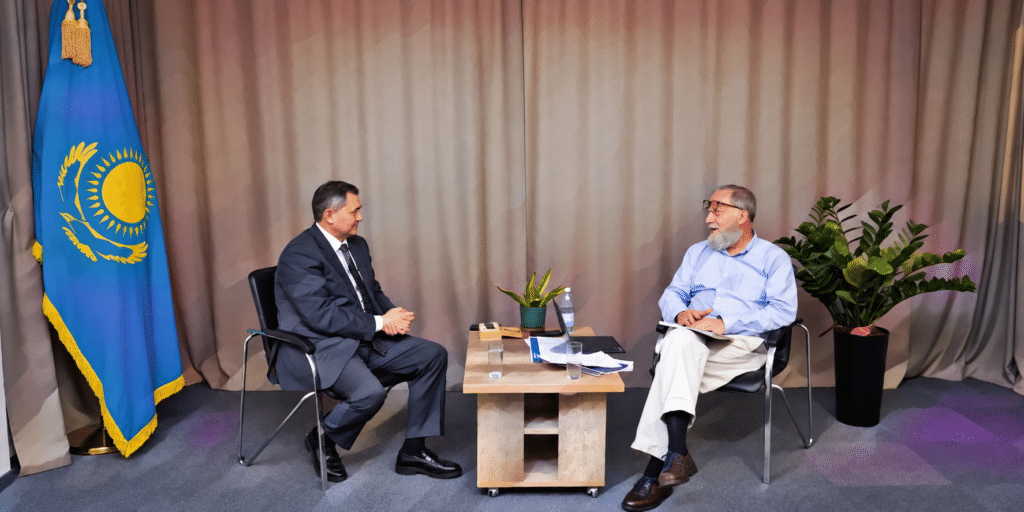
Economist Murat Temirkhanov, an adviser to the chairman of Halyk Finance who took part in expert discussions of the government’s plan, says this approach distorts market relations. A directive requirement to raise wages could push businesses away from formal hiring and into the shadow economy to cut costs.
In his view, the plan ignores the only real source of income growth: higher labor productivity. The document devotes only one point to this factor, even though international institutions such as the International Monetary Fund and the World Bank have directly recommended that Kazakhstan reduce the state’s role in the economy and promote fair competition.
As part of inflation control, the government plans to reduce railway tariffs for transporting basic food products by 36%. At the same time, strict oversight of retail chains will continue: the maximum markup on socially significant goods will remain capped at 15%.
Directly capping margins reduces profitability for retailers. Selling basic foodstuffs can become financially unviable, creating the risk of shortages. Shops may compensate for losses by sharply raising prices in other product categories.
Temirkhanov argues: “The government, instead of helping socially vulnerable groups through the state budget, wants to do so at the expense of private business profits.”
Forced reductions in margins could push manufacturers either to stop producing socially significant goods or to cut wages because of lower profits. Moreover, the proposed measures address only the symptoms of inflation. Temirkhanov stresses that the plan completely overlooks what he sees as the two main causes of price growth in Kazakhstan: large-scale government spending, including quasi-fiscal stimulus, and planned increases in utility and fuel tariffs.
Overall, the plan appears to be aimed less at increasing incomes for the majority of the population than at reducing their expenses, which carries additional risks.
The government plans to reduce borrowing costs by imposing caps on interest rates and requiring debt restructuring for overdue loans held by vulnerable groups. Artificially lowering rates would reduce bank revenues while maintaining default risks. In response, the financial sector could limit lending to low-income borrowers.
This category of borrowers could then be forced to turn to shadow lenders under harsher conditions.
In the corporate sector, the document proposes continuing the policy of state lending to businesses. Drawing on IMF reports, Temirkhanov says such support undermines competition. State-owned companies gain privileged access to financing, crowding out independent small and medium-sized businesses.
As a result, companies compete for access to state subsidies rather than market efficiency.
Temirkhanov adds: “The most dangerous aspect of this model is that companies begin competing not for consumers or product quality, but for proximity to the budget. In such an environment, it is impossible to build an economy capable of surviving without constant state injections.”
Private companies that receive subsidies will also have to raise employee wages. This could make state support financially unprofitable for businesses. To offset higher labor costs, companies may cut staff or move workers into informal payment schemes.
The government’s Comprehensive Plan contains a number of practical social initiatives, including the digitalization of benefits and tax relief for mortgages. However, its core strategy replaces natural mechanisms of income growth with administrative directives.
Sustainable wage growth cannot be achieved through government orders. Artificially forcing businesses to raise wages leads only to layoffs and the expansion of the shadow economy.
As experts note, the only real way to raise labor incomes is by increasing economic productivity.
For citizens to truly earn more, the state must focus on creating a strong and independent private sector. That requires genuine reforms: protecting small businesses from monopolies, developing transparent competition, and abandoning manual state control over economic processes.
Only an economically free business environment, protected from administrative pressure, can generate quality jobs and ensure steady improvements in living standards.
The views expressed in this article are those of the author and do not necessarily reflect the official policy or position of the publication, its affiliates, or any other organizations mentioned.