• KGS/USD = 0.01144 0%
  • KZT/USD = 0.00196 -0%
  • TJS/USD = 0.10899 -0%
  • UZS/USD = 0.00008 -0%
  • TMT/USD = 0.28490 0%
  • KGS/USD = 0.01144 0%
  • KZT/USD = 0.00196 -0%
  • TJS/USD = 0.10899 -0%
  • UZS/USD = 0.00008 -0%
  • TMT/USD = 0.28490 0%
  • KGS/USD = 0.01144 0%
  • KZT/USD = 0.00196 -0%
  • TJS/USD = 0.10899 -0%
  • UZS/USD = 0.00008 -0%
  • TMT/USD = 0.28490 0%
  • KGS/USD = 0.01144 0%
  • KZT/USD = 0.00196 -0%
  • TJS/USD = 0.10899 -0%
  • UZS/USD = 0.00008 -0%
  • TMT/USD = 0.28490 0%
  • KGS/USD = 0.01144 0%
  • KZT/USD = 0.00196 -0%
  • TJS/USD = 0.10899 -0%
  • UZS/USD = 0.00008 -0%
  • TMT/USD = 0.28490 0%
  • KGS/USD = 0.01144 0%
  • KZT/USD = 0.00196 -0%
  • TJS/USD = 0.10899 -0%
  • UZS/USD = 0.00008 -0%
  • TMT/USD = 0.28490 0%
  • KGS/USD = 0.01144 0%
  • KZT/USD = 0.00196 -0%
  • TJS/USD = 0.10899 -0%
  • UZS/USD = 0.00008 -0%
  • TMT/USD = 0.28490 0%
  • KGS/USD = 0.01144 0%
  • KZT/USD = 0.00196 -0%
  • TJS/USD = 0.10899 -0%
  • UZS/USD = 0.00008 -0%
  • TMT/USD = 0.28490 0%
08 December 2025

‘No Complaints,’ Says Tajikistan Ombudsman Amid Allegations of Journalist Mistreatment

Representatives from the Office of the Human Rights Ombudsman in Tajikistan stated they have met with several imprisoned journalists and received no formal complaints from them. The announcement was made by Khusniddin Nidoev, deputy head of the department for civil and political rights protection, during a press conference on August 4.

Visit to the Detention Facility

According to Nidoev, he personally visited the “First Soviet” correctional colony on May 5, where he met with journalists Daler Emomali, Zavkibek Saidamin, Abdullo Gurbati, and Ahmad Ibrohim, editor-in-chief of the regional newspaper Paik.

“We are in constant contact with them. Even during phone conversations with the heads of institutions, we ask about their condition, especially those whose names are widely covered in the media,” Nidoev said.

He added that the journalists expressed satisfaction with their conditions and did not report any grievances.

Relatives Raise Concerns

However, relatives of other imprisoned journalists have reported troubling circumstances. The family of Abdusattor Pirmuahmadzoda, a blogger and former employee of Radio Sadoi Dushanbe, said they have had no contact with him since March. His brother, Abdukarim, told Asia-Plus that Abdusattor was placed in solitary confinement after he publicly questioned why his name was excluded from a list of candidates for amnesty during an official visit to the prison.

Since then, neither his wife nor his children have been able to visit him, despite repeated requests.

Nidoev confirmed that the ombudsman’s office met with Pirmuahmadzoda in 2024 while he was held in a Khujand prison but acknowledged that no such visit has occurred this year. He promised to investigate his current status.

In a separate case, the wife of Zavkibek Saidamin, Mahfirat Khudoynazarova, reported in early July that her husband is suffering from a nervous condition and experiencing pain in his spine and eyes.

“We sent him medicine. He is taking it. They said he was examined by an eye doctor and treated. But he still doesn’t feel well,” she told Asia-Plus.

Meanwhile, the families of Daler Emomali and Ahmad Ibrohim have said their relatives are in stable condition, although they continue to object to their imprisonment.

Sentences and Human Rights Reactions

The prison terms for the journalists range from seven to over ten years. Ahmad Ibrohim was sentenced to 10 years and 4 months, Daler Emomali to 10 years, Abdullo Gurbati to 7.5 years, and both Abdusattor Pirmuahmadzoda and Zavkibek Saidamin to 7 years each.

Appeals filed by defense lawyers and relatives have been rejected by higher courts, leaving the sentences in force.

International human rights organizations, including Reporters Without Borders, have repeatedly condemned the imprisonments as politically motivated and called for the journalists’ immediate release. To date, Tajik authorities have not responded publicly to these demands.

Since 2022, at least six journalists have been arrested and sentenced to lengthy prison terms in Tajikistan.

Maternal and Infant Mortality Rates Continue to Decline in Kazakhstan

Kazakhstan’s Health Minister Akmaral Alnazaraeva has announced further reductions in maternal and infant mortality rates, although some regions are showing a troubling reversal of the trend.

Speaking at a recent government meeting, Alnazaraeva attributed the improvements to the adoption of recommendations from the World Health Organization (WHO) and UNICEF. In 2024, maternal mortality declined by 12 percent to 10.1 deaths per 100,000 live births, while infant mortality dropped by 11 percent to 6.88 deaths per 1,000 live births. The positive trend continued into the first half of 2025, with maternal mortality falling by another 10 percent and infant mortality by 26 percent.

The minister noted that clinical protocols in obstetrics and pediatrics have been revised nationwide. Since June 2024, tariffs for obstetric and pediatric services, including childbirth, surgeries, and neonatal care, have been increased. These changes have improved access to expensive medications, reduced the debt burden of medical institutions, and helped attract qualified specialists to the sector.

The Health Ministry also highlighted the expanded role of air ambulance services, which have saved 96 percent of women in labor and their newborns in remote areas. In 2025, for the first time, medications for pregnant women with conditions such as pyelonephritis, diabetes, and hypertension were added to the list of free drugs.

To improve rural maternal care, “Salaawatty Ana” (Healthy Mother) boarding houses have opened in Turkestan, East Kazakhstan, and Akmola regions. These facilities offer pre-hospital care and postnatal rehabilitation for women with complicated births, with their effectiveness monitored in real time by regional situation centers.

Kazakhstan is also making strides in healthcare digitalization. The electronic child health passport, now mandatory for kindergarten and school enrollment, has been introduced nationwide. A monitoring system for early detection of pediatric health problems has been deployed, and a digital health profile is being developed for every child under 18.

Despite overall national progress, the minister acknowledged rising maternal mortality in Akmola, Zhambyl, Aktobe, Kostanay, Zhetysu, and Abai regions. Infant mortality has also increased in Kostanay, West Kazakhstan, Zhambyl, Abai, and Zhetysu. The situation is most severe in Akmola, where maternal mortality is seven times the national average. Key factors include severe extragenital conditions, obstetric complications, congenital malformations, and neonatal respiratory disorders.

In response, stricter regulatory oversight will be introduced starting in September 2025. The Medical and Pharmaceutical Control Committee will be granted new powers to suspend the licenses of medical facilities and dismiss uncertified personnel. Qualification standards will be raised, and patient support services will be expanded.

As previously reported by The Times of Central Asia, Kazakhstan continues to experience a steady decline in birth rates despite government efforts to encourage demographic growth.

Zelensky Steps Up Claims of Uzbek and Tajik Citizens Fighting for Russia in Ukraine

Ukrainian President Volodymyr Zelensky has claimed that citizens of Uzbekistan and Tajikistan are among foreign fighters serving in the Russian army in Ukraine. The statement was made on August 4 via his official Telegram channel, following a visit to the 17th Separate Motorized Infantry Battalion in the northern city of Vovchansk, Kharkiv region.

“Today I was alongside those defending our country on the Vovchansk front the soldiers of the 17th Separate Motorized Infantry Battalion of the 57th Brigade named after Kostiantyn Hordiienko,” Zelensky wrote. “We spoke with commanders about the situation on the front line, the defense of Vovchansk, and the dynamics of the fighting. Soldiers on this front are recording the participation of mercenaries from China, Tajikistan, Uzbekistan, Pakistan, and several African countries. We will respond.”

During the visit, Zelensky also discussed issues related to drone supplies, recruitment, and direct funding for brigades. He awarded service medals to Ukrainian troops and stated: “It is an honor for me to be here. Thank you for fighting, serving your state, the Ukrainian people, and supporting one another.”

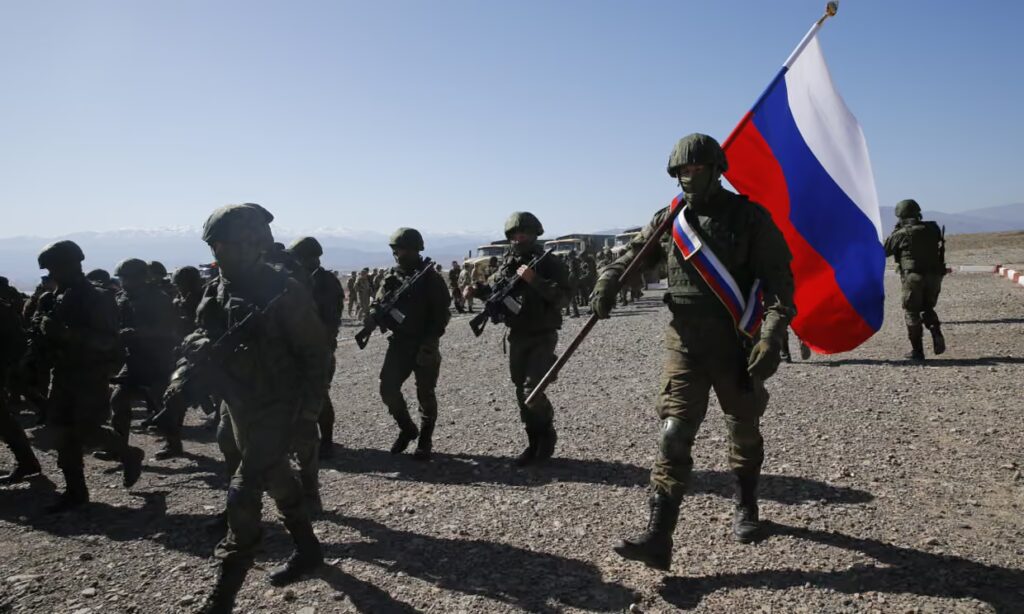
However, independent verification of these claims is limited. In some cases, reports suggest a different dynamic: in May, Alexander Bastrykin, head of Russia’s Investigative Committee, stated that authorities had “tracked down 80,000” newly naturalized Russian citizens, many originally from Uzbekistan, Tajikistan, and Kyrgyzstan, who had tried to evade military service. Around 20,000 were reportedly sent to the front lines. These figures, while not independently verified, suggest that conscription, rather than voluntary enlistment or mercenary recruitment, may account for much of Central Asian involvement.

The war continues to have a profound economic impact. Ukraine’s industrial production index dropped from 101.7% in December 2021 to 69.3% by December 2024. Trade between Ukraine and Central Asia has also declined sharply. Kazakhstan’s trade turnover with Ukraine fell from $5.5 billion in 2012 to just $391 million in 2023. Once Ukraine’s 15th-largest trading partner in 2021, Kazakhstan ranked 35th by the end of 2023.

“Where a Russian Soldier Treads, That’s Ours”: Kazakhstan in the Crosshairs of Putin’s Neo-Imperial Playbook

In June 2025, Russian President Vladimir Putin made a chilling declaration at the St. Petersburg Economic Forum: ‘There’s an old rule – wherever a Russian soldier sets foot, that’s ours.’ Far from a metaphor, this line encapsulated the Kremlin’s evolving foreign policy doctrine. It is a doctrine where military occupation becomes territorial acquisition, and where presence becomes ownership. 

But this ideology did not appear overnight. It has been systematically constructed through years of rhetorical groundwork, beginning with Putin’s 2014 remark at the Seliger Youth Forum: ‘Nursultan Nazarbayev created a state on territory where there had never been a state. The Kazakhs never had statehood.’ In 2021, speaking at a Moscow press conference, Putin went further, describing Kazakhstan as ‘a Russian-speaking country in the full sense of the word.’ 

These comments expose a geopolitical logic that fuses cultural affinity, historical denial, and military dominance. They form the pillars of what scholars like Marlene Laruelle and Timothy Snyder describe as Russia’s ‘narrative imperialism’: the use of historical revisionism and linguistic hegemony to delegitimize the sovereignty of neighboring states. 

Nowhere is this doctrine more clearly manifest than in the cases of Ukraine and Kazakhstan. In Ukraine, the justification for annexing Crimea in 2014 and launching a full-scale invasion in 2022 relied heavily on the protection of Russian-speaking populations and claims of historical unity. In Kazakhstan, the groundwork is rhetorical – but eerily similar. 

In 2014, Putin reversed Nikita Khrushchev’s legacy by annexing Crimea, which Khrushchev had transferred to the Ukrainian SSR in 1954. At the same time, Kremlin-aligned voices began revisiting Khrushchev’s failed plan to remove five northern regions of Kazakhstan to form Russian ‘Virgin Lands’. 

This was not a mere administrative reform: the plan involved transferring the fertile, Slavic-populated regions of Akmolinsk, Kostanay, Pavlodar, North Kazakhstan, and East Kazakhstan regions from the Kazakh SSR to the Russian SFSR. The objective was both economic and political — to consolidate agricultural output under Moscow’s direct jurisdiction and reduce the autonomy of the Kazakh republic by undermining its territorial coherence and ethnic composition.

These areas were the backbone of Khrushchev’s Virgin Lands Campaign and held great strategic value. The proposal sparked resistance from within the Kazakh leadership, most notably from Premier Zhumabek Tashenov, who openly opposed the Kremlin’s intentions. As a result of his opposition, he was dismissed from his position, but he succeeded in preserving Kazakh territorial integrity. 

These northern regions, like Crimea, are demographically significant: they are home to a large ethnic Russian population, many of whom speak only Russian, consume Russian media, and express nostalgia for Soviet-era unity. Cities like Petropavlovsk, where Russians still outnumber Kazakhs, mirror the pre-2014 situation in Donetsk and Luhansk. 

In 2023, a group calling itself the ‘People’s Council of Workers’ in Petropavlovsk released a video declaring independence based on the 1937 Constitution of the Kazakh SSR. Prosecuted for inciting separatism, they nonetheless reflected growing latent support for Russian intervention. 

Even earlier, in 2014, Russian ultra-nationalist Eduard Limonov made headlines by urging Russia to annex Northern Kazakhstan during a perceived political vacuum. In a Facebook post, he wrote: ‘I hope that part of Ukraine will go to Russia, if we do not yawn, and northern Kazakhstan too — we can get our Russian cities back into Russia in the moment between governments in Kazakhstan.’ 

His call triggered a diplomatic protest from the Kazakh Ministry of Foreign Affairs, which emphasized Kazakhstan’s sovereignty and territorial integrity. While dismissed as a fringe voice, Limonov’s rhetoric mirrored the Kremlin’s growing tendency to conflate Russian ethnicity and language with sovereign entitlement. 

Limonov was not alone. Duma member Denis Maydanov publicly described regions east of the Dnipro River and northern Kazakhstan as ‘primordially Russian.’ State media host Vladimir Solovyov has repeatedly advocated for strikes on Europe and ridiculed Kazakhstan’s efforts to assert its own national language. In 2020, Duma members declared that ‘Northern Kazakhstan is a gift from Russia,’ further escalating tensions. 

This convergence is not accidental. It is the result of long-term settler colonial policy. Just as Zionist strategists in Palestine targeted fertile Palestinian lands for acquisition, Soviet planners in the 1950s chose the rich black soils of northern Kazakhstan as the site for Khrushchev’s Virgin Lands Campaign. The campaign’s goal was not only to feed Soviet cities, but to anchor Slavic demographic dominance. 

Over 43 million hectares were taken under the guise of ‘virgin land,’ despite being inhabited or used by Kazakh nomadic communities. Both cases reveal the same logic: that land becomes ‘productive’ only when repurposed through settler frameworks. The Zionist motto of ‘making the desert bloom’ has its Soviet counterpart in the Virgin Lands campaign, where productivity became a means of erasure. As historian Kate Brown writes: ‘Virgin Lands were not empty. They were made to appear so through cartography, statistics, and ideology.’ 

Putin’s 2025 proclamation that Russian military presence confers territorial legitimacy is merely the latest iteration of this logic. As with any neo-colonial or neo-imperialist power in the modern century, everything begins not with invasion, but with information control and narrative seeding. In the case of Ukraine, the groundwork was laid as early as the mid-2000s. 

When I was studying at Moscow State University, it was not uncommon to hear members of the academic elite openly express frustration with the political trajectories of Georgia and Ukraine. This sentiment was echoed and amplified by Russia’s most powerful propaganda apparatus: its state-controlled television. These channels and political talk shows relentlessly pushed disinformation and revisionist history, preparing the Russian public psychologically for the eventual invasions of Georgia in 2008 and Ukraine in 2014 and again in 2022.

A similar rhetorical pattern has been emerging in relation to Kazakhstan since the mid-2010s, as narratives around ‘Russophobia,’ ‘protection of Russian speakers,’ and historical territorial claims have become increasingly common in Kremlin-aligned discourse. This is not accidental — it is the same imperial script, playing out once again. Like the Zionists before 1948, and like the Soviet strategists before him, Putin treats cultural proximity, military capability, and historical manipulation as tools to reshape borders and subvert sovereignty. His empire is built not only with tanks, but with narratives. 

Kazakhstan, like Ukraine, now stands at a crossroads. Putin’s statement about the sanctity of Russian military presence is particularly alarming given that Russia maintains its largest military base abroad in Tajikistan. The 201st Military Base, with an estimated 6,000–7,000 troops, operates in Dushanbe and Bokhtar and serves as the Kremlin’s principal outpost in Central Asia. While Kazakhstan does not host a large-scale base of this nature, it does lease the Baikonur Cosmodrome to Russia until 2050, and hosts Russian-operated radar systems and CSTO-linked infrastructure. 

These facts are not benign: they reflect a triad of mechanisms through which Russia pursues its neo-imperial project of historical revisionism and territorial expansion. First, the Kremlin actively re-writes history, denying the legitimacy of its neighbors’ statehood – as seen in claims about Kazakhstan’s alleged lack of historic sovereignty and the illegitimacy of Ukraine’s post-Soviet borders. 

Second, it exploits citizenship law as a geopolitical tool. Russian legislation grants Moscow the legal right to intervene abroad to protect its citizens. By encouraging Russian populations in former Soviet republics to retain or regain Russian passports, the Kremlin effectively lays a juridical pretext for military engagement. This logic was central in Crimea and is increasingly visible in regions of Kazakhstan with high numbers of dual passport holders. 

Third, Russia uses its military bases and peacekeeping mechanisms — like the CSTO — to maintain a physical and psychological presence. The very infrastructure that claims to defend regional stability can, under Putin’s doctrine, serve as a foothold for annexation under the guise of protection or peacekeeping. 

Together, these steps comprise a sophisticated playbook: one that begins with myth-making, continues through identity manipulation, and culminates in occupation. Kazakhstan has no nuclear deterrent, having voluntarily dismantled the world’s fourth-largest arsenal in the 1990s. Its military infrastructure near the Russian border is minimal. 

And yet, it faces the same creeping logic of imperial incorporation. Language, land, and memory are weaponized in the service of expansion. 

As Kazakh analyst Gaziz Abishev warns: ‘If Russia supports separatism and succeeds, it will lose Kazakhstan forever. And then, foreign military bases – Chinese or Western – will line the Russian border.’ 

The irony is sharp: a state dismissed by Putin as having ‘never had statehood’ may one day mark the final rupture in the Russian imperial dream. In this moment of creeping authoritarianism and regional vulnerability, the question must be asked: with so many red flags waving — from historical revisionism to military presence and legal pretexts for intervention — are the Central Asian states, and Kazakhstan in particular, truly prepared to face what may be coming? 

Will China, their powerful neighbor and supposed strategic partner, stand by them when sovereignty is threatened? Or will it, like so many others today in the face of global injustices and ongoing atrocities, limit its response to empty statements and silent complicity?

***

The views expressed in this article are those of the author and do not necessarily reflect the official policy or position of the publication, its affiliates, or any other organizations mentioned.

Opinion: Why Russia May Stop Oil Supplies via the CPC

The global confrontation between the West and East could, quite literally, devastate the economies of Central Asian countries in the near future. Some experts argue that the position Kazakhstan and its regional neighbors now occupy, four years into the war between Russia and Ukraine, has spiraled beyond anyone’s control.

The disruption began with Ukrainian drone strikes on Russian infrastructure used by the Caspian Pipeline Consortium (CPC), which indirectly impacted oil flows from Kazakhstan to Europe.

On August 2, several media outlets, citing sources within the Ukrainian military, reported an attack on the Central Asia-Center (SAC) gas pipeline running through Kazakhstan. The attack allegedly caused an indefinite halt in gas deliveries that Russia had been sending in reverse flow to Uzbekistan. Kazakhstan also uses this gas domestically. Shortly after, the energy ministries of both Uzbekistan and Kazakhstan denied reports of any damage to the pipeline. Nonetheless, Ukraine’s classification of the SAC pipeline as a legitimate target remains on record.

Notably, although Kazakhstan’s Foreign Ministry has issued a formal protest to Kyiv over the CPC attacks, it has yet to reveal any official response from the Ukrainian side.

Kazakhstan thus finds itself in an extremely vulnerable position: its national budget is heavily dependent on oil exports, while its southern infrastructure increasingly relies on imported gas. For example, the planned conversion of Almaty’s TPP-2 to gas is unfeasible without stable fuel supplies. In other words, Kazakhstan has become fully dependent on developments in the Russian-Ukrainian war.

Compounding the geopolitical tension, U.S. President Donald Trump has pursued an aggressive and often unpredictable foreign policy approach. He has threatened sanctions against Russia’s economic partners if they continue buying oil from President Vladimir Putin. This pressure is primarily directed at China and India, both of which have already signaled they do not intend to comply with Trump’s ultimatum.

In response, Russia may adopt symmetrical countermeasures targeting American companies, specifically, by halting oil flows via the CPC. That’s the view of JPMorgan analysts, who suggest that such a move could drive global oil prices up to $80 per barrel. This would benefit Russia but would deal a serious blow to Kazakhstan, which relies on CPC to export up to a million barrels of oil per day.

Unfortunately, Kazakhstan lacks viable alternatives. The Baku-Tbilisi-Ceyhan (BTC) pipeline, often cited as a backup route, depends heavily on Caspian Sea shipping, which is increasingly hindered by shallow waters. Heavier oil barges dispatched from Aktau to Baku risk running aground. As a result, Kazakhstan’s oil volume transported via BTC is expected to increase by only 300,000 tons this year, from 1.4 to 1.7 million tons.

It’s worth noting that CPC exports oil produced by American firms Exxon and Chevron, the British company Shell, Italy’s ENI, and France’s TotalEnergies. These are the very firms Russia could target in retaliation. As Trump’s statements deepen the appearance of a Russia-versus-West conflict, energy infrastructure could increasingly become a battlefield.

Hints of Moscow’s readiness to act have already emerged. In mid-July, President Putin signed a decree mandating that vessels arriving from foreign ports obtain permission from the FSB before entering Russian seaports. The order gives port captains, in consultation with FSB representatives, the authority to grant or deny entry. The FSB will determine the list of officials responsible for these decisions. One affected port is Novorossiysk, which handles Kazakh oil exports shipped via the CPC. Although rumors spread that Kazakh ships were being denied entry, these were later refuted. Still, alarm bells are ringing.

Will Kazakhstan act to prevent its strategic partner from taking such a drastic step?

Doubts persist as to whether Astana will intervene at all. Official circles in Kazakhstan remain focused on revising profit-sharing agreements with Western oil majors. A decline in the negotiating position of those companies might even work in Akorda’s favor, particularly after the premature celebrations in Western capitals over their court win against Kazakhstan’s Ministry of Ecology.

In early August, Bloomberg reported that shareholders in the Kashagan project had prevailed in a lawsuit over a potential $4 billion environmental fine. The dispute stemmed from Kazakhstan’s attempt to impose a penalty of 2.3 trillion tenge, then equivalent to $5.1 billion, now $4.2 billion at current exchange rates.

“We welcome the Court of Appeal’s decision confirming the correctness of NCOC’s sulfur management operations, which are conducted responsibly and in accordance with the laws of the Republic of Kazakhstan, as well as applicable standards and best practices,” Bloomberg quoted the shareholders as saying.

However, that sense of triumph was short-lived. According to court documents, the ruling to overturn the order “does not mean automatic recognition of the absence of violations of environmental legislation.” The court did not assess the merits of the claims from the Department of Ecology, nor did it rule out renewed action once procedural errors are addressed.

For officials in Astana, the eagerness with which Western firms assumed they were off the hook may have exposed what they view as a lingering colonial attitude among American and European stakeholders. In this context, it would be entirely logical, though unofficial, for Kazakhstan to support Moscow’s economic pressure campaign while publicly voicing “concern” and refraining from diplomatic intervention.

That would leave Western partners with a sobering realization: if they want continued access to Kazakhstan’s natural resources, they may need to start offering a price that reflects the real value and the political risks involved. How high that price goes may ultimately depend on how deep their economic desperation becomes.

NCOC Wins Temporary Reprieve in Environmental Case in Kazakhstan

An Astana court has overturned a multi-billion-dollar environmental fine imposed on the North Caspian Operating Company (NCOC), the consortium developing the Kashagan oil field in Kazakhstan’s sector of the Caspian Sea. The ruling was based on procedural violations by Kazakhstan’s environmental authorities. However, the court made clear that the decision does not prevent the re-filing of claims once the procedural flaws are addressed.

The NCOC consortium comprises KMG Kashagan B.V. (16.877%), Shell Kazakhstan Development B.V. (16.807%), Total EP Kazakhstan (16.807%), Agip Caspian Sea B.V. (16.807%), ExxonMobil Kazakhstan Inc. (16.807%), CNPC Kazakhstan B.V. (8.333%), and Inpex North Caspian Sea Ltd. (7.563%).

In March 2023, the Ministry of Ecology and Natural Resources filed a $4.2 billion lawsuit against NCOC, based on a complaint from the Atyrau Region Department of Ecology. The agency alleged that more than 1.7 million tons of sulfur were being stored at the Kashagan site, far exceeding the 2022 legal limit of 730,000 tons.

NCOC denied the allegations, stating that its sulfur production and storage practices fully complied with Kazakh legislation and international standards.

In March 2025, an arbitration court ruled in favor of NCOC. The case then proceeded to the appellate level, where the Administrative Chamber of the Astana Court annulled the initial enforcement order due to violations of the Administrative Procedure Code by the environmental authorities.

“It has been established that the authorized body committed violations of the Administrative Procedure Code of the Republic of Kazakhstan when issuing the order, which was the basis for overturning the contested order,” the court’s press service stated.

The court emphasized that its ruling was procedural and did not address the substance of the environmental claims. “The court did not assess the validity of the conclusions of the Department of Ecology on the merits. Thus, the decision does not affect the substance of the violations identified and does not prevent the authorized body from taking further action after the procedural errors have been corrected,” the statement continued.

As previously reported by The Times of Central Asia, this is not Kazakhstan’s only legal dispute with NCOC. An international arbitration case remains ongoing, in which the government is seeking $150 billion in lost profits, citing delays in the Kashagan field’s launch and the failure to meet oil delivery commitments.