
• KGS/USD = 0.01144 0%
  • KZT/USD = 0.00193 -0%
  • TJS/USD = 0.10811 -0.28%
  • UZS/USD = 0.00008 0%
  • TMT/USD = 0.28490 0%
  • KGS/USD = 0.01144 0%
  • KZT/USD = 0.00193 -0%
  • TJS/USD = 0.10811 -0.28%
  • UZS/USD = 0.00008 0%
  • TMT/USD = 0.28490 0%
  • KGS/USD = 0.01144 0%
  • KZT/USD = 0.00193 -0%
  • TJS/USD = 0.10811 -0.28%
  • UZS/USD = 0.00008 0%
  • TMT/USD = 0.28490 0%
  • KGS/USD = 0.01144 0%
  • KZT/USD = 0.00193 -0%
  • TJS/USD = 0.10811 -0.28%
  • UZS/USD = 0.00008 0%
  • TMT/USD = 0.28490 0%
  • KGS/USD = 0.01144 0%
  • KZT/USD = 0.00193 -0%
  • TJS/USD = 0.10811 -0.28%
  • UZS/USD = 0.00008 0%
  • TMT/USD = 0.28490 0%
  • KGS/USD = 0.01144 0%
  • KZT/USD = 0.00193 -0%
  • TJS/USD = 0.10811 -0.28%
  • UZS/USD = 0.00008 0%
  • TMT/USD = 0.28490 0%
  • KGS/USD = 0.01144 0%
  • KZT/USD = 0.00193 -0%
  • TJS/USD = 0.10811 -0.28%
  • UZS/USD = 0.00008 0%
  • TMT/USD = 0.28490 0%
  • KGS/USD = 0.01144 0%
  • KZT/USD = 0.00193 -0%
  • TJS/USD = 0.10811 -0.28%
  • UZS/USD = 0.00008 0%
  • TMT/USD = 0.28490 0%
10 December 2025

Opinion: A Sea of Discord? Intensifying Military Drills Threaten Stability in the Caspian Region

On Monday, Russia and Iran launched joint military exercises in the Caspian Sea under the banner “Together for a Safe and Secure Caspian Sea.” Officially, the drills aim to enhance maritime security and naval cooperation between the two countries and are being coordinated by Iran’s Northern Fleet. While such exercises might once have passed without much notice, their timing and frequency reflect a shifting dynamic: the Caspian region is rapidly emerging as a potential hotspot in global geopolitics.

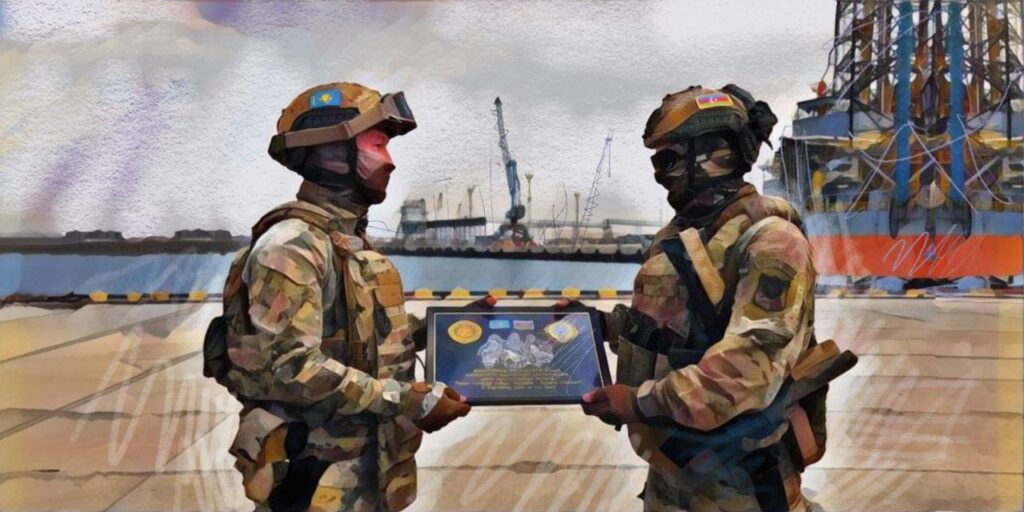
Just one month prior, the same waters hosted joint military exercises between Azerbaijan and Kazakhstan, held in Aktau, western Kazakhstan. These were followed by the “Tarlan-2025” air and tactical drills in Azerbaijan from July 8-10, which focused on enhancing UAV operations and military coordination.

Baku’s strategic alliance with Ankara is a key factor here. Azerbaijan, a close Turkish partner, is now engaged in a more strained relationship with Russia. Moscow’s muted reaction to this cooling suggests an awareness that Ankara is increasingly shaping a Turkic military-political bloc, an emerging force in a region of strategic importance to both Russia and China.

Earlier this month, Turkey launched its annual Anadolu-2025 special forces exercises. Participants included troops from 33 nations, Kazakhstan, Azerbaijan, Pakistan, Uzbekistan, and others but notably excluded Russia.

For the first time, in 2024, military exercises were held in the Caspian without Russian involvement. The Birleistik (Unity) 2024 drills were conducted at Kazakhstan’s Oymasha training ground and Cape Tokmak along the Caspian coast. Troops from Azerbaijan, Kazakhstan, Kyrgyzstan, Tajikistan, and Uzbekistan rehearsed scenarios including conflict zone identification, night maritime operations, and amphibious landings.

Previously, regional military cooperation had been limited to bilateral engagements, such as the 2023 UZAZ exercises (Azerbaijan-Uzbekistan), Kanzhar-2023 (Kazakhstan-Uzbekistan), and Hazri-2023 (Azerbaijan-Kazakhstan).

The spike in joint drills during 2024-2025 underscores growing rivalries between regional and global powers. These operations are not mere formalities but reveal emerging security alignments and geopolitical signals.

Three distinct blocs appear to be coalescing in the Caspian, with implications for Central Asia as well.

The first bloc includes Russia, Iran, and China. These nations have held annual “Maritime Security Belt” exercises since 2019, with the most recent in March 2025 off the Iranian coast.

The second bloc comprises Turkey, Azerbaijan, and members of the Organization of Turkic States (OTS). Defense ties among these countries are becoming a core element of OTS cooperation. At the 10th OTS Summit in Astana in 2023, Azerbaijani President Ilham Aliyev emphasized defense as the main guarantor of member state security, citing ongoing regional conflicts and violations of international law.

The third bloc, more pragmatic and focused, is the Kazakhstan-Azerbaijan partnership. These countries are cooperating on the basis of the 2018 Caspian Convention to secure maritime communications. Azerbaijan contributes military expertise, particularly in UAV and drone warfare developed during the Karabakh conflicts. Kazakhstan brings diplomatic credibility and promotes regional governance and connectivity, offering a stabilizing complement to Azerbaijan’s military strengths.

In sum, the Caspian Sea, once colloquially referred to as “Russia’s lake”, is steadily losing that identity. It is transforming into a contested strategic zone, where three competing security visions intersect. The risk of escalation is real.

Whether the Caspian remains a sea of cooperation or becomes a flashpoint of geopolitical strife may soon depend on decisions made far beyond its shores.


Kazakhstan and China Pilot Driverless Cargo Transport Project

Kazakhstan and China have  launched a pioneering pilot project called “Smart Customs,” which will enable the use of driverless vehicles to transport cargo across their shared border.

The program is currently being tested at the Bakhty (Kazakhstan) and Pokitu (China) border checkpoints. Its main goal is to streamline customs procedures using high-tech solutions, with autonomous trucks as the project’s central feature. These unmanned vehicles are designed to cross the border automatically, removing the need for human drivers.

The initiative was formalized during a working meeting between Zhandos Duisembiev, Chairman of Kazakhstan’s State Revenue Committee, and Zhixianwei, Party Secretary of the Chinese city of Tacheng in the Xinjiang Uyghur Autonomous Region. The two sides signed a cooperation agreement confirming their commitment to harmonize efforts, share expertise, and support digital innovation in logistics.

The Smart Customs system incorporates several advanced technologies:

  • A unified electronic declaration system recognized by both countries
  • Fully digitized documentation and data processing
  • Continuous, unmanned cargo movement across the border
  • Automated navigation and operational control

These innovations are expected to reduce border processing times, lower transportation costs, and improve operational transparency. The project also aims to support the development of logistics infrastructure along the border.

Key objectives of the initiative include:

  • Expanding annual cargo capacity to 10 million tons
  • Establishing logistics hubs to relieve pressure on current infrastructure
  • Creating employment opportunities and attracting investment
  • Increasing exports of Kazakhstani agricultural products, including grain, oilseeds, meat, and processed goods

According to Kazakhstan’s Ministry of Finance, the initiative is intended to strengthen the country’s position as a regional transit hub and to deepen trade relations with China.

Kazakhstan has previously faced criticism over delays in customs inspections. A study by the German Society for International Cooperation (GIZ) in late 2024 found Kazakhstan had the slowest inspection times among Central Asian countries, averaging 2 hours and 26 minutes per cargo inspection. In comparison, Turkmenistan averaged 50 minutes, Uzbekistan 1 hour and 25 minutes, Kyrgyzstan 1 hour and 28 minutes, and Tajikistan 1 hour and 50 minutes.

The rollout of Smart Customs is expected to significantly improve these statistics and help Kazakhstan match the efficiency of regional leaders in border processing.

Autonomous cross-border freight transport has also been explored by Russia and China. Previous plans aimed to launch driverless cargo operations across the new Blagoveshchensk–Heihe Bridge, although that  project has yet to materialize.

New Russian Regulations Halt Kazakhstan’s Black Sea Oil Exports

Kazakhstan has temporarily suspended oil exports via the Black Sea ports of Novorossiysk and Yuzhnaya Ozerovka due to newly enforced Russian regulations. The rules, which took effect on July 21, require foreign vessels entering Russian ports to receive prior approval from the Federal Security Service (FSB) and the port captain.

Strategic Ports, Vulnerable Logistics

According to Reuters, the new clearance procedures have effectively blocked shipments of Kazakh crude transported through the Caspian Pipeline Consortium (CPC) system. The disruption could reduce global oil supply by more than 2% (source).

Over 80% of Kazakhstan’s oil exports are shipped through terminals in Novorossiysk and Yuzhnaya Ozerovka. The primary export product is CPC Blend, produced by major Kazakh oil firms, including ventures with significant American corporate participation.

The decree by President Vladimir Putin, issued earlier this month, was introduced amid rising maritime threats. In 2025 alone, five tanker explosions have occurred in the region. One of the most serious incidents involved the tanker Koala, which was damaged in February while docked in the Russian port of Ust-Luga.

Despite suspicions, none of the targeted tankers were carrying Russian crude sold above the G7 price cap. Tracking data revealed that each vessel had visited ports used for Kazakh oil exports, which are not subject to Western sanctions, according to the Financial Times.

The CPC had planned to export 6.5 million tons of CPC Blend in August, maintaining the July level. Of that, 2.2 million tons were shipped via Novorossiysk.

Mounting Risks, Limited Alternatives

The security of Kazakhstan’s energy infrastructure is further threatened by ongoing regional instability. In February, seven Ukrainian drones attacked the CPC’s Krokotinskaya oil pumping station. While there were fears of a 30% drop in throughput, Kazakhstan’s Ministry of Energy denied any disruption, stating that “oil is being received according to schedule”.

Financial analyst Rasul Rysmambetov, writing on his Telegram channel ArtFinanze, urged restraint but acknowledged the seriousness of the situation: “If attacks on infrastructure continue, it will become increasingly difficult to protect the underwater pipeline system.”

He also warned that the involvement of Western firms such as Chevron may not deter further risks: “Contrary to popular belief, the participation of companies such as Chevron will not stop anyone. On the contrary, such infrastructure can be used to put pressure on entire countries”.

Currently, nearly all of Kazakhstan’s oil exports transit Russian territory. The CPC handles 80%, while another 13% flows through the Atyrau-Samara pipeline, connected to Russia’s Transneft system. The remaining 7% is routed via the Kazakhstan, China pipeline, the Baku-Tbilisi-Ceyhan (BTC) pipeline, and railways.

Even if capacity on the BTC route is expanded to 3 million tons annually, it would barely compensate for the over 60 million tons currently exported through the CPC system.

Despite frequent official calls for diversification since 2022, Kazakhstan’s oil export infrastructure remains acutely vulnerable, highly dependent on transit decisions made by foreign governments.

Kazakhstan Leads Central Asia in Latest Global Passport Rankings

Kazakhstan holds the most powerful passport in Central Asia, according to the latest update of the Henley Passport Index. The index ranks 199 passports by the number of destinations their holders can access without a prior visa. Kazakh citizens can now travel to 79 countries visa-free.

Following Kazakhstan in the regional ranking is Kyrgyzstan, whose passport ranks 73rd globally with access to 63 countries. Uzbekistan is close behind in 74th place, with 62 visa-free destinations. Tajikistan ranks 80th (56 countries), while Turkmenistan trails at 85th, with just 49 destinations accessible without a visa.

The Henley Passport Index calculates scores by awarding one point for each destination where no visa is required, or where travelers can obtain a visa on arrival, a visitor’s permit, or an electronic travel authorization. A score of zero is assigned if a visa is required prior to departure or if government pre-approval is needed for a visa on arrival.

On the global stage, Singapore retains the top spot for the second consecutive year, granting its passport holders visa-free access to 193 countries. Japan and South Korea share second place, each offering visa-free travel to 190 destinations. The top ten is dominated by European countries.

The Times of Central Asia previously reported on last year’s edition of the Henley Passport Index and its implications for mobility in the region.

Indian Regulator Flags Concerns About Uzbek University

India’s National Medical Commission (NMC) has issued a warning to Indian students regarding enrollment at the Chirchik branch of Tashkent State Medical University in Uzbekistan, as well as three medical schools in Belize.

As reported by The New Indian Express, the NMC cited multiple concerns, including alleged non-compliance with Indian medical education standards, subpar infrastructure, inadequate clinical training, high tuition fees, and instances of student harassment.

According to the NMC, all of the institutions in question “did not comply with Indian medical education standards, lacked adequate or functioning campus infrastructure, provided poor quality educational and clinical training, and had instances of harassment of Indian students.

Additionally, they reportedly charged excessive fees and refused refunds upon withdrawal from the course.”

In response, the Chirchik branch issued an official statement categorically denying the accusations, calling them “unfounded.” The university emphasized that it adheres strictly to academic and clinical guidelines established by Uzbekistan’s Ministry of Health and the World Federation for Medical Education (WFME).

Established by presidential decree in July 2023, the branch began full operations in December 2024. It currently enrolls 801 students, including five from India, alongside others from Jordan, Pakistan, and Egypt.

The university highlighted its modern facilities, which include fully equipped classrooms, laboratories, simulation centers, and student dormitories. “An open and transparent environment is created for students,” the statement read, underlining a commitment to academic freedom and equal treatment.

The Chirchik branch is listed in the World Directory of Medical Schools, jointly maintained by WFME and FAIMER. It offers English-language medical programs and maintains partnerships with several international universities and clinical institutions.

“We take the concerns raised by the NMC seriously,” the university stated. “However, we believe these claims are based on information that has not been verified locally and are unfounded.”

The university expressed openness to inspections and dialogue with Indian authorities and reassured students and families of its adherence to global academic standards. “We categorically reject attempts to damage our reputation,” the statement concluded.

German University Launches Bachelor’s Programs in Kazakhstan

Germany’s Anhalt University of Applied Sciences has opened a branch campus in Almaty, marking a new milestone in German-Kazakh educational cooperation. The new campus, based at Energo University, is now accepting applications for bachelor’s programs in Biomedical Engineering and Electrical Engineering and Information Technology.

The initiative is supported by Kazakhstan’s Ministry of Science and Higher Education and the German Consulate General in Almaty. According to the ministry, the programs were selected to align with current demands in Kazakhstan’s labor market. Graduates will receive dual diplomas, one from Anhalt University and one from a Kazakhstani institution.

A total of 100 state-funded scholarships will be awarded to students who qualify through a competitive selection process.

The Almaty campus features modern classrooms and laboratories equipped for practical and research-based instruction in electronics, biomedical science, and information technology.

“This is a large-scale initiative for young people in Kazakhstan who are eager to learn,” said Jörg Bagdahn, President of Anhalt University. “They now have the opportunity to obtain a German engineering degree without leaving their country.”

Courses will be taught by faculty from Germany, and German language instruction is included in the curriculum.

“Partnership with Anhalt University is a strategic step for Energo University,” said Rector Gani Cosmetology. “We are creating a platform to deliver top-tier European education locally.”


