• KGS/USD = 0.01144 0%
  • KZT/USD = 0.00212 0%
  • TJS/USD = 0.10456 0.19%
  • UZS/USD = 0.00008 0%
  • TMT/USD = 0.28490 0%
  • KGS/USD = 0.01144 0%
  • KZT/USD = 0.00212 0%
  • TJS/USD = 0.10456 0.19%
  • UZS/USD = 0.00008 0%
  • TMT/USD = 0.28490 0%
  • KGS/USD = 0.01144 0%
  • KZT/USD = 0.00212 0%
  • TJS/USD = 0.10456 0.19%
  • UZS/USD = 0.00008 0%
  • TMT/USD = 0.28490 0%
  • KGS/USD = 0.01144 0%
  • KZT/USD = 0.00212 0%
  • TJS/USD = 0.10456 0.19%
  • UZS/USD = 0.00008 0%
  • TMT/USD = 0.28490 0%
  • KGS/USD = 0.01144 0%
  • KZT/USD = 0.00212 0%
  • TJS/USD = 0.10456 0.19%
  • UZS/USD = 0.00008 0%
  • TMT/USD = 0.28490 0%
  • KGS/USD = 0.01144 0%
  • KZT/USD = 0.00212 0%
  • TJS/USD = 0.10456 0.19%
  • UZS/USD = 0.00008 0%
  • TMT/USD = 0.28490 0%
  • KGS/USD = 0.01144 0%
  • KZT/USD = 0.00212 0%
  • TJS/USD = 0.10456 0.19%
  • UZS/USD = 0.00008 0%
  • TMT/USD = 0.28490 0%
  • KGS/USD = 0.01144 0%
  • KZT/USD = 0.00212 0%
  • TJS/USD = 0.10456 0.19%
  • UZS/USD = 0.00008 0%
  • TMT/USD = 0.28490 0%

From Rare Collectibles to Mainstream Chic: The Suzani’s American Story

At the turn of the century, a suzani, the traditional embroidered textile from Central Asia, was almost impossible to find in the United States. These pieces, once given as dowries in Uzbekistan and Tajikistan, were the kind of object you might stumble upon in the back room of a rug gallery or in the private collection of a well-traveled dealer. To collectors, they were mysterious and precious, valued partly for their rarity as much as their beauty.

Today, in New York and across the U.S., suzanis are everywhere. They hang in boutique hotel lobbies, appear in glossy interior design magazines, and are sold by the dozen on Etsy and Instagram. The journey from rarity to ubiquity is both cause for celebration and reason for reflection, and reveals how cultural objects travel, are reinterpreted, and can carry heritage into new contexts.

Rooted in family life and ritual, suzanis were traditionally embroidered by brides with circular and floral motifs, each stitch carrying symbolic meaning. They were displayed at weddings, passed down through generations, and treasured as heirlooms, remaining within Central Asian households for centuries before appearing on international auction blocks or design blogs.

Shortly after the collapse of the Soviet Union, suzanis began appearing in the U.S., arriving primarily through Istanbul’s antique textile markets. These textiles – once private heirlooms – caught the eye of auction houses in London and New York as rare examples of artistry. As design editors and boutique retailers rediscovered their vibrant motifs and handmade quality, suzanis shifted from decorative obscurity to sought-after global accents.

Collectors quickly prized their vivid palettes and dense embroidery, and museums displayed them as artifacts of a little-known artistic tradition. At auction houses, the most exceptional pieces commanded astonishing prices. For instance, a Shakhrisabz (Green City) suzani from eighteenth-century Uzbekistan was recently valued at up to £50,000 ($67,000) at Sotheby’s in London. As someone who once ran a family Persian rug gallery in the Midwest, I remember the excitement when a genuine suzani appeared. It was almost mythical, a piece that drew genuine excitement from serious buyers and curiosity from casual visitors.

In New York, designers showcase suzanis as bedspreads, wall hangings, and upholstery, while fashion houses borrow their patterns for prints. The mainstream embrace is a sign that a once-overlooked textile is now celebrated as part of the city’s design vocabulary, and that Central Asian culture is being appreciated in new ways.

Hand-embroidered suzanis take months of work, with their thread tension, symbolic motifs, and slight irregularities forming part of their beauty. Machine-made copies, now sold widely online, mimic the look but erase the artistry; selling for a fraction of the price, they may look authentic but have no connection to Central Asian makers or traditions. Yet the enduring appeal of hand-stitched suzanis shows that authenticity continues to matter, and that the artistry behind these textiles cannot be replaced by machines.

As suzanis find their way into new settings, they show that traditions remain vibrant as they adapt and endure. Their symbols of prosperity and continuity still resonate, whether in a family home in Samarkand or a loft in Brooklyn. To see a suzani draped on a bed or hanging on a wall is to encounter art in its most accessible form, something born of ritual yet still able to transform modern spaces. Their presence in the U.S. is not a dilution but a widening of recognition, proof that living traditions adapt without losing their spirit.


Caspian Pipeline Consortium Workers Among Injured in Ukrainian Attack in Russia

Ukrainian drones struck Russia’s Black Sea port of Novorossiysk on Wednesday, killing at least two people and injuring others, including two employees of the Caspian Pipeline Consortium, according to Russian officials and the consortium. 

“The attack targeted the central part of the city, near the Novorossiysk hotel,” said Veniamin Kondratyev, governor of the Krasnodar Krai region in Russia. “Preliminary information reports two dead and three injured. Five residential buildings, including apartment buildings, as well as the hotel building, were damaged.”

Tass, the Russian state news agency, later reported that eight people were injured.

The Caspian Pipeline Consortium, which is critical to the export of oil from Kazakhstan, said its office was damaged in what it described as a “massive” attack.  

“Two company employees sustained injuries of varying severity and were transported to a medical facility. The administrative office’s work is temporarily suspended, and the staff has been evacuated,” said the consortium, also known as CPC.    

The drone strike also seriously injured people in the building who are not employees of the international crude oil transportation project, according to the CPC. 

Russia, Kazakhstan and major international oil and gas companies participate in the CPC project, which primarily delivers crude oil from western Kazakhstan as well as Russian producers to a marine terminal at Novorossiysk. There, it is loaded onto tankers for delivery to international markets. 

Ukraine has increasingly targeted Russia’s energy infrastructure with long-range drone attacks, raising concerns about the vulnerability of Kazakhstan’s oil industry to the long-running war.

Kazakhstan’s Rail Deal – A Long Way from Soviet-Era Locomotives

The roots of the $4.2 billion deal in which American firm Wabtec will provide 300 locomotives for Kazakhstan’s growing railway infrastructure emerged soon after the country’s 1991 independence, when the new government needed to upgrade its decaying Soviet-built locomotives. 

Pennsylvania-based GE Transportation, a major producer of railway equipment, helped with the modernization program in the mid-1990s and continued business with Kazakhstan in the following decades. In 2019, Wabtec, a transportation and technology company, bought GE Transportation. Wabtec celebrated the deal that was announced on Monday during Kazakh President Kassym-Jomart Tokayev’s visit to New York for the U.N. General Assembly. 

How big was the deal?   

The agreement has been described in different shades of magnitude. The U.S. Commerce Department said it was “the largest locomotive deal in history” – Wabtec said it was the largest in Wabtec’s history – and the Kazakh government and media have generally steered clear of historical references. 

Other big international railway deals include a 3 billion euro Siemens project in India that was announced in January 2023. Under that deal, the German company is to deliver 1,200 electric locomotives and provide 35 years of full service maintenance.

In March this year, France-based Alstom said it had delivered 500 electric locomotives to Indian Railways, part of a 3.5 billion euro contract to deliver 800 locomotives for freight service. That contract was signed in 2015. 

Who gets the credit? 

U.S. Commerce Secretary Howard Lutnick described the deal with Kazakhstan as “President Trump’s America First trade policy in action.”

Still, GE Transportation, which later became part of Wabtec, has been a key part of Kazakhstan’s railway industry for years. The company modernized hundreds of diesel freight locomotives decades ago and later transferred technology to Kazakhstan, developing engineering skills that could be used to build new trains.  

Wabtec acquired full ownership of a manufacturing facility in Astana in 2023 and says it has exported locomotives to countries including Tajikistan, Mongolia, Moldova and Ukraine.

“I mean, it’s great,” Evan A. Feigenbaum, a former U.S. State Department official, said of this week’s deal in a post on X. 

“But GE and Wabtec have been doing a locomotive business in and with Kazakhstan for 20 years. I was in the Bush Administration as the deputy assistant secretary of State overseeing Central Asia and was giving speeches and talks about locomotives and Kazakhstan back then…” Feigenbaum said. 

Kazakhstan’s decision to make a big agreement with Wabtec fits with its policy of developing ties with a wide range of diplomatic and business partners. Alstom, of Europe, and Chinese locomotive maker CRRC are also significant players in Kazakhstan’s railway industry. 

What does the deal mean for Kazakhstan?

A lot. Railways underpin the economy. Rail transport accounts for about 64% of Kazakhstan’s total freight turnover, far more than other forms of transport such as air and road, according to Kazakh railway officials. Kazakhstan is one of the biggest countries in the world, ranging from its Chinese and Russian borders in the east to the Caspian Sea in the west. 

Kazakhstan believes the deal will position it as a leader in the Eurasian transport technology market. Other countries stand to benefit as development of the so-called “Middle Corridor,” a trade route from China and Central Asia through the South Caucasus and into Europe, gains momentum. 

How about the environment? 

In a social media post about the locomotive deal, U.S. President Donald Trump said: “We need to support our U.S. Rail Industry, which has been attacked by Fake Environmentalists for years.” 

Electric trains are widely viewed as a cleaner, more efficient alternative to diesel locomotives. However, Wabtec says the diesel locomotives from its Evolution Series that are earmarked for Kazakhstan “will improve fuel efficiency and operate for longer periods between maintenance overhauls.”

Also, the rollout of all-electric models could pose additional infrastructure challenges for Kazakhstan, which is already making some electric locomotives with the help of the Alstom company.  

Kazakhstan Temir Zholy, Kazakhstan’s national railway company, said in its 2024 report that rail transport is “one of the most environmentally friendly modes of transportation,” while acknowledging that it can contribute to pollutant emissions, a negative impact on ecosystems and noise pollution. It said it was making progress, reducing emissions by 1.6% to 62,900 tons between 2023 and 2024.

Kazakhstan and Germany Launch Mining and Metallurgy Consortium

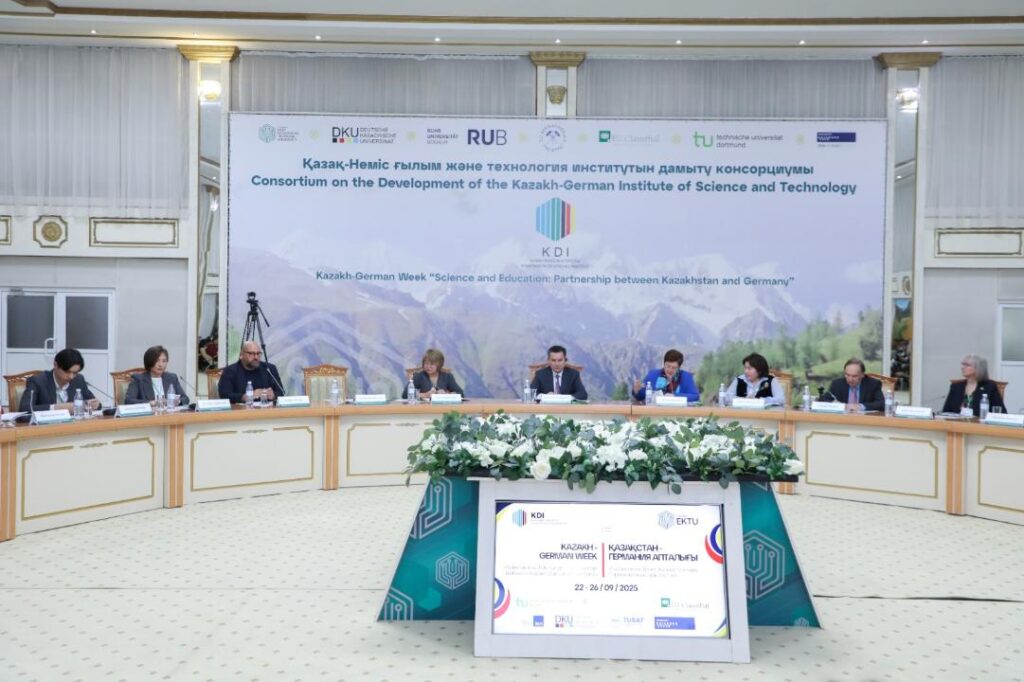
The second Kazakh-German Week, Science and Education: Partnership between Kazakhstan and Germany, opened on September 23 at Serikbayev East Kazakhstan Technical University in Oskemen (Ust-Kamenogorsk), the industrial heart of East Kazakhstan region and a key hub for the country’s mining and metallurgical sector.

A major outcome of the opening ceremony was the establishment of the Consortium for the Development of the Kazakh-German Institute of Science and Technology. The institute, launched in 2024 at East Kazakhstan Technical University, focuses on specialized training for professionals in mining and metallurgy.

The new Consortium brings together leading academic institutions from both countries, including Serikbayev East Kazakhstan Technical University, Kazakh-German University, Technische Universität Bergakademie Freiberg (Freiberg University of Mining and Technology), Ruhr University Bochum, Clausthal University of Technology, Technical University of Dortmund, and the University of Duisburg-Essen.

Its mission is to promote joint research, academic exchange, technology transfer, and applied projects across critical industrial domains such as mining, geology, rare earth metals, energy, and environmental engineering.

Key industrial players in East Kazakhstan, including Kazzinc, the Ust-Kamenogorsk Titanium and Magnesium Plant, and the Ulba Metallurgical Plant, are actively supporting the initiative through applied science and innovation partnerships.

In a video address, Minister of Science and Higher Education Sayasat Nurbek emphasized that German universities remain strategic partners for Kazakhstan in developing a future-ready workforce.

Officials noted that the consortium’s launch holds particular significance for East Kazakhstan, where mining and metallurgy form a cornerstone of the national industrial economy. Long-term sustainability in the sector, they said, will depend on the integration of science, innovation, and high-level technical education.

Kazakhstan Enforces Fuel Export Ban

Kazakhstan’s Ministry of Energy has confirmed that the country’s six-month ban on fuel exports remains in full effect, with no gasoline shipments currently sent to Uzbekistan or other neighboring countries.

Officials acknowledged a single exception earlier this year, when surplus volumes of AI-92 gasoline were exported to Uzbekistan in the spring. The ministry characterized the shipment as a routine measure aligned with international practice, designed to optimize domestic storage and increase tax revenues.

Since June, all fuel exports have been suspended to build strategic reserves ahead of scheduled maintenance at Kazakhstan’s oil refineries. The ban, introduced on May 19, covers gasoline, diesel, and other petroleum products.

Reports of Fuel Shortages and Smuggling

Speculation over renewed fuel shortages in Kazakhstan surfaced in local media on September 22, with reports citing illegal cross-border smuggling as a contributing factor. Some sources also claimed that Uzbekistan had increased purchases of Kazakh gasoline amid a decline in fuel imports from Russia.

In response, the Ministry of Energy reiterated that no current fuel exports are taking place and emphasized that the export moratorium is being strictly enforced.

Uzbekistan’s Fuel Market in Transition

Uzbekistan’s state energy company Uzbekneftegaz recently announced plans to phase out production of AI-80 gasoline starting in September. Beginning in 2026, the country intends to supply only higher-octane grades, including AI-92 and AI-95, to align with international fuel standards.

The regional fuel market has already undergone significant restructuring. In April 2024, the Telegram channel Oil & Gas of Kazakhstan reported that Uzbekistan was scaling back crude oil imports from Kazakhstan in favor of cheaper Russian supplies.

During the first quarter of 2024, Uzbek companies imported 15,200 tons of crude oil from Kazakhstan by rail, down from 25,600 tons during the same period in 2023. Most of this volume was refined at the Ferghana plant.

Meanwhile, Russia’s Gazprom Neft significantly expanded deliveries to Uzbekistan. In the first quarter of 2024, the company shipped 75,000 tons of crude via pipelines through Kazakhstan, nearly seven times more than the 10,700 tons delivered a year earlier.

From Reform to Deals: Central Asia Steps Onto the Global Stage at UNGA-80

Ecology, global instability, and the need for UN reform dominated the speeches of all five Central Asian presidents at the 80th session of the UN General Assembly. Presenting a united front while emphasizing national priorities, the leaders made clear that Central Asia intends to play a pivotal role in shaping the global future.

UN Reform

Kazakh President Kassym-Jomart Tokayev was the first among the CIS leaders to address the assembly, speaking of a growing crisis of trust in multilateral institutions and calling for sweeping reforms. Tokayev emphasized the need to expand the UN Security Council, arguing that major powers from Asia, Africa, and Latin America must receive rotational representation, and that the influence of middle powers should be strengthened.

“We need to create a new group of like-minded states that will professionally and decisively advance concrete proposals for reforming the UN so that it better responds to today’s challenges and tomorrow’s tasks,” he said, proposing Kazakhstan as a platform for these discussions.

Uzbek President Shavkat Mirziyoyev echoed these concerns, highlighting the weakening of international institutions and the proliferation of global conflicts. He endorsed UN Secretary-General António Guterres’ UN-80 initiative and voiced support for the Pact for the Future, which sets out commitments to strengthen multilateral cooperation and address global challenges through 2045, the UN’s centenary. Mirziyoyev also advocated for an expanded Security Council to better represent developing countries.

In his address, Kyrgyz President Sadyr Japarov called for a more just and representative Security Council, underscoring Africa’s right to greater participation. He also announced Kyrgyzstan’s candidacy for a non-permanent seat on the Security Council for 2027-2028, noting that his country has never before held such a position.

Tajik President Emomali Rahmon warned of growing instability, uncertainty, and complexity in world affairs. Rahmon stressed the UN’s role as a platform for dialogue and cooperation and called for equal partnerships between large and small states to restore adherence to international law.

Turkmen President Serdar Berdimuhamedov argued that the current global situation requires a “decisive shift toward coordinated interaction among states and international organizations to maintain peace and security.” He proposed declaring 2028 the Year of International Law to strengthen the legal foundations of global cooperation.

Ecology and Finance

On environmental issues, the Central Asian leaders focused on national and regional concerns. Tokayev addressed the ongoing shallowing of the Caspian Sea, while both he and Mirziyoyev raised the issue of the Aral Sea crisis, often described as “one of the world’s worst environmental disasters.” Rahmon highlighted the rapid disappearance of glaciers, a point supported by Japarov, given the critical dependence of Kyrgyzstan and Tajikistan on mountain water resources. Berdimuhamedov, meanwhile, proposed establishing a regional center for combating desertification in Central Asia. Other initiatives included the proposed Caspian Environmental Forum in 2026 and continued advancement of the Caspian Environmental Initiative, originally introduced by Ashgabat.

Financial concerns were also prominent. Rahmon called for reforms to international financial mechanisms, citing the continued suffering of vulnerable developing countries from the impacts of economic crises, poverty, disease, natural disasters, and food insecurity.

Japarov criticized the impact of unilateral sanctions on Kyrgyzstan’s financial system and accused Western nations of hypocrisy. “You demand that we stop cooperating with Russia, while you yourselves are actively developing trade and economic ties with it,” he said.

Japarov also demanded the return of Afghanistan’s frozen assets, arguing that withholding financial aid is unacceptable. More than $9 billion is held by Western nations, he claimed, and should be released to support Afghanistan’s reconstruction, banking sector, and agricultural development. “You use these funds and profit from them,” Japarov said, highlighting that over 15 million Afghans face hunger, while 24 million require humanitarian aid.

Major Deals

Uzbek President Shavkat Mirziyoyev and Kazakh President Kassym-Jomart Tokayev also drew the attention of U.S. President Donald Trump. During a meeting with Mirziyoyev, Trump praised a reported $105 billion deal for the purchase of American goods, including 22 Boeing aircraft. “They have a lot of money. A lot of oil and a lot of money,” Trump remarked.

Trump had earlier spoken by phone with Tokayev in a call facilitated by U.S. Commerce Secretary Howard Latnik. “I just concluded a wonderful call with the Highly Respected President of Kazakhstan, Kassym-Jomart Kemeluly Tokayev. They have signed the largest Railroad Equipment Purchase in History, $4 Billion Dollars’ Worth of United States Locomotives and Rail Equipment,” Trump wrote on Truth Social.

Currently struggling to meet global demand, Boeing has yet to deliver Kazakhstan’s long-awaited Dreamliner aircraft.

According to a statement issued by the Kazakh president’s press service, the $4.2 billion agreement with U.S. company Wabtec involves the production of 300 freight locomotives with upgraded specifications, along with long-term servicing within Kazakhstan.

“Wabtec, a recognized global leader in transport technologies, is one of the key partners in modernizing Kazakhstan’s railway industry. Since 2009, the Wabtec Kazakhstan locomotive assembly plant has been operating successfully in Astana. During this period, the company has invested over $230 million. The plant has produced more than 600 locomotives for Kazakhstan Temir Zholy and for export, achieving a localization level of 45%. In July 2024, Wabtec opened a Technology and Engineering Center in Kazakhstan, serving as a platform for innovation and workforce training,” the Akorda press release stated.

The locomotive deal underscores Kazakhstan’s growing role as a hub for localized U.S. technology and transport innovation. By expanding assembly and engineering capacity in Astana, Wabtec is embedding long-term cooperation into Kazakhstan’s industrial base. Meanwhile, Uzbekistan’s Boeing purchase highlights the region’s rising demand for modern aviation infrastructure. Taken together, these agreements signal a deepening U.S. economic footprint in Central Asia, rooted in high-value sectors such as transport and aviation.

A Collective Voice

From UN reform to ecology and major economic deals, Central Asia’s leaders used the UNGA-80 platform to project a stronger regional stance on global challenges. Their calls for reform, combined with multibillion-dollar agreements, underscored the region’s ambition to move beyond balancing external powers toward shaping the international agenda. In doing so, they signaled that Central Asia is seeking recognition, not as a peripheral actor, but as an emerging force in global governance.