The world is reverting to the logic of bloc confrontation. Sanctions regimes, technological barriers, and deepening mistrust between major powers are compelling medium-sized states to chart independent courses. Kazakhstan stands at the center of this evolving geopolitical matrix.
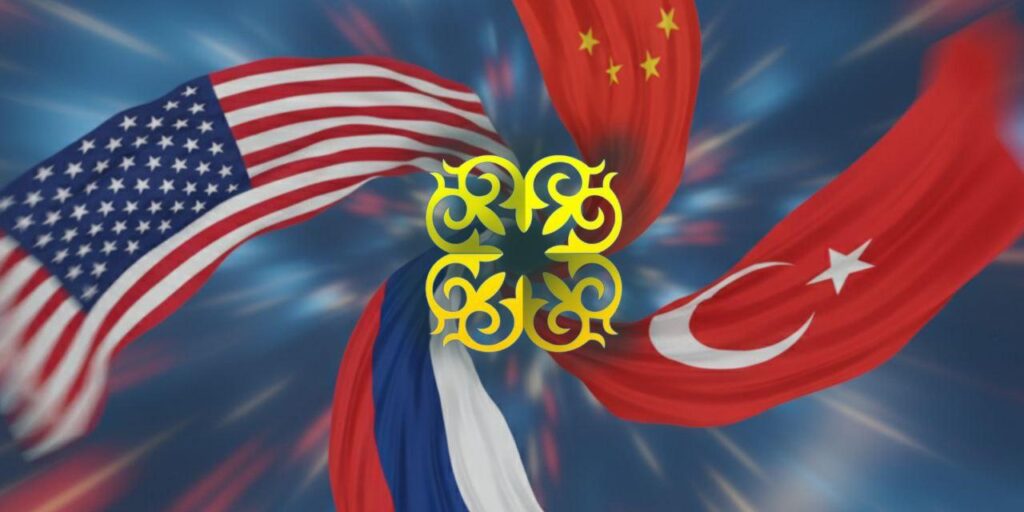
While Moscow remains a vital partner in defense and energy, Astana is simultaneously cultivating strong ties with other global power centers, including China, the U.S., Turkey, the European Union, and the Gulf states. Yet Kazakhstan refuses to align with any single bloc, adhering instead to a strategy of “flexible autonomy”, cooperating broadly while preserving its sovereignty.
Russia: Alliance with Strategic Boundaries
On November 11-12, 2025, President Kassym-Jomart Tokayev met with Russian President Vladimir Putin in Moscow. The two leaders signed a declaration on a comprehensive strategic partnership and alliance, reaffirming cooperation on security, energy, and logistics projects.
Key discussions included the gasification of border regions, the modernization of energy infrastructure, and the transit of Russian energy via Kazakhstan. Tokayev emphasized Kazakhstan’s interest in a stable and prosperous Russia, calling Putin a “statesman of global stature.”
Still, this alignment does not supplant Kazakhstan’s multi-vector policy. The Moscow visit directly followed Tokayev’s talks in Washington, underscoring that Astana views relations with Russia as one of several strategic pillars.
The U.S.: Investment and Critical Minerals Diplomacy
During Tokayev’s visit to the U.S. in early November 2025, he and President Donald Trump oversaw the signing of 29 agreements totaling approximately $17 billion. The deals spanned industry, energy, digitalization, education, and innovation.
Highlights in recent collaboration between Kazakhstan and the U.S. include a $2.5 billion John Deere production facility in Kostanay and Turkestan, a $1.1 billion development of tungsten deposits, and over $1 billion in digital infrastructure cooperation with companies such as Hewlett Packard Enterprise, Oracle, and Starlink. Leading global funds also pledged roughly $1 billion in new investments.
These agreements reflect growing trust and a shared commitment to investment-driven, high-tech cooperation.
China: Strategic Synergy and Technological Convergence
China remains Kazakhstan’s largest trading partner and a cornerstone of its eastern vector. During Tokayev’s October 17, 2023 visit to Beijing, he and President Xi Jinping reaffirmed a “comprehensive strategic partnership” built on political trust and economic cooperation.
In June 2025, Xi Jinping visited Astana for the second China-Central Asia Summit, where he and Kassym‑Jomart Tokayev reinforced their countries’ “comprehensive strategic partnership”, oversaw deals spanning energy, infrastructure, agriculture, and digital technology. Later that year, at the Shanghai Cooperation Organisation summit in Tianjin, the two leaders used the platform to deepen cooperation within a multilateral framework, promoting connectivity and regional trade under the Belt and Road Initiative.
Turkey: Civilizational Ties and Strategic Growth
Ties between Kazakhstan and Turkey are underpinned by shared cultural and historical foundations. At the fifth High-Level Strategic Cooperation Council meeting in Ankara on July 29, 2025, President Recep Tayyip Erdoğan welcomed Tokayev, reaffirming Turkey’s role as a major investor and educational partner.
More than 12,000 Kazakh students are enrolled in Turkish universities. Defense cooperation is expanding under the Organization of Turkic States (OTS), and tourism and humanitarian ties remain robust. Turkey thus anchors Kazakhstan’s Turkic vector, bolstering its role as a bridge between Europe, Asia, and the Islamic world.
Central Asia: Regional Consolidation and Strategic Autonomy
Central Asian cooperation is a pillar of Kazakhstan’s foreign policy. Astana views regional integration not as an alternative to global engagement but as its foundation.
Kazakhstan promotes the development of regional electricity markets, climate coordination, and transnational energy corridors. Consultative formats and dialogue platforms serve to build trust, enabling the region to face external turbulence with collective resilience.
Europe, Asia, and the Caucasus: Broadening Investment and Infrastructure Ties
The European Union remains Kazakhstan’s largest trading partner and major investor. Initiatives under the Global Gateway and EU-Central Asia Energy Dialogue support green transition goals, critical minerals development, and infrastructure upgrades.
East Asia is a key source of technological modernization. South Korea ranks among the top five investors in Kazakhstan, while with its “trust-building diplomacy” approach, Japan is engaged in ecological and energy cooperation. Kazakhstan is also strengthening energy and transport ties with India through the North-South corridor.
In the South Caucasus, Azerbaijan is an important strategic partner. Kazakh oil transits via the Baku-Tbilisi-Ceyhan pipeline, and the ports of Aktau, Alyat, and Batumi in Georgia serve as vital links to the Black Sea and Mediterranean.
Arab States: Energy Diplomacy and Islamic Finance
Kazakhstan is deepening ties with the UAE, Qatar, and Saudi Arabia through renewable energy, port development, and financial cooperation. The 1 GW Masdar wind project in Zhambyl is a striking example of joint energy infrastructure.
Iran remains a pragmatic transit partner, facilitating trade through the North-South corridor and contributing to Caspian Sea ecological preservation efforts.
Multilateralism: Diplomacy as National Identity
Kazakhstan’s multi-vectorism is closely tied to its leadership in multilateral institutions. The country plays an active role in the UN, OSCE, SCO, EAEU, OIC, CSTO, and CICA. Its diplomacy is centered on peace, nuclear non-proliferation, and interreligious dialogue.
Tokayev’s previous tenure as UN Deputy Secretary-General and Director-General of the Geneva Office further enhanced Kazakhstan’s global profile, and his experience lends credibility to the country’s commitment to resolving global conflicts and promoting sustainable development.
A Middle Power in Motion
Under Tokayev, Kazakhstan’s multi-vector policy has blossomed. The country skillfully balances partnerships with Russia, China, the U.S., and Europe, while deepening ties with Turkic, Arab, and regional partners.
Rather than serving as a buffer, Kazakhstan aspires to be a mediator, one that prioritizes diplomacy, sustainability, and shared growth. In the emerging global order, it is positioning itself as a unifying force, where influence derives not from military might, but from the ability to connect.
The views expressed in this article are those of the author and do not necessarily reflect the official policy or position of the publication, its affiliates, or any other organizations mentioned.