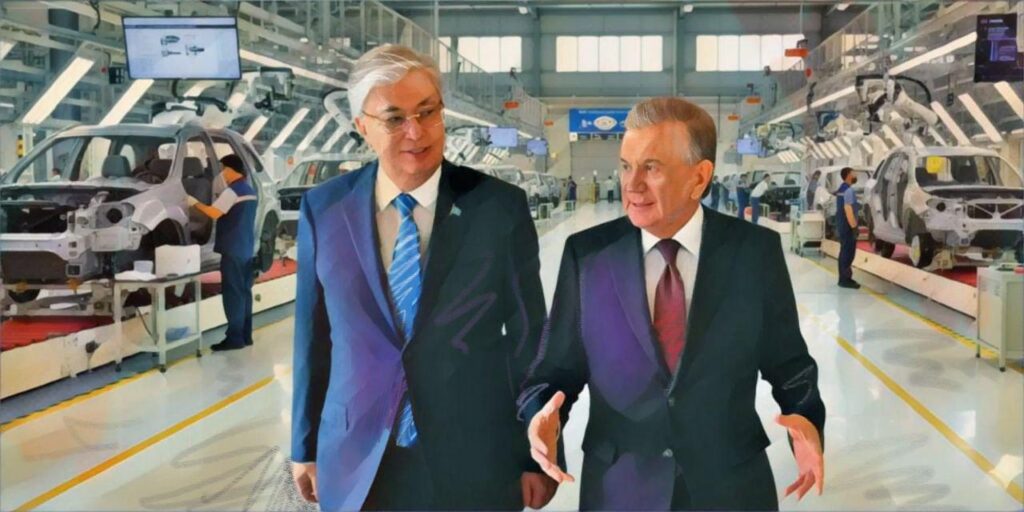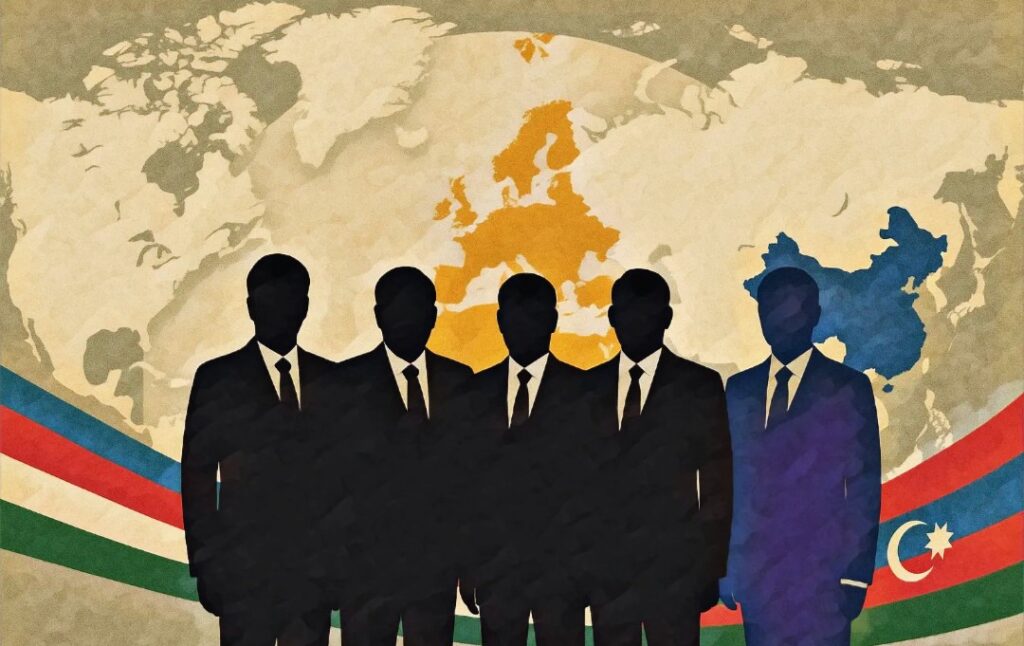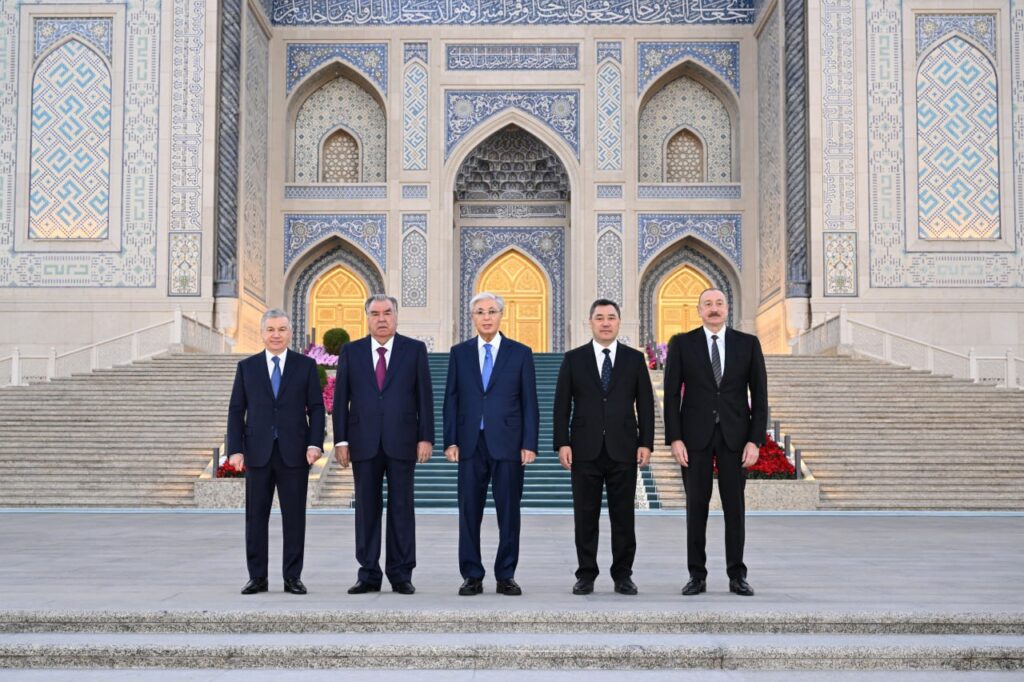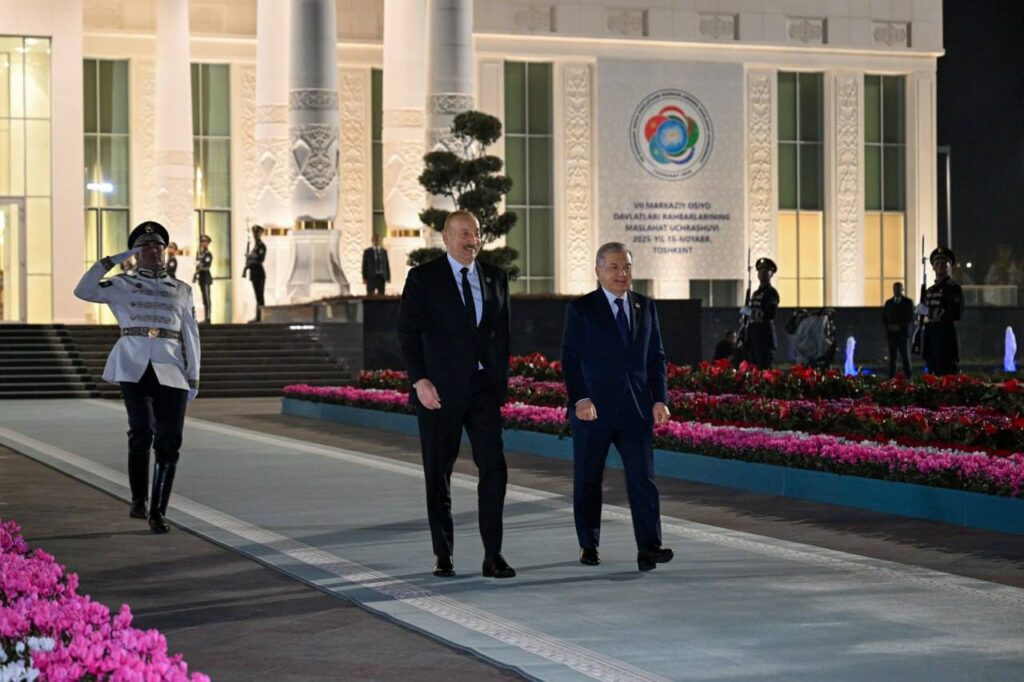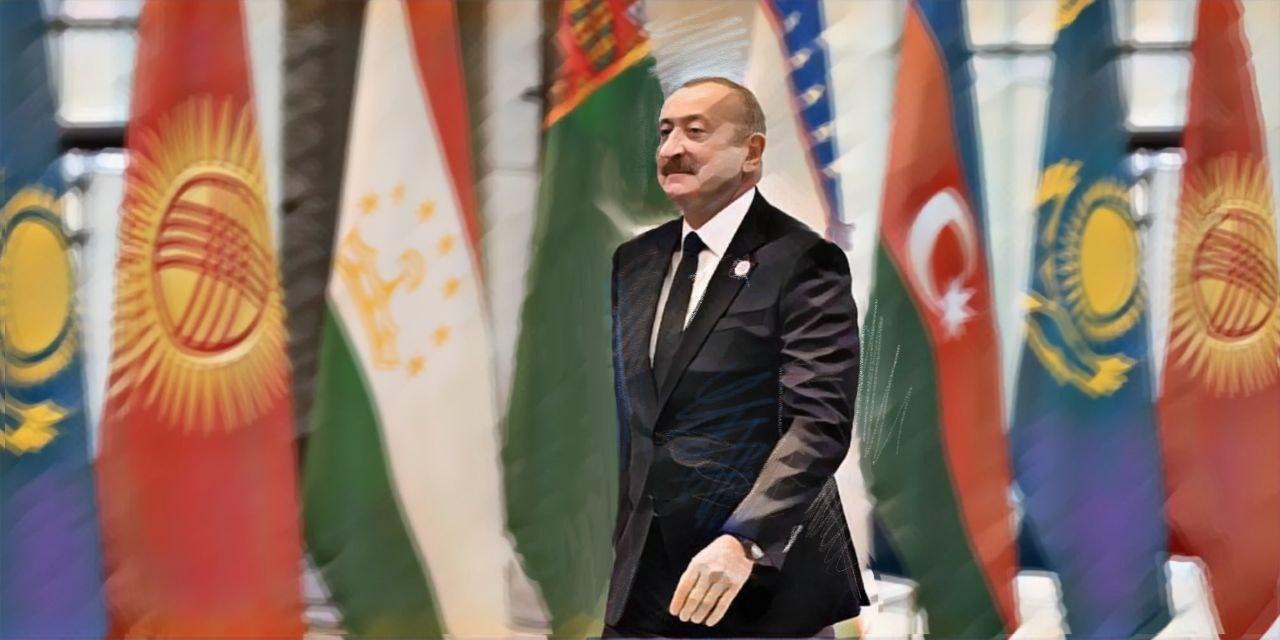
Central Asian leaders met in Tashkent on November 15–16 for the seventh Consultative Meeting of Heads of State. Azerbaijan attended as a guest with full rights, as it had done at the meetings last year and the year before. This time, the leaders agreed that Azerbaijan would sit as a full participant in future meetings, transforming the C5 into the C6. In his opening remarks, Uzbekistan’s President Shavkat Mirziyoyev proposed turning the loose consultative mechanism into a formal regional body under the working title, the “Community of Central Asia.”
Mirziyoyev went further and suggested extending the mandate from economic integration to include security and environmental cooperation for the region as a whole. The Uzbek President called the decision to admit Azerbaijan “historic,” as the leaders framed the welcoming of Azerbaijan not as a courtesy to a neighbor but as part of a wider integration project that already runs across the Caspian and that is now seeking to bring a South Caucasus transit and energy hub directly into the frame.
The consultative format is thus being asked to carry a heavier load than when it was created in 2018 as a careful space for political dialogue and security confidence-building. For governments and external partners, the practical question is whether this emerging “Central Asia plus Azerbaijan” geometry can evolve into a corridor community with its own regional rules, or whether it will remain largely declaratory while decisions continue to track external finance and great-power projects.
Azerbaijan and Central Asia Begin to Co-Author the Agenda
From the start, the consultative meetings of the Central Asian heads of state were conceived as a modest, leader-level forum to ease regional tensions and reopen direct dialogue after a decade of drift. The first gathering in Astana in March 2018 focused on borders, water management, and security issues that had festered since the 1990s, and that format’s agenda had mainly remained focused on political reconciliation and crisis management. The seventh meeting in Tashkent was different in kind. By bringing Azerbaijan formally into the room on a continuing rather than one-off basis, and by placing corridor and digital questions at the center of proceedings rather than on the margins, it reframed the forum from an inward-looking confidence-building device into a platform that aspires to shape external connectivity.
Azerbaijan’s presence at earlier summits in 2023 and 2024 created a transitional phase in which Baku could test how far its own transit and energy agenda resonated with Central Asian priorities. In Tashkent, that ambiguity effectively ended. President Ilham Aliyev’s speech, delivered after the leaders had agreed that Azerbaijan would participate in future meetings as a full member, described Central Asia and Azerbaijan as forming “a single geopolitical and geo-economic region whose importance in the world is steadily growing.” He tied that claim to concrete developments along the Middle Corridor segment through Azerbaijan, the Alat port complex, upgraded customs procedures, and cross-Caspian energy and data links.
For Kazakhstan, the Tashkent meeting offered a complementary opportunity. President Kassym-Jomart Tokayev used his speech to propose the joint drafting of a comprehensive strategy for the development of Central Asia’s transport system explicitly anchored in the consultative format. In a separate passage, he called for work on a declaration on the responsible use of artificial intelligence by Central Asian states. Considered together, the two proposals pushed the consultative format into domains where rules and standards matter as much as physical infrastructure, and where external actors already compete to set the terms.
Dual Anchors and Moving Parts
The UN Special Program for the Economies of Central Asia (SPECA) illustrates how this C6 geometry has existed quietly on paper. Its membership already consists of the five Central Asian republics plus Azerbaijan. In November 2023, the SPECA Governing Council meeting in Baku agreed to establish a multi-partner trust fund and endorsed a roadmap for the digitalization of multimodal data and document exchange along the Trans-Caspian route. In the subsequent Baku Declaration, the states affirmed their intention to enhance SPECA’s role as a platform for economic cooperation and continuous dialogue. What the Tashkent meeting does is to bring the same six states into a political format at the head-of-state level, aligning that forum with corridor and digital issues where SPECA has already done some groundwork.
External finance, however, still runs primarily through Kazakhstan. The European Union’s Global Gateway initiative pledged a total of €10 billion for the Trans-Caspian route at an investors’ forum in early 2024, followed by an additional €12 billion package for Central Asia announced at the first EU–Central Asia summit in Samarkand in April 2025. Of that second package, around €3 billion was earmarked explicitly for transport connections that include Middle Corridor segments. Much of the concrete project pipeline is in Kazakhstan, with the Asian Infrastructure Investment Bank targeting upgrades to key east–west sections and multimodal nodes, while EBRD and EU co-financing is going into the expansion of the country’s inherited mainlines of Caspian ports and associated logistics facilities.
That pattern creates a structural asymmetry that the new C6 format will either reinforce or partially correct. Azerbaijan’s advantage lies in the transshipment hub at Alat, its stakes and operational roles in regional pipelines, and the ability to couple physical transit with undersea fiber and power cables, while Kazakhstan can convene financiers around large-ticket rail and terminal projects on its territory. If the C6 leaders choose to treat this configuration, with SPECA’s help, as a corridor governance core, they can link access to joint standards on tariffs, customs IT, and digital data flows. Azerbaijan and Kazakhstan would become system integrators for the wider region.
Beyond the Caspian Core
The C6 configuration still sits within a wider field of competing and complementary routes. One is the China–Kyrgyzstan–Uzbekistan (CKU) railway, where Beijing, Bishkek, and Tashkent approved a trilateral pact in June 2024 to move from concept to construction, with work already underway on this shorter path offering a direct rail window into China and back to Europe via existing links through Kazakhstan and the Caspian. The railway would reduce Kazakhstan’s monopoly over east–west rail access inside Central Asia without displacing it.
A second family of routes runs south through Afghanistan toward Pakistani ports. Uzbekistan has promoted a Trans-Afghan railway since 2018, and in July 2025, the three governments signed an agreement to accelerate the project, which would extend Afghanistan’s rail network from Mazar-i-Sharif through Kabul and onward to the Torkham crossing and Peshawar. The risk calculus is straightforward: financing, security, and sanctions issues are all more complex than on the Caspian route, which is why Trans-Afghan plans move forward in bursts and pauses rather than on a steady timetable.
Turkmenistan’s gradually changing situation adds another degree of institutional and routing complexity. The EU and Turkmenistan now present the country as a key partner in the Trans-Caspian transport corridor, with European officials visiting Turkmenbashi port under the Global Gateway banner and speaking of support for infrastructure modernization and alignment of standards. In parallel, Turkmenistan has joined Azerbaijan, Georgia, and Romania in advancing a Turkmenbashi–Baku–Black Sea–Constanța route that would add yet another Caspian leg to the wider corridor system. For the new C6 configuration, this means that corridor policy is no longer a purely regional matter: every choice about standards or investment priorities inside the Caspian core interacts with alternative routes that pull traffic east, south, and west at the same time.
A Turning Point for Regional Integration
The Tashkent summit marks a clear shift in how Central Asian leaders present their own role in the region’s connectivity. A forum that began in 2018 as a cautious device for rebuilding trust and talking through old disputes has now been asked to carry a different weight. By bringing Azerbaijan fully into the format and by centering corridor, digital, and technology issues in the discussion, the heads of state have drawn a line under the idea that transit is merely an external project imposed from outside.
The emerging C6 geometry treats the Middle Corridor and related links as a joint asset, yet the practical test will come in how the C6 handles the growing tangle of alternative routes pressing in from every side. The CKU, Trans-Afghan lines to Pakistani ports, the north–south axis through Iran, and new initiatives around Turkmenbashi all compete for cargo, financing, and political attention. A corridor community worthy of the name would use the new political format to align those options with shared regional priorities, rather than letting each project proceed according to its own logic.