• KGS/USD = 0.01144 0%
  • KZT/USD = 0.00194 0%
  • TJS/USD = 0.10841 0%
  • UZS/USD = 0.00008 0%
  • TMT/USD = 0.28571 0%
  • KGS/USD = 0.01144 0%
  • KZT/USD = 0.00194 0%
  • TJS/USD = 0.10841 0%
  • UZS/USD = 0.00008 0%
  • TMT/USD = 0.28571 0%
  • KGS/USD = 0.01144 0%
  • KZT/USD = 0.00194 0%
  • TJS/USD = 0.10841 0%
  • UZS/USD = 0.00008 0%
  • TMT/USD = 0.28571 0%
  • KGS/USD = 0.01144 0%
  • KZT/USD = 0.00194 0%
  • TJS/USD = 0.10841 0%
  • UZS/USD = 0.00008 0%
  • TMT/USD = 0.28571 0%
  • KGS/USD = 0.01144 0%
  • KZT/USD = 0.00194 0%
  • TJS/USD = 0.10841 0%
  • UZS/USD = 0.00008 0%
  • TMT/USD = 0.28571 0%
  • KGS/USD = 0.01144 0%
  • KZT/USD = 0.00194 0%
  • TJS/USD = 0.10841 0%
  • UZS/USD = 0.00008 0%
  • TMT/USD = 0.28571 0%
  • KGS/USD = 0.01144 0%
  • KZT/USD = 0.00194 0%
  • TJS/USD = 0.10841 0%
  • UZS/USD = 0.00008 0%
  • TMT/USD = 0.28571 0%
  • KGS/USD = 0.01144 0%
  • KZT/USD = 0.00194 0%
  • TJS/USD = 0.10841 0%
  • UZS/USD = 0.00008 0%
  • TMT/USD = 0.28571 0%
18 December 2025

Strained Currents: Managing the Syr Darya’s Waters

On both banks of the Syr Darya, apartments are springing up. The embankment itself is undergoing extensive renovation. Trucks crawl along, their weight pounding the freshly lain asphalt into shape. Its acrid whiff rankles in the nose for some distance.

Kyzylorda’s new Akim, Nurzhan Akhatov, appointed in August 2024, is determined to make the most of his short term in office, explains Kanat Utegenov, founder of LLP ECO GUARD, an ecological laboratory. This makes the new landscaping important.

“There is a lot of construction… it is visually noticeable to the population,” he told The Times of Central Asia. “Unfortunately, the economics of it have not necessarily been calculated.” Utegenov cites a new stadium on the left bank of the river as an example of one of these potential white elephant projects.

Worse still, all this landscaping is dependent on one critical factor which is only partly under the control of the Akim, and only partly under the control of Kazakhstan. That issue is water.

The low-running Syr Darya passing through Kyzylorda, Kazakhstan; image: TCA, Joe Luc Barnes

In late April, the view that a ritzy new apartment buys you is one of sad, sandy banks. Wading birds plod methodically through the mud, looking for worms. The dirty grey river does not so much flow but keeps up a ponderous momentum, inching its way northwest. Some of this water will reach the North Aral Sea, which is being propped up on life support by the Kokaral Dam.

Utegenov attributes the low water level as being partly due to climatic change. “Winter has become milder and almost snowless,” he said, adding that it’s not unusual to see a low river in spring. “This is when the rice is planted; all the water goes to the irrigation canals.”

Governments across the region are doubling down on rice production, says Bulat Yessekin, an expert on environmental and water policy in Central Asia. However, he points out that growing rice is incredibly inefficient in this part of the world. “If we take into account the full irrigation cycle, five tons (5,000 liters) of water are used to cultivate just one kilo of rice,” he told TCA.

However, Kazakhstan’s government is keen to trumpet successes. The use of laser leveling technology in rice fields has helped save over 200 billion liters of water by distributing it more evenly. According to Kazakh state media, this has meant that the yield from each hectare of rice crop has increased by around 60-70%.

This has done little to convince Yessekin, who believes this is little more than a sticking plaster. “There was no such need for technology before as there was enough water. Now, such technology has become necessary because otherwise, they will simply not be able to grow the crop. In countries with much greater precipitation, such as Thailand or India, you can grow it, but here there are no prospects for rice. Sooner or later people need to move to other crops.”

Yessekin argues that the use of technological quick fixes demonstrates that the authorities have a paradigm issue. “All these technologies for saving water… their purpose is not water conservation or replenishment; it is simply to increase water intake.”

The Kokaral Dam; image: TCA, Stephen M. Bland

The flaw in focusing on “water intake” rather than “water conservation” can be seen a few hundred kilometers west of Kyzylorda, where the remains of the Aral Sea fester like a sore in the heart of Central Asia.

Two rivers flow into the Aral Sea: the Syr Darya, and its sister to the south, the Amu Darya. Each has seen its throughflow decline precipitously over the last century, both in the Soviet and independence eras.

Managing the flow of the Syr Darya requires the coordination of four countries: from its sources in Kyrgyzstan’s mountains, the river flows through Uzbekistan and Tajikistan before reaching Kazakhstan.

Every year, these countries agree on a quota for how much water they can drain from the river. Last year, Kazakhstan and Uzbekistan agreed to install digital monitoring stations to more precisely measure these flows.

For these four thirsty nations, the negotiations are complex, particularly as the river passes through the densely populated Ferghana Valley. Most of the Syr Darya’s waters are therefore allocated to Uzbekistan, the most populous country along its course.

Last year, given unexpectedly heavy rainfall, no country came close to using its limit, and more water than expected reached the Aral Sea.

Water user Water volume, km³
BWO schedule/limit Actual
1. Total water withdrawal (in the reach up to Shardara reservoir) 11.90 9.85
2. By country:
– Kyrgyz Republic 0.270 0.244
– Republic of Uzbekistan 8.800 7.566
– Republic of Tajikistan 1.905 1.312
– Republic of Kazakhstan 0.921 0.728

Indeed, over the previous three years, the North Aral Sea grew by 111 km2, with its volume increasing by around 17% in the same period.

Yessekin notes, however, that this increase in water levels is not necessarily positive. “Recent years have been a little better, but experts attribute this to the increased melting of glaciers. This is also not very good, because one day the melting period will end.”

A Dam Shame

Negotiations over water quotas often include much wrangling. Arguments are particularly fierce at the Syr Darya’s headwaters, says Eugene Simonov of the Rivers Without Boundaries think tank. He explains that in the Soviet period, large reservoirs, such as Kyrgyzstan’s Toktogul Reservoir, were built to regulate the flow of water to downstream areas to make it more predictable. However, he notes that since independence, Kyrgyzstan has begun repurposing those reservoirs to satisfy its energy needs.

“This caused significant disruptions in downstream water use,” Simonov told TCA. When water is used to power hydroelectric stations in winter, a side effect is that this increases the flow of water downstream, which can cause flooding. The inverse is true in summer, with downstream water being insufficient when it is hoarded in upstream reservoirs.

“So far, upstream countries (Kyrgyzstan and Tajikistan) have consistently refused to develop mutually enforceable agreements with their downstream neighbors, which limits their ability to distort the seasonal flow of rivers by regulating reservoirs,” said Simonov, adding that the inconvenience was such that it led Kazakhstan to build its own reservoir – Kok-Sarai – to try and gain a little more control over the flow of water.

Simonov warns that future projects, including Kambar-Ata-1, a planned Kyrgyz reservoir, will likely be the subject of more quarreling.

“In order to make this development safe for downstream countries, upstream neighbors need to agree to a mutually binding agreement to use the entire cascade for the common good. This has not happened so far, therefore further tensions are possible,” he said.

Rhetoric and Reality

The Syr Darya’s story is part of a broader systemic failure, driven by short-term political cycles and immediate economic pressures. Yessekin observes that dams and reservoirs, which are constructed under the guise of climate adaptation but, in reality, are built for economic and energy goals, act as “blood clots” on the rivers. “With each such action, we strengthen, accelerate, and increase the cause that leads to the degradation of the entire ecosystem,” he said.

Despite scientific knowledge and expertise within government ranks, the pressure to deliver visible results within limited political terms narrows planning horizons to just a few years, too short to address the long-term nature of water and climate crises.

In 2023, the first global water conference in over fifty years took place in New York City. At this and at regional summits, such as last week’s international conference on glacier preservation in Dushanbe, there has been a surge in rhetoric around sustainable water management. Yet there is a contradiction between what Central Asian governments proclaim internationally and what they pursue at home. Most glaring is the region’s failure to wean itself off its addiction to cheap cotton production, a crop that is almost as thirsty as rice, using four tons of water for every kilogram produced.

Without a dramatic shift in water usage habits across the region, the Syr Darya and the broader Aral Sea basin risk further decline. The potential consequences, Yessekin notes, could be severe: “All the recommendations, advice, and warnings that in three to five years there will be conflict and war or famine, they are simply not taken into account. This is the main tragedy of our system.”


Global Declaration on Saving Disappearing Glaciers Signed in Dushanbe

The first high-level international conference focused on the global crisis of glacier melt concluded this week in Dushanbe, marking a major milestone in global environmental cooperation. The event brought together over 2,500 participants from 80 countries, including scientists, NGO representatives, heads of delegations, and international donors.

The Dushanbe Declaration

A key outcome of the conference was the adoption of the Dushanbe Declaration, a collective commitment to coordinated international action to safeguard glaciers. The document outlines urgent concerns: glaciers are retreating at an alarming rate, threatening the freshwater supply of millions who rely on mountain rivers.

“Every piece of glacier lost is a step toward greater threats to the future of humanity,” said Tajikistan’s President Emomali Rahmon.

The declaration calls for immediate measures including reductions in greenhouse gas emissions, shifts to environmentally sustainable production, and the implementation of advanced monitoring systems. An international coalition was also announced, comprising states, scientific institutions, civil society organizations, and environmental movements. This coalition will oversee the declaration’s implementation, facilitate knowledge exchange, attract investment, and foster climate technology innovation.

Glacier Protection and Knowledge Access Fund

To support practical initiatives, participants agreed to establish an international Glacier Protection and Knowledge Access Fund. The fund will finance scientific expeditions, the installation of glacier monitoring systems, freshwater source restoration projects, and the dissemination of eco-friendly technologies. Countries with limited resources will be prioritized.

Education emerged as another central theme. The conference advocated for integrating glacier studies into school and university curricula, and for community-based environmental literacy programs, particularly for youth. Greater public awareness, participants emphasized, is essential for fostering long-term climate resilience.

Andrea Celeste Saulo, Secretary-General of the World Meteorological Organization, highlighted the chronic underfunding of climate science. “Funding for science remains extremely limited, even though it is science that enables us to predict risks and develop response measures,” she said, urging both governments and businesses to invest in sustainable monitoring systems.

Tajikistan Joins IUCN

A significant development during the conference was Tajikistan’s accession to the International Union for Conservation of Nature (IUCN), joining over 1,400 global members. This move grants Tajikistan access to a broad network of expertise, funding opportunities, and international partnerships, thereby enhancing its role in global environmental policy.

In his speech, Rahmon shared sobering statistics: in 2023 alone, glaciers lost an estimated 600 gigatons of fresh water, contributing to rising sea levels and ecosystem instability. Since 2000, the world has lost nearly one-third of its mountain glaciers, and a projected two-degree rise in temperature could eliminate another third. He proposed a seven-point plan, including strengthening international cooperation, early warning systems, and resource mobilization.

Central Asia Under Threat

The urgency is particularly acute for Central Asia. Over the last 50-60 years, Tajikistan has lost up to 30% of its glacier area and about 20% of its volume. More than 1,000 glaciers have vanished in the past 23 years. According to the UN Environment Programme, over 50% of Central Asia’s glaciers could disappear by 2050, endangering water access for over 64 million people, especially in rural and mountainous areas.

Kyrgyzstan presented an innovative solution: the construction of artificial glaciers, or “ice towers,” which store water in winter and release it during dry months. This technology could become a vital adaptation tool for ecosystems under climate stress.

The choice of Dushanbe as the host city was no coincidence. The UN General Assembly had earlier declared 2025 the International Year of Glacier Conservation at the initiative of Rahmon. With rising global temperatures and growing pressure on water resources, the protection of glaciers is no longer a national concern, it is a global imperative.

Kazakhstan Improves Standing in Global Anti-Money Laundering Ranking

Kazakhstan has made significant progress in the Basel AML Index, moving up to 111th place out of 164 countries in the 2025 global ranking for quantifying money laundering.

The index, published by the Basel Institute on Governance, ranks countries from highest to lowest risk, meaning Kazakhstan’s lower position reflects improved performance and reduced vulnerability.

According to a recent analysis by Finprom.kz, Kazakhstan now ranks among the top three performers in the Commonwealth of Independent States (CIS), surpassed only by Armenia (129th) and Moldova (112th). The country’s index score improved from 4.71 in 2024 to 4.65 in 2025, signaling enhanced resilience in anti-money laundering (AML) measures.

At the other end of the CIS spectrum, Turkmenistan (23rd), Tajikistan (30th), and Kyrgyzstan (45th) were listed among the top 50 countries facing the highest money laundering risks. Belarus (53rd), Azerbaijan (74th), Uzbekistan (81st), and Ukraine (82nd) fared slightly better but remained behind Kazakhstan in terms of overall AML performance.

Globally, Myanmar, Haiti, and the Democratic Republic of the Congo recorded the highest risk levels. In contrast, San Marino, Iceland, and Finland topped the rankings as the countries least susceptible to money laundering activities.

Analysts caution that the Basel Index does not measure actual volumes of money laundering, but rather evaluates countries based on the potential risk and their institutional capacity to prevent and combat financial crime.

Stronger Law Enforcement Activity in 2025

Domestically, Kazakhstan has also seen a surge in law enforcement activity. In the first four months of 2025, authorities registered 77 criminal offences under the legalisation of criminal proceeds article, 2.8 times more than during the same period in 2024, when 28 cases were reported.

The capital, Astana, led with nine cases, up from two in January-April 2024. Shymkent followed with eight cases (up from three), and Almaty recorded seven (up from four). Significant increases were also reported in the Almaty region (from one to six cases) and the Karaganda region (from one to five).

These figures point to intensified law enforcement efforts and a greater capacity to detect and prosecute money laundering-related crimes.

Kyrgyzstan Begins Construction of Its First Wind Power Plant

Kyrgyzstan has begun construction of its first-ever wind power plant, marking a significant step toward diversifying the country’s energy mix and addressing chronic electricity shortages. The ferroconcrete foundation was recently laid near the city of Balykchy on the northern shore of Lake Issyk-Kul, according to the Ministry of Water Resources, Agriculture, and Processing Industry.

The 100-megawatt (MW) wind farm will be developed in two phases:

  • Phase One: 21 turbines with a combined capacity of 50 MW
  • Phase Two: 20 turbines, each with a capacity of 2.5 MW

The first wind turbine, rated at 1 MW, is expected to be commissioned in August 2025. Once fully operational, the facility will generate up to 250 million kilowatt-hours (kWh) of electricity annually, offsetting emissions equivalent to those produced by 35,000 cars.

The wind farm will supply power not only to the Issyk-Kul region but will also contribute to electricity exports through the CASA-1000 (Central Asia-South Asia) transmission project. This regional initiative aims to export surplus summer electricity from Kyrgyzstan and Tajikistan to Afghanistan and Pakistan.

The government has emphasized that expanding renewable energy sources is essential for resolving the country’s long-standing energy deficit and attracting much-needed investment in the sector.

Despite having the potential to produce 142 billion kWh annually, Kyrgyzstan’s current electricity output is only about 14 billion kWh, roughly 10% of its hydropower capacity. In 2024, the country’s total electricity consumption reached 18.3 billion kWh, up 1.1 billion kWh from the previous year.

Hydropower plants accounted for the bulk of production, generating 12.77 billion kWh. Coal-fired thermal plants contributed 1.76 billion kWh, while small private hydropower stations produced 156.2 million kWh. Solar installations added just 0.17 million kWh.

To bridge the shortfall, Kyrgyzstan imported 3.63 billion kWh of electricity in 2024, an increase of 141.7 million kWh from 2023.

Turkmenistan Among Nations Targeted in New U.S. Travel Restrictions and Bans

Citizens from Turkmenistan face restrictions on travel to the United States under an order signed by President Donald Trump that bans or curbs the entry of nationals from 19 countries.

Trump said in a statement released by the White House on Wednesday that the order, which takes effect on June 9, aims to protect national security and prevent people from overstaying their visas in the United States. The measure resembles an effort in Trump’s first term as president to tighten control of the influx of foreign nationals, prompting court challenges and criticism that such sweeping policies are discriminatory.

“Many of these countries have also taken advantage of the United States in their exploitation of our visa system and their historic failure to accept back their removable nationals,” said Trump, who has cracked down on immigration since his second term began in January.

A full travel ban, subject to case-by-case waivers and other exceptions, will go into effect for nationals from Afghanistan, Myanmar, Chad, the Republic of Congo, Equatorial Guinea, Eritrea, Haiti, Iran, Libya, Somalia, Sudan and Yemen.

Turkmenistan is among seven countries whose citizens face partial restrictions, such as not being able to move permanently to the U.S. or get tourist and student visas. The other countries are Burundi, Cuba, Laos, Sierra Leone, Togo, and Venezuela.

“According to the Overstay Report, Turkmenistan had a B-1/B-2 visa overstay rate of 15.35 percent and an F, M, and J visa overstay rate of 21.74 percent,” the Trump administration’s order said. “The entry into the United States of nationals of Turkmenistan as immigrants, and as nonimmigrants on B-1, B-2, B-1/B-2, F, M, and J visas is hereby suspended.”

B-1 (business) and B-2 (tourism) refer to non-immigrant visas for people who want to stay temporarily in the U.S. F, M, and J visas are for non-immigrant visas used by students and other visitors enrolled in exchange programs.

Turkmenistan tightly controls its population and it is difficult to get independent information about the country. Despite Turkmenistan’s vast energy resources, some of its nationals attempt to seek opportunities abroad.

Interview: Taliban-Ruled Afghanistan Looks to Kazakhstan

ASTANA – War-torn Afghanistan, now led by the Taliban, is in desperate need of funding. The radical group is seizing every opportunity to secure not only financial support but also major infrastructure projects that could help rebuild the country.

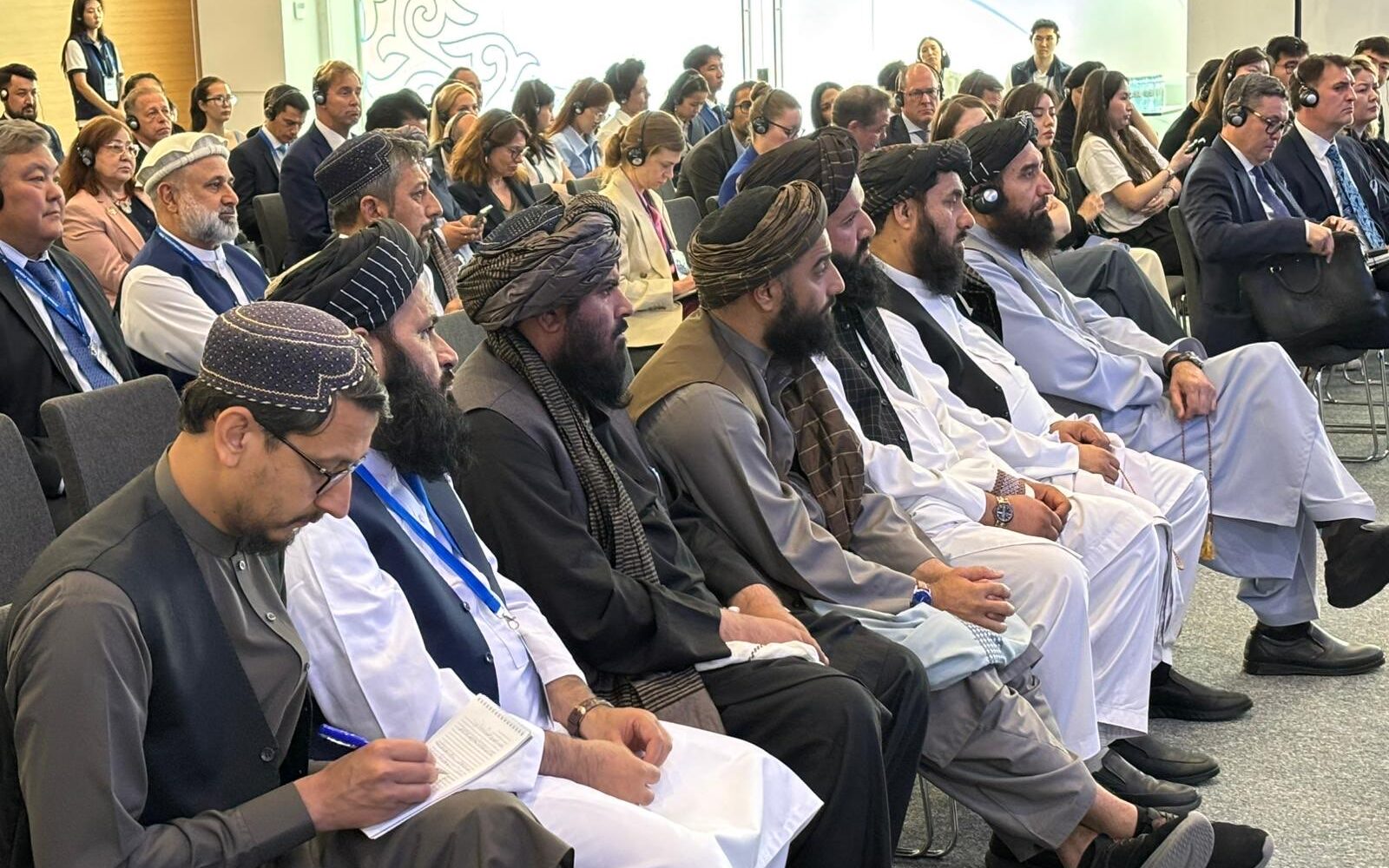
In late May, a delegation of Taliban representatives, led by Haji Nooruddin Azizi, the Minister of Trade and Industry, visited Kazakhstan to attend the Astana International Forum (AIF). During the summit, they spoke with The Times of Central Asia, discussing their ambitions and plans.

It was their first participation in the prominent forum, made possible by Kazakhstan’s 2024 decision to remove the Taliban from its list of terrorist organizations. Since then, Kazakhstani political and business leaders have traveled to Kabul on several occasions aiming to establish closer relations with the Islamic Emirate.

Image: TCA, Nikola Mikovic

Most recently, during a meeting with Azizi, Kazakhstan’s President Kassym-Jomart Tokayev emphasized the need to strengthen political ties with Afghanistan. The economy, however, seems to play an equally important role in this relationship, with Astana aiming to increase its bilateral trade volume with Afghanistan to $3 billion in the coming years.

Kazakhstan is also eyeing investing $500 million in the construction of the 115-kilometer (71 miles) Turgundi–Herat railway line, a section of the rail corridor linking Turgundi in the north of Afghanistan and Spin Boldak on the country’s border with Pakistan. The route effectively connects Central and South Asia via Afghanistan.

Neighboring Turkmenistan is also interested in participating in this project, as the railway aims to connect Central Asia to Pakistan’s Karachi and Gwadar ports, providing Turkmenistan and its neighbors access to vast South Asian markets. The Turgundi–Herat–Kandahar–Spin Boldak railway line is considered a key segment of the broader Trans-Afghan Railway project, which even Russia has expressed an interest in joining.

“It is still too early to discuss who will build the railway, although it is clear that Afghan companies are unlikely to be able to undertake the project,” Mirwais Ghafouri, Senior Advisor of the Afghanistan Railway Authority, told The Times of Central Asia in an interview.

In his view, given that Afghanistan is a mountainous country, the entire project will cost at least $2–3 billion. The problem for Kabul is that – due to various sanctions and the fact that most countries still do not officially recognize the Taliban-led government – it cannot count on significant support from international financial institutions such as the World Bank and the Asian Development Bank.

“But we expect Kazakhstan to invest in this project, as well as in our economy in general. The shortest route connecting Central Asia and South Asia is through Afghanistan. Once the railway is complete, Kazakhstan and other Central Asian nations will be able to use it to export their agricultural products to huge markets such as India, Pakistan, and Bangladesh”, Ghafouri stressed, pointing out that Kabul and Astana are currently working on a project feasibility study.

The Taliban appear to be aiming to revive nearly all previously announced projects of regional and interregional importance. In doing so, they hope to attract foreign investment.

“We plan to develop extensive energy and infrastructure projects by 2030,” Haji Nooruddin Azizi said during a session of the Astana International Forum, emphasizing that Afghanistan can prosper “only if it receives economic assistance.”

Many countries remain skeptical about investing in the “Graveyard of Empires,” however. What worries them are the Taliban’s radical policies regarding women’s rights, as well as various controversial bans they have imposed since coming to power in 2021. For Azizi, however, such issues are not priorities at the moment.

“We call on the international community to try to see the situation in Afghanistan from our perspective, not through the prism of Western propaganda. We have 15 million young people who need jobs, and many people in Afghanistan are hungry. We will address the issue of women’s rights. Women can also be an important part of economic development,” the Taliban-appointed Minister of Trade and Industry stressed.

Meanwhile, Kabul will likely focus on developing ties with nations that do not insist on human rights issues but have adopted a more pragmatic stance toward Afghanistan. Kazakhstan is undoubtedly one of them.

“Over the past few years, we have managed to establish good relations with Kazakhstan, the region’s largest economy, and now we hope to strengthen economic ties between our two countries,” Muhammad Rehman Rahmani, the Taliban-appointed Chargé d’Affaires of the Islamic Emirate of Afghanistan to Kazakhstan, told The Times of Central Asia.

Muhammad Rehman Rahmani, Chargé d’Affaires of Afghanistan to Kazakhstan; image: TCA, Nikola Mikovic

Similarly, Azizi views Kazakhstan as Afghanistan’s “role model,” claiming that Astana has opened all doors to the Afghan private sector. Moreover, following the earthquakes that struck Afghanistan in early October 2023, Kazakhstan delivered over 1,600 tons of humanitarian aid to Afghanistan’s Herat province, effectively winning the hearts and minds of the local population.

Thus, the Central Asian nation has the capacity to position itself well in Afghanistan, hoping to achieve some of its geoeconomic goals by strengthening influence, expanding trade routes, and potentially securing a long-term strategic partnership with Taliban-ruled Afghanistan.