• KGS/USD = 0.01144 0%
  • KZT/USD = 0.00196 -0%
  • TJS/USD = 0.10899 -0%
  • UZS/USD = 0.00008 -0%
  • TMT/USD = 0.28490 0%
  • KGS/USD = 0.01144 0%
  • KZT/USD = 0.00196 -0%
  • TJS/USD = 0.10899 -0%
  • UZS/USD = 0.00008 -0%
  • TMT/USD = 0.28490 0%
  • KGS/USD = 0.01144 0%
  • KZT/USD = 0.00196 -0%
  • TJS/USD = 0.10899 -0%
  • UZS/USD = 0.00008 -0%
  • TMT/USD = 0.28490 0%
  • KGS/USD = 0.01144 0%
  • KZT/USD = 0.00196 -0%
  • TJS/USD = 0.10899 -0%
  • UZS/USD = 0.00008 -0%
  • TMT/USD = 0.28490 0%
  • KGS/USD = 0.01144 0%
  • KZT/USD = 0.00196 -0%
  • TJS/USD = 0.10899 -0%
  • UZS/USD = 0.00008 -0%
  • TMT/USD = 0.28490 0%
  • KGS/USD = 0.01144 0%
  • KZT/USD = 0.00196 -0%
  • TJS/USD = 0.10899 -0%
  • UZS/USD = 0.00008 -0%
  • TMT/USD = 0.28490 0%
  • KGS/USD = 0.01144 0%
  • KZT/USD = 0.00196 -0%
  • TJS/USD = 0.10899 -0%
  • UZS/USD = 0.00008 -0%
  • TMT/USD = 0.28490 0%
  • KGS/USD = 0.01144 0%
  • KZT/USD = 0.00196 -0%
  • TJS/USD = 0.10899 -0%
  • UZS/USD = 0.00008 -0%
  • TMT/USD = 0.28490 0%
08 December 2025

Turkmenistan Plans to Raise Conscription Age

Turkmenistan plans to raise the age of military conscription from 27 to 30, Turkmen News reports. A decree has reportedly been prepared, but President Serdar Berdimuhamedov has yet to sign it.

Avoiding the draft in Turkmenistan is difficult. Men who study abroad must report to military office upon their return. Without a military ID, they face restrictions on employment, housing, and official registration.

Since late December 2024, reports have indicated that military offices have largely stopped issuing “white tickets” – documents that confirm an individual’s fitness for service without requiring enlistment. This policy shift leaves potential conscripts with fewer options: staying abroad leaves them in legal limbo while returning home runs the risk of immediate conscription.

The Turkmen army has long struggled with a shortage of soldiers. Changing conscription rules appears to be an attempt to bolster the ranks, but it may only deepen young men’s reluctance to serve.

Conscripts often endure poor living conditions, inadequate supplies, and mistreatment by senior soldiers. Corruption remains a significant issue, with funds allegedly being misappropriated and discipline deteriorating. Defense Minister Begench Gundogdyev has been criticized for failing to address these problems.

In other Central Asian countries, such as Uzbekistan and Kazakhstan, the conscription age remains at 27.

Russia to Build Gas Pipeline for Northern Kazakhstan

Russia will construct a new trunk gas pipeline to supply fuel to the northern and northeastern regions of Kazakhstan. The decision was formalized in an order signed by the Russian government on February 18, which was published on the country’s official legal information portal. 

According to the document, the pipeline will have a design capacity of 10 billion cubic meters of gas per year, with compressor stations capable of generating 50 megawatts. The route will pass through Russia’s Tyumen region.

Kazakhstan’s Gas Supply Strategy

Kazakhstan’s Energy Minister Almasadam Satkaliyev had previously outlined two potential strategies for ensuring gas supplies to the country’s northern regions. 

  • The first option involved extending Gazprom’s existing Saryarka pipeline project, which would supply Kazakh gas to northern Kazakhstan.
  • The second option, now selected, is to import Russian gas through a newly built route.

Strategic Importance of Gasification

The issue of supplying gas to northern Kazakhstan was first raised by President Kassym-Jomart Tokayev in 2021. Tokayev emphasized that gasification of the Akmola and North Kazakhstan regions is a strategically important task.

“This is a matter of national importance,” he said at the time, stressing that expanding gas infrastructure would not only strengthen the region’s industrial potential but also enhance its attractiveness for business and improve living conditions for local residents.

Experts Warn Central Asia Faces Chronic Water Shortage by 2028

Central Asia is heading toward a severe water crisis as climate change, population growth, and outdated infrastructure put increasing pressure on the region’s water resources, experts have warned.

At a recent roundtable on climate change and water management, Stanislav Pritchin, head of the Central Asia sector at the Russian Academy of Sciences, highlighted the growing threat.

Climate change is a major factor, as rising temperatures accelerate glacier melt – the primary source of freshwater in Central Asia. Meanwhile, rapid population growth is driving up demand. Uzbekistan, the region’s most populous country, has seen its population increase from 22 million in 1991 to an estimated 37.5 million in 2025. Across Central Asia, the total population is approaching 80 million.

Another challenge is outdated infrastructure. Pritchin noted that up to 50% of irrigation water is lost due to inefficient and aging systems. Moreover, the region lacks a strong institutional framework for managing water distribution and policy. While some cooperative projects exist – such as the joint construction of the Kambar-Ata hydropower plant – they are insufficient to address the broader crisis.

In response to these challenges, on February 19, the Asian Development Bank (ADB) approved a $125 million loan to help Uzbekistan improve water security, reduce losses, and enhance distribution efficiency.

The Climate-Smart Water Management Improvement Project aims to introduce advanced monitoring and management systems. Uzbekistan’s national water utility, Uzsuvtaminot, will implement digital technology to track water flow, minimize waste, and improve service delivery. The initiative will also establish a comprehensive inventory of water supply infrastructure and deploy a nationwide bulk flow metering and telemetry system.

“Uzbekistan’s water resources are under acute threat from climate change and inefficient usage,” said ADB Country Director for Uzbekistan, Kanokpan Lao-Araya. “ADB’s project introduces smart water management systems to improve water usage, reduce energy consumption, and increase operational efficiency to lower Uzbekistan’s carbon footprint.”

This initiative is part of Uzbekistan’s broader efforts to modernize infrastructure and prepare for future water challenges. However, experts caution that without stronger regional cooperation, no single country can fully resolve the crisis.

Simurgh Self-Help: Slavs and Tatars’ New Show Rethinks National Symbolism

“It’s interesting that in Western symbolism you never see a delicate female eagle,” notes Payam, one-half of the artist collective Slavs and Tatars, from his studio in Berlin. “But the central-Asian Simurgh is gender-fluid, metaphysical. It doesn’t belong to this world.”

The mythological figure of the Simurgh is the focus of Slavs and Tatars’ latest show at the gallery The Third Line in Dubai called “Simurgh Self-Help”. The show speaks of the importance of reclaiming and reframing cultural memories in a fractured world, and an invitation to think beyond the artificial, top-down confines of nationalism, to find cultural unity.

Slavs and Tatars Samovar Vacuum-formed plastic, acrylic paint; Image: Courtesy of the artist and The Third Line, Dubai

The exhibition extends a lineage of conceptual inquiry, drawing upon the mystical bird Simurgh, ever-present in Persian and Central Asia mythologies, as a counterpoint to the ubiquitous, secularized eagle of Western heraldry.

A constant companion of Zeus in Greek mythology, the eagle is a recurring symbol in the Western world: “Everywhere you look in the West, you find eagles,” notes Payam. “It’s on the German flag, on American football teams, on the Albanian flag. It’s a tired, secularized symbol, heavy with the weight of imperial history.” In contrast, the Simurgh exists on a different plane, one that rejects hierarchies in favor of collective transformation.

Slavs and Tatars Samovar Vacuum-formed plastic, acrylic paint; Image: Courtesy of the artist and The Third Line, Dubai

Today the Simurgh is going through a similar secularization to the Western eagle, with Turkish SIM cards and Azerbaijani soccer teams called Simurgh. “It’s easy, in some sense, for as an artist to take something which is very high and important, let’s say spiritual or religious, and make it make fun of it, bring it down in a caricatural way,” says Payam. “What’s very hard as an artist is to take something which has been debased and make it high again.”

In the show, we see works that go in either direction, presenting an alternative mythology, one that shows that cultures are fluid and interconnected. “Simurgh Self-Help,” which had previous iterations in Warsaw, Athens, and Baden-Baden, was originally started two years ago as a conceptual echo of Marcel Broodthaers’ Musée d’Art Moderne: Département des Aigles. This was a conceptual museum/artistic project created by the Belgian artist in 1968, full of artworks referenced by Slavs and Tatars in their show.

Slavs and Tatars, Soft Power_2023, Woolen Yarn; Image: Courtesy of the artist and The Third Line, Dubai

The Simurgh, Payam explains, traverses territories from Kazakhstan to Ukraine, yet remains absent in Poland. “It’s a question of defining a region not through imposed political structures but through the myths that bubble from the ground up,” remarks Payam. The Simurgh becomes a cipher for alternative cartographies, a challenge to the top-down imposition of nationhood.

If the eagle stands for conquest and dominance, the Simurgh stands for the dissolution of categories and unity with the whole. The myth, present in Attar’s poem The Conference of the Birds, speaks of a journey — a dissolution of the self in pursuit of the divine. “In the traditional story a number of birds seek the Simurgh,” Payam reflects, “and when they arrive, they find a pond where they can see their own reflections. This a very Sufi concept, by which God is within. They are the Simurgh. It’s an act of annihilating the ego, of merging with the infinite.”

Installation View, Slavs and Tatars, Simurgh Self-Help, 2025, The Third Line. Photo: Altamash Urooj

The exhibition unfolds through a number of glassworks, carpets, installations, and text-based works, in an interplay of languages that are both visual and textual. The craft element is very present, as the collective closely works with artisans with the idea of continuity: “We work with the same artisans repeatedly, ensuring quality and deepening relationships.”

Payam has recently come back to the cold temperatures of Berlin from the warmth of Jeddah to participate in the second edition of their Islamic Biennial. As Slavs and Tatars will also join the forthcoming first edition of the Bukhara Biennial, the artist is encouraged to reflect on how different versions of Islam enter the secular world and open up to the contemporary art public.

Installation View, Slavs and Tatars, Simurgh Self-Help, 2025, The Third Line. Photo: Altamash Urooj

“As artists, we have always been interested in religion as a repository of knowledge,” Payam asserts. “If you claim to be interested in knowledge, you cannot ignore the metaphysical. We have so many different types of knowledge, the rational, the mystical, the analytic, the emotional, the digestive even. You can’t say you are interested in one, and reject the others.”

Well, what a Simurgh-like thing to say.

U.S.-Funded Plane Carrying Some Central Asian Migrants Lands in Costa Rica

A total of 135 migrants, including people from Central Asia, have arrived in Costa Rica on a flight from the United States, where the Trump administration has promised mass deportations and has enlisted several Latin American countries as transit points for migrants being transferred to their countries of origin.

None of the migrants on the passenger plane that arrived at the international airport near the capital of San José on Thursday have been flagged by the United States as a security threat, said Omer Badilla, Costa Rica’s deputy interior minister.  Costa Rica is conducting its own checks, he said.

“They’re families, they’re people who don’t have any record” of criminal or allegedly criminal conduct, Badilla told local media. About half of the group are children.

Costa Rica has said the migrants will be held at a temporary facility in the south of the country for up to several weeks prior to their transfer to their countries of origin.

The government originally said it was expecting to receive 200 migrants on Thursday’s flight.

The operation is being supervised by the International Organization for Migration, a Geneva-based United Nations agency that will take care of the migrants while they are in transit, according to the Costa Rican government.  Human rights groups have expressed concern that deported migrants could face persecution in some cases if returned by force to their countries.

Obituary – Kristopher White: The Gentle Giant Who Inspired a Generation of Central Asian Scholars

Kristopher Dodge White, known to his friends simply as “Kris”, was a distinguished scholar, mentor, and friend, who dedicated two decades of his life to academia in Kazakhstan. Kris was a gentle giant, someone people naturally gravitated toward. Respected and loved by friends, colleagues and students alike, his personality left an indelible mark on everyone he met.

In terms of professional discipline, Kris was a geographer, having conducted undergraduate studies at Clark University and an MA and a PhD at the University of Connecticut. He established himself as a leading interdisciplinary scholar of Central Asia, advancing our understanding of post-Soviet transitions, environmental crises, and the interplay between human societies and their landscapes. Kris’s life work is a testament to the power of geography as a lens for understanding complex regional challenges. Future scholarship will undoubtedly build upon his illuminating insights into the interdependencies of nature, economy, and identity.

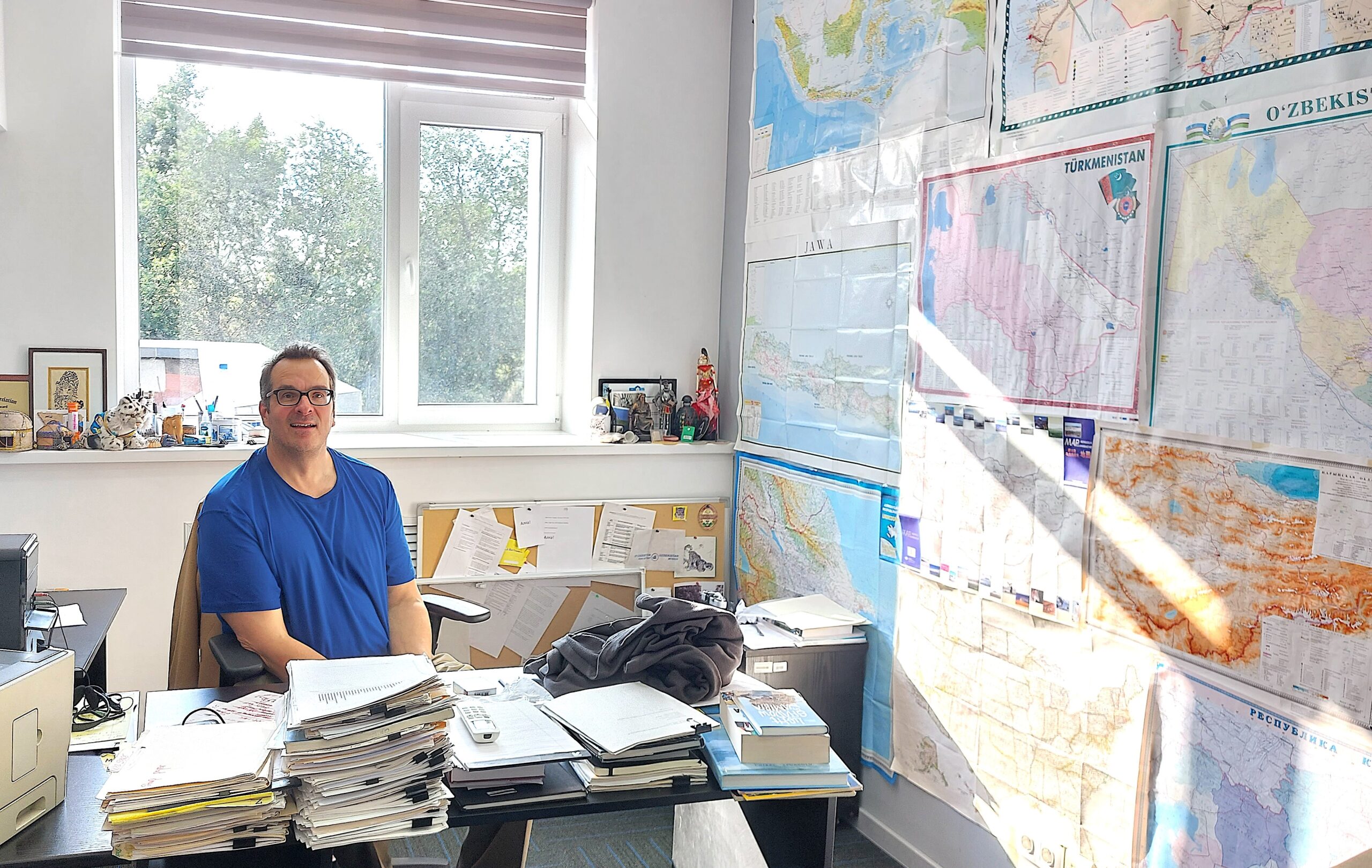
Kristopher White in his office at KIMEP, 2023

Kris was a prolific writer and researcher, devoting much of his work to the study of the Aral Sea and highlighting the ecological and social challenges of the region. His work excelled in weaving environmental and economic themes with cultural analysis. For example, he explored how the endangered snow leopard has become a symbolic linchpin for Kazakhstan’s national identity, ecotourism marketing, and international conservation agendas.

As an educator at KIMEP University since 2004, Kris helped shape a generation of Central Asian scholars through courses like Oil Geopolitics and The Aral Sea Crisis: A Geographical Perspective. His pedagogical approach—rooted in regional case studies —exemplified his commitment to place-based learning.

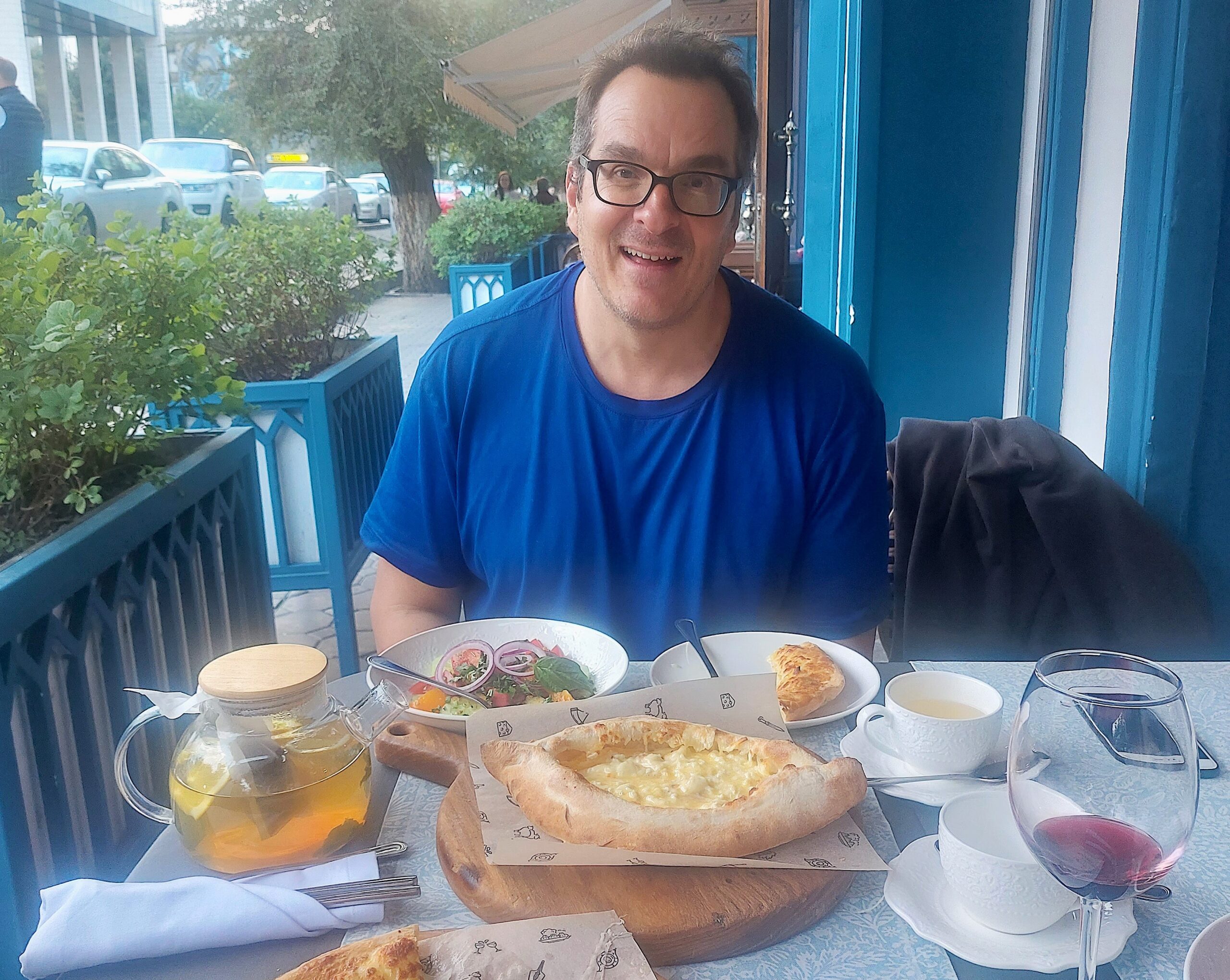
Back in Almaty

Beyond his professional work, Kris had an adventurous spirit. His love for travel took him across the globe, capturing the beauty of the world through his keen eye for photography. Whether exploring the vast Kazakh steppe, documenting the remnants of the Aral Sea, or wandering through historic cities, he found joy in sharing stories through his lens. He later developed and taught a course on photojournalism at KIMEP.

Kris and I overlapped at KIMEP for four years (2004-08). I always appreciated that irrespective of the challenges of any given day, he was an oasis of calm and fun, liking nothing better than to unwind over a glass of Kazakh beer or Georgian wine. Kris was the epitome of a true friend who would never let you down, someone who always had your back and you had his ear. We made several unforgettable road trips throughout Central Asia, particularly in Uzbekistan and Turkmenistan.

Kristopher White with Donnacha Ó Beacháin, 2023

Kris passed away while visiting his family in Florida. Today, the 21st February, would have been his 56th birthday. He had so many plans for the future, and it’s heartbreaking that he won’t see them come to fruition. Those who knew him will forever remember his kindness and wisdom. His legacy lives on in the minds he inspired, the friendships he nurtured, and the body of work he leaves behind, all of which will resonate for many years to come.