• KGS/USD = 0.01144 0%
  • KZT/USD = 0.00193 -0%
  • TJS/USD = 0.10811 -0.28%
  • UZS/USD = 0.00008 0%
  • TMT/USD = 0.28490 0%
  • KGS/USD = 0.01144 0%
  • KZT/USD = 0.00193 -0%
  • TJS/USD = 0.10811 -0.28%
  • UZS/USD = 0.00008 0%
  • TMT/USD = 0.28490 0%
  • KGS/USD = 0.01144 0%
  • KZT/USD = 0.00193 -0%
  • TJS/USD = 0.10811 -0.28%
  • UZS/USD = 0.00008 0%
  • TMT/USD = 0.28490 0%
  • KGS/USD = 0.01144 0%
  • KZT/USD = 0.00193 -0%
  • TJS/USD = 0.10811 -0.28%
  • UZS/USD = 0.00008 0%
  • TMT/USD = 0.28490 0%
  • KGS/USD = 0.01144 0%
  • KZT/USD = 0.00193 -0%
  • TJS/USD = 0.10811 -0.28%
  • UZS/USD = 0.00008 0%
  • TMT/USD = 0.28490 0%
  • KGS/USD = 0.01144 0%
  • KZT/USD = 0.00193 -0%
  • TJS/USD = 0.10811 -0.28%
  • UZS/USD = 0.00008 0%
  • TMT/USD = 0.28490 0%
  • KGS/USD = 0.01144 0%
  • KZT/USD = 0.00193 -0%
  • TJS/USD = 0.10811 -0.28%
  • UZS/USD = 0.00008 0%
  • TMT/USD = 0.28490 0%
  • KGS/USD = 0.01144 0%
  • KZT/USD = 0.00193 -0%
  • TJS/USD = 0.10811 -0.28%
  • UZS/USD = 0.00008 0%
  • TMT/USD = 0.28490 0%
10 December 2025

Kazakhstan Seizes $16.7 Million in Virtual Assets in Crypto Crackdown

Kazakhstan has shut down 130 illegal cryptocurrency exchanges suspected of laundering criminal proceeds, seizing virtual assets worth $16.7 million, Deputy Chairman of the Financial Monitoring Agency (AFM) Kairat Bizhanov announced during a recent government meeting.

Under Kazakh law, only crypto exchanges licensed by the Astana Financial Services Authority (AFSA) and integrated with local banks are permitted to operate. These licenses are granted under the Law on Digital Assets. Platforms operating without such authorization are deemed illegal.

“The activities of 130 unlicensed crypto exchanges involved in laundering criminal proceeds have been terminated this year. Virtual assets worth $16.7 million were seized,” Bizhanov said.

Targeting Cash-Out Schemes

The AFM is also intensifying efforts to combat illegal cash-out operations. According to Bizhanov, 81 shadow groups with a combined turnover of 24 billion KZT (over $43 million) were uncovered in 2024. He emphasized that ATMs remain a critical vulnerability.

“Despite the measures taken, the volume of cash withdrawals continues to grow. A total of 13.2 trillion KZT ($24.1 billion) has already been withdrawn, one trillion more than last year. The main risk is the ability to carry out anonymous transactions without identifying the sender or recipient. These operations are often conducted using bank cards issued to nominal owners,” he said.

To curb these practices, the AFM and the National Bank of Kazakhstan have introduced new regulations. Card top-ups exceeding 500,000 KZT ($913) now require the input of an individual identification number (IIN) and confirmation via mobile applications. Since January 1, banks have also been required to retain ATM camera footage for at least 180 days. Authorities plan to expand biometric identification, including facial and fingerprint recognition for all cash transactions.

New Rules to Curb Shell Companies

In cooperation with the Ministry of Justice and the Ministry of Artificial Intelligence, the AFM has drafted amendments to tighten business registration protocols. “The main focus is on verifying company founders and executives based on risk criteria,” Bizhanov noted, pointing to a surge in fictitious companies used for money laundering and financial fraud.

Over the past three years, tax authorities have annulled the registration of 3,600 shell firms linked to 30,000 fraudulent transactions totaling 280 billion KZT ($511 million).

As The Times of Central Asia previously reported, Kazakhstan is positioning itself as a regional leader in blockchain innovation, aiming to become Central Asia’s hub for digital asset regulation and blockchain development.

Kazakhstan’s Finance Ministry Cracks Down on Widespread Tax Evasion Among Small Businesses

Kazakhstan’s Ministry of Finance has identified more than 260,000 entrepreneurs suspected of underreporting taxable income, Finance Minister Madi Takiyev said during a recent government meeting.

According to Takiyev, in 2024, around 17,000 cash registers across the country failed to issue any receipts, while 260,000 taxpayers consistently reported either a single daily transaction or identical revenue amounts. However, enforcement efforts appear to be paying off, with 70,000 businesses now issuing receipts properly.

The minister noted that tax evasion schemes remain widespread, including the mass registration of multiple companies at the same address. Currently, around 20,000 firms are registered at 3,576 locations, collectively owing over 60 billion KZT ($110 million) in unpaid taxes.

Takiyev reported that the shadow economy declined slightly in 2024, accounting for 16.7% of GDP, a marginal improvement from the previous year. He highlighted notable progress in trade, education, and agriculture, supported by new digital tools such as Smart Data Finance, which uses artificial intelligence to detect tax evasion. The system currently integrates data from 74 sources, with 30 more expected to be added by the end of the year.

Biometric identification has also played a role in strengthening compliance, helping authorities block fake invoices worth over 33 billion KZT ($60 million). Meanwhile, the E-Tamga system has processed 250 million electronic invoices and 500 million payments, potentially adding up to 100 billion KZT ($182 million) in annual tax revenue.

To combat illicit trade, the authorities seized more than 1 million liters of alcohol, 6.6 million cigarette packs, and 37,000 tons of petroleum products in 2024, preventing estimated tax losses of over 7 billion KZT ($12.7 million).

As The Times of Central Asia previously reported, Kazakhstan’s new Tax Code, raising the value-added tax (VAT) from 12% to 16%, is set to take effect in 2025.

Gabala 2025: What the Turkic World Will Discuss Amid Global Turbulence

On October 7, leaders of the Organization of Turkic States (OTS) will gather in Gabala, Azerbaijan, for the 12th summit under the theme “Regional Peace and Security.” At first glance, it may look like another routine engagement. Yet against the backdrop of overlapping global crises, the forum is increasingly a test of the OTS’s maturity and relevance.

The summit unfolds amid a turbulent international landscape. Afghanistan continues to cast a shadow over Central Asia: economic volatility, migration risks, and the activity of extremist groups remain sources of concern for OTS members. The ongoing war in Ukraine, meanwhile, is reshaping Eurasian transit routes, placing the bloc’s states in delicate positions between East and West. At the same time, violence in the Middle East is adding to the pressures on Turkey’s already complex foreign policy environment.

The Middle Corridor at the Center

A key theme in Gabala will be the advancement of the Middle Corridor, formally known as the Trans-Caspian International Transport Route. This east–west route connects China with Europe via Kazakhstan, the Caspian ports of Aktau and Kuryk, Azerbaijan, Georgia, and Turkey. Investments are moving forward across the chain: Kazakhstan is expanding port and rail capacity, Azerbaijan is modernizing the Port of Baku in Alat, Georgia is upgrading its railway hubs, and Turkey is reinforcing the Baku–Kars line.

Once a logistical project, the corridor is evolving into a strategic framework that ties together economic, environmental, and security considerations. Customs harmonization, digital tracking systems, and sustainability standards are now discussed as much as cargo volumes.

Security, Coordination, and Soft Power

Security will also be on the table, though framed in practical rather than military terms. Issues such as counter-terrorism cooperation, cyber resilience, disaster response, and the safety of emerging transit corridors are likely to feature. In this sense, security is increasingly seen as the foundation for trade and investment rather than a standalone agenda.

Beyond infrastructure, OTS continues to develop soft power tools. Educational exchanges, cultural cooperation, green energy initiatives, and water management projects are part of efforts to build intra-regional trust. The recently inaugurated UN Regional Center for the SDGs in Almaty provides another anchor, aligning the Turkic bloc with global sustainability frameworks.

A Turning Point for the Turkic Council?

Founded in 2009 primarily as a cultural and humanitarian forum, the OTS is now edging toward a broader role. By coordinating infrastructure projects, harmonizing regulations, and cautiously addressing security concerns, it is positioning itself as a relevant player in Eurasian affairs.

Much will depend on whether Gabala produces more than communiqués. Concrete steps on the Middle Corridor, digital customs corridors, joint water initiatives, or disaster coordination could demonstrate that the OTS is maturing into a platform for practical solutions. While major breakthroughs are unlikely, even incremental progress would signal that the Turkic Council is becoming a pillar of regional stability and integration.

Kyrgyzstan Snap Election: Democracy on Edge or Politics as Usual?

On September 25, Kyrgyzstan’s parliament voted to dissolve itself, clearing the way for snap elections. As previously reported by The Times of Central Asia, deputies approved the dissolution by an 84–0 vote, with five abstentions and one absence. The election will now take place on November 30, under revised electoral rules. The new system divides the country into 30 constituencies, each of which elects three deputies, at least one of whom must be a woman.

Lawmakers justified the move by pointing to the costs and logistical burdens of overlapping parliamentary and presidential campaigns, arguing that holding parliamentary elections a year early would streamline preparations and reduce the administrative strain. Critics, however, have suggested the real motivation is political, noting that pro-government blocs stand to benefit from locking in deputies under the new majoritarian system by mobilizing local administrative resources, especially after years of pressure on opposition groups and independent media.

“Regarding the early elections, I fully support this decision,” Eldar Turatbek, founder of the Legalize political party, told The Times of Central Asia. “There is no point in waiting another year until the end of the 7th convocation’s term, especially when you consider that after the 2020 revolution, most deputies spent a year in temporary status anyway. In essence, they have already ‘worked off’ their five-year term.”

Japarov’s Centralization of Power

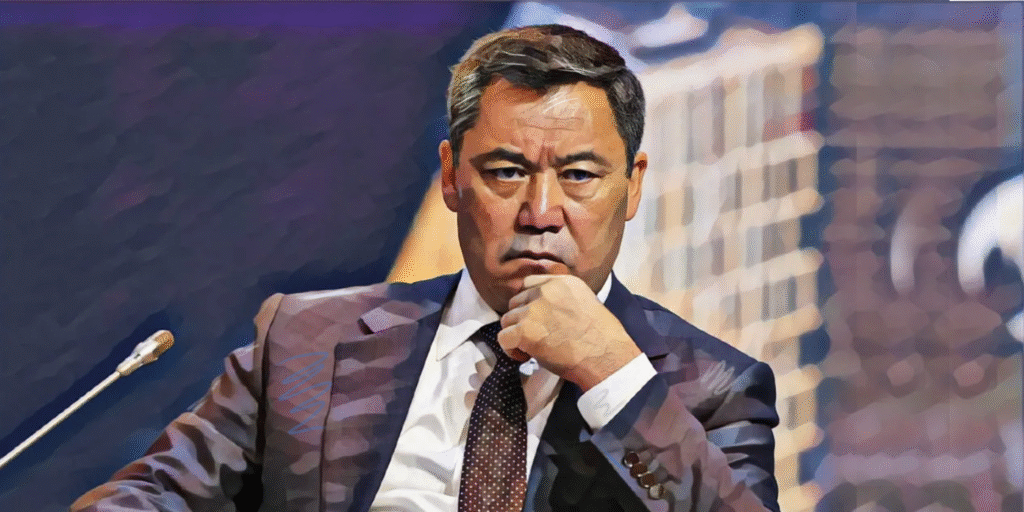
The dissolution also fits into a broader cycle of political reshuffles across the region. Both Kyrgyzstan and Kazakhstan have undergone rapid personnel and institutional changes in recent months, with Bishkek’s early vote reflecting President Sadyr Japarov’s emphasis on electoral timing, and, analysts argue, designs to cement his grip on power.

The step arrives in a political environment that has grown markedly more centralized since Japarov’s rise during the turmoil of 2020. New restrictions on online media and internet traffic have narrowed the space for civil society, measures the government frames as necessary to restore order and promote national values. Rights advocates, however, warn of democratic backsliding in a country once seen as the most pluralistic in Central Asia.

Opposition journalist Bolot Temirov offered a blunt assessment as to the reasons why the authorities are holding early parliamentary elections. “In recent years, the president’s entourage and the head of the State Committee for National Security have acquired money, and now want to show off their deputy badges,” he told TCA. “Kamchybek Tashiyev will try to get as many of his people into parliament as possible to strengthen his position in the confrontation with Sadyr Japarov and his team. Mandates have long since become a commodity, and parliamentary seats are for sale.”

International IDEA has recorded a decline in civil liberties and checks on executive authority under the current administration, and Kyrgyzstan’s trajectory makes this moment especially significant. The country has experienced three revolutions since independence – in 2005, 2010, and 2020 – each triggered by discontent over corruption, contested elections, and concentrated presidential power. These upheavals reshaped institutions but also entrenched a cycle of volatility that continues to cast a shadow over politics today.

Economic Strains and Sanctions Pressures

The political stakes are amplified by economics. Growth has been buoyed by transit trade and gold output, but the World Bank still classifies Kyrgyzstan as highly vulnerable to external shocks. Remittances are central to household incomes, with migration data showing transfers equal to nearly a quarter of GDP.

Most Kyrgyz migrants work in Russia, making the domestic economy sensitive to regulatory changes or downturns there. The banking sector has also come under strain, with Japarov recently denouncing what he called “politicized sanctions” after several Kyrgyz banks were targeted over alleged links to Russia. U.S. and UK sanctions on Kyrgyz banks illustrate how difficult foreign policy choices reverberate through the domestic economy.

Against this backdrop, lawmakers’ argument that separating electoral cycles will reduce costs is both fiscally defensible and politically convenient, but it does not address deeper structural risks.

Regionally, the snap election also follows a period of shifting dynamics. Earlier this year, Kyrgyzstan and Tajikistan signed a treaty to complete border demarcation, easing a longstanding flashpoint that had periodically erupted into violence. Uzbekistan has also been involved in border frictions, with Tashkent confirming its troops acted lawfully in the shooting of two Kyrgyz citizens on August 31, underscoring how sensitive frontier issues remain even amid new regional agreements on demarcation.

Democracy on the Line?

Whether the vote proves a genuine stress test for Kyrgyz democracy or merely a routine adjustment will hinge on two issues. The first is whether the campaign permits real competition, despite recent legal changes that have constrained opposition figures and independent media. The second is whether the new electoral system delivers accountability: in theory, territorial three-member districts could make deputies more responsive to local communities, but in practice, outcomes may be shaped more by administrative leverage and unequal media access.

Political analyst Bakyt Baketaev argues that the scheduling burden was a major factor behind the dissolution, likening the parliamentary and presidential elections to manty “sticking together in a steamer,” and warning that the Central Election Commission would struggle to handle overlapping campaigns. While the presidential vote is officially slated for January 2027, critics contend that campaign preparations would have collided with parliamentary contests if they had been held later.

“The deputies explain everything in a childishly simple way,” Baketaev told TCA. “But many are tormented by the question: could there be something more behind this dissolution? Of course! This is Kyrgyzstan. Here, even a skullcap can hide constitutional reform. In reality, the early dissolution of parliament is not a conspiracy, a cunning plan, or an alien attack. It is a pragmatic step in the spirit of ‘better now than a revolution later.’ Politics in our country is like a TV series: one season ends, another begins. The main thing is not to lose your sense of humor.”

For Japarov and his allies, including powerful security chief Kamchybek Tashiyev, success would mean a more compliant parliament and calmer governance ahead of the next presidential election, which has been rescheduled for January 24, 2027, in line with constitutional amendments. Critics argue, however, that the redistribution of influence within the ruling elite – with Tashiyev keen to place loyalists in parliament – could entrench an imbalance of power and further marginalize opposition voices.

Why this matters beyond Bishkek is clear. Kyrgyzstan has long been seen as an outlier in Central Asia, cycling through upheavals but preserving a degree of contestation rare in the region, and how this vote is conducted will indicate whether that endures. The country’s reliance on remittances and transit also makes political stability a public good, since uncertainty could curtail investment and create household-level shocks. At the same time, regional and global partners are watching for cues: a tightly managed election followed by a compliant legislature could point to deeper reliance on Moscow, while a competitive campaign would signal lingering room for a more balanced foreign policy.

At this stage, the economy is growing but remains vulnerable, with remittances critical to stability. What remains uncertain is whether the campaign will widen political space or narrow it further.

According to the Central Election Commission, more than 50 self-nominated candidates have filed to run so far, while three parties – Kyrk Uuz, Legalize, and Yntymak – have submitted notices of intent to nominate, with registration open until November 10.

From Kyrgyzstan to Scotland: Shahsanem Murray’s Naked Nimbus Explores Love, Loss, and Belonging

In the wake of Finding the Holy Path, published in 2014, and Cold Shadows in 2016, Naked Nimbus is Shahsanem Murray’s long-awaited third novel. Once again, Murray’s multifaceted plot is woven with intrigue and mysticism, referencing the stark cultural contrasts between life in Central Asia under the Soviet regime and that in the West.

The story focuses on Arthur, a young, ambitious artist struggling to find his way in the world and recognition for his craft. Haunted by his role in a fatal accident, he searches for atonement whilst battling to maintain his moral, personal, and professional integrity.

Faced by numerous challenges, Arthur experiences a storm of emotions from despair to euphoria, and, highly sensitive to his surroundings and everyone he meets, the thin line between reality and fantasy blurs as he continues to hold out hope for true love. Friendships are put to a test, and he must muster the strength to forgive both himself and those closest to him for acts of disloyalty.

Arthur’s journey takes him across the globe, from his Soviet homeland to Scotland, France, and finally, the wilds of Siberia. Often feeling dislocated, he finds himself questioning his identity and self-worth both as a man and an artist; a situation compounded by supernatural encounters.

Murray further explores the human condition and the problems faced by society at large by introducing parallel stories of other characters’ lives, including Arthur’s acquaintances and his friend Alik’s father, Turdubek, as he searches for a soulmate under the Soviet regime.

Like the Surrealist paintings which inspired it, this novel is filled with poignant visual imagery and symbolism, which, open to interpretation, lead the reader to ponder the outcome of events.

Editor Laura Hamilton caught up with Shahsanem Murray to discuss the author’s new novel:

LH: What is the meaning or inspiration behind the book’s title?

SM: I wanted the title to be both poetic and to act as a key for the reader’s attention. After writing the first two chapters, I realized that the original title wouldn’t work. Then, one Sunday morning, my business partner Gordon Murray mentioned the word ‘nimbus.’ Unfamiliar with the term, I began searching for images and decided that ‘Naked Nimbus’ would be a perfect description of Arthur’s plight. As a man without wings, he is unable to fly, and so, if he is to soar in his life’s journey, he must explore, harness, and embrace the moral and cultural tenets of the society in which he lives and works.

LH: The video trailer recreates the opening violent murder scene, but unlike typical crime fiction, the book focuses on its prolonged mental impact on the protagonist. Was it your intention that readers view crime from a different perspective?

SM: The video trailer was carefully created as a marketing tool to entice readers. It sets the scene for the impact the accidental murder has on the protagonist’s life. I hope it doesn’t disappoint!

LH:  In common with your previous novels, the new book provides a glimpse of life in Central Asia – especially your native Kyrgyzstan – both before and after the fall of the USSR, and your adopted home in Scotland. Are any of the characters in Naked Nimbus drawn from real people or events?

SM: My characters possess the attributes of people I have encountered and their response to specific events and circumstances, especially during the period under and leading up to the fall of the USSR. Having lived in Kyrgyzstan during that period and afterwards, in Scotland, I was inspired by both my own and my associates’ experiences as we gradually adapted to significant changes in the societies in which we lived.

LH: Mysticism and legends – important in Kyrgyz culture – also feature prominently in your writing. What draws you to incorporate these to enhance your storyline and the mental state of your characters?

SM: Kyrgyz literature is rich in mysticism, and legends based on ancient folklore are integral to our culture. I’m constantly revisiting tales narrated by my grandparents and rediscovering a rich and powerful trove of material that can be incorporated into my work. By comparing the two, and to my surprise, I recognized similarities in how Scottish and Kyrgyz folklore is revered, treasured, and preserved by generations both past and present.

LH: Arthur, the key protagonist in Naked Nimbus, is portrayed as a man battling to come to terms with his involvement in a murder, leading him to question his very being and his place in the world. Crime aside, is this something that was inspired by your own experience of having to adapt to life in a country alien to where you grew up?

SM: Although Naked Nimbus is fictional, Arthur’s involvement in the murder is, sadly, something that occurs daily worldwide. I recall a newspaper article about one young man who, returning from a night out celebrating his birthday, was attacked and robbed by a local gang. Had he chosen to join the gang, he would not have ended up in hospital with serious injuries. And worse, had he fought back, he might well have committed murder. The world is a dangerous place for young men, especially those faced with pressures to join the ‘dark side.’ Through Arthur, I wanted to explore the consequences, both mental and moral, of rejecting crime and violence to follow a good and honest life.

To quote Shakespeare: ‘To be or not to be, that is the question.’

LH: The book contains many parallel stories, and the ending is open to interpretation. What role did your knowledge of Surrealist art play in your often enigmatic plots and use of the imaginary?

SM: Surrealism is my favorite art genre. It has the power to surprise and force the viewer to re-evaluate what the artist is trying to convey whilst conjuring up personal memories. The inclusion of parallel plots in my book is akin to the Surrealist artists’ juxtaposition and layering of motifs; interrelated yet standing alone as vehicles of the characters’ dreams, disappointments, and aspirations.

Uzbekistan Signs Fabio Cannavaro as Coach Ahead of World Cup

Fabio Cannavaro has signed a contract with the Uzbekistan Football Association to coach the national team, which qualified for the 2026 FIFA World Cup for the first time in the country’s 34 years of independence.

“The Italian coach will prepare our team for the World Cup to be held in the United States, Canada, and Mexico,” the association said after the contract was signed on Monday at Uzbekistan’s National Football Center. It said Cannavaro had the experience and skills to deliver success for Uzbekistan, describing him as “a three-time World Cup participant, 2006 World Cup winner, one of the best defenders of the recent past, and a renowned expert.”

“We have seen that a defensive playing style brings results,” Ravshan Irmatov, the association’s first vice president, said at a news conference. “We believe that with his international experience, professional culture, and tactical strictness, he will bring new spirit and a new system to our national team.”

At the news conference, Cannavaro said he was thankful for the trust shown in him and outlined some plans to help Uzbekistan’s national team get comfortable with the pace and demands of the World Cup level.

“The intensity of the Super League needs to be increased; we will discuss this with the management. The more we move at a high tempo during the game, the better the results will start to be. Players’ recovery is also very important. We would also ask the coaches at clubs to send daily, weekly, or monthly performance data of the players so that we can know whether their results are improving or not,” Cannavaro said.

“I had offers from 7-8 places. First of all, the fact that the team qualified for the World Cup and the seriousness of the project here encouraged me to accept the offer. Is it difficult to play at the World Cup? Yes, very difficult, but we will try,” he said.

Cannavaro replaces Timur Kapadze, an Uzbekistani former pro football player who led the national team to its first-ever qualification for the World Cup with a 0-0 draw against the United Arab Emirates in Abu Dhabi in June. Cannavaro said he had discussed the team with his predecessor, noting that having “local specialists” on the staff will help him learn about the players’ mentality and the culture of Uzbekistan.

To that end, Kapadze will remain for now as an assistant coach.

The Uzbekistan Football Association said the coaching staff that will help Cannavaro includes assistant coach Eugenio Albarella, who has worked with Japan’s national team as well as Juventus, Udinese, and Dinamo Zagreb; fitness coach Francesco Troise, who has collaborated with Benevento, Udinese, and Dinamo Zagreb; and goalkeepers coach Antonio Kimienti, who has experience with Italy’s national youth team, and the Sampdoria and SPAL clubs.