• KGS/USD = 0.01144 0%
  • KZT/USD = 0.00211 0%
  • TJS/USD = 0.10460 0.19%
  • UZS/USD = 0.00008 0%
  • TMT/USD = 0.28490 0%
  • KGS/USD = 0.01144 0%
  • KZT/USD = 0.00211 0%
  • TJS/USD = 0.10460 0.19%
  • UZS/USD = 0.00008 0%
  • TMT/USD = 0.28490 0%
  • KGS/USD = 0.01144 0%
  • KZT/USD = 0.00211 0%
  • TJS/USD = 0.10460 0.19%
  • UZS/USD = 0.00008 0%
  • TMT/USD = 0.28490 0%
  • KGS/USD = 0.01144 0%
  • KZT/USD = 0.00211 0%
  • TJS/USD = 0.10460 0.19%
  • UZS/USD = 0.00008 0%
  • TMT/USD = 0.28490 0%
  • KGS/USD = 0.01144 0%
  • KZT/USD = 0.00211 0%
  • TJS/USD = 0.10460 0.19%
  • UZS/USD = 0.00008 0%
  • TMT/USD = 0.28490 0%
  • KGS/USD = 0.01144 0%
  • KZT/USD = 0.00211 0%
  • TJS/USD = 0.10460 0.19%
  • UZS/USD = 0.00008 0%
  • TMT/USD = 0.28490 0%
  • KGS/USD = 0.01144 0%
  • KZT/USD = 0.00211 0%
  • TJS/USD = 0.10460 0.19%
  • UZS/USD = 0.00008 0%
  • TMT/USD = 0.28490 0%
  • KGS/USD = 0.01144 0%
  • KZT/USD = 0.00211 0%
  • TJS/USD = 0.10460 0.19%
  • UZS/USD = 0.00008 0%
  • TMT/USD = 0.28490 0%

Kazakhstan Considers Criminal Liability for Mass Leaks of Personal Data

Kazakhstan is considering tightening legal responsibility for violations related to personal data protection. The Ministry of Artificial Intelligence and Digital Development has proposed introducing criminal liability for mass leaks of citizens’ personal data, along with a significant increase in administrative fines for failing to comply with information security requirements.

The proposal was announced by Rostislav Konyashkin, First Deputy Minister of Artificial Intelligence and Digital Development, during a government meeting.

According to Konyashkin, Kazakhstan is adopting a “zero tolerance” policy regarding the mishandling of personal digital data.

“In implementing the constitutional rights of citizens to privacy and the protection of personal information, we are moving to a zero-tolerance policy in this area. Digital transformation should not undermine the security of citizens, and any irresponsible handling of personal data should be punished in accordance with the law,” he said.

In addition to criminal penalties for mass data breaches, the ministry is proposing to significantly increase administrative liability for officials violating information security standards.

The current maximum fine is approximately $17,000. The proposed new ceiling would be about $42,500.

The initiative would apply to government agencies, the quasi-public sector, financial institutions, and private companies that handle large volumes of personal data.

The day prior to the government meeting, President Kassym-Jomart Tokayev addressed the issue of digital security at the National Kurultai (Assembly).

He emphasized that the right to personal data protection should be enshrined in the country’s.

“Our Constitution must keep pace with the times. In the 21st century, digitalization is developing at a rapid pace and has a direct impact on human rights and freedoms. Therefore, the Basic Law must clearly stipulate that the personal digital data of citizens is protected by law,” Tokayev said.

The push for stricter regulation follows a series of large-scale data breaches.

In spring 2024, the State Technical Service of the National Security Committee identified a leak affecting over 2 million clients of the microfinance organization zaimer.kz.

In summer 2025, the government confirmed the largest data breach in Kazakhstan’s history, compromising the personal information of over 16 million people, more than three-quarters of the country’s population of just over 20 million.

Experts say the proposed legal reforms mark Kazakhstan’s shift toward a stricter regulatory framework, aligning with standards seen in the European Union and some Asian jurisdictions, where personal data breaches carry both administrative and criminal consequences.

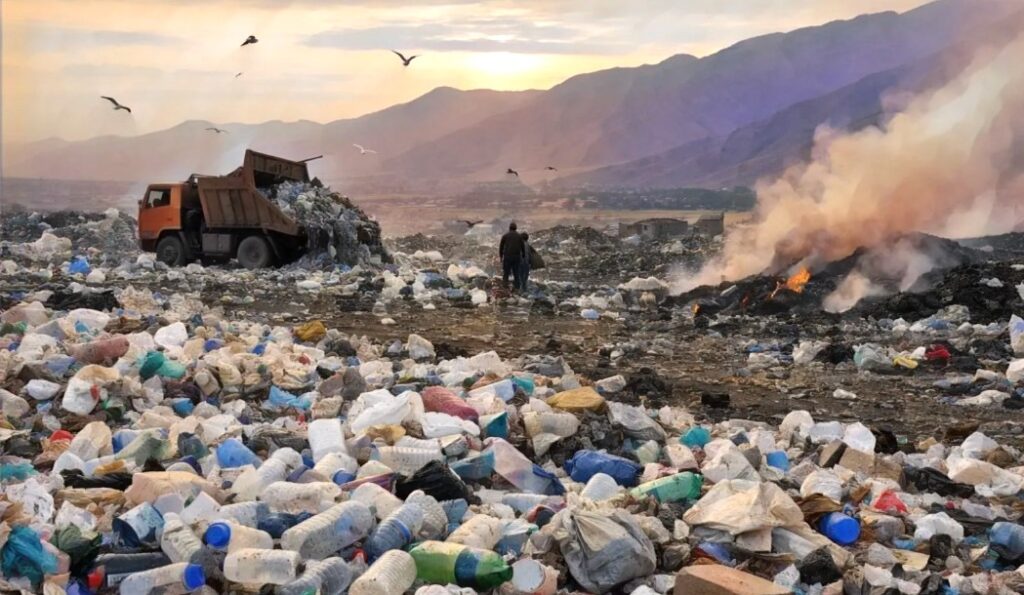
Tajikistan Is Drowning in Plastic: Inside a Waste System Under Strain

According to domestic sector-specific sources, more than nine million tonnes of municipal solid waste (MSW) are generated annually in Tajikistan, of which around 322,000 tonnes is plastic. The key feature of plastic waste is its extreme resistance to decomposition; it can persist in natural environments for decades or even centuries, accumulating in soil and water bodies.

However, estimates of total waste generation vary widely depending on the source, with international organizations offering more conservative figures. The United Nations Environment Programme (UNEP), for instance, reports approximately two million tonnes of formally collected municipal waste generated annually in Tajikistan.

This discrepancy is likely due to differing accounting methodologies. National statistics typically include waste from unauthorized dumps and the informal sector, while international estimates often rely on formally collected and officially documented waste. Still, even the most conservative figures highlight the significant environmental burden posed by Tajikistan’s waste-management system.

Tajikistan’s Position in International Waste Rankings

Waste accumulation and limited recycling capacity are reflected in global assessments. According to domestic reporting citing the 2024 Mismanaged Waste Index (MWI), 87.1% of Tajikistan’s waste is either not collected through organized systems or is disposed of in violation of environmental standards. This would place the country among those with the most vulnerable waste-management systems.

In practice, this means waste is often dumped at unauthorized sites, openly burned, or dispersed into the environment. These practices place pressure on soil, water resources, and air quality, while also posing long-term risks to public health.

This crisis is unfolding amid a global plastic-waste emergency. Even in countries with advanced recycling systems, the proportion of recycled plastic remains low. UNEP estimates that only around 9% of all plastic ever produced has been recycled; the rest remains in the environment.

Regional Disparities: Cities vs. Rural Areas

Tajikistan’s domestic statistics divide the country into three groups based on waste generation. The “Mega” group includes the largest cities and adjacent areas (e.g., Dushanbe, Khujand), home to roughly 4.2 million people. Average daily waste generation here is 1.013 kg per person, resulting in up to an estimated 148,000 tonnes of plastic waste annually.

The “Medium” group comprises 10 mid-sized cities (e.g., Bokhtar, Kulob, Kanibadam), with a combined population of 1.99 million. Daily per capita waste generation in this group averages 0.902 kg, leading to an estimated 62,000 tonnes of plastic annually.

In rural areas and smaller districts, with over 4 million residents, waste generation averages 0.79 kg per person per day. While the plastic share here is less precise, these regions still generate an estimated 100,000 tonnes of plastic waste per year.

It is in these smaller settlements that waste-management infrastructure is most deficient. While cities have basic municipal services and landfills, many rural areas lack even waste-collection containers. As a result, waste is often dumped in ravines, rivers, or burned in backyards, meaning much of it goes unrecorded in official statistics and may significantly exceed documented levels.

Where the Plastic Goes: Disposal, Loss, and Recycling

Most plastic waste in Tajikistan is either buried or left in landfills. Estimates suggest that only about 2.6%, roughly 8,500 tonnes per year, is recycled. Around an estimated 267,000 tonnes (83% of the total) is transported to landfills, where it remains unprocessed. Around another 46,000 tonnes is lost during transit, blown from containers, dropped by collection trucks, or left at informal dumps.

This means that of more than 320,000 tonnes of plastic discarded annually, only a fraction re-enters the economic cycle. The rest contributes to growing environmental degradation.

Environmental experts warn that urgent action is required. Proposals include banning the production and import of single-use plastics such as tableware and packaging under 15 microns, products nearly impossible to recycle. Similar bans in other countries have successfully reduced hard-to-recycle waste.

The State of Recycling and Infrastructure

Despite formal commitments to green principles, Tajikistan still lacks a robust recycling industry. Currently, only 42 small enterprises handle waste processing for plastic, paper, and metal. As of 2024, just 19 firms were dedicated to plastic recycling, insufficient to handle the national volume.

There is no systematic separation of waste; plastics are typically discarded with organic and other refuse, making sorting difficult. Large-scale recycling facilities have yet to be developed. Recycling is fragmented and driven primarily by individual initiatives.

Signs of Progress

Recent data, however, show encouraging trends. Between 2020 and 2023, production of goods from recycled plastic increased significantly. Plastic profile materials for construction rose by 250%, reaching 19,300 tonnes in 2023. Metal-plastic construction output (e.g., windows and doors) rose by 200%, producing 596,000 square meters. Plastic pipe production grew by 132%, reaching 10,600 linear metres. The manufacture of smaller products such as bottle caps rose by 439%, exceeding 193,000 units annually.

Waste management has also begun to attract political attention. In November 2024, Dushanbe hosted an international seminar on plastic waste in mountainous regions. Tajik officials presented strategies to reduce plastic use and proposed investment initiatives for recycling.

Despite these positive developments, the challenge remains severe. Plastic waste is fueled not only by domestic consumption but also by imports, exacerbating pressure on the waste system. This underscores the urgent need for a circular plastic economy, one that expands recycling, promotes reuse, and curtails unnecessary single-use items.

Without such systemic reforms, Tajikistan’s plastic footprint will continue to grow, deepening its waste crisis.

U.S. Envoy Gor Visits Turkmenistan As American Outreach to Central Asia Deepens

Sergio Gor, the U.S. special envoy for South and Central Asia, is on a trip to Turkmenistan as the United States expands its relationships with Central Asian countries.

Gor is traveling to Turkmenistan on Thursday and Friday and will meet top government officials and business leaders to discuss regional stability and economic collaboration, the U.S. State Department said.

“The United States looks forward to engaging with Turkmenistan on new opportunities for collaboration that will benefit both our nations and contribute to prosperity and security across the region,” the agency said.

Turkmenistan has some of the largest natural gas reserves in the world, though the government’s tight internal controls have made it difficult for multinational companies to operate there.

Gor and U.S. Deputy Secretary of State Christopher Landau traveled to Kazakhstan and Uzbekistan in October, ahead of a Washington summit that President Donald Trump hosted the following month for the leaders of those two countries, as well as Kyrgyzstan, Tajikistan and Turkmenistan.

The United States is building deeper trade ties with Central Asia, aiming to benefit from its energy and other natural resources while contesting Russian and Chinese influence in the region. For their part, Central Asia countries are diversifying their relationships with the big powers while looking for opportunities to collaborate as a regional bloc.

Tokayev Unveils Major Political Reforms as Kazakhstan Moves to Replace the National Kurultai

The fifth and final session of the National Kurultai in Kazakhstan, held on January 20, marked the announcement of plans to dismantle and replace two key institutions: the National Kurultai and the Assembly of the People of Kazakhstan, structures that have played central roles in the country’s civic dialogue, particularly over the past three decades. In a sweeping address, President Kassym-Jomart Tokayev declared that these legacy institutions would be replaced by new mechanisms for state-society interaction, crafted with an eye toward modern governance models and constitutional reform. The move reflects Tokayev’s long-running criticism of consultative bodies that, while symbolically inclusive, have often duplicated functions or lacked clear decision-making authority.

Tokayev’s address, which included references to U.S. President Donald Trump, prompted analysts to draw deeper geopolitical and institutional parallels. As Tokayev enters the second phase of his presidency, analysts note a shift in strategy and control. His first term (2019-2022) was marked by attempts to correct the excesses and structural stagnation of his predecessor, Nursultan Nazarbayev. At the time, Tokayev faced entrenched resistance from the political establishment, with some officials reportedly appealing directly to Nazarbayev to circumvent presidential directives.

The January 2022 unrest, an attempted power shift, marked a turning point. Tokayev consolidated power and launched a comprehensive reform agenda across the political and economic spectrum. The analogy with Trump, some analysts argue, lies in this dual-phase leadership: an initial struggle with the establishment, followed by a more assertive, transformation-driven second term. Since then, Tokayev has framed political reform as a safeguard against elite capture and institutional paralysis, arguing that fragmented authority contributed to the crisis.

Yet Tokayev continues to face political resistance, particularly to structural reforms. Political analyst Daniyar Ashimbayev, commenting on Tokayev’s Kurultai speech, described the president’s evolving approach as both methodical and tactical.

“Sometimes, the head of state announces strategic steps he has been considering for over a year, but only unveils them at the last moment, when no one has the opportunity to influence the message,” Ashimbayev observed. He cited Tokayev’s September 2025 proposal for a unicameral parliament as an example of such strategic maneuvering, an initiative that caught even senior officials by surprise.

Ashimbayev argues that Tokayev’s aim was to sideline speculation about succession by announcing long-term institutional reforms. The president further solidified this strategy by reviving the position of vice president, abolished under Nazarbayev, while proposing the dissolution or merging of overlapping structures such as the Senate, the Assembly of the People, and the Kurultai into a proposed National People’s Council.

This consolidation, Ashimbayev notes, serves both symbolic and strategic purposes. “The image of a ‘lame duck’ has vanished, and a self-confident Uncle Scrooge, so to speak, with complex plans, has returned. Everyone expected the discussions to take a year or a year and a half, but the president decided to seize the initiative again and unexpectedly moved the Kurultai to January, where he announced a huge package of new ideas,” he remarked.

The announcement of the vice presidency, one of the most consequential changes, reportedly came without prior consultation. Mazhilis (lower house of parliament) member and parliamentary reform working group participant Nikita Shatalov confirmed that this proposal had not been discussed in advance.

“The powers of the vice president will be outlined by presidential decree and approved by a simple parliamentary majority,” Shatalov explained. Unlike in the U.S., the vice president will not be elected jointly with the president but appointed, granting the role hybrid legitimacy.

Shatalov added that the new parliament formed under the restructured Kurultai model will gain expanded oversight powers, including approval of Supreme Court judges, members of the Chamber of Auditors, and the Central Election Commission. Legislative procedures will also shift to a three-reading format, creating a more complex and deliberative process.

“This is not an artificial unification, but a deepening of the parliamentary structure. More influence means more responsibility,” Shatalov stated.

Political scientist Gaziz Abishev highlighted another critical change: the removal of the “remainder of term” clause for presidential succession. Previously, if a president left office early, their successor would complete the existing term. Under the new proposal, early presidential elections must be held within two months.

Abishev recalled that when Nazarbayev stepped down in March 2019, Tokayev could have served until December 2020. Instead, Tokayev called early elections in June 2019 to secure his own mandate. The new rule would eliminate that discretionary gap.

Despite the top-down nature of the reforms, Shatalov argued that most of the proposals represent an evolutionary continuation of trends established in 2022, particularly the strengthening of the Mazhilis. The reforms aim to distribute power more broadly across government institutions, creating multiple centers of authority capable of navigating growing domestic and international complexity. Supporters say the changes could strengthen accountability and parliamentary oversight, while critics warn that consolidation risks concentrating power unless the new institutions prove genuinely autonomous.

“In turbulent times, it’s crucial to have several hubs of power advancing the modernization agenda and drawing society into the process,” Shatalov concluded.

Guardiola Praises Uzbekistan’s “Top” Khusanov After Champions League Start

Manchester City head coach Pep Guardiola has praised Uzbek defender Abduqodir Khusanov for his standout performance and professionalism, before the club’s UEFA Champions League clash with Norway’s Bodo/Glimt. Guardiola’s remarks were shared by City Xtra on X following the pre-match press conference.

“Just read the media, how they praised Khusanov. They’re right. He’s top,” Guardiola said. “We don’t have complaints. The last game he was exceptional and the previous one as well. We’re really pleased.”

Manchester City lost 3-1 to Bodo/Glimt on January 20, in the seventh round of the Champions League. Khusanov started the match and played the full 90 minutes, anchoring City’s defense throughout.

Guardiola commended Khusanov’s attitude during a period of limited playing time earlier in the season. “After Arsenal, a month without playing, and you cannot imagine how he behaved in training and in the locker room. That defines Khusanov,” he said. The manager attributed the defender’s discipline and adaptability to his formative years in Uzbekistan and his stint in France prior to joining the Premier League champions.

“He listened, he learned, and of course his condition is exceptional,” Guardiola added. “Manchester City will have a central defender for many, many years, and at a top, top level.”

According to statistics from SofaScore, Khusanov was a key figure in City’s build-up play, registering 110 touches and completing 94 of 96 passes, a 98% accuracy rate. SofaScore rated his overall performance at 6.3/10.

Defensively, Khusanov made eight key actions, including three interceptions, three clearances, and five ball recoveries. He won both of his ground duels, though he was less successful in aerial challenges, losing all three attempts.

Tokayev to Join Trump at Davos for Board of Peace Ceremony

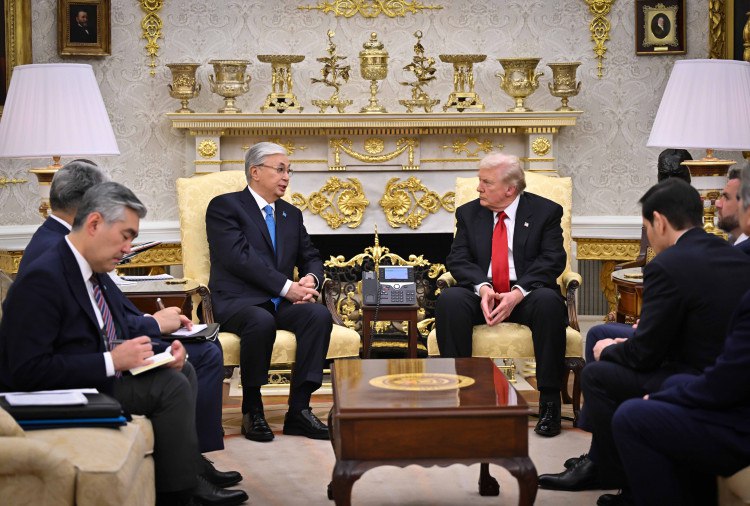
President Kassym-Jomart Tokayev of Kazakhstan will visit Davos, Switzerland on Thursday for the signing ceremony of the “Board of Peace,” an international mechanism set up by U.S. President Donald Trump to help rebuild war-torn Gaza and possibly address other conflicts in the world. 

Tokayev will attend the board’s signing ceremony at Trump’s invitation, Kazakhstan’s presidential press office said on Wednesday. 

The ceremony will occur during the annual World Economic Forum meeting in the mountain resort of Davos, where national leaders, business executives and other influential people gather to discuss global issues. This year’s event comes amid a widening rift between the United States and its traditional allies in Europe over U.S. plans to take over Greenland as well as the prospect of more trade tension between the two sides. 

Trump is the inaugural chairman of the Board of Peace, and he has invited dozens of countries to join. Kazakhstan and Uzbekistan are among a number of countries that have agreed to do so, while others have expressed caution about the initiative, partly because they believe it could undermine the United Nations. 

Another concern about U.S. intentions is that countries seeking permanent membership on the board have to pay more than $1 billion, according to the board’s charter text, which was published by The Times of Israel. 

Uzbekistan is ready to join the Board of Peace as a “founding state,” said Sherzod Asadov, press secretary to President Shavkat Mirziyoyev. 

Mirziyoyev “noted that this initiative is seen as an important step in resolving long-standing conflicts in the Middle East and ensuring peace and stability in the vast region,” Asadov said this week.