Unbent, Unbowed, Unbroken: The Art of Saule Suleimenova

“I’m a very emotional person,” says artist Saule Suleimenova with a bright, open laugh from her home studio in Almaty. Widely recognized as one of the most significant Kazakh artists working today, Suleimenova’s spontaneity and passion emerge clearly as the artist lightens up when talking about the joy and necessity of making work, when she excavates memories of the early days of making art, or when suddenly, she grows gloomy, remembering some of the most painful moments in the history of her country.
Behind her back stands a large canvas, where translucent elements, almost resembling stained glass from a distance, slowly reveal themselves as fragments of discarded plastic bags fused together through heat and a whole lot of patience.
Born in 1970, Suleimenova has developed a practice that spans painting, drawing, photography, and public art, consistently navigating the delicate and often hard to define boundary between personal memory and collective history: “I feel my personal life can’t be detached from politics and everything that happens around me,” she says, embodying, in a way, a motto from the seventies: “the personal is political.”
Suleimenova was an early member of the Green Triangle Group, an experimental artist collective known for its avant-garde and punk-influenced art, which emerged during the Perestroika era and the collapse of the USSR, playing a significant role in revolutionizing contemporary art in Kazakhstan.
Today, she is working mostly with archives, vernacular imagery, and the visual language of contemporary urban space. In her work, she investigates how narratives are formed, distorted, and even rewritten over time, particularly within the historical and political context of Kazakhstan.
An example is her ongoing series, Cellophane Paintings, composed entirely from used plastic bags, transforming everyday waste into luminous, layered pictorial fields that hold together subjects as vast as socio-political trauma, from the Kazakh famine of 1930–1933, human rights violations, Karlag, one of the largest Gulag labor camps, and the Uyghur genocide. Those heavy themes are associated with some that are more intimate: family members, flowers, and cityscapes.
Suleimenova is currently participating in the Union of Artists at the Center of Modern Culture Tselinny in Almaty (15 January – 19 April 2026), curated by Vladislav Sludsky, an exhibition reflecting on artistic partnerships as systems of survival in a region where art historically survived through shared spaces and personal alliances between artists, rather than institutional support.
The Times of Central Asia spoke to Suleimenova about memory, material, and the ways personal experience and political history converge in her art.
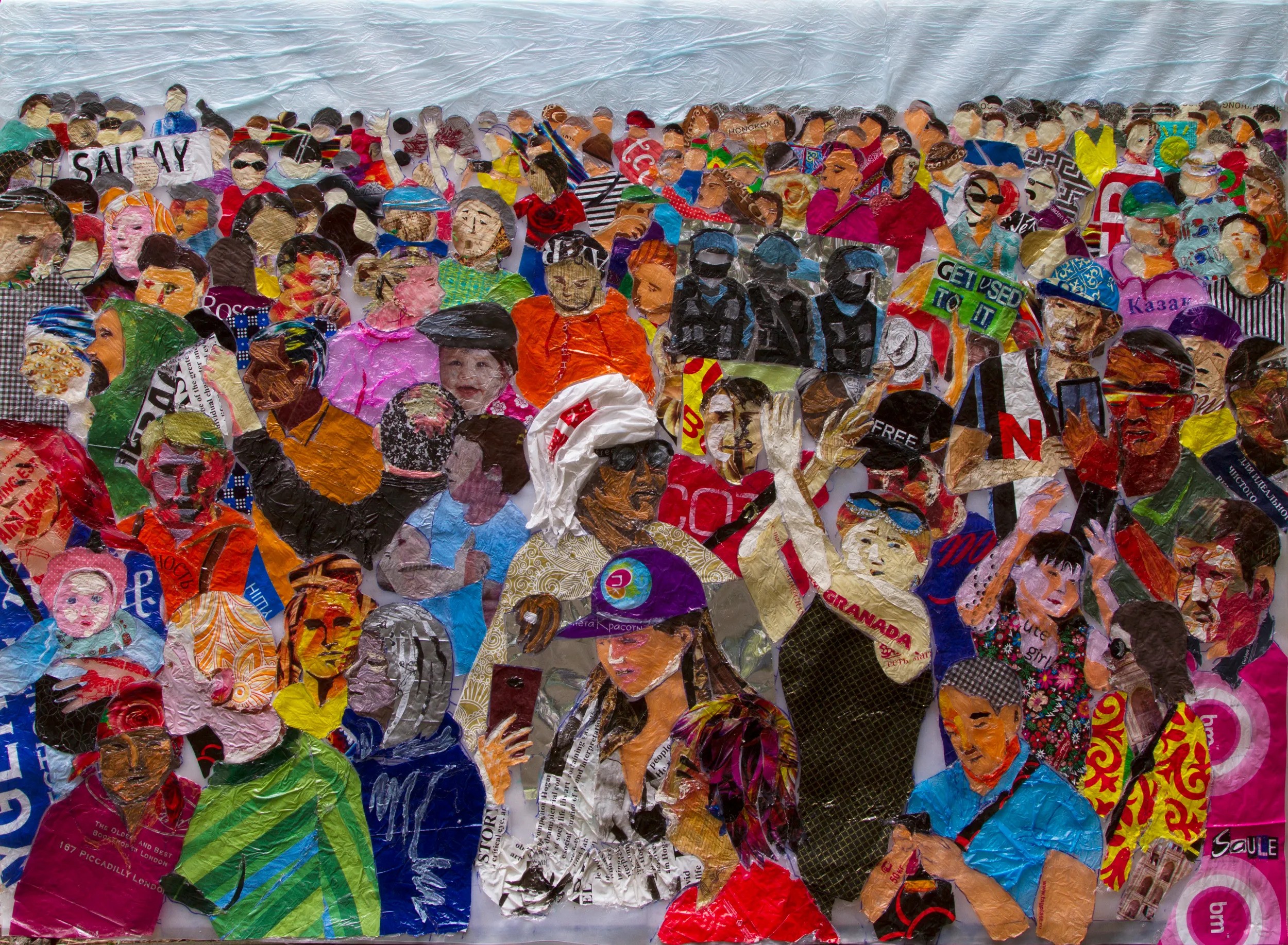
From the series, One Step Forward
TCA: Your recent work at the Bukhara Biennial, Portraits of the people of Bukhara, was made from polyethylene bags collected by the community itself. Can you tell me how your work on this project took shape?
Suleimenova: From the beginning, the work was meant to be collaborative with local artists or artisans rather than something already finished and brought from outside. I decided to collaborate with a folk ensemble of Bukhara women – the retired performers of the Shiru Shakar folk ensemble – who dance and sing, and whose presence carries traditions in a living way. I made a site-specific installation of seven polyethylene transparent films with some images, so the visual part and its embodied practice existed together in the same space.
During the biennial, these women performed two times a week, so the installation was constantly activated by their presence and movement. It ended up being very popular.
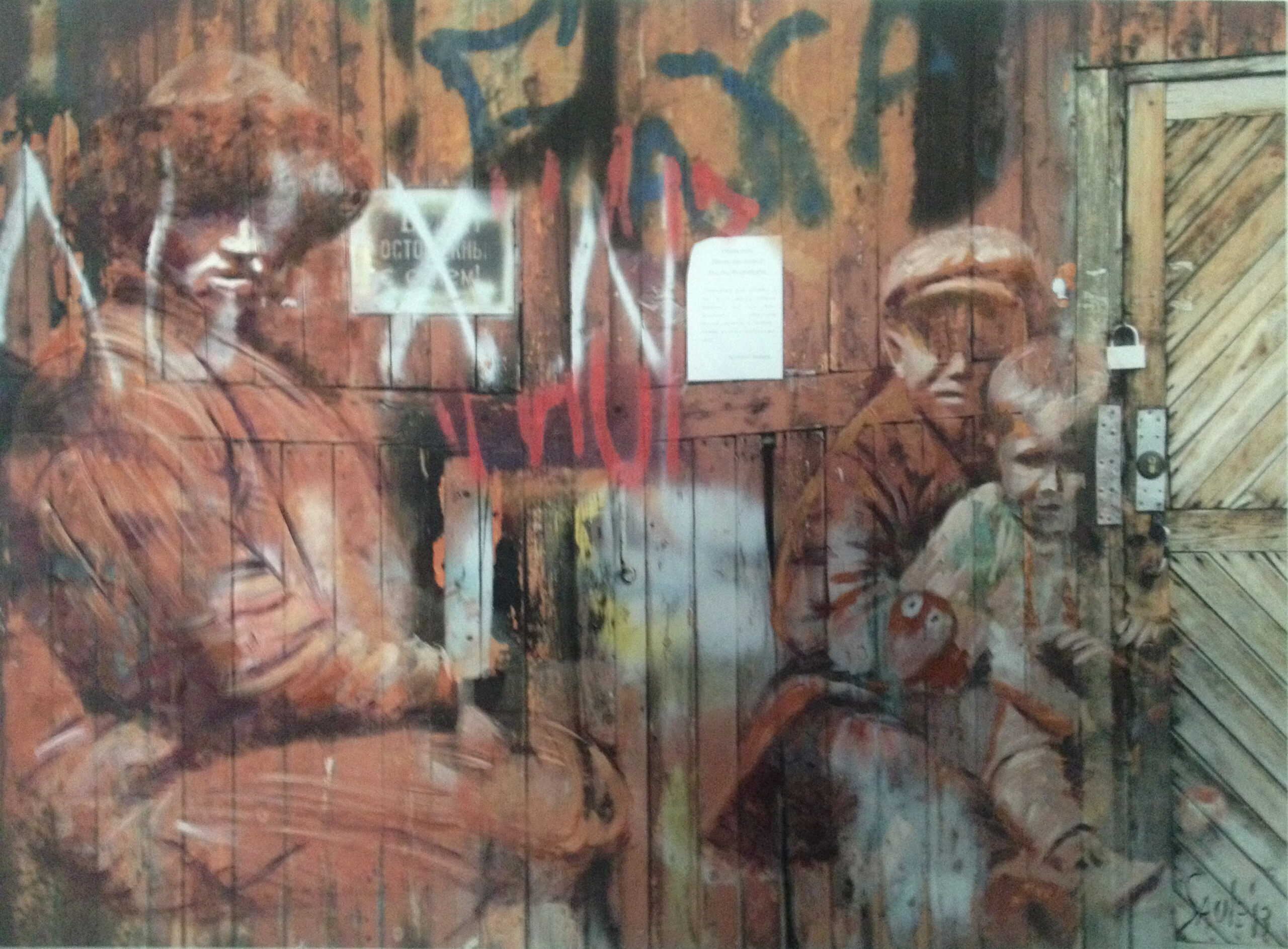
From the series, Aruakhs (Ancestors Spirits)
TCA: You were born into an artistic family, yet you’ve said you initially resisted art school. What was your relationship with art as a young girl?
Suleimenova: When I was a child, I went to art school, but I didn’t feel there was something interesting for me there at that time, so I couldn’t connect to it in a real way. I even lied to my mom that I was going to art school, but instead I spent time somewhere else, because I didn’t feel that what was happening there was truly for me.
Only when I was 16 did I realize that I physically needed to do something with my hands, to paint, to use some pastels and watercolors, and that this need was not coming from outside expectations but from inside my body.
TCA: Was there a particular moment that triggered this need?
Suleimenova: It was a kind of painful time, because I was heartbroken, which made everything feel very intense. It was a time when even breathing felt painful, and the only way to survive was to do something with my hands, to express this feeling that was quite heavy and difficult to carry inside.
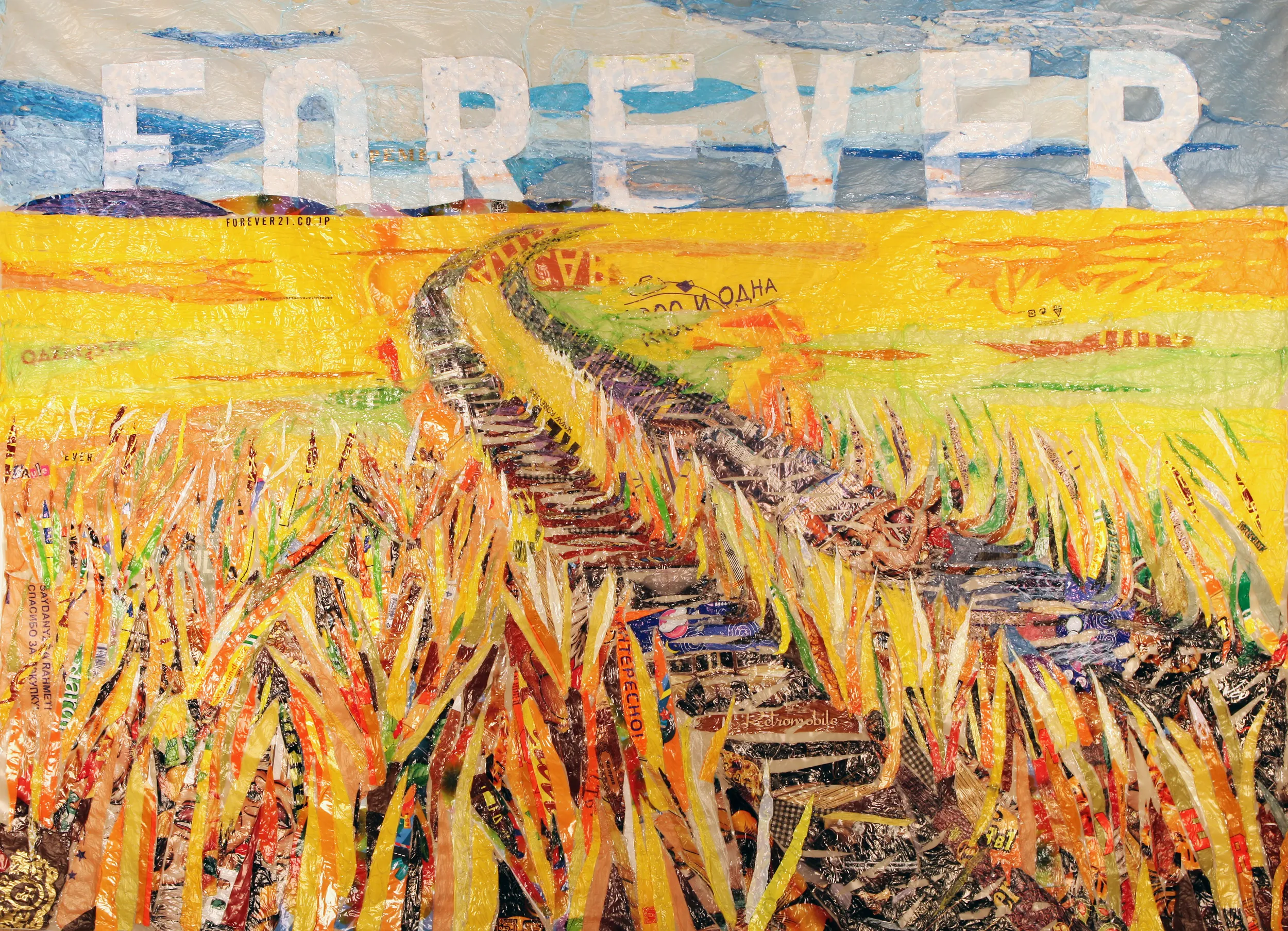
From the series, One Step Forward, “Forever.”
TCA: What did your earliest works look like during that period?
It was mostly work on paper, because that was what I could access. I even had my first attempt to use oil, but I didn’t have an opportunity to buy oil paints and canvas, so mostly it was paper, newspaper, cardboard, or something like that, materials that were simply available.
TCA: Later on, you formed the underground group Green Triangle. What was that moment like?
Suleimenova: Green Triangle really brought together young people who were searching for another way. It was Almagul Menlibayeva, Ablikim Akmullaev, and me, and then a number of young artists joined in. We were just trying to make alternative exhibitions, mostly underground, outside official structures.
When we first met in October 1987, the first time, on the Day of Almaty, which was a big festival, I was trying to earn some money by making portraits of people in the street. There was a huge crowd of people, and it was the first time in the Soviet period that something like this could happen. It felt so open; it was Perestroika.
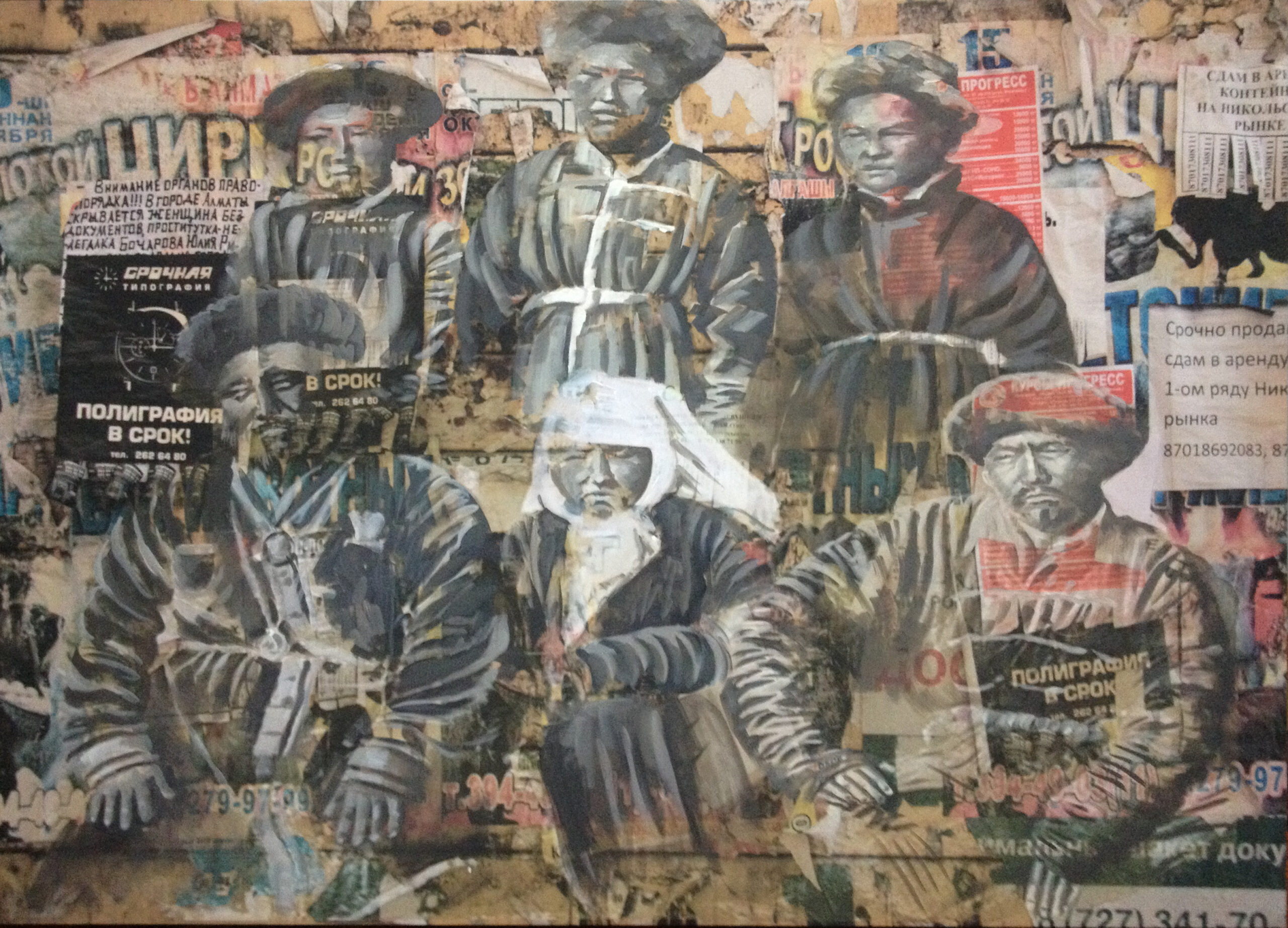
From the series, Aruakhs (Ancestors Spirits), “Family.”
TCA: What do you remember about that atmosphere?
Suleimenova: I was trying to be different, I was wearing hippie clothes and trying to go out and make a performance every day, just to feel I was participating in some way in that moment of change.
And I met these people, these young, beautiful guys with long hair…. we just met each other in the street and found each other. We recognized a similar spirit in each other. We all looked very different than Soviet people, but this was dangerous at the time. This was almost 40 years ago.
TCA: You’ve consistently worked with found materials. Where does that impulse come from?
Suleimenova: I used what I could find on the street – for example, window glass, because it was difficult to find art materials. For the same reason, I just used old clothes and glued them, grounding them as a canvas, using what was there.
Besides the practical element, for me it was always very interesting to work with value, to question what value means and how it works. Why is gold more important than, for example, waste? This question was very interesting for me, and it was important to create a value myself, not to use a kind of already well-known value.
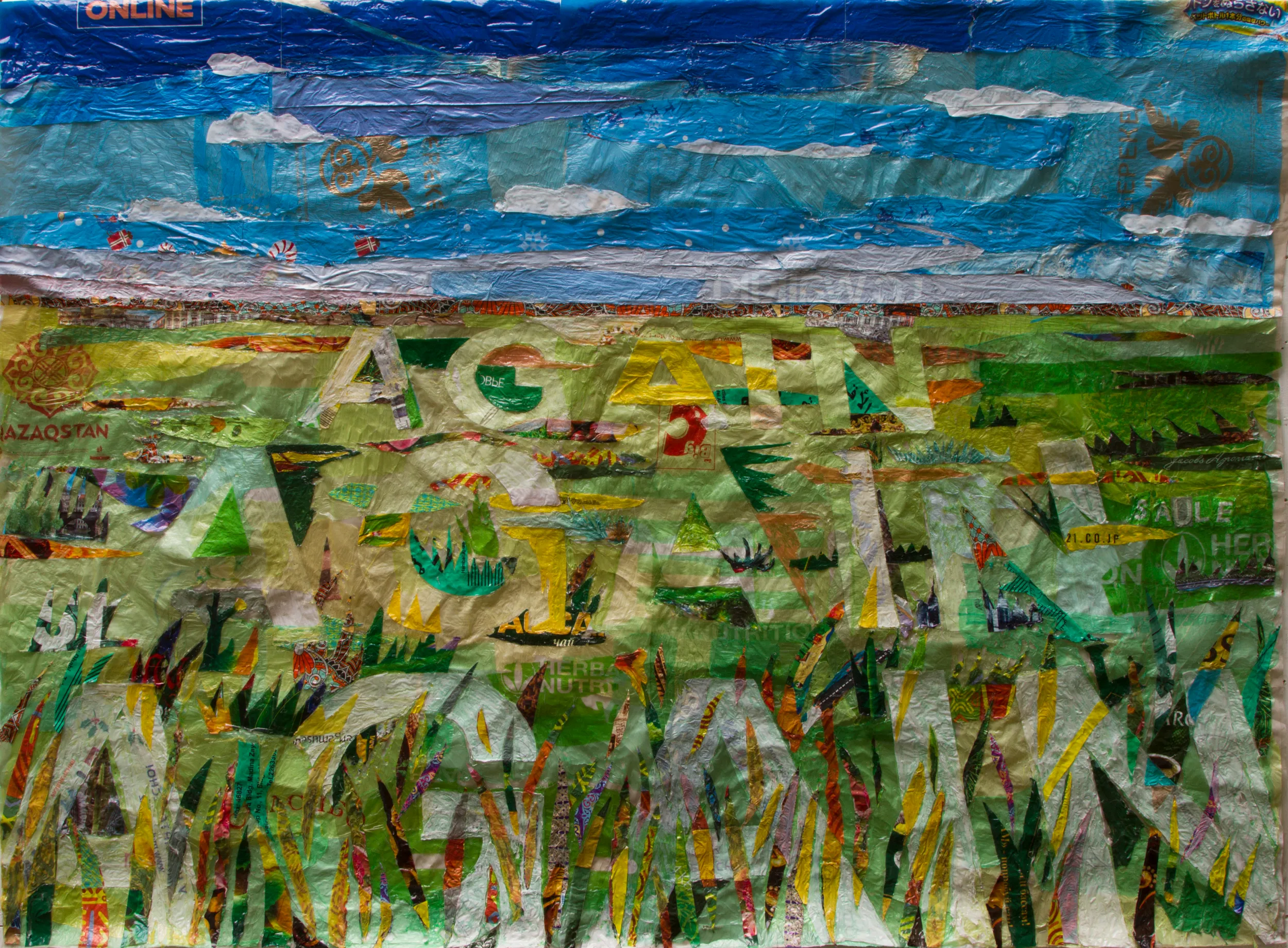
From the series, One Step Forward, “Again.”
TCA: You later began painting over archival photographs. How did that phase develop?
Suleimenova: It was again about measuring values, and I realized in that moment that the most beautiful things I see around are old surfaces, shutters from the garages, or old walls that carry time. There was a lot of graffiti and some ‘do not park your car nearby’ signs, a lot of advertisements, and all these layers. I love this play of light and fades on the surfaces, how time and weather change them.
For the images, it was very important to find this ‘Kazakh-ness’, this proper intonation, because we have a kind of official art that is very idealized. It’s like fairytale images of beautiful girls and warriors, who all look perfect. It was so far from real life, and based on a complex of not feeling proud to be Kazakh. It’s almost like artists needed to create a more glamorous version of ourselves, instead of appreciating what already existed.
I was thinking the best way is to find archival photos, photo documents, and paint them like models on the urban surfaces I mentioned before, corresponding to our current life. I did this juxtaposition of past and present, of different surfaces, so they could exist together in the eye of the viewer.
TCA: And then from there, how did plastic finally enter your practice?
Suleimenova: I found this bag, a plastic bag with little plastic bags inside my mother’s home, and found that I had enough amazing colors there. For several years, I was trying to find a way to glue them, not to use any paint at all. The problem is that polyethylene and polymers are very hard to glue to each other, and there is only one way, which is at a high temperature.
I became very well versed in chemistry… polymers, plastic, polyethylene, polycarbonate, all this horrible stuff holds no secrets for me now. I started to use hot silicone in a glue gun and plastic surfaces, fuel, or polycarbonate, and then I glued the plastic bags together.
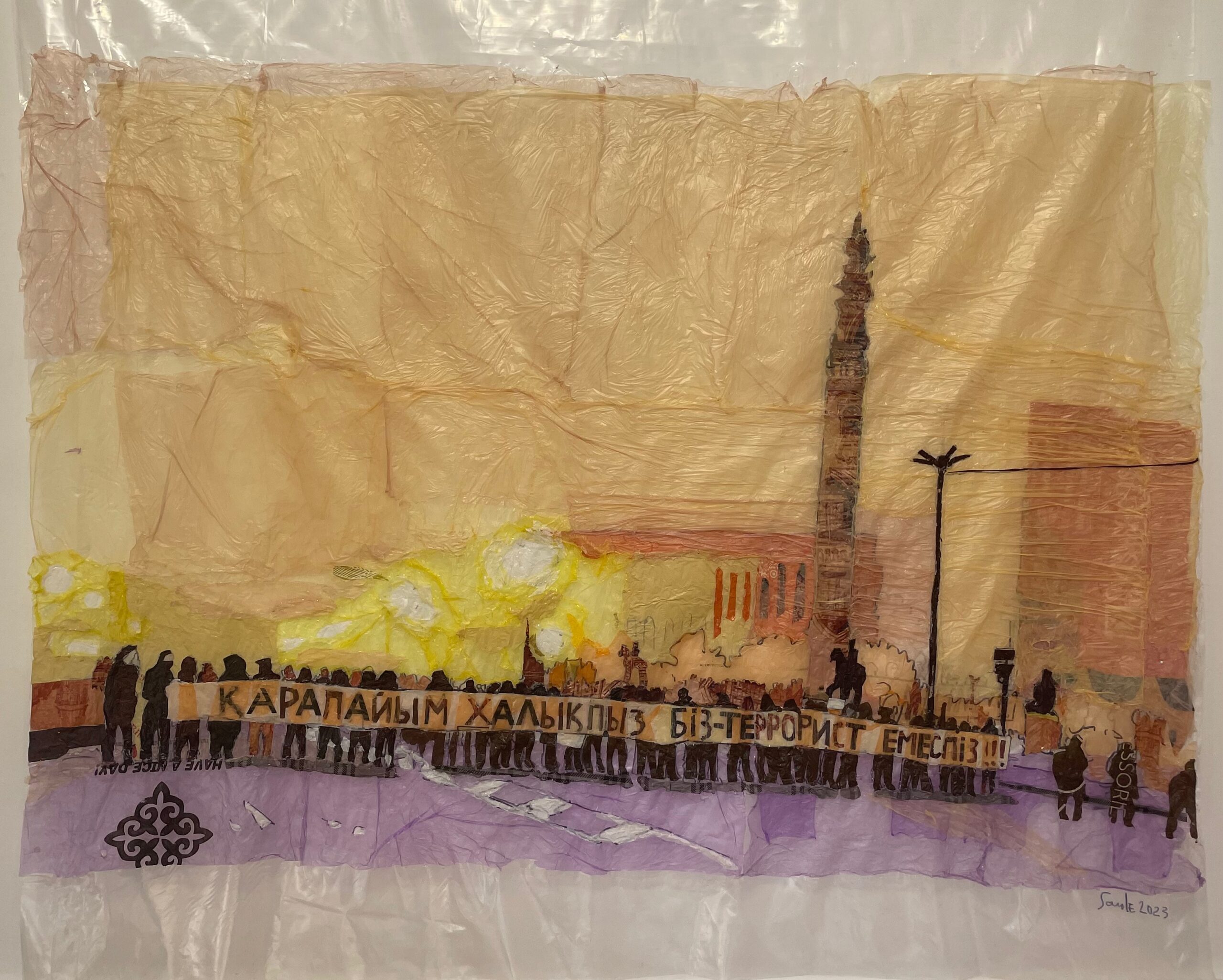
Fog. Qandy Qantar
TCA: Your work merges political and personal themes. How do you see that relationship?
Suleimenova: When I start a series, I cannot finish it; it’s open, because I’m very emotional. Politics is also about emotions, about empathy for people, about what they feel, and I’m just trying to express what I’m feeling through the work. For me, I don’t feel a big difference between my private, personal, and political life. Personal is political.
TCA: You addressed the 2022 events in Kazakhstan in works like Sky Above Almaty. Is it tricky to show this kind of work in your home country?
Suleimenova: That work was first exhibited in Warsaw, and then recently the Almaty Museum of Art wanted to buy it. There was a long discussion, two years. Finally, when the deal was almost sealed, the museum backed away at the very last minute because of concerns about the opening. The work was acquired by another institution, but you can see how there is still unease and a willingness to forget a part of recent history.
TCA: Your work can be very militant; have you ever been subjected to censorship?
Suleimenova: I remember a show that I had four years ago, in a public space in Almaty, which was open 24 hours, a place artists could rent studios and make performances and installations.
Some people from the government visited the show and tried to shut it down. But while they started to see if it was possible to remove the work, all of a sudden, people started to take selfies, and next thing you know, these government officials were taking selfies too. It was a nice exhibition, with many visitors, and those images of the works circulated. I hope that somehow art can make a small impact and speak of a history that must not be erased.