


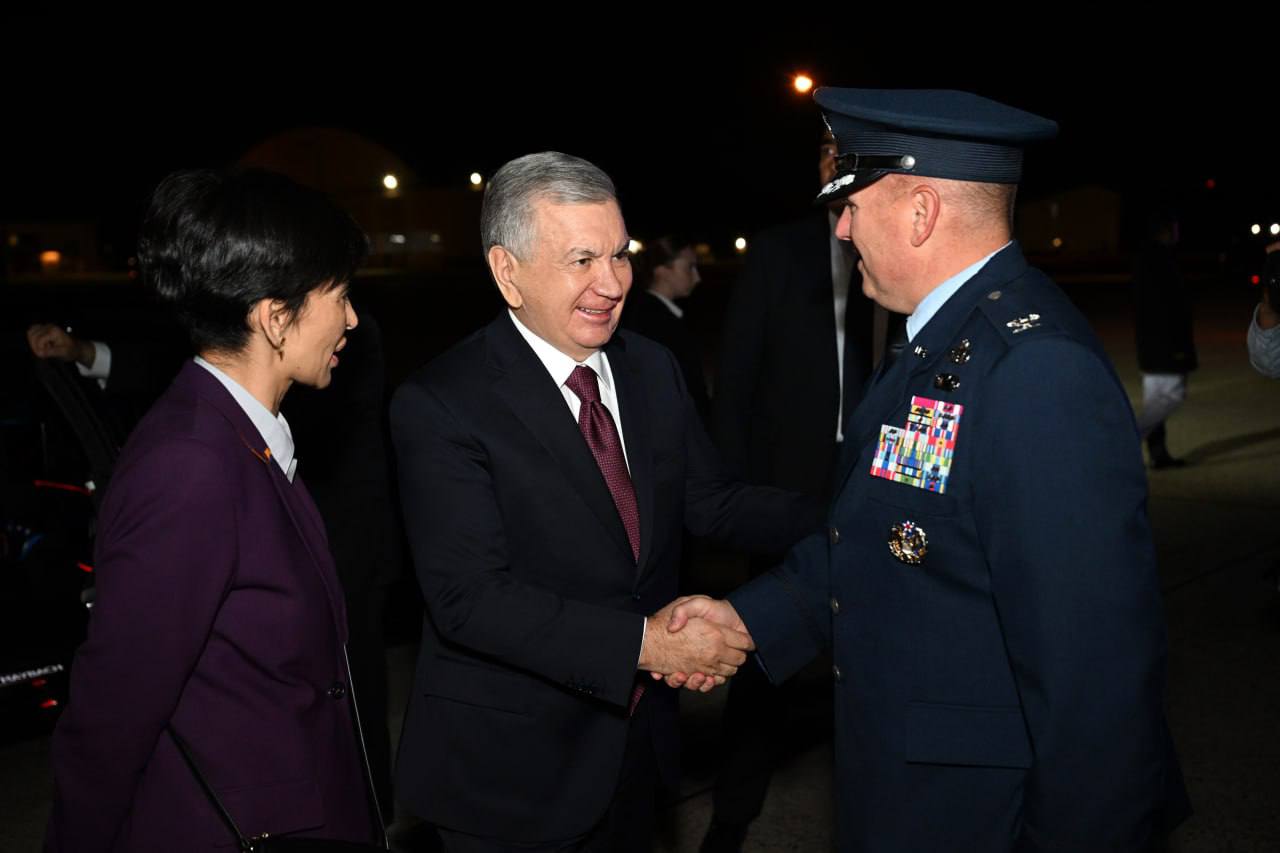
The United States and Uzbekistan are deepening their economic and technological partnership. Following President Shavkat Mirziyoyev’s meeting with U.S. President Donald Trump in Washington, the U.S. State Department announced a sweeping package of agreements, described as among the most significant in the history of bilateral relations in both investment and strategic scope.
High-Level Business Engagements
During his Washington visit, President Mirziyoyev held talks with representatives from major American corporations, investment funds, and financial institutions.
The meeting was attended by U.S. Secretary of Commerce Howard Lutnick, Special Assistant to the President Ricky Gill, Special Assistant to the President Ricky Gill, Deputy Secretary of Agriculture Stephen Vaden, and executives from companies such as Traxys, FLSmidth, McKinsey, Meta, Google, Amazon, Boeing, Air Products, Axiom Space, Cove Capital, Freeport-McMoRan, Orion CMC, Cargill Cotton, John Deere, Honeywell, Valmont Industries, and Flowserve Corporation.
Opening the event, Mirziyoyev highlighted that trade between Uzbekistan and the U.S. has quadrupled over the past eight years, and more than 300 American companies are now operating in the country. He added that this is just the beginning of a new era in economic cooperation.
Key strategic goals were outlined: by 2030, Uzbekistan aims to develop a new-generation energy system with 18-20 GW of renewable capacity, more than half of it sourced from solar and wind. In this context, the two countries plan to jointly develop and process critical minerals such as uranium, copper, tungsten, molybdenum, and graphite, establishing resilient supply chains and leveraging U.S. processing technologies.
Infrastructure is another major focus. Uzbekistan intends to invest over $12 billion by 2030 to modernize roads, railways, terminals, and airports.
Digital cooperation is also expanding. Projects with Google, Meta, and NVIDIA include the launch of Apple Pay and Google Pay, the creation of a Digital Academy, and the development of startup hubs. These initiatives are expected to be supported by the U.S. International Development Finance Corporation (DFC) and the U.S. Exim Bank.
Mirziyoyev reaffirmed his personal commitment to supporting American investment, stressing that Uzbekistan remains a stable and favorable destination for foreign businesses.
Securing Access to Strategic Raw Materials
Washington’s primary interest lies in critical minerals. The U.S. will gain priority access to joint mining projects and exclusive access to geological data on rare earth and other strategically significant elements. This move is part of a broader U.S. effort to diversify global sources of inputs vital to defense, green energy, and other high-tech sectors.
The two countries are also preparing a $400 million investment package to develop sustainable supply chains for critical and rare earth minerals. For Uzbekistan, this represents a key step toward integration into global value chains and reduced reliance on limited partners.
Energy Cooperation: A Role for Small Modular Reactors
Uzbekistan plans to acquire American small modular reactors (SMRs), a technology increasingly favored by emerging economies for its scalability and relatively low upfront costs.
Interest in SMRs has grown following the 2025 approval of the upgraded NuScale Power Module (77 MW), and Uzbekistan may become one of the first countries in the region to deploy the technology.
In parallel, U.S.-based Air Products is planning to invest up to $3 billion in a methanol production facility in Uzbekistan. The project will anchor the initiative known as “Methanol Island,” which is a key component of a future olefin production hub in the Bukhara region.
For Tashkent, this marks one of the largest foreign investments in years and a critical step toward deeper gas processing and the development of an export-oriented petrochemical industry.
Visa-Free Regime, Security, and Technology Transfer
Beginning in 2026, U.S. citizens will be able to enter Uzbekistan without a visa for up to 30 days, a measure aimed at boosting business travel and investment flows.
Security cooperation is also intensifying, with plans for enhanced intelligence sharing and equipment supply for Uzbekistan’s law enforcement agencies.
Tashkent is preparing to purchase $5 billion worth of American auto parts over the next three years. At the same time, the U.S. may participate in the planned 2026 privatization of UzAuto Motors, offering a potential entry point for American automakers and specialist suppliers.
Uzbekistan Airways has also announced a major acquisition: a $8.5 billion order for 22 Boeing 787 Dreamliners.
Meanwhile, the country intends to import up to $2 billion worth of American agricultural equipment, a move expected to significantly enhance the efficiency of its farming sector.

