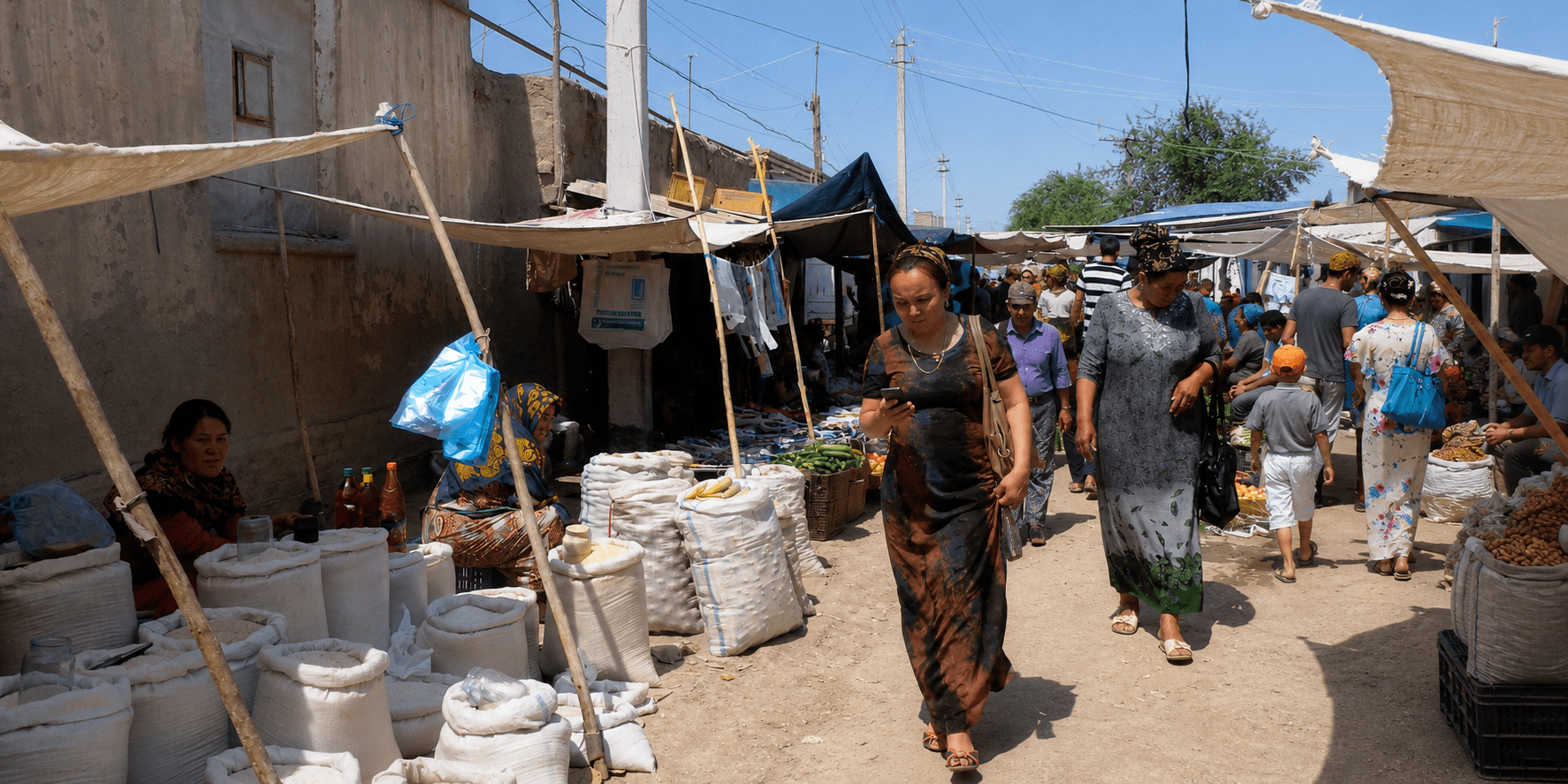
In Diýýar, a village in northern Turkmenistan close enough to catch Uzbekistan’s mobile signal, a foreign SIM card inserted into a small Wi-Fi router can turn a barely functioning 2G connection into usable home internet. In early July, police reportedly entered around ten households in the village, identified Uzbek-connected routers, and confiscated the SIM cards.
Similar inspections have been under way across close to 60 settlements in Dashoguz Province, according to Radio Azatlyk, the Turkmen Service of Radio Free Europe/Radio Liberty. The campaign covers parts of Shabat and Görogly districts, including Kirov, Diýýar, Bedirkent, Aýlak, and Nyýazow, in areas where Uzbek mobile signals cross the border.
The Internet Across the Border
What the authorities are removing is more than a foreign phone number. Residents told Radio Azatlyk that Turkmen Telecom internet is either unavailable or extremely slow in several border villages. TMCell, the mobile brand operated by the state-owned Altyn Asyr network, often provides only 2G service, while home Wi-Fi is unavailable.
Households able to obtain an Uzbek SIM card use networks such as Ucell and Uztelecom, placing the card in a router that supplies internet throughout the home. Residents said YouTube and Instagram become accessible through these connections, although TikTok and many foreign websites still require a VPN. One resident described the Uzbek service as “300 times” faster than the Turkmen alternative, a personal estimate rather than a measured comparison.
The cards arrive through an informal chain of traders and other residents who regularly cross into Uzbekistan. A Dashoguz source said they sell for around 200 manats and that sellers also help buyers complete the registration. The arrangement depends on geography, personal contacts, and a signal strong enough to reach across the frontier.
One local source said many people from Dashoguz work abroad, including in Russia, Poland, and Germany. For households with relatives overseas, a usable connection can provide a direct link beyond the village. It also opens independent news sites and social platforms that remain blocked or unreliable on Turkmen networks. Residents confronted by police sometimes say they use the internet only to pass the time, reportedly hoping to avoid a fine.
A Signal Treated as Suspicion
The reported consequences vary. Some first-time offenders receive a warning, particularly when they cannot afford a penalty. Others are threatened with fines of up to 50,000 manats or imprisonment. That amount is about $14,300 at Turkmenistan’s official exchange rate and roughly $2,500 using the widely reported informal rate.
Residents said officers described the use of foreign telecommunications services as possible espionage on behalf of another country. The reports cite no court case or published provision under which simply possessing an Uzbek SIM card constitutes espionage. The threat itself, however, raises the stakes around an ordinary household connection.
Police and security officers reportedly do not use specialist equipment to locate the routers. Local sources said they rely instead on informants in villages, schools, and local administrations. They allegedly gather information through schoolchildren as well. Residents who travel regularly to Uzbekistan, including small traders, are said to appear first on lists of suspected users.
The authorities have given no public explanation for the campaign. Radio Azatlyk said the Dashoguz provincial administration, police, and the mobile operator did not respond to requests for comment. A source familiar with local law enforcement linked the raids to the details of a murder-suicide in Görogly district appearing online, in which a father was reported to have killed six children before taking his own life. The source said officials suspected that news of the tragedy had reached independent outlets through an Uzbek SIM card. The authorities have not confirmed that explanation.
From Uzbek SIM Cards to Starlink
This is not the first attempt to close an alternative route to the internet. In July 2024, Podrobno.uz reported raids targeting Uzbek SIM cards in northern and eastern Turkmenistan. The cards were said to be brought across the border by regular travelers and sold through informal dealers. That report put the average price of a usable mobile number at around $450, far above the 200-manat figure cited in the latest account. The difference may reflect a volatile underground market or different costs for cards, registration, and equipment, but neither figure can be independently verified.
In April 2026, law enforcement agencies also began nationwide Starlink raids to identify and dismantle satellite equipment. Homes, offices, commercial buildings, and rooftops were searched. Users said the service had gained popularity after connectivity deteriorated in February. Starlink reportedly delivered speeds above 200 Mbps, while Turkmen Telecom packages for the general public offered a maximum of 6 Mbps. The equipment and installation cost between $1,000 and $1,500, putting it beyond the reach of most households.
A More Digital State, Under Tight Control
The crackdown is unfolding as Turkmenistan promotes a far more ambitious digital future. Its public-services portal advertises more than 500 functions, Arkadag has launched a 5G network, and the government has approved a Digital Economy Development Concept for 2026-2028. A recent TCA review found 3.53 million internet users in October 2025, equivalent to 46.1% of the population. Uzbekistan’s rate was estimated at 89%.
These national plans sit uneasily beside the experience of a Dashoguz household searching for a signal from across the border. Digital public services, mobile banking, and online payments require reliable access, yet Human Rights Watch says internet use remains tightly controlled and independent media is unavailable inside the country.
The timing also carries a diplomatic contrast. On July 14, Uzbekistan and Turkmenistan signed an information security agreement during Foreign Minister Bakhtiyor Saidov’s visit to Ashgabat. The two governments also discussed cross-border cooperation and closer economic ties. No evidence links that agreement to the raids, which residents said began earlier in July.
The police may be able to confiscate a card or router, but the demand for a workable connection remains. Residents have turned to VPNs, Uzbek mobile towers, and satellite terminals as each previous route became blocked or dangerous. In Diýýar and neighboring villages, access to the outside world can depend on whether a signal reaches the house and whether someone reports it.