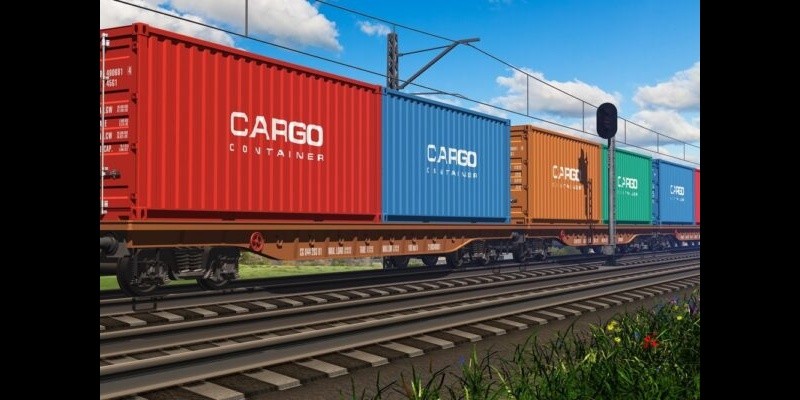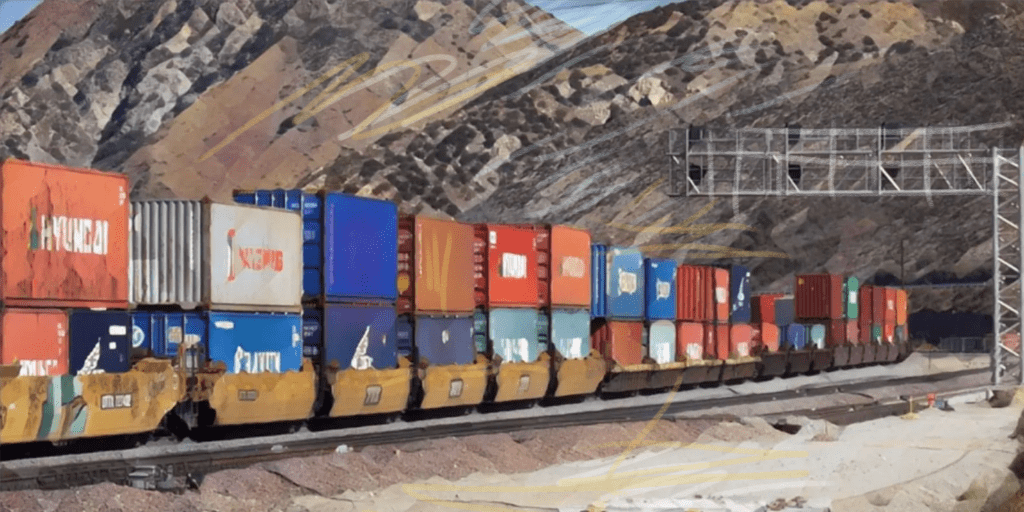
Container traffic is growing along the Middle Corridor from China and Central Asia toward Europe, but the route is far less busy in the opposite direction. In the first eight months of 2026, about 80% of container traffic moved westward and only 20% eastward. Operators are now looking for goods in Europe and Türkiye that can be shipped back across the Caspian Sea and Kazakhstan toward Central Asia and China.
Container traffic totaled 53,574 TEU along the Trans-Caspian International Transport Route, also known as the Middle Corridor, in January–August. One TEU is equivalent to a standard 20-foot container. During the same period last year, the figure was 48,326 TEU, meaning traffic increased by 11%.
But the flows were highly uneven. According to ADY Express, 42,642 TEU moved from east to west, compared with just 10,932 TEU in the opposite direction – a ratio of almost four to one.
Interest in the route increased sharply after 2022, when companies began looking for additional ways to move goods between China and Europe without transiting Russia.
Over the past several years, participants in the Middle Corridor have focused on increasing shipments from China. New train services have been introduced, while countries along the route have invested in railways, terminals, and Caspian ports. Chinese freight has grown, but there is still not enough cargo for the return journey.
For transport operators, the issue comes down to finances. Once containers reach Europe, they need to be used again or repositioned. If there is cargo for the return journey, the equipment generates revenue in both directions. Without it, operators can face the cost of moving empty equipment.
The 80%-to-20% split, however, does not establish how many containers actually make the return journey without cargo. Railway companies themselves are now acknowledging the shortage of eastbound cargo.
“For this, backhaul freight is necessary,” Emil Mammadov, Adviser to the Chairman of Azerbaijan Railways, said at the Black Sea and Caspian Freight Forum 2026 in Baku. According to Mammadov, attracting cargo from Europe would help increase freight volumes, optimize transportation costs, and allow at least some containers to be returned to their countries of origin.
Until now, the route has been promoted more actively in China, Kazakhstan, Azerbaijan, Georgia, and Türkiye. European companies have received less attention. Railway operators are now looking for customers at the western end of the corridor as well.
A shipment from Türkiye showed what such a return journey could look like. In May, KTZ Express and Pasifik Eurasia dispatched a train from Izmir to China carrying household refrigerators. Fifty 40-foot containers crossed the Caspian Sea, traveled through Kazakhstan, and continued into China via the Altynkol border station.
For now, such shipments remain limited. The Chinese side continues to push for more westbound traffic. On September 9, Azerbaijan Railways held talks with Shanghai International Port Group and Lianyungang Port on expanding shipments of Chinese goods through Kazakhstan, across the Caspian, and through Azerbaijan toward Europe.
ADY Express also reported that 265 container block trains operated along the Middle Corridor in January–August 2026. The train count does not establish how fully those services were loaded or how much equipment returned empty.
Kazakhstan occupies the central section of this route. Cargo from China crosses the country by rail, reaches Aktau or Kuryk, and is then shipped across the Caspian Sea to Azerbaijan. From there, it continues through Georgia toward Türkiye or the Black Sea.
Kazakhstan is investing heavily in railways and its Caspian ports. In February, the World Bank approved an $846 million guarantee intended to mobilize $1.41 billion in financing for a major railway project along the Middle Corridor. The World Bank says the project is expected to contribute to tripling freight operations and halving end-to-end transit times along the corridor by 2030.
Mammadov identified automotive products as potential eastbound cargo. He said attracting European shippers would depend on the transit times and service standards the corridor could offer.