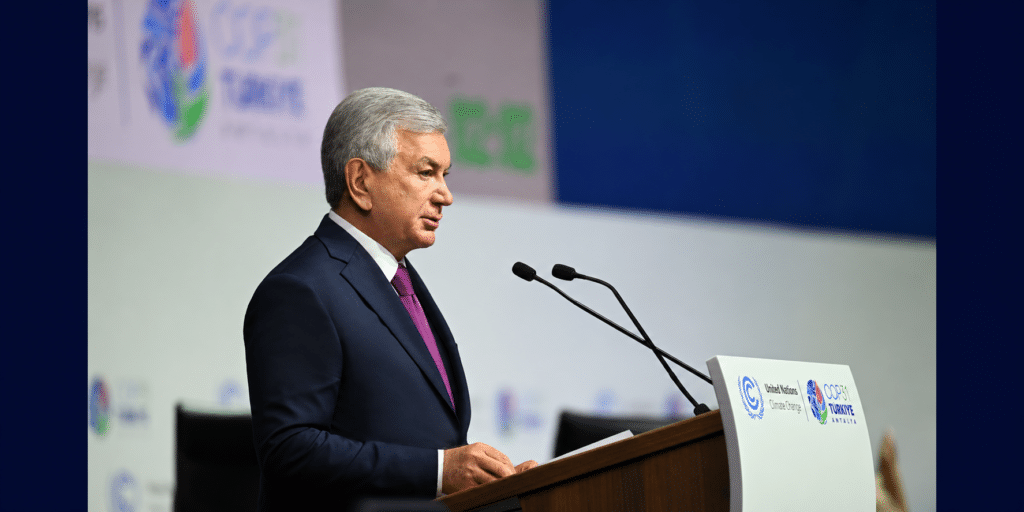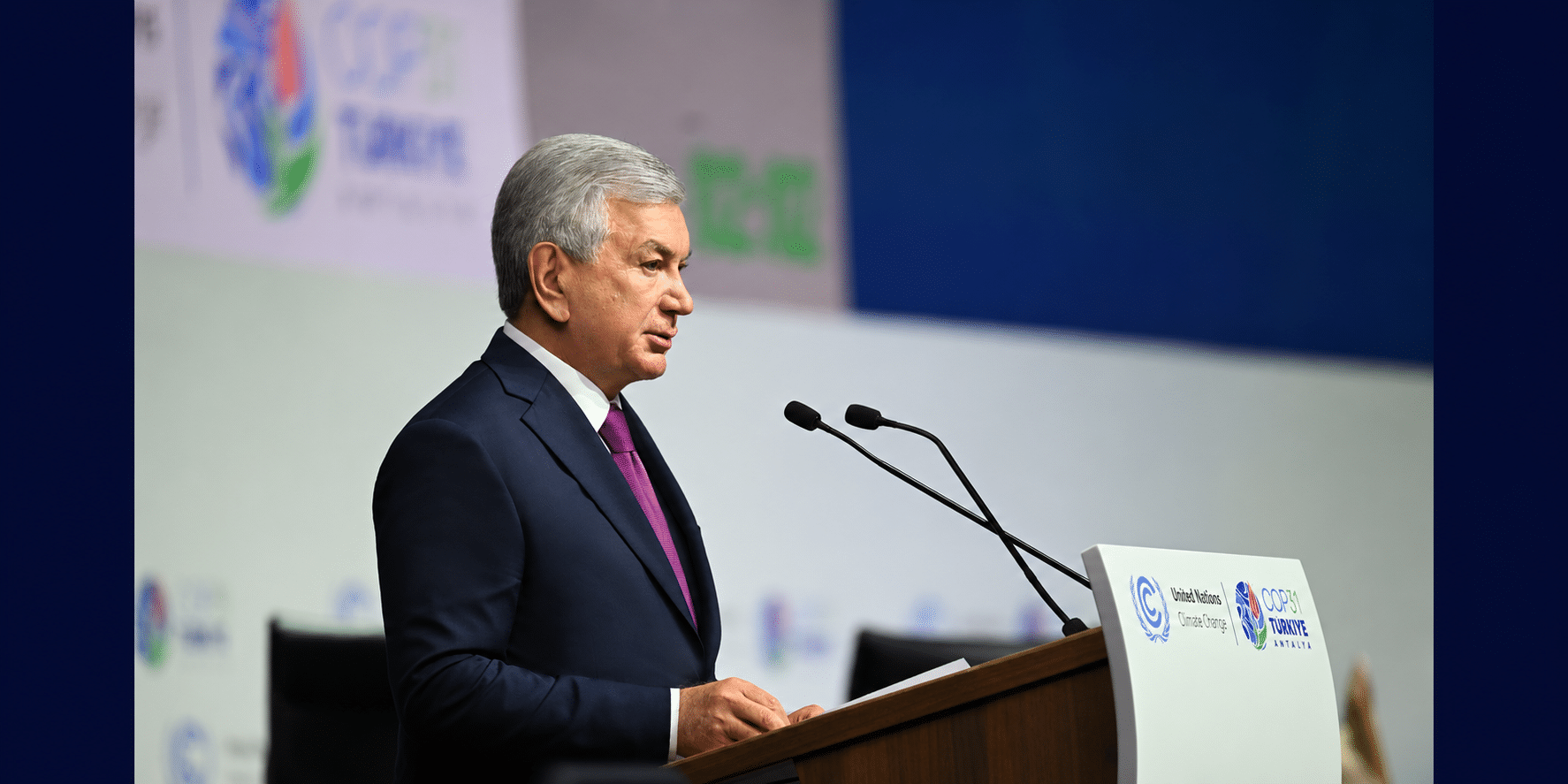
Uzbekistan has proposed establishing a joint early warning system for natural disasters in Central Asia. The plan also calls for greater climate data sharing and coordinated efforts to fund land restoration. The initiative was presented by President Shavkat Mirziyoyev on November 11 at the COP31 leaders’ summit, part of the United Nations Climate Change Conference in Antalya, Türkiye.
“No country can address the challenges of climate change on its own,” Mirziyoyev said.
Mirziyoyev proposed beginning with the exchange of information on climate risks, supported by the World Meteorological Organization (WMO). The next step would be to establish common indicators for monitoring long-term changes, including glacier retreat. Two additional areas of cooperation would involve soil restoration technologies and new financing mechanisms for arid regions.
For Central Asia, accurate forecasting has direct economic implications. Much of the region’s river runoff originates in the mountains of Kyrgyzstan and Tajikistan, while most water withdrawals are used to irrigate agricultural land in Uzbekistan, Turkmenistan, and southern Kazakhstan. According to the World Bank, agriculture accounts for approximately 90% of freshwater withdrawals in the region. Information on snow cover, precipitation, and expected river flows allows authorities to adjust reservoir operations and irrigation schedules in advance.
During the 2025 glaciological year, which ran from October 2024 through September 2025, most monitored glaciers in the Tian Shan and Pamir mountains experienced substantial mass loss. The WMO attributes this to insufficient winter precipitation and elevated temperatures between May and September. Glacier retreat is changing the seasonal distribution of river flows on which agriculture, hydropower generation, and water supplies depend.
Shared Forecasts Instead of Fragmented Monitoring
Central Asian countries already exchange some hydrometeorological information. With World Bank support, Kyrgyzstan and Tajikistan have modernized their monitoring networks and expanded data sharing with regional centers, including the existing WMO-designated regional meteorological center operated by Uzhydromet in Tashkent.
According to the bank, the sharing of real-time observations has improved forecast accuracy and helped national agencies warn neighboring countries about flooding risks along transboundary rivers. The proposed mechanism would extend this practice to other climate threats.
On November 10, the day before Mirziyoyev’s address, WMO Secretary-General Celeste Saulo outlined possible functions for a new regional climate center serving Central Asia and the Turkic states at an event in Antalya. Such a center could produce seasonal forecasts, assess drought risks, and help national meteorological agencies monitor glaciers.
Establishing the center would require agreed rules for data exchange, a division of responsibilities, and sustained funding. The WMO has emphasized that national meteorological services would retain responsibility for forecasts and warnings within their respective countries.
Uzbekistan intends to address some of these issues during its 2027–2029 chairmanship of the International Fund for Saving the Aral Sea (IFAS). The fund was established by the five Central Asian countries in 1993 to promote cooperation on water management in the Aral Sea basin.
On November 9, Mirziyoyev was presented with 133 projects worth a combined $3.3 billion. They include modernization of water management infrastructure, automated water monitoring and distribution, and a regional digital platform for forecasting floods and droughts. The proposals also include a shared database covering the Amu Darya and Syr Darya basins, the region’s two major river systems.
The government plans to approach the World Bank, Asian Development Bank, European Bank for Reconstruction and Development, and international environmental funds for financing. Uzbekistan’s government has been instructed to prepare a month-by-month implementation plan for 2027.
Coordinating river flow data is also important for water allocation among countries. In the upper reaches of the Amu Darya and Syr Darya, reservoirs are used primarily for electricity generation, while agricultural areas downstream need the largest volumes of water during the summer. Joint forecasts could improve planning, but they cannot replace interstate agreements on water use.
Land Restoration and the Search for Financing
The second part of Mirziyoyev’s initiative concerns technologies for restoring degraded soils, increasing carbon storage in arid landscapes, and combating sand and dust storms.
At COP31, the president said water-saving technologies were already being used on more than 60% of Uzbekistan’s irrigated land. The country intends to turn its annual Eco Expo Central Asia environmental exhibition into a permanent platform for presenting new technologies to investors.
At an environmental summit in Astana in April, Uzbekistan had already proposed creating a regional atlas of desertification, land degradation, and water resources, as well as granting regional status to the desertification research center at Tashkent’s Green University. Another proposal called for developing a shared portfolio of climate projects for international investors.
Mirziyoyev said Central Asia needed “reliable and sustainable sources of financing” that reflected regional conditions and needs.
In Antalya, Mirziyoyev called on development banks and specialized funds to develop financing mechanisms for water management and environmental projects, including preferential financing and grants. He specifically mentioned blue finance, which focuses on water-related projects, and financial instruments designed to support arid regions.
On November 10, the president discussed financing with Mafalda Duarte, executive director of the Green Climate Fund (GCF). The talks included the possibility of giving Uzbek financial institutions direct access to the fund’s resources. Such access would allow accredited institutions to submit funding proposals and manage approved projects themselves.
The two sides also discussed ecosystem restoration in the Aral Sea region and the development of environmentally sustainable cities. According to the Uzbek presidential administration, the country’s joint project portfolio with the fund has exceeded $200 million.
CLiCA: $296 Million for Land Restoration in Three Countries
Separately from Mirziyoyev’s new proposal, Uzbekistan, Kyrgyzstan, and Tajikistan have secured approval for CLiCA, an international landscape restoration program.
On November 9, COP31 hosted a presentation of Climate-Resilient Landscapes in Central Asia (CLiCA). The program was developed by the German Agency for International Cooperation (GIZ) in cooperation with the three countries. The Green Climate Fund’s board approved the project on October 28, 2026.
According to the financing structure published by the fund, the seven-year program has a total value of approximately $296 million. Of this amount, $133.9 million will come from a Green Climate Fund grant, while another $162.1 million is expected in co-financing, including loans, additional grants, and in-kind contributions.
The loan component is estimated at approximately $134.4 million. The proposed participation of the European Investment Bank depends on decisions by the borrowing countries and agreement on financing terms. Although the program has been approved, implementation has not yet begun.
CLiCA will cover 180 municipalities across the three countries. Local communities will participate in selecting pastures and forest areas for restoration, identifying agricultural measures, and preparing drought adaptation plans.
Smallholder farmers and pasture users will be able to apply for grants to help them adopt more sustainable agricultural practices. Rural enterprises may also obtain loans through local financial institutions, provided the necessary funding is secured.
The program includes restoring degraded land, introducing more resilient agricultural practices, and coordinating planning in border areas. Approximately 940,000 hectares are expected to benefit from improved land management, conservation, or restoration activities.
One priority area will be the Ferghana Valley, which is shared by Uzbekistan, Kyrgyzstan, and Tajikistan. Agriculture there depends on interconnected irrigation systems, while changes in seasonal river flows affect water supplies across national borders.
CLiCA’s developers estimate that the program could strengthen climate resilience for approximately 2.5 million people, including both direct and indirect beneficiaries. This is a projected outcome for the entire seven-year implementation period.
What the Program Means for Uzbekistan
Approximately €103.7 million is expected to be allocated to Uzbekistan’s component of CLiCA. Activities will cover 15 districts in Andijan, Fergana, Namangan, and Surkhandarya regions.
The program provides for the restoration of 18,000 hectares of forest land and 123,000 hectares of pasture, the introduction of drip irrigation, the use of drought-resistant crop varieties, and greenhouse construction.
Approximately 12,000 farmers are expected to receive advice on adapting to climate change. The program also aims to expand agricultural producers’ access to loans through local banks.
According to Uzbekistan’s National Committee on Ecology and Climate Change, the measures are expected to improve climate resilience for 342,000 people, half of whom will be women.
Implementation is scheduled to begin in 2027, overseen by a national steering committee and project management unit. Activities will be incorporated into district development plans.
The National Committee on Ecology has committed to publishing implementation results, including the area of restored land, changes in farmers’ incomes, and indicators of residents’ quality of life.