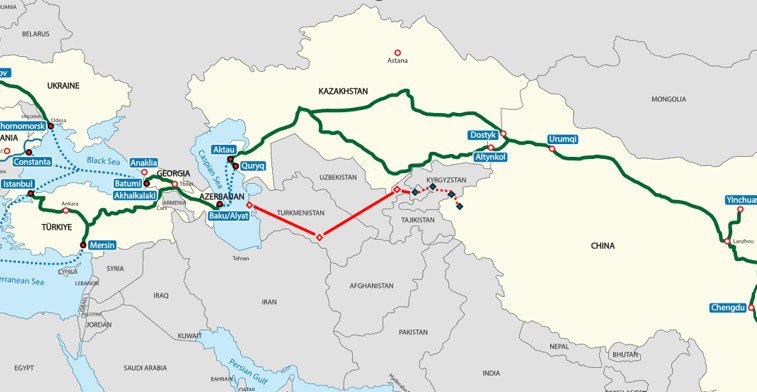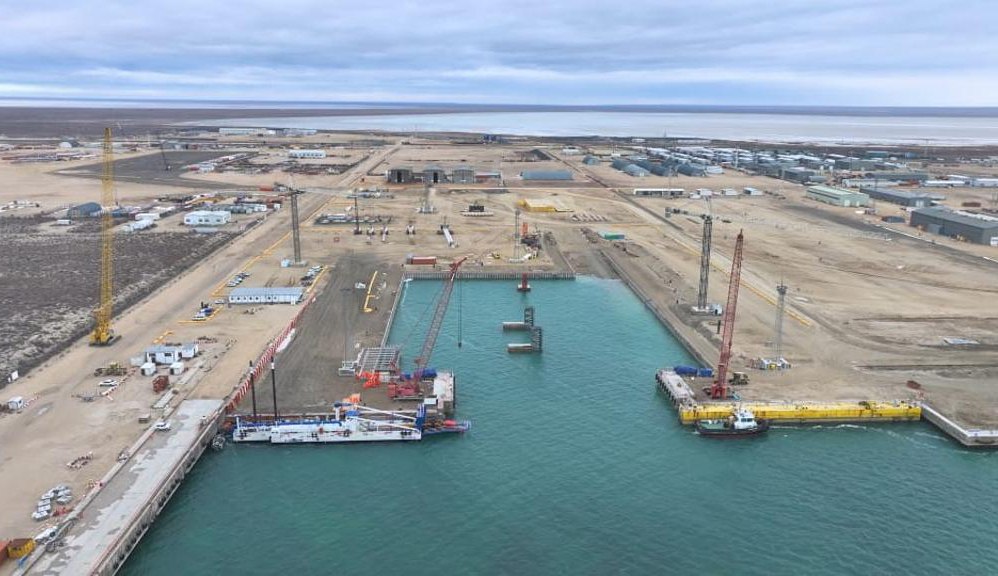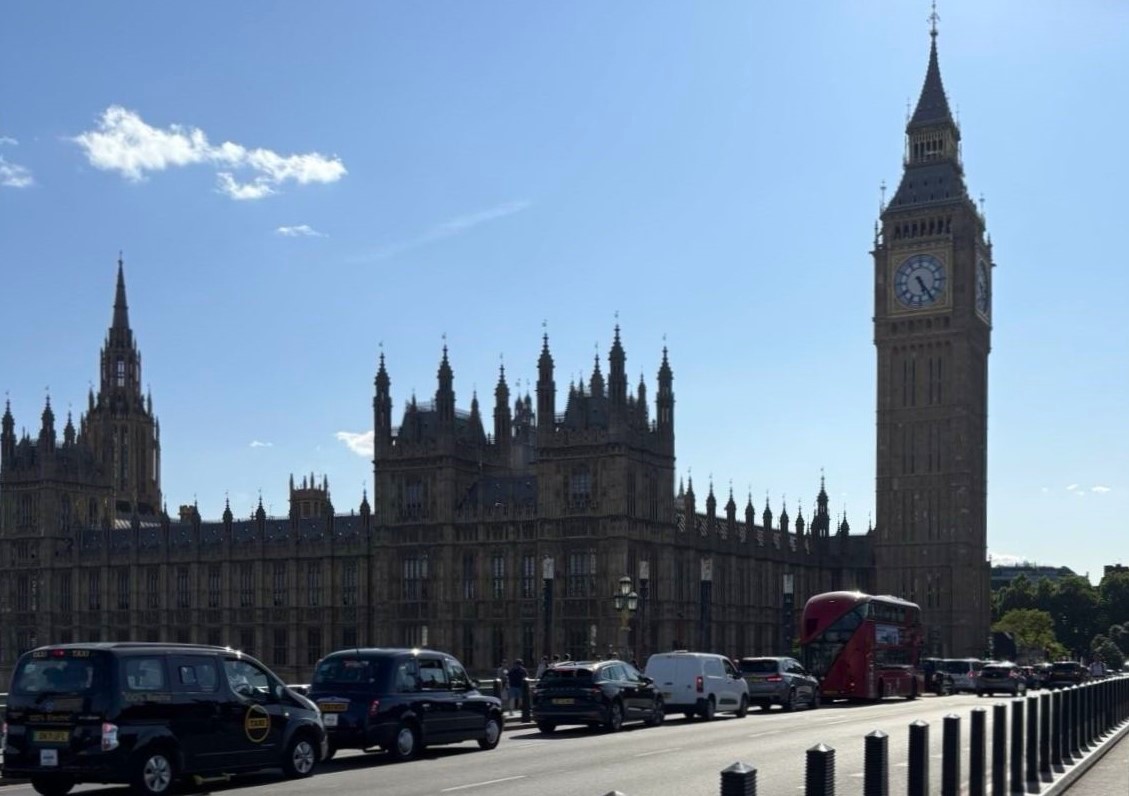
On July 2nd, a roundtable held at the House of Lords, the upper chamber of the British parliament, brought together diplomats, trade envoys, logistics professionals, and academics to promote the Middle Corridor – the overland route connecting China to Europe via Kazakhstan, the Caspian Sea, Azerbaijan, Georgia, and Turkey.
The session aimed to highlight the strategic and economic case for British involvement in the corridor. However, in a crowded political landscape, the pitch struggled to gain airtime. On the same day, British economic minister Rachel Reeves shed tears in parliament’s lower chamber, sparking fears of political instability, and, a few miles away, the Wimbledon tennis season had just begun. In short, Westminster and the British media were elsewhere.
Nonetheless, speakers made their case for the corridor’s importance to China-Europe freight. The Middle Corridor has gained attention as an alternative to the Northern Corridor – a rail network that runs from China through Kazakhstan, Russia, and Belarus, all members of the Eurasian Economic Union (a shared customs zone). The Northern route could, in theory, deliver goods from China to Europe in as little as ten days. But its viability has been damaged by Russia’s invasion of Ukraine and the sanctions regime that followed.

Since then, cargo traffic along the Middle Corridor has surged. “Before the war in Ukraine, 99% of goods travelled along the northern corridor, and just 1% along the Middle Corridor,” said Dr Chris Brooks, Global Director of Risk, Quality and Compliance at Bertling Logistics. “Now it’s about 90% along the Middle Corridor.”
In raw numbers, the increase has been stark. Back in 2021, cargo volume transported through the Middle Corridor was around 800,000 tonnes; that stood at 4.5 million tonnes at the end of 2024.
“It is never going to be an alternative to the maritime route,” Brooks said, estimating that even with major investment, capacity would top out at around 16,000 tonnes per month, which is dwarfed by maritime trade between China and Europe, which totals around 800,000 tonnes a month.
However, he did call the route a “strategic insurance policy,” citing its neutrality, flexibility, and compliance with Western sanctions. For automotive, electric, and fast-moving consumer goods (FMCG) with short shelf lives, the route will prove particularly useful.
“Whether you’re going through the Red Sea or around the Cape of Good Hope, maritime typically takes anything between 35 and 52 days. The Northern Russian corridor is 10 to 20 days. The Middle Corridor can actually do similar.”
But Brooks added that infrastructure and the weather remain limiting factors, meaning that lead times are anything between 14 and 45 days, with some shipments taking up to two months.
“We have as many as 400 trucks queuing up… not because of customs – they’re just queuing to get onto the ferry from Baku to Kazakhstan… Drivers are waiting anything from one week to one month,” he said, adding his concerns that the corridor also has limited capacity to move large cargo.

Image: middlecorridor.com
Many speakers called for a long-term commitment to addressing these infrastructure issues, with fears that as soon as relations with Russia improve, the corridor will be swiftly abandoned. “We need to look at the Middle Corridor not only as a commercial corridor, but also as a strategic corridor,” said Arzu Abbasova of the Royal United Services Institute. “European stakeholders ought to engage… not only when it’s geopolitically convenient, but also [for] the long haul.”
Abbasova also highlighted the corridor’s east-west imbalance: “If a truck driver is only getting its goods from China and then comes back empty, then that raises the costs for the logistics companies.”
British officials have expressed their support in principle. Lord Alderdice, Britain’s Trade Envoy to Central Asia, said in comments to Kazakh media that the corridor offers “a promising area for UK collaboration, expertise, and investment.” Dr Afzal Khan, Trade Envoy to Turkey, noted that the discussion coincided with active UK-Turkey free trade negotiations and called Turkey a key link in strengthening ties across Central Asia.
Britain’s concrete commitments remain limited, however. While the EU has pledged €10 billion through its Global Gateway initiative, the UK has yet to announce specific funding or projects. The event featured little participation from British industry or the financial sector, a fact not lost on the Central Asian delegations.

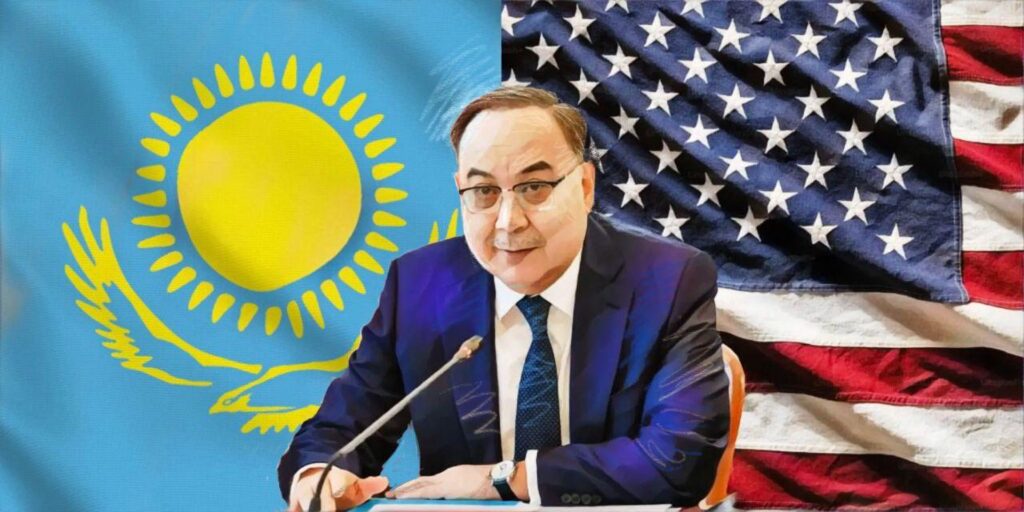
Ambassador of the Republic of Kazakhstan to the United Kingdom, Magzhan Ilyassov
Kazakhstan’s ambassador, Magzhan Ilyassov, expressed concern that the country not be seen merely as a transit zone. “In the U.S., there are the flyover states – Nebraska, Omaha, and Idaho,” Ilyassov said. “We don’t want to be a passed-by country on that route from China to Europe because we’re in the middle. We are a country with huge potential.” The ambassador added that Kazakhstan is seeking value-added partnerships, including in processing rare earths and industrial materials.
From a European perspective, the timing of those remarks raised eyebrows. Just weeks before the event, Kazakhstan had awarded a nuclear power plant contract not to France’s EDF but to Russia’s Rosatom, a decision that led to questions about the country’s willingness to receive Western investment that risked putting it on a collision course with Moscow.
Still, despite the obstacles, there is definite enthusiasm on both sides for increased collaboration.
Dr Assylbek Nurgabdeshov of Heriot-Watt University, who moderated the session, concluded by reiterating the corridor’s potential. “With effective coordination, high-quality human capital, and strategic investment, trade volumes could triple and transit times be halved by 2030,” he said, stressing that the UK is well-placed to support logistics, education, and infrastructure development across the region.
For now, however, little of that opportunity is being grasped. With British political attention decidedly short-termist, the strategic opportunities risk passing London by.
The backdrop to the roundtable made that much clear. Long queues formed outside Parliament as attendees, including ambassadors and executives, waited under the summer sun to clear security. Inside, the event began late and ended abruptly, with guests being ushered out to make way for the next session on the Lord’s packed agenda. Some did at least manage to grab as many scones as they could make off with, but the cheese and pickle sandwiches went untouched.