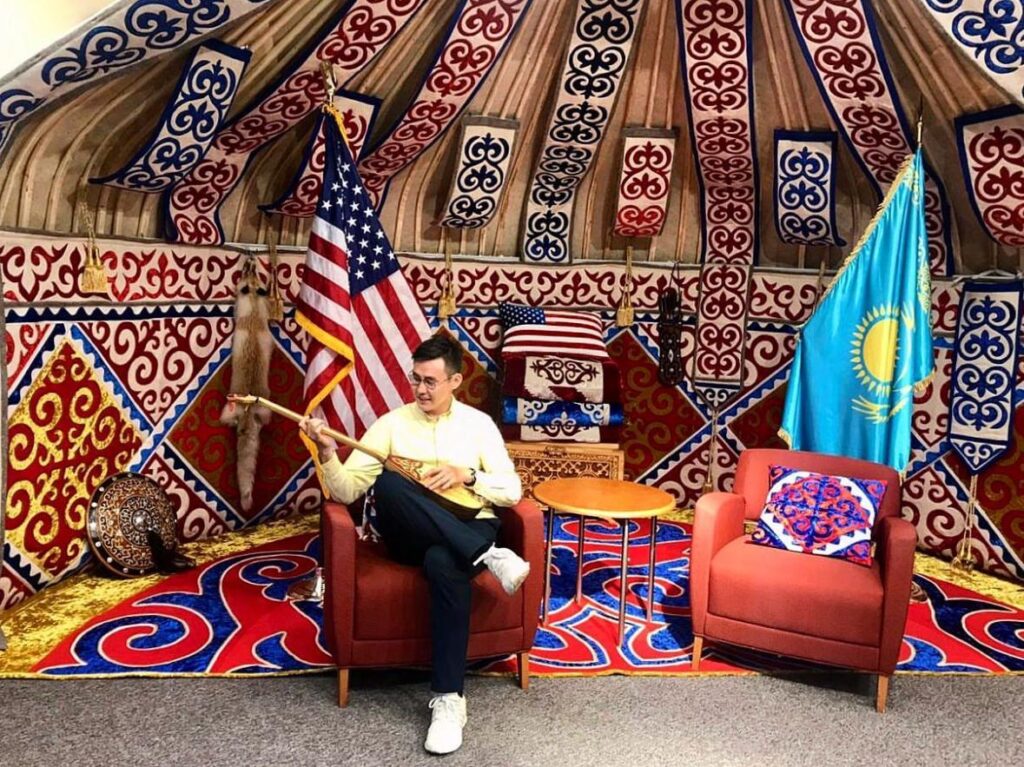
Louis Albertini has been involved in technology and startups across the United States and Kazakhstan for a decade, working with Silicon Valley and venture capital-backed startups based in Kazakhstan, including ORBI and Farel. He is passionate about supporting founders in succeeding in the U.S. market and building connections between the U.S. and Kazakhstan. TCA spoke with Louis to gain insights from his experiences in the Kazakhstan market.
TCA: Can you share your career journey in Kazakhstan and what motivated you to work in diverse roles like marketing, consulting, and startups?
Louis: I arrived in Kazakhstan in July 2015 as a Princeton in Asia fellow and spent a year working in the President’s Office at KIMEP University with Dr. Chan Young Bang. I served as his communications officer, writing official correspondence, liaising with different departments, and managing the day-to-day affairs of the office. After my PiA fellowship ended, I decided to stay in Almaty and start exploring the nascent startup scene. In 2016, I joined the founding team of a startup called ORBI, which developed 360-degree video recording glasses. This was the first Kazakhstani startup that attracted significant venture financing and was invited to interview at Y Combinator in 2016. We raised about $7 million for the company and secured $350 thousand in pre-orders, the largest ever for a Kazakh start-up. Back then, the YC batches were extremely small, and interviews were conducted in person at their historic but now-closed 320 Pioneer Way office in Mountain View. This was my first applied experience with Kazakhstan startups, and I’ve been involved ever since.
TCA: What inspired you to create Redfern Partners, and how did you help address the challenges SMBs and tech companies face in Central Asia?
Louis: Working at the American Chamber of Commerce gave me some insight into the market research landscape in Kazakhstan, primarily by listening to business leaders complain about available options. Besides the major consulting firms like McKinsey and BCG, which are more focused on quasi-state projects that need stamps of approval, the SMB space for high-quality independent research was largely empty. The Big 4 have variations of market research services, but their core specialty is audit and tax. Most local incumbents were formed in the early 1990s and use outdated methodologies that produce inaccurate or trivial insights. International research firms lack local coverage and rely on a loose patchwork of freelancers. Redfern was formed to offer high-quality, independent market research services to fill this void. We completed about twenty projects and continue to be a partner for the European Bank for Reconstruction and Development (EBRD) small business initiative.
TCA: What common mistakes did you see SMBs in the region make, and how did you help them overcome these?
Louis: The SMB space in Kazakhstan is hugely underserved and overlooked, offering the largest surface area regarding technology adoption. In the US, SMBs employ nearly half of the American workforce, representing 45% of America’s GDP. In Kazakhstan, the market is mainly asymmetrical, with large players dominating most services and little incentive for radical, competition-driven innovation. Many larger companies were opportunistically started by black swan events in a vacuum, acquiring ownership over public enterprises and reselling them to Western corporations. They accumulated enough capital and influence to exert their will on the market. Startups and SMBs must consider their advantages, acquisition, process improvement, and customer service. And I mean this in tactical terms, not simply organizing a new “Customer Experience” department and staffing it with people untrained in the operating principles of customer service. As far as helping SMBs overcome obstacles, we brought the same process rigor and analysis to each engagement. I was personally involved in each project, and we adhered to ESOMAR and international standards. This quality helped us serve clients mainly on a word-of-mouth basis and build friendships along the way.
TCA: Central Asia’s tech ecosystem is snowballing. What trends or opportunities do you see for local entrepreneurs?
Louis: Firstly, I want to say that I’m what’s called an “operator.” Someone who’s worked deeply at several VC-backed startups in strategic and tactical roles. I’m not a VC or consultant with approximate knowledge of building startups. That said, it’s incredible to see how far the startup ecosystem has developed since I came to Almaty in 2015. Back then, Kaspi wasn’t listed for $17.5B on Nasdaq, Astana Hub, and Silkroad Innovation Hub didn’t exist, VC funding was around $5M (now nearly $100M), Freedom Finance wasn’t acquiring startups, and Patagonia vests were a rarity. And while still nascent compared to LatAm or MENA, I’m very bullish on Kazakhstan and Central Eurasia as a region and excited to see what’s next.
Money is gradually getting smarter, and terms are becoming more founder-friendly. VCs are also developing deeper bench strength, writing larger checks, and pairing portfolio companies with domain experts and industry intros. Many fantastic Kazakhstan founders are alumni of top international accelerators like YC, 500 Startups, Antler, etc.
Another trend still developing is the Digital Decolonization theme, which means that international products and services will eventually erode in favor of home-grown solutions natively in tune with consumer preferences and the ecosystem. You can see distinct examples in Nigeria and Brazil, where local players dominate over international entrants.
Another opportunity is to test the product in the local Kazakhstan market, win customers, iterate, and then meaningfully evaluate if you’re ready to scale. There are a lot of overlooked problems that could have solutions delivered as simply as possible. Many companies immediately try to enter the US and raise money from US investors/angels. This is nearly impossible without the right pedigree and signals. Yes, there are examples, but usually, it’s the case of graduates from top US universities or significant experience accumulated while already working in the US, which are all outliers. For local entrepreneurs, the image of conquering Silicon Valley is deeply alluring. However, what’s not seen is very sophisticated product management, deep ties to VCs and communities, and highly contextual marketing and sales acumen. A famous book called Ten Types of Innovation posits that you don’t need a groundbreaking feature and can innovate across different categories like business models, channels, customer engagement, etc.
TCA: What is your role as an advisor at Astana Hub, and how do you help startups prepare to scale into the US market?
Louis: Over the past year, I’ve talked to 15+ Kazakh founders, mostly at pre-seed and seed stages, half of whom have raised money. Most of my advising work focuses on fundraising strategy, go-to-market planning, and helping package the company for US import. This means “Americanizing” pitch decks and sales assets to tell better stories, assisting founders in thinking through customer acquisition by targeting the right customers and addressing important operational/logistics issues like incorporation, cap table management, taxes, payroll, etc. These founders can’t use the same marketing tools that work in Kazakhstan and expect them to work in the US.
TCA: What are the biggest challenges Central Asian startups face when entering global markets, especially the US?
Louis: I’ve worked at 3 YC-backed startups from pre-seed to Series B, so I’ve been fortunate — or misfortunate — enough to experience the various growth phases. The areas that I see the most room for improvement are as follows:
Can you deliver a meaningfully viable product, pilot and test it, gather helpful customer feedback, and then iterate in a structured and compounding way? This is extremely important for software companies; US-based startups often “bake” into R&D exceptionally well. Product management in Kazakhstan is mostly backlog management, and overall, its education feels very 2010s. So, by using dated frameworks and methodologies, you simply iterate slower, deliver the wrong things, and solve for vitamins versus painkillers when playing in more mature markets.
The largest challenge for Central Asian startups is the soft skills needed to influence, persuade, and collaborate at scale meaningfully. This extends far beyond proficiency in English but is more related to storytelling, building partnerships, selling the vision, getting first customers excited about a product, and all aspects of driving relationships. The lack of this development is rooted in the hierarchical management structure, which typically concentrates decision-making power at the top, leaving middle managers with limited autonomy and strategic ownership. This top-down approach inhibits innovation and organizational agility and is mainly disempowering over time. This is changing rapidly, though, and the soft skills gap is a huge opportunity.
I see startups get a foothold in the US by usually selling to other CIS countrymen. This is like .001% of the US market, so scaling to a true business requires a more structured approach to building trust and credibility. Unlike Kazakhstan, decision-making frequently involves multiple stakeholders and can be a lengthy, consensus-driven process. Secondly, product-driven companies don’t succeed; solutions-driven ones do. US businesses are not just buying a product; they are buying a solution to an acute problem, a partnership, and a promise of ongoing support. I’ve seen a lot of technical demos from Kazakhstan startups that focus on being very product-centric, and it is still unclear what specific customer pain points are being addressed.
TCA: Central Asia is often seen as an emerging market. What are its biggest strengths and weaknesses in the tech sector?
Louis: I often get this question and see maximalist answers about Almaty or Astana becoming the new digital hub like Dubai. I’ve seen countless MOU signing ceremonies and splashy announcements, but few actual partnership deliverables or measurable outcomes reported. Secondly, there’s a revolving carousel of the same batch of founders and startups covered by the startup media, so in this vein, I will only share my own experience.
The young population is highly technical, and IT outsourcing has immense potential. For example, 60% of the 36 million population in Uzbekistan is under 29 years old. Digital Kazakhstan, Astana Hub, and IT Park (Uzbekistan) are highly supportive of startups, providing infrastructure, tax advantages, and ongoing programs to help companies scale both within and beyond Central Asia. The startup scene, though still burgeoning, features a close-knit tech community. Founders are extremely supportive and willing to help and share guidance altruistically, which is a significant advantage.
Kazakhstan’s VC landscape is still maturing. Few VCs offer strong investment theses and deep ecosystems to scale companies efficiently. Operator-led VCs, where GPs are successful ex-entrepreneurs, are even rarer. This contrasts with the US trend of increasing operator-led funds versus traditional finance/PE-background VCs. Kazakhstan’s unique geopolitical position indeed places it at the center of a complex web of international relations, particularly in the context of sanctions. Navigating this, especially for startups, takes up more time and resources. As mentioned before, specialists with modern training in product management, product marketing, and technical project management are in severe shortage. Most universities and boot camps focus on the technical aspects of creating software but far less on user research, GTM planning, and the critical aspects of building an enduring company.
TCA: What technologies or industries do you think have the most potential for growth in Central Asia over the next 5–10 years?
Louis: There are many areas I’m bullish on in Kazakhstan, and the following areas stand out the most. Intelligent hardware manufacturing to take advantage of incredible amounts of land that could automate the building of vehicles, parts, appliances, etc. AgTech will modernize the Soviet-era manual agricultural processes and plug the sector into real-time analytics, predictive AI, and IoT for optimization. Anything related to automating and streamlining the still very manual logistics industry. IT outsourcing needs to raise awareness on the global stage and move beyond “technical expertise” and business expertise, which means packaging up and offering more full service versus just the backend piece.
TCA: As someone who has worked with startups and established companies, what advice would you give to aspiring entrepreneurs in the region?
Louis: It’s not how smart you are but how fast you can learn. Many founders over-index on renting experience too early, removing themselves from critical activities like sales and operations and delegating tasks as if they’re already an established company with clear market fit and processes. It’s like trying to build muscle by having another person exercise for you. What I always advise is to do the hard work yourself. You have to work hard to discover how to work smart. There aren’t any sustainable shortcuts. Avoid the trap of chasing fleeting vanity metrics. I’ve noticed many Kazakhstan founders juggling two businesses: one that exists only on Instagram and LinkedIn and another that operates in the real world with actual customers and employees. You don’t need to be a guru or visionary; just aim to improve your startup each week. Being consistently good will almost always outperform being periodically great. This boils down to intense focus, prioritizing what to build, and shaping the culture. Some of the best Kazakhstan entrepreneurs I’ve come across have been extraordinarily good at time management and knowing exactly where they should spend their time.
TCA: If you could bring one resource or initiative to Central Asia to accelerate its tech ecosystem, what would it be?
Louis: Brain drain is a critical challenge for Central Asia’s tech ecosystem. Top developers often gain experience working remotely for international companies and ultimately relocate. Innovation hubs like the Silk Road are fantastic, but they can easily become one-way pipelines and amplify the perspective that the best opportunities exist outside Kazakhstan. The region needs a structured approach to attract and retain talent, essentially bringing Silicon Valley’s ecosystem directly to Central Asia and creating pathways in that direction… a reverse brain drain to have returnees bring insightful product experience, empowerment, etc.