• KGS/USD = 0.01144 0%
  • KZT/USD = 0.00211 0%
  • TJS/USD = 0.10460 0.19%
  • UZS/USD = 0.00008 0%
  • TMT/USD = 0.28490 0%
  • KGS/USD = 0.01144 0%
  • KZT/USD = 0.00211 0%
  • TJS/USD = 0.10460 0.19%
  • UZS/USD = 0.00008 0%
  • TMT/USD = 0.28490 0%
  • KGS/USD = 0.01144 0%
  • KZT/USD = 0.00211 0%
  • TJS/USD = 0.10460 0.19%
  • UZS/USD = 0.00008 0%
  • TMT/USD = 0.28490 0%
  • KGS/USD = 0.01144 0%
  • KZT/USD = 0.00211 0%
  • TJS/USD = 0.10460 0.19%
  • UZS/USD = 0.00008 0%
  • TMT/USD = 0.28490 0%
  • KGS/USD = 0.01144 0%
  • KZT/USD = 0.00211 0%
  • TJS/USD = 0.10460 0.19%
  • UZS/USD = 0.00008 0%
  • TMT/USD = 0.28490 0%
  • KGS/USD = 0.01144 0%
  • KZT/USD = 0.00211 0%
  • TJS/USD = 0.10460 0.19%
  • UZS/USD = 0.00008 0%
  • TMT/USD = 0.28490 0%
  • KGS/USD = 0.01144 0%
  • KZT/USD = 0.00211 0%
  • TJS/USD = 0.10460 0.19%
  • UZS/USD = 0.00008 0%
  • TMT/USD = 0.28490 0%
  • KGS/USD = 0.01144 0%
  • KZT/USD = 0.00211 0%
  • TJS/USD = 0.10460 0.19%
  • UZS/USD = 0.00008 0%
  • TMT/USD = 0.28490 0%

Tourism Master Plan for Almaty-Bishkek Economic Corridor Updated with Green Focus

On February 12, Bishkek hosted a presentation of the green update to the tourism master plan for the Almaty-Bishkek Economic Corridor (ABEC) between Kazakhstan and Kyrgyzstan, a document prepared with the support of the Asian Development Bank (ADB).

The event brought together representatives of Kyrgyz government agencies, officials from the Issyk-Kul and Chui regions bordering Kazakhstan, as well as members of tourism associations and international development partners.

The ABEC tourism master plan was initially approved in 2019. According to Kyrgyzstan’s Ministry of Economy and Commerce, the updated version emphasizes three key areas.

The first is green tourism, including the development of eco-tourism routes, sustainable accommodation facilities, hiking and cycling trails, and measures to reduce pressure on mountain ecosystems, lakes, and national parks.

The second priority is sustainable development. This includes improving resource efficiency, introducing renewable energy sources, promoting green logistics, and reducing the carbon footprint of tourism-related activities.

The third focus area is regional integration and connectivity. Planned measures include digitalizing border-crossing procedures, developing sustainable transport solutions, strengthening cross-border coordination, and creating more convenient tourist routes along the corridor.

The updated master plan aims to attract investment and mobilize financial resources from the ADB, national governments, the private sector, and development partners to implement priority projects along the ABEC corridor.

A central infrastructure component of the ABEC initiative is the proposed construction of an alternative highway linking Almaty, Kazakhstan’s largest city, with Lake Issyk-Kul, Kyrgyzstan’s leading tourist destination.

Lake Issyk-Kul remains a major attraction for visitors from across the region and is particularly popular among Almaty residents seeking weekend or summer trips. Although the two locations are separated by only about 80 kilometers in a straight line, mountain ranges make direct travel difficult. The existing route passes through Bishkek, extending the journey to more than 460 kilometers and turning what could be a short trip into an approximately eight-hour drive to Cholpon-Ata, the largest resort town on the lake’s northern shore.

The Times of Central Asia previously reported on long-standing plans to establish a more direct road between Almaty and Issyk-Kul. In 2007, Kazakhstan and Kyrgyzstan signed a memorandum of understanding for a route bypassing Bishkek, running through Uzynagash and Kemin and connecting directly to Cholpon-Ata. The project, however, stalled at an early stage. If completed, it would reduce the travel distance to approximately 260 kilometers and significantly shorten travel time.

The project is currently at the stage of preparing a feasibility study.

World Bank Ready to Allocate Up to $1 Billion Annually for Projects in Kazakhstan

The World Bank plans to allocate up to $1 billion per year to Kazakhstan over the next six years to finance projects under a new Country Partnership Framework for 2026-2031. The announcement followed negotiations in Astana between the Kazakh government and representatives of the World Bank Group.

The parameters of the forthcoming strategy were discussed at a meeting between Deputy Prime Minister and Minister of National Economy Serik Zhumangarin and representatives of the international financial institution. According to Zhumangarin, the new framework is expected to support structural reforms through financing, technical expertise, and joint initiatives.

According to the meeting participants, the potential funding, up to $1 billion annually, will focus on private sector development, infrastructure, and improving economic competitiveness. The draft strategy prioritizes transport and digital connectivity, climate policy, improved water and energy services, financial market development, stimulation of private investment, and expanding the share of renewable energy.

The Kazakh side stated that these priorities align with the country’s national strategic and socio-economic objectives. Analytical support for reforms will continue under the government’s joint economic research program with the World Bank.

Under the previous partnership strategy for 2020-2025, 14 projects totaling $4.2 billion were implemented. Among the largest were the development of the Western Europe-Western China international transit corridor, the reconstruction of the Almaty-Khorgos highway, and the modernization of irrigation and drainage systems.

Andrei Mikhnev, the World Bank’s permanent representative in Kazakhstan and Turkmenistan, said that the Western Europe-Western China corridor has improved transport accessibility for more than 5 million people. Travel time has been reduced by approximately two-thirds, average speeds have tripled, and transportation costs have declined by 35%. The project created more than 1,200 permanent jobs, and most residents in the surrounding regions reported improvements in their quality of life.

Support for small and medium-sized enterprises under the previous program included grants and advisory assistance to more than 1,000 businesses. With support from the program, 175 start-ups were launched, generating approximately $41 million in sales and attracting $16 million in investment. Irrigation modernization projects improved water-use efficiency across 92,000 hectares and enhanced conditions for 94,000 water users, including around 60,000 farmers.

The International Finance Corporation (IFC), part of the World Bank Group, has announced plans to continue providing advisory support for public-private partnership projects and investment initiatives in Kazakhstan. Priority areas include modernization of railway infrastructure, financing for micro and small businesses through partner banks, and projects in the agro-industrial sector, ranging from the acquisition of modern agricultural equipment to deep grain processing.

The parties agreed to finalize the draft strategy, incorporating the proposals discussed, and submit it to the World Bank’s Board of Directors for consideration.

The Times of Central Asia, previously reported that the IFC, together with the Asian Infrastructure Investment Bank, is participating in financing the construction of the Almaty railway bypass line.

Murder of Aigul Sailybayeva: Husband Among Key Suspects in Ongoing Investigation

The death of 40-year-old Aigul Sailybayeva became publicly known approximately a year and a half ago. The former judge from Kazakhstan was 24 weeks pregnant at the time of her death. She had been living in Germany with her husband and young daughter and, according to relatives, had reduced contact with family members roughly a year before the incident.

According to media reports, on June 4, 2024, Sailybayeva took her daughter to kindergarten and then disappeared. Two weeks later, volunteers discovered a suitcase containing human remains near a lake outside the town of Bensheim in the German state of Hesse. Forensic experts reported multiple stab wounds and chemical burns on the body.

Case Timeline

Open-source reporting indicates that on June 4, 2024, Sailybayeva dropped her child off at a kindergarten in Bensheim and subsequently stopped responding to messages and calls. Relatives in Kazakhstan reported her missing after failing to reach her. Her husband, Alexander Dontsov, reportedly was unable to clearly account for her whereabouts.

On June 16, volunteers found a suitcase containing remains near a lake outside Bensheim. German authorities opened a murder investigation. Forensic findings cited stab wounds and chemical burns.

Several media outlets, citing investigative sources, reported that the fatal incident may have occurred on the day of her disappearance. According to these reports, a domestic conflict allegedly took place, after which Dontsov contacted his mother, Natalya Dontsova. It has also been claimed that the couple’s daughter may have been present. These details are based on media leaks and have not been confirmed by a final court ruling.

Investigators reportedly documented cleaned blood traces in the residence and seized an object believed to be a possible weapon. Media reports state that fingerprints attributed to the mother-in-law were found on it. Authorities also noted that shortly after the disappearance, Alexander Dontsov left Germany with the child for Russia, and his mother flew to Moscow the following day.

By July 2024, German authorities had placed Natalya Dontsova on an international wanted list via Interpol. A criminal case was also opened in Kazakhstan under articles related to torture and violent death. The victim’s parents publicly accused their son-in-law and his mother of involvement in the killing.

Through late 2024 and 2025, additional investigative details appeared in the press. Kazakhstan’s Ministry of Internal Affairs sent inquiries to Russia regarding the suspects’ citizenship status. Russian authorities initiated checks following media reports that the Dontsovs might be in Moscow.

In February 2026, journalists reported that both individuals were in Moscow. According to these reports, Alexander Dontsov works as a research fellow at the Faculty of World Economy and International Affairs at HSE University. Natalya Dontsova also resides in Moscow and reportedly declined to testify, invoking her constitutional rights.

The investigation remains ongoing.

Who Was Aigul Sailybayeva

Sailybayeva was a Kazakh lawyer and former judge who previously worked in Kazakhstan’s judicial system. She later lived in the United Kingdom, where she met Alexander Dontsov, and in 2020 moved to Germany with her husband and daughter.

According to relatives and acquaintances cited by media, the family relationship was strained and marked by recurring conflicts, including tensions with her mother-in-law, described as a former investigator and notary. These claims originate from interviews and have not been independently verified in court proceedings.

Some outlets reported that shortly before her death she expressed concern about possible legal steps by her husband regarding a second citizenship for their daughter without her consent. Public documentation on this point remains limited.

A public statement by Sailybayeva’s mother was later circulated on social media.

Suspects and Reported Evidence

German investigators have focused on individuals from the victim’s immediate circle. According to media accounts, the victim’s parents publicly named her husband and mother-in-law as responsible; however, no conviction has been issued.

Reporting citing investigative sources states that a conflict allegedly occurred on the night of the disappearance. It is claimed that after Sailybayeva lost consciousness, Dontsov contacted his mother and that both may have inflicted fatal injuries with a heavy object. These assertions remain part of the investigative version described in the press and have not been confirmed in court.

Forensic sources cited by media state that the body was dismembered and that parts may have been stored in a freezer. Reported evidence includes blood traces in an apartment and a vehicle, as well as a knife allegedly containing DNA from both the victim and her mother-in-law. These details derive from media summaries of investigative materials.

Acquaintances interviewed by journalists also alleged prior incidents of domestic violence. One reported SMS message attributed to Sailybayeva read: “Where the ear is red is where he hit, it turned red from his slap.” This quote is reproduced as cited in media coverage and interviews.

Investigation and International Cooperation

Kazakh authorities opened a related case and announced cooperation with German investigators. Deputy Prosecutor General Galymzhan Koigeldiev stated that Kazakhstan sent formal requests to Russia to verify the suspects’ citizenship. Depending on the outcome, jurisdictional steps may follow. Under Russian law, Russian citizens are not subject to extradition.

In February 2026, the head of Russia’s Investigative Committee requested a report following media claims that the suspects were in Moscow. Checks involving law enforcement and border authorities were reportedly initiated.

The case has received broad media coverage in Kazakhstan, Germany, and Russia. Representatives of Sailybayeva’s family have called on authorities to ensure a full and impartial investigation and to hold those responsible accountable if guilt is established.

Opinion: Kazakhstan’s Constitutional Referendum – Strategic Reset or Institutional Consolidation?

Kazakhstan will hold a nationwide referendum on March 15 to adopt an entirely new constitution – an initiative President Kassym-Jomart Tokayev describes as a decisive break from the country’s super-presidential legacy. The draft, published on February 12 after deliberations by a Constitutional Commission, proposes far-reaching institutional reforms. Among the most notable changes are the replacement of the bicameral parliament with a unicameral body known as the Kurultai; the reinstatement of a vice presidency; and the constitutionalization of commitments to digital transformation, economic modernization, and strengthened sovereignty.

The government presents the reform as a necessary modernization of the state in response to global turbulence. Yet the scope and timing of the proposal indicate that the referendum is as much about strategic recalibration as it is about institutional redesign.

The Accelerated Timeline

The speed of the process has drawn considerable attention. In September 2025, Tokayev advised against rushing constitutional reform and suggested that 2027 would allow sufficient time for public consultation. However, by February 2026, the referendum had been scheduled for mid-March. This abrupt shift suggests a deliberate political calculation rather than simple administrative urgency.

One factor under discussion is the legal effect of adopting a wholly new constitution. While reforms in 2022 limited presidents to a single seven-year term, the introduction of a new constitutional order could create ambiguity regarding the continuity of those limits. Even if not explicitly intended as a reset mechanism, such a transformation inevitably introduces flexibility into questions of tenure and succession.

Geopolitical pressures also help explain the acceleration. Tokayev has pointed to profound changes in global trade, security alignments, and technological competition. In a world increasingly shaped by sanctions regimes and geoeconomic fragmentation, Kazakhstan seeks to project institutional coherence and responsiveness. Constitutional reform, in this sense, becomes a signal of adaptive capacity.

At the same time, the draft completes the political transition that began after the unrest of January 2022. Although earlier amendments removed former President Nursultan Nazarbayev’s constitutional privileges, the 1995 framework remained largely intact. The new proposal replaces that structure altogether, extinguishing residual legal ties to the Nazarbayev era and consolidating a distinct political phase under Tokayev’s leadership.

Sovereignty as Constitutional Doctrine

A defining feature of the draft is the elevation of sovereignty, independence, territorial integrity, and the unitary nature of the state to foundational, effectively immutable principles. This language carries clear geopolitical resonance, particularly in the aftermath of Russia’s invasion of Ukraine. While Kazakhstan continues to pursue a multi-vector foreign policy, the constitutional entrenchment of territorial integrity reinforces the state’s insistence on inviolable borders.

The draft also expands restrictions on foreign financing of political parties and introduces stricter transparency rules for foreign-funded non-governmental organizations. These provisions reflect a doctrine of symmetrical distance: limiting political influence from any external actor, whether Russia, Western governments, or other international stakeholders. The emphasis is not ideological alignment but institutional insulation.

Language and Identity: Managed Ambiguity

The most domestically sensitive amendment concerns the status of Russian. The draft alters the phrasing from Russian being used “on an equal footing” with Kazakh to being used “along with” it. While officials describe this as a technical harmonization between language versions, its symbolic implications are substantial.

For Kazakh nationalists, the change is modest and insufficient to guarantee the primacy of the state language. For Russian-speaking communities and Moscow, even a subtle shift carries political meaning. The revised wording preserves official bilingualism while signaling incremental affirmation of Kazakh identity. Rather than resolving the tension between nation-building and inclusivity, the constitution manages it through calibrated ambiguity.

Economic Predictability and Institutional Signaling

The economic provisions of the draft are designed to reassure both domestic and international investors. It expands constitutional authorization for special legal regimes beyond the Astana International Financial Center to include “rapidly developing cities” with distinct administrative and judicial arrangements. By potentially extending common law–style enclaves to industrial and logistics zones, Kazakhstan aims to strengthen contract enforcement credibility and reduce perceptions of political risk.

The draft also constitutionalizes protections for privacy and personal data, including in the use of digital technologies. These provisions signal an ambition to position Kazakhstan within emerging technological and AI-driven sectors. Clear succession rules – requiring presidential elections within two months in the event of early vacancy – and the reinstated vice presidency seek to mitigate uncertainty surrounding leadership transitions, a recurring concern in Central Asia.

Business associations have largely welcomed these reforms as enhancing Kazakhstan’s attractiveness in a fragmented global economy, though their effectiveness will depend on consistent implementation rather than constitutional language alone.

Regional Implications

Within Central Asia, Kazakhstan’s approach reinforces a broader trend toward constitutionalized executive governance. Uzbekistan has pursued similar reforms that combine institutional restructuring with consolidated presidential authority. Other regional states may selectively adapt elements of Kazakhstan’s model, particularly regarding succession management and special economic jurisdictions, though domestic political conditions will shape their capacity to do so.

The referendum thus resonates beyond Kazakhstan’s borders. It suggests that regional legitimacy increasingly rests not on competitive pluralism but on institutional predictability and state resilience.

Strategic Adaptation in a Volatile Region

The March 15 referendum is neither a dramatic democratic breakthrough nor a simple authoritarian retrenchment. It is better understood as a strategic adaptation. Kazakhstan seeks to craft institutions capable of responding swiftly to external shocks while projecting predictability and safeguarding sovereignty.

The ultimate measure of success will lie not in the referendum’s outcome but in its implementation. If new rules are applied consistently, if special legal regimes deliver credible judicial independence, and if succession mechanisms function transparently, the constitution may enhance institutional resilience. If not, it risks entrenching executive dominance without delivering the promised stability.

In a region where autonomy and stability are continually tested, constitutional design has become a central instrument of statecraft. Kazakhstan’s referendum reflects this reality: sovereignty and resilience are not proclaimed – they are constructed through institutions that must prove both durable and trustworthy over time.


The views expressed in this article are those of the author and do not necessarily reflect the official policy or position of the publication, its affiliates, or any other organizations mentioned.

Uzbek Minister Says No Evidence of 15 Million Citizens’ Data Leak

In early February, The Times of Central Asia reported that the personal data of Uzbek citizens may have been leaked from government information systems and circulated on darknet forums. The report followed online discussions alleging that databases linked to state institutions were being distributed via anonymous platforms.

According to posts shared on Reddit, links to online repositories, including darknet resources, allegedly contained data obtained from Uzbek state institutions. Some users claimed the breach could involve the personal information of up to 15 million citizens. The allegations quickly spread across social media, prompting public concern and official responses.

On February 12, a press conference was held at the Ministry of Digital Technologies, attended by journalists, media representatives, and members of the public. Minister of Digital Technologies Sherzod Shermatov addressed the reports, stating that the issue had become the subject of widespread discussion in recent days.

Shermatov emphasized that information security and personal data protection remain state policy priorities. He said authorized bodies had conducted research immediately after the reports emerged and presented preliminary findings based on technical analysis.

According to officials, cyberattacks targeted the information systems of three state agencies between January 27 and 30. However, the claim that data relating to 15 million citizens had been leaked was not confirmed during the initial assessment. Authorities stated that the number of potentially affected records appears to be closer to 60,000, rather than the figure circulating on social networks.

During the briefing, officials placed the situation in an international context. They noted that with the rapid expansion of digitalization worldwide, cyberattacks have increased even in technologically advanced countries. In 2025 alone, global losses from cybercrime reportedly reached $10.5 trillion, while more than 16 billion user records were compromised from major corporate platforms. Media reports have described large-scale breaches in several countries, including China, the United States, the United Kingdom, and Indonesia over the past two years.

Uzbek officials stressed that the key challenges in such cases are early detection, rapid response, and damage mitigation, followed by strengthening protective systems. They reported that in 2024 more than seven million cyber threats were neutralized through national cybersecurity nodes. In 2025, that figure exceeded 107 million, reflecting both increased activity in cyberspace and expanded monitoring capacity.

To contain the recent incident, authorities said unauthorized access to information infrastructure was blocked. Passwords for users of the Unified Identification System, known as OneID, were reset, and additional technical safeguards were introduced. Officials added that new measures now allow users to control whether their personal data can be shared with other systems based on individual consent.

Explaining the concept of a personal data leak, officials clarified that it does not automatically mean a citizen’s private account has been hacked. In many cases, limited data, such as a name, date of birth, address, or phone number, may be exposed. On its own, such information does not enable fraudsters to act on behalf of an individual without additional verification data. However, it may be used in social engineering schemes.

Authorities warned that scammers often call citizens while posing as bank employees or security officers, using partial personal information to gain trust and request SMS codes or login credentials. Officials urged the public to remain vigilant and avoid sharing passwords, bank details, or verification codes with anyone claiming to represent official institutions.

The ministry stated that while state systems are regularly updated and reinforced, personal cyber hygiene remains essential. Citizens are encouraged to use strong passwords, enable two-factor authentication in OneID and banking applications, avoid clicking on suspicious links in messaging apps, and verify information through official websites.

Vending Machines Selling Gold Bars to Appear in Tajikistan

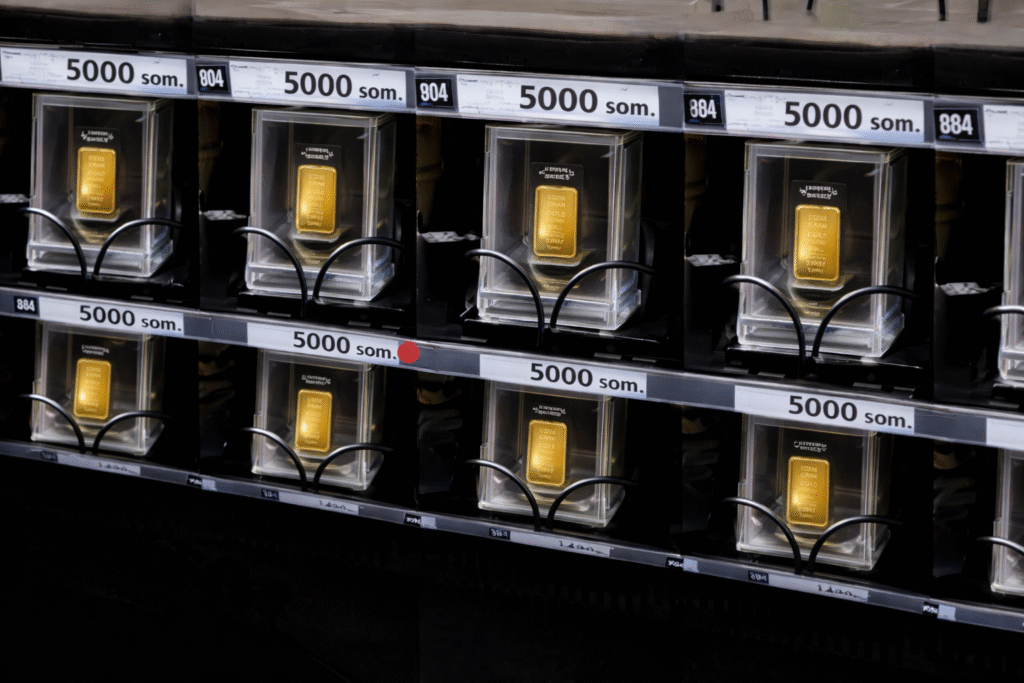
The National Bank of Tajikistan plans to expand public access to investments in precious metals by installing specialized vending machines in the capital Dushanbe, allowing customers to buy and sell gold bars. The initiative was announced by the bank’s chairman, Firdavs Tolibzoda.

According to the regulator, the equipment will be installed in Dushanbe and will enable residents to conduct transactions with gold bars automatically.

The machines will operate similarly to conventional ATMs. Customers will be able to select a gold bar, pay by bank card, and receive the product. Some machines are also expected to allow customers to sell gold back to the bank.

Such devices are typically located in shopping centers, airports, and other high-traffic areas. As Tolibzoda emphasized, the decision is aimed at “expanding public access to the purchase of gold bars.”

Gold bars have been in free circulation in Tajikistan since June 2017. They are currently sold at the central office of the National Bank in Dushanbe and through several commercial banks.

According to the regulator, 200 kilograms of gold were sold in the country in 2025 for a total of $24.64 million. Individuals accounted for the majority of purchases. The price of bullion is set daily. It is calculated based on the price of a troy ounce (31.1034768 grams) at the morning interbank fixing in London. Additional costs, including production, transportation, insurance, and customs duties, are also taken into account. The bars are produced from gold mined in Tajikistan.

According to the National Bank, 2025 marked a turning point for the domestic gold market. The price of its standardized gold bars rose by an average of 39.03% during the year, the highest increase in recent years. The growth was attributed to rising global gold prices amid geopolitical tensions, a weakening U.S. dollar, and increased demand for safe-haven assets.

Bars weighing 10, 20, and 50 grams are available for purchase. As is customary in the bullion market, the larger the bar, the lower the price per gram.