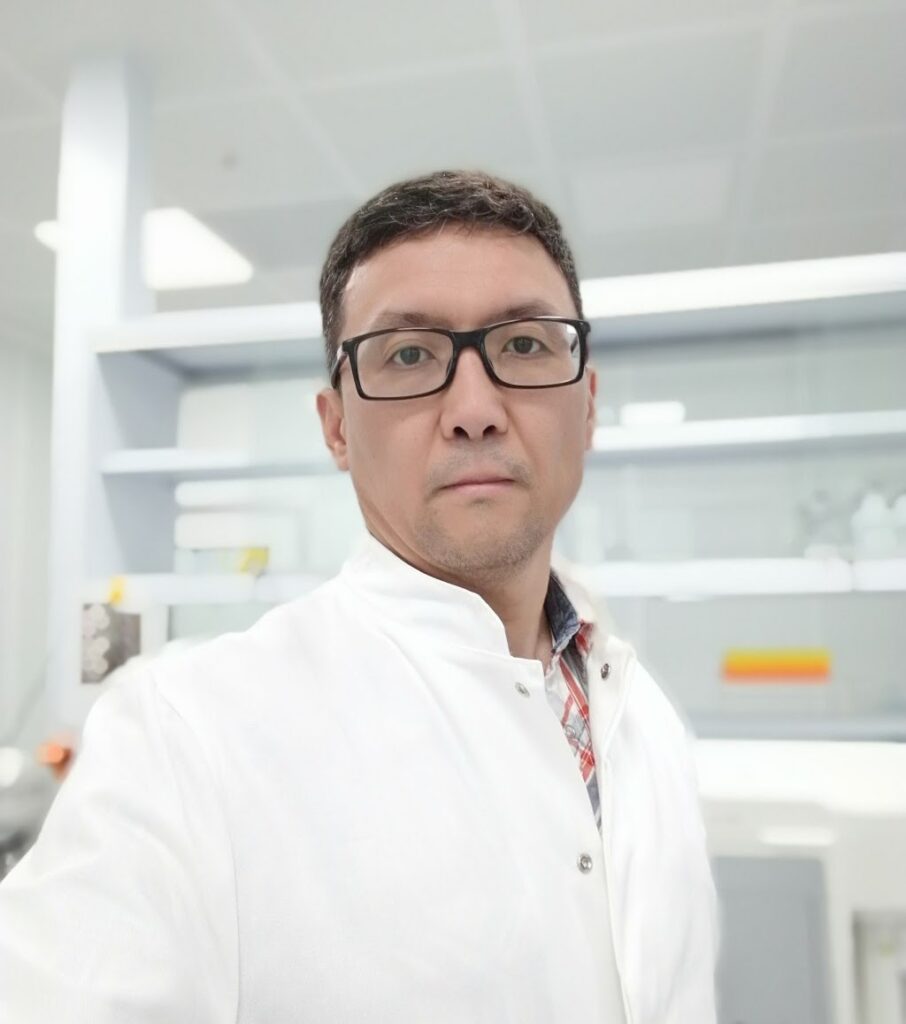
At Kazakhstan’s Nazarbayev University (NU), work is geared toward understanding the intricacies of modern science. TCA spoke to Dr. Aidos Baumuratov, the science director of the NU Collective Use Office, who discussed the importance of scientific collaboration, supported by world-class laboratories, and how Kazakhstan is aiming to nurture the next generation of scientists.
TCA: Can you tell me about the work that NU laboratories do?
Baumuratov: The laboratories have collected unique, expensive equipment from all over the university. The staff that interprets the results has been selected. In simple words, we help scientists to create science. Unfortunately, Kazakhstan cannot afford the purchase of expensive devices in large quantities, so the model is justified from an economic point of view. The model of a shared office is taken from American and European universities. Today, I manage 23 laboratories with 80 main items of equipment and about 400 additional ones. We are creating a world-class scientific infrastructure, and the laboratories are equipped accordingly.
NU scientists win grants, among other things, and consequently, they implement their developments in practice. They come to our laboratories for the missing equipment and perform most of their experiments here.
TCA: How much of NU’s research is focused on practical applications?
Baumuratov: Science is designed to solve global problems. It cannot be considered only from the point of view of immediate return. I can say that in the top global universities, where there are thousands of scientists, only a few startups occur after many years of research, which are eventually taken into development by industrial giants or IT corporations.
TCA: What should be done to make the young generation in Kazakhstan more eager to enter science?
Baumuratov: I can only express my personal opinion. Attitudes should be learned from childhood. Today, science is undeservedly in the shadows. After the collapse of the USSR, we went through difficult years; we had to fix the economy, and of course, this had an impact on who stayed. If I am not mistaken, 70-80% of scientists left after the collapse. Of those who remained, about the same number went into business, anywhere but science. It takes time to restore the potential, and it should start with schools.
When I began working at the university, I proposed an initiative to organize schoolchildren’s visits to our laboratories. The initiative was successfully implemented and is still in use today. Children from the 5th and 6th grades visit us; they see aesthetically pleasing, insanely complex equipment at the international level, the finest instruments, and they can talk to those who work here. This is very useful, as it clearly shows schoolchildren what path they can choose. They see and realize that science brings benefits to society and the country. Even the signature of a scientist under an article in a journal, where the university and Kazakhstan are mentioned, already works for the image of the country as a whole.
In addition, scientists’ general intelligence creates an appropriate environment around children. Ethical norms, the priority of education, and high standards of behavior are spreading. In other words, society is influenced in a multifactorial way.
It should be understood that science is based on academic freedom, expanding funding sources, and creating an environment where scientific ideas emerge. With an active exchange of opinions and ideas, breakthrough projects can happen. NU has such projects. Research in the post-Soviet space is making substantial developments.
TCA: What makes NU laboratories stand out?
Baumuratov: One example is that we have a laboratory of electron microscopy. It has five electron microscopes, whose main function is to capture the nanoworld. It can show what can’t be seen with a magnifying glass or even conventional microscopes. With the electron microscope, we can see up to atomic resolution. For instance, a physicist creates new materials for solar panels. Of course, they do a series of tests to validate the improvement, but publishing in highly-rated journals requires comparative images. The scientist brings us a sample, we take a picture and make a comparison. That’s how 70-90% of science works, by comparing existing prototypes with modified prototypes that the scientist is trying to implement.
This lab has the right level of staff behind the microscopes. At NU, microscopes are active; we help scientists from other universities understand the equipment. This format is unique for Kazakhstan and Central Asia, and on the scale of the CIS (Commonwealth of Independent States), there are three to five scientific centers. This is a story about only one laboratory, but we have many of them.
TCA: At the state level, there is an understanding of the importance of funding science. Unfortunately, there are not always funds in the budget. Now, there are ideas for introducing a new financing model through endowment funds, which are formed at the expense of donations. In your opinion, how realistic is introducing an additional system of financing science and universities?
Baumuratov: Endowment funds work very well in the global practice. In the U.S., this practice has proved itself perfectly. If a patron of the arts decides to donate, for instance, a million dollars to a higher education institution, an amount is deducted from their taxes, which, of course, has a favorable effect on business. Unfortunately, we do not have such mechanisms yet. Now, a private person cannot always allocate funds to an organization because, in some cases, it will be considered corruption.
However, such methods—creating boards of trustees and endowment funds—may become very effective soon. Science has no other choice in a difficult economic situation. I hope Kazakhstan will realize this potential, but we must remember that science does not always produce immediate applied results. On the contrary, years of significant investments are needed.
TCA: You have worked abroad for a long time in the USA and Europe. To what extent does the education system at NU differ from the standards in Kazakhstan?
Baumuratov: There is a tangible difference between NU and other universities in Kazakhstan. Our university interacts with professors who are directly involved in science. Accordingly, students don’t just get books but real experience of scientific activity, which is highly appreciated.
Furthermore, as I said, science is about funding, infrastructure, and academic freedom. Regarding infrastructure, at NU, one is immersed in the academic process, and later on, young people have the opportunity to engage directly in science under the guidance of their professor. In addition, the life and leisure of students are fully established: high-level living conditions, sports and cultural activities, and more than a hundred student clubs. Of course, we would like such conditions to become a common practice.
TCA: What do you think about the Ministry of Science and Higher Education’s initiative to divide universities into higher, secondary, and target leagues, and those different leagues affecting the amount of funding and the number of grants?
Baumuratov: The state should determine which specialists it needs, which spheres of education will be financed, and accordingly, which sectors of the economy will develop faster than others. This is agriculture – a vital sector of the economy on a global scale. This is medicine and biomedicine, biotechnology, and, of course, IT. Without the development of artificial intelligence, progress isn’t possible. Implementing AI means that all the areas I have mentioned will be strengthened many times over.
This division is not segregation but a redirection of the vector, as it seems to me. It would undoubtedly correspond to the world trends in the state as a whole. Today, it is necessary to consider the priorities of future generations in Kazakhstan regarding the development of science.