• KGS/USD = 0.01144 0%
  • KZT/USD = 0.00212 0%
  • TJS/USD = 0.10456 0.19%
  • UZS/USD = 0.00008 0%
  • TMT/USD = 0.28490 0%
  • KGS/USD = 0.01144 0%
  • KZT/USD = 0.00212 0%
  • TJS/USD = 0.10456 0.19%
  • UZS/USD = 0.00008 0%
  • TMT/USD = 0.28490 0%
  • KGS/USD = 0.01144 0%
  • KZT/USD = 0.00212 0%
  • TJS/USD = 0.10456 0.19%
  • UZS/USD = 0.00008 0%
  • TMT/USD = 0.28490 0%
  • KGS/USD = 0.01144 0%
  • KZT/USD = 0.00212 0%
  • TJS/USD = 0.10456 0.19%
  • UZS/USD = 0.00008 0%
  • TMT/USD = 0.28490 0%
  • KGS/USD = 0.01144 0%
  • KZT/USD = 0.00212 0%
  • TJS/USD = 0.10456 0.19%
  • UZS/USD = 0.00008 0%
  • TMT/USD = 0.28490 0%
  • KGS/USD = 0.01144 0%
  • KZT/USD = 0.00212 0%
  • TJS/USD = 0.10456 0.19%
  • UZS/USD = 0.00008 0%
  • TMT/USD = 0.28490 0%
  • KGS/USD = 0.01144 0%
  • KZT/USD = 0.00212 0%
  • TJS/USD = 0.10456 0.19%
  • UZS/USD = 0.00008 0%
  • TMT/USD = 0.28490 0%
  • KGS/USD = 0.01144 0%
  • KZT/USD = 0.00212 0%
  • TJS/USD = 0.10456 0.19%
  • UZS/USD = 0.00008 0%
  • TMT/USD = 0.28490 0%

South Korea Launches $4 Million Railway Project in Tajikistan

As reported by Asia-Plus, the Ministry of Transport of Tajikistan and the Korea International Cooperation Agency (KOICA) have signed a memorandum of negotiations on the $4 million economical and technical development of the Jaloliddin Balkhi–Nizhniy Pyanj railway project.

“The main goal of this project is to enter the market of South Asian countries—Afghanistan, Pakistan, India,” stated Azim Ibrahim, Minister of Transport of Tajikistan after explaining and that the railway will ensure the development of regional trade, help maintain the condition of roads, and reduce the burden and intensity of traffic on the streets.

“If the project is successfully implemented, Tajikistan will become an attractive railway transit country,” he continued. “And the increase in the volume of cargo and product transportation with neighbouring countries will prove very beneficial for Tajikistan and other countries in the region.”

Acting Ambassador of South Korea to the Republic of Tajikistan, Kim Jeon Sik, hailed the project as another step towards the country’s progressive future and said that with direct access to the sea,  Tajikistan had the potential to become the main link in international cargo transportation.

He closed by expressing his hope that South Korea’s first railway construction project in Central Asia would be completed within three years.

Uzbekistan Pushed to Clean Up Cities Amid Air Pollution Protests

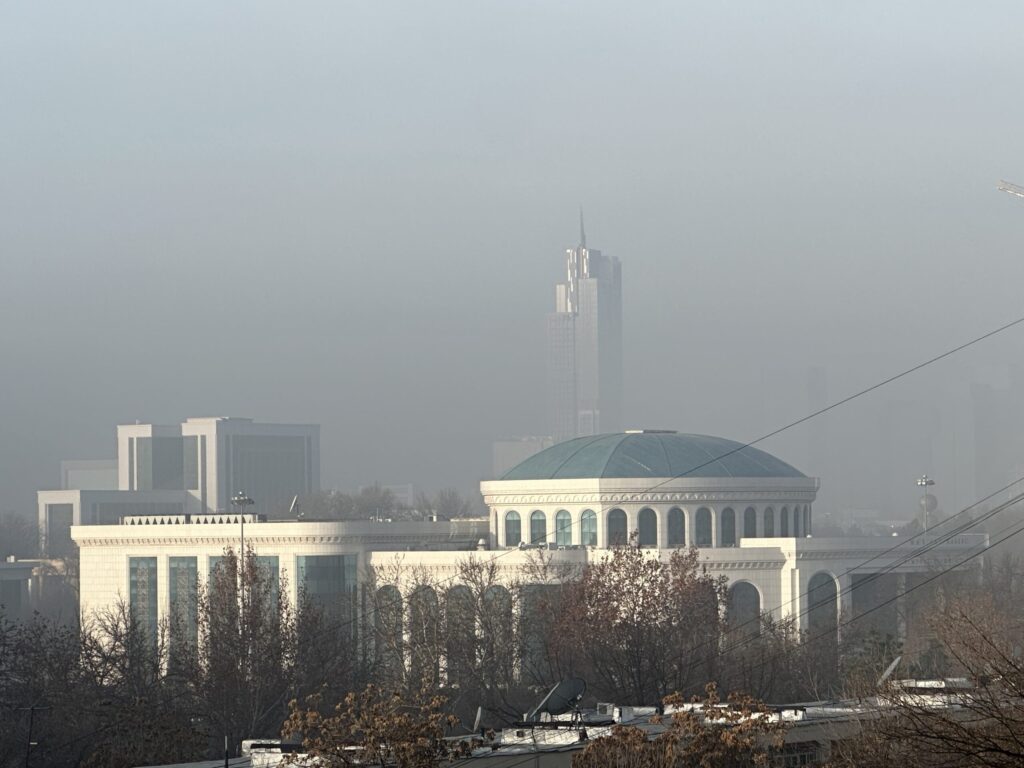
Uzbekistan’s capital Tashkent continues to suffer from high levels of air pollution. According to the IQAir portal, on the morning of August 2 the concentration of PM 2.5 (fine particles in the air) in the city was 5.4 times higher than the WHO base indicator.

Protest groups have been holding flash mobs in Tashkent this summer. One participant, Temurkhan Jahangir, believes that the main factor for the city’s dangerous air is the government’s poor urban planning policy. “The urban development strategy, implemented at the expense of urban densification, was a complete mistake from the start. It is foolish to sell land in the city center and build more buildings between multi-story buildings,” he said.

According to the Ministry of Ecology, about 49,000 trees have been illegally cut down in the Tashkent region recently, which has also had a negative impact on air quality.

At a meeting on January 29, the country’s president Shavkat Mirziyoyev spoke about ecological problems. In particular he criticized the implementation of construction projects that don’t consider environmental protection. He instructed the ministry to develop a “master plan” for each city and district of Uzbekistan, for local governors to improve the ecological situation by the end of the year.

“On average, 730,000 motor vehicles move in Tashkent every day. In addition, 160,000 to 300,000 motor vehicles enter from the regions. Engines using A-80 gasoline, which does not meet international standards, emit harmful emissions into the atmosphere, exceeding the norm,” the Ministry of Ecology says.

Mirziyoyev has also tasked the ministry with comprehensively abandoning A-80 gasoline from 2025 onwards, and developing sustainable public transport. He added that encouraging the population to switch to electric cars must be introduced to support green energy, prevent environmental problems, and reduce harmful emissions.

Kazakhstan Prepares for the Second Phase of North Aral Sea Restoration

On August 1, Kazakhstan’s minister for water resources and irrigation, Nurzhan Nurzhigitov, chaired a meeting on preparations for the second phase of the North Aral Sea restoration project.

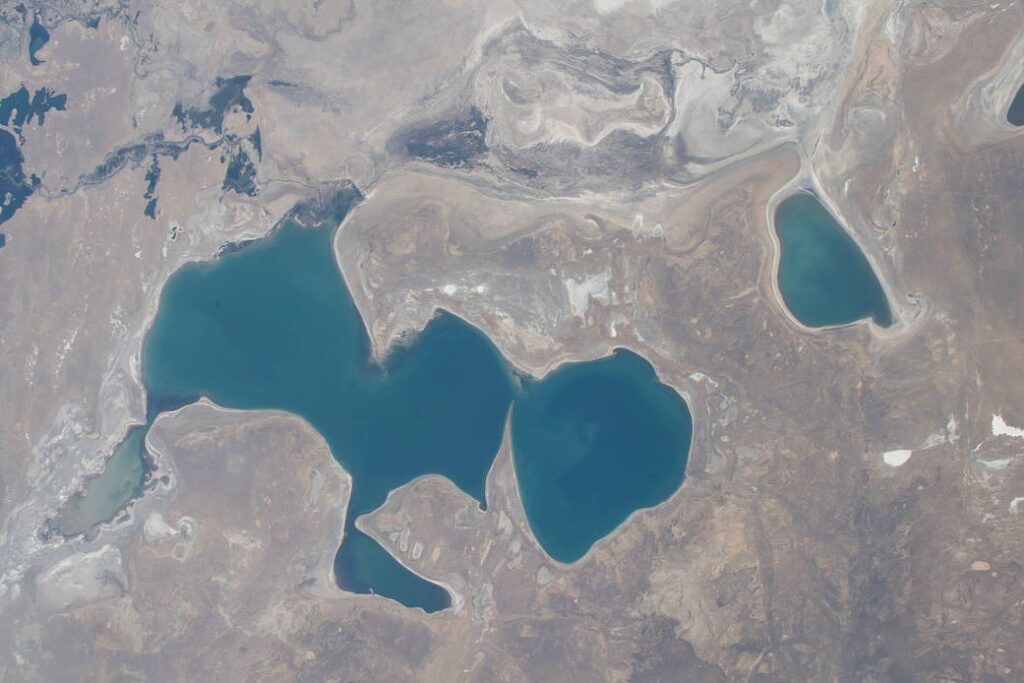
The North Aral Sea is the portion of the former Aral Sea fed by the Syr Darya River. It split from the South Aral Sea in 1987–1988, when water levels dropped due to water diversion for agricultural use.

The meeting reviewed the preparation of a feasibility study for the project.

The project consists of three components. The first component improves conditions for fisheries and the aquatic environment in and near the sea, and stabilizes wetlands in the Syr Darya River delta.

The second component supports sustainable economic, social, and environmental activities in Kazakhstan’s Kyzylorda region by developing fisheries, livestock farming, tourism, and forest planting.

The third component plans to improve water management systems in the Aral-Syr Darya basin.

Nurzhigitov commented: “The project being prepared is a continuation of a large-scale project to regulate the Syr Darya River bed and preserve the North Aral Sea, which was implemented between 2002 and 2010 and positively affected the entire Aral Sea region. The second phase covers many different areas — from the stable provision of the North Aral Sea with water to developing economic and social projects.”

High Water in Kyrgyzstan’s Toktogul Reservoir Forecast to Boost Electricity Generation

On August 2, the volume of water in the reservoir of Kyrgyzstan’s Toktogul hydroelectric power plant reached 11.922 billion cubic meters, which according to the plant’s operator Electric Stations OJSC, is almost one billion cubic meters more than that recorded on August 1, 2023.

Located on the Naryn River, which feeds the Syr Darya River that flows to Kazakhstan and Uzbekistan, Toktogul HPP is the largest power plant in Kyrgyzstan and generates some 40% of the country’s electricity.

The Toktogul reservoir currently receives 840 cubic meters of water per second and releases 475 cubic meters per second. The released water is used to generate electricity and then flows to downstream countries where it is used for irrigation.

The reservoir has a maximum capacity of 19.5 billion cubic meters, with an average volume is 17.3 billion cubic meters, and the “dead” level at which the power plant would stop operating is 5.5 billion cubic meters.

As reported by 24.kg news agency, Electric Stations OJSC expects  the volume of water in the Toktogul reservoir to reach 12.5 billion cubic meters at the beginning of the next heating season (October 1, 2024) and at the end of  2024/25 season, fall to around  7.9 billion cubic meters.

Toktogul HPP comprises four hydroelectric units with a total generating capacity of 1320 MW and on completion of the modernization of hydroelectric unit #1, later this year, the capacity will increase by 60 MW and reach 1380 MW.

In recent years, because Kyrgyzstan has been unable to produce enough electricity to meet the country’s growing demand, electricity has been imported from neighbouring states.


EU’s Borrell Reaffirms European Commitment to Cooperation with Kazakhstan

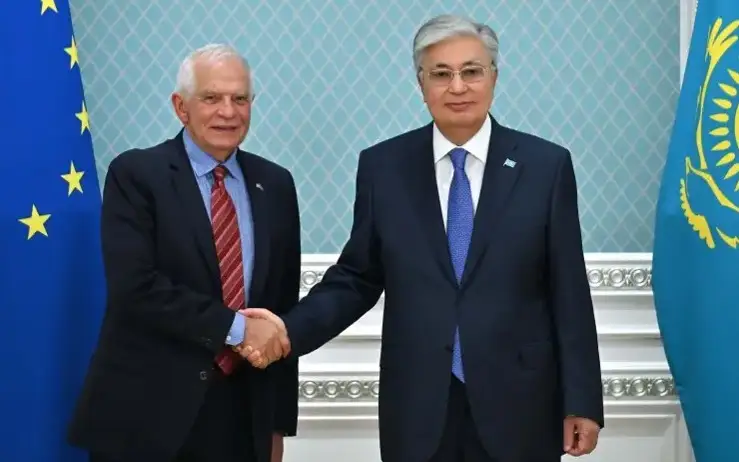
On August 1, the high representative of the European Union for foreign affairs and security policy, Josep Borrell, visited Astana and met with Kazakhstan’s President Kassym-Jomart Tokayev, and Foreign Minister Murat Nurtleu.

Explaining the purpose of the visit, Borell said “as my mandate as a representative of the European Union ends in three months, it was very important for me to come here to Astana to reaffirm the strong interest and commitment of the European Union to strengthen cooperation with Central Asia in general and with Kazakhstan in particular as the strongest country in the region.”

“I used to say that four years ago, when I came to Brussels, Central Asia was a little bit in the middle of nowhere – and now, you are in the middle of everything…Everything that matters between Europe and Asia goes through you”, he added.

The EU High Representative also said, “Under the leadership of President Tokayev, Kazakhstan has embarked on the path of the wide range of political and economic reforms that we support”. Stressing Kazakhstan’s strategic geographical position as a bridge between Europe and Asia, Borrell noted that the EU is Kazakhstan’s number one trade partner, representing more than one-third of all Kazakh exports, and the biggest investor in the country.

Borrell’s meeting with President Tokayev covered progress of the Enhanced Partnership and Cooperation Agreement between Kazakhstan and the EU, a comprehensive accord aimed at enhancing political, economic, and social collaboration between the EU and Kazakhstan.

Tokayev commended the high-level dialogue between Kazakhstan and the EU, notably the productive visit of European Council President, Charles Michel, and talks with the President of the European Commission, Ursula von der Leyen. “I think we reached many common views as far as our cooperation is concerned,” Tokayev said. He also lauded a memorandum signed by the Government of Kazakhstan and Ursula von der Leyen on the development of green hydrogen on November 7, 2022, during the COP27 climate conference in Sharm El-Sheikh, calling it “a very concrete step forward in terms of mutual cooperation”.

Borrell commented that they had “discussed key political and economic reforms in Kazakhstan and topics of mutual interest in the challenging geopolitical context. We appreciate Kazakhstan’s principled support to the UN Charter and commitment to international law.”

Borrell also met with the Minister of Foreign Affairs of Kazakhstan Murat Nurtleu. Speaking about the Ukraine war, Borrel stated: “We encourage you to take further steps in order to make this war reach an end, and to use your influence for that.” Also on the agenda were cooperation in transport and logistics, digitalization, civil aviation, agriculture, use of critical raw materials, and energy.

According to Kazakhstan’s Foreign Ministry, the European Union is Kazakhstan’s leading trading and investment partner, accounting for more than 30% of Kazakhstan’s foreign trade and investments. In 2023, trade between Kazakhstan and the EU amounted to $41.4 billion. In January-May 2024, bilateral trade reached $20.2 billion, showing a 14.1% increase compared to the same period last year ($17.7 billion). The volume of European investments in Kazakhstan’s economy since 2005 has amounted to $180 billion.

Kazakhstan was the first country in Central Asia to sign a memorandum of understanding with the EU on critical raw materials in 2022.

China Expands Footprint in Central Asia

In July, Chinese leader Xi Jinping, architect of the Belt and Road economic initiative, traveled to Kazakhstan for a meeting of the Shanghai Cooperation Organization, a security group whose founding members include several Central Asian countries. There, Xi warned against the threat of “external interference” and celebrated Chinese collaboration with President Vladimir Putin of Russia, the region’s other traditional power. Then he visited Tajikistan, a security partner that borders China and Afghanistan.

Europe and the United States, which want to counterbalance Chinese and Russian sway in Central Asia, were watching.

Last week, several analysts affiliated with Western institutions held a Zoom discussion titled “The China-Central Asia Crossroads.” It was hosted by the Center for the National Interest, a non-profit group based in Washington – a few blocks from the White House. Here are excerpts from the analysis:


Balancing China and Russia:

Temur Umarov, a fellow at the Berlin-based Carnegie Russia Eurasia Center:

There is a misconception that “China is somehow replacing Russia” as the main partner in Central Asia because of unease over Russia´s full-scale invasion of Ukraine in 2022.

“The reality is much more nuanced and detailed,” Umarov said. Since the end of the Soviet Union in 1991, he said, Central Asian countries have always looked for “diversified ties with the world” and “Central Asia wants to have China’s presence be enlarged into other spheres and to have a counterbalance in the face of Russia.”


Elizabeth Wishnick, an expert on Sino-Russian relations at the Center for Naval Analyses and the Weatherhead East Asian Institute at Columbia University:

“Central Asians wanted to diversify away from Russia to have more choice. China is not necessarily the only partner they want. And they they’ve been trying, especially recently, to engage with European countries, with India, with Iran, with Turkey, with a broader range of countries.”

Wishnick, who traveled recently to Central Asia, said some people described Russia as “toxic” in private conversations. She also said: “You see a lot of caution about the relationship with China in terms of the lack of transparency of some of the projects that China is investing in, the potential environmental consequence of some of these projects.


Brian Carlson,  a research professor at the Strategic Studies Institute of the U.S. Army War College:

There is “a little bit of slippage of Russian influence in the region,” although Putin has worked to maintain it with frequent meetings with Central Asian leaders, Carlson said. He noted that, after Putin visited China in May, he called the leaders of Kazakhstan and Uzbekistan to update them on the trip. Even so, China’s influence is increasing.

“And so, this does pose challenges for the Central Asian countries. In the past, they’ve kind of tried to play Russia and China off against each other. To some extent, that will be more difficult given that China and Russia have a very close partnership. So, it will be difficult for Central Asian countries to navigate great power relations in the coming years. It’s true that they can look beyond just Russia and China to other partners.”


Xi’s Visit to Tajikistan:

Umarov:

President Emomali Rahmon of Tajikistan is “getting closer and closer” to transferring power to his son, and so, since Xi doesn’t visit Tajikistan often, this might be the Chinese leader’s last trip there before the political transition.

There are two Chinese armed police bases on the border between Tajikistan and Afghanistan, according to Umarov, and “this is a unique case, not only for Central Asia, but also for the world.”


Wishnick:

“For China, there’s a lot of concern about Afghanistan and its future. And Tajikistan is seen as integral to that question.”

“They probably see Tajikistan as a kind of weak link on China’s border, and they’re trying to invest as much as possible to bolster Tajikistan. Although I would say that sometimes it doesn’t have the desirable conclusions, like the investment in a gold mine there has led to some dissatisfaction on environmental grounds as well.”


Carlson:

For years, people have talked about a “sort of informal agreement on a division of labor in which China promotes economic development, whereas Russia has the main security role” in Central Asia.

“Starting several years ago, China did begin to engage with the countries along its western border – Kyrgyzstan, Tajikistan, Afghanistan and Pakistan – in a format that did not include Russia. And the discussions were mainly about security along China’s western border and making sure that instability didn’t spill over, especially from Afghanistan, across the border into China.”


U.S. Withdrawal from Afghanistan:

Carlson:

The U.S. withdrawal from Afghanistan in 2021 potentially opened opportunities there for China, which along with Russia has engaged in outreach to the Taliban.

A Taliban representative made a statement of “support for China’s policies in Xinjiang, or at least, a pledge not to do anything that would aggravate the situation.”

(China has imposed an assimilation program in its western region of Xinjiang, which borders Kazakhstan. Rights groups accuse China of widespread abuses, including mass detentions, against Uyghurs and other Muslims).


China and Russia – Getting Along in Central Asia:

Umarov:

“In my view, we tend to underestimate the level of cooperation that exists between Moscow and Beijing on Central Asia.”

“I think it will be a hybrid future – there will exist some sort of competition between these two countries, but also a lot of cooperation… Cooperation is also something that Central Asian countries want to see.”

Even Russia and the United States, which have big problems in their bilateral relationship, coexist in a place like Kazakhstan, according to Umarov.


Wishnick:

“Central Asia is one of the routes that Chinese entities use to send their dual use items to Russia for use in Ukraine. And of course, there’s a lot of different sentiment on the war in Central Asian countries and large swathes of public opinion opposed to the war. But there are certain business entities and elites that are collaborating in this trade.”

China surpasses Russia in terms of trade in Central Asia, but Russia still has “levers of influence,” for example in the way it impacts Kazakhstan’s westward export of energy through pipelines that pass through Russian territory.


The U.S. Role:

Umarov:

Central Asian countries thought the Trump administration’s efforts to get them to cooperate less with China were “unrealistic.”

But the Biden administration “got rid of this approach and started to not even mention so much China, Russia or anything outside of Central Asia when it comes to building relationships with the region, but rather highlighting the strategic importance of the region as it is.”


Carlson:

“I think that the United States also has an interest in encouraging the Central Asian countries to work more closely [with] each other to strengthen intraregional collaboration, and that should strengthen the Central Asian countries´ hand in dealing with China; and possibly the United States also has an interest in other countries exerting some influence in the region, including Turkey, as a way to get the Central Asian countries some other options.”

A possible Chinese invasion of Taiwan would put Central Asia in a difficult position because “the United States would be interested in getting the Central Asian countries to provide some kind of support for the U.S. effort, but it would be very difficult for them to stand up to China by joining sanctions or cutting off energy supplies or anything like that. So, the Central Asian countries in that case would just have to try as hard as possible to maintain neutrality and stay out of it.”


Wishnick:

Lately, the United States “has focused more on functional areas of cooperation rather than grand strategies, looking at strategic minerals, customs clearance, green energy, things like that, where the U.S. can play a useful role. I think another area that would be very promising and helpful would be education.”

“To get Central Asia out of both the Russian and Chinese information space, they need to have access to other information spaces.”