• KGS/USD = 0.01144 0%
  • KZT/USD = 0.00193 -0%
  • TJS/USD = 0.10876 0.55%
  • UZS/USD = 0.00008 0%
  • TMT/USD = 0.28490 0%
  • KGS/USD = 0.01144 0%
  • KZT/USD = 0.00193 -0%
  • TJS/USD = 0.10876 0.55%
  • UZS/USD = 0.00008 0%
  • TMT/USD = 0.28490 0%
  • KGS/USD = 0.01144 0%
  • KZT/USD = 0.00193 -0%
  • TJS/USD = 0.10876 0.55%
  • UZS/USD = 0.00008 0%
  • TMT/USD = 0.28490 0%
  • KGS/USD = 0.01144 0%
  • KZT/USD = 0.00193 -0%
  • TJS/USD = 0.10876 0.55%
  • UZS/USD = 0.00008 0%
  • TMT/USD = 0.28490 0%
  • KGS/USD = 0.01144 0%
  • KZT/USD = 0.00193 -0%
  • TJS/USD = 0.10876 0.55%
  • UZS/USD = 0.00008 0%
  • TMT/USD = 0.28490 0%
  • KGS/USD = 0.01144 0%
  • KZT/USD = 0.00193 -0%
  • TJS/USD = 0.10876 0.55%
  • UZS/USD = 0.00008 0%
  • TMT/USD = 0.28490 0%
  • KGS/USD = 0.01144 0%
  • KZT/USD = 0.00193 -0%
  • TJS/USD = 0.10876 0.55%
  • UZS/USD = 0.00008 0%
  • TMT/USD = 0.28490 0%
  • KGS/USD = 0.01144 0%
  • KZT/USD = 0.00193 -0%
  • TJS/USD = 0.10876 0.55%
  • UZS/USD = 0.00008 0%
  • TMT/USD = 0.28490 0%
11 December 2025

How a Kazakh Writer`s Book About American Couch Grass Was Written

During his lifetime, Gabit Musirepov was celebrated as a people’s writer, translator, dramatist, critic, academician, Hero of Socialist Labor, and statesman. Known in Kazakhstan as the “Master of Words,” he became a figure of national pride, and his works continue to be widely read today.

What is less known, however, is the story of his very first book. Long before he became famous for his fiction, Musirepov published a small agricultural manual titled Amirkan Bidayygy (American Couch Grass). Released in 1928 by the “Kazakhstan State” publishing house in Kyzylorda with a circulation of 5,000, the booklet sought to answer a pressing question: how could Kazakh farmers improve their fields and livestock fodder?
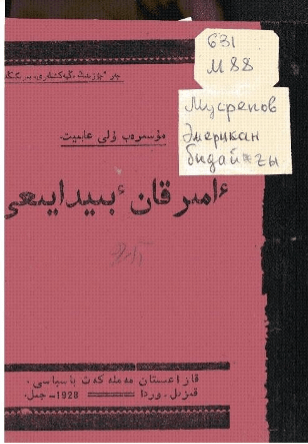
First page of book Amirkan Bidayygy (American Couch Grass)

The introduction explained the need for such a work. At the time, Kazakh peasants planted oats, millet, wheat, and barley, but often without proper techniques. Fodder crops were largely unknown, except in limited areas along the Syr Darya River. Previous manuals existed, but they were poorly translated from Russian or intended for experienced Russian farmers, making them inaccessible to Kazakhs. Musirepov’s book, written in plain language and tailored to local conditions, filled that gap.

This was Musirepov’s first published book. He wrote it in early 1927, the same year his first prose work, In the Grip of the Sea, appeared later in the autumn. Fellow writer Sabit Mukanov recalled: “After graduating from the Orenburg Workers’ Faculty in 1926, Gabit entered the Agricultural Academy in Omsk. In early 1927, he sent me his booklet Amirkan Bidayygy for publication. We printed it. I still keep his letter where he wrote, ‘The money from this book kept my family fed for half the winter.’”

The publisher acknowledged in the foreword that the young author might have overlooked some scientific details, but praised the work as “one of the best guides for improving the lives of Kazakh peasants,” insisting that every farmer should read it.
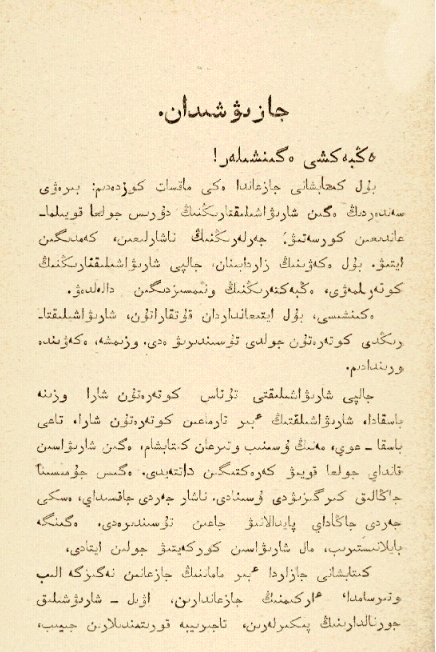
Musirepov`s introduction

In his own introduction, Musirepov explained, “I had two goals. First, to show why farming remained unproductive by pointing out poor land conditions. Second, to offer ways of overcoming these problems and raising productivity. I believe I achieved both.”

This statement reflects the sincerity and social purpose that would later define his literary career: whatever he wrote, it was always with the hope of benefiting his people.

Musirepov also asked a practical question: What kind of grass does the Kazakh land need? His answer was clear – crops that could withstand severe winters, scorching summers, and drought, while producing abundant, nutritious fodder and enriching the soil. After considering various options, he concluded that yellow alfalfa and American couch grass were the most suitable. Of the two, he argued, couch grass was best suited to Kazakhstan’s harsh climate.
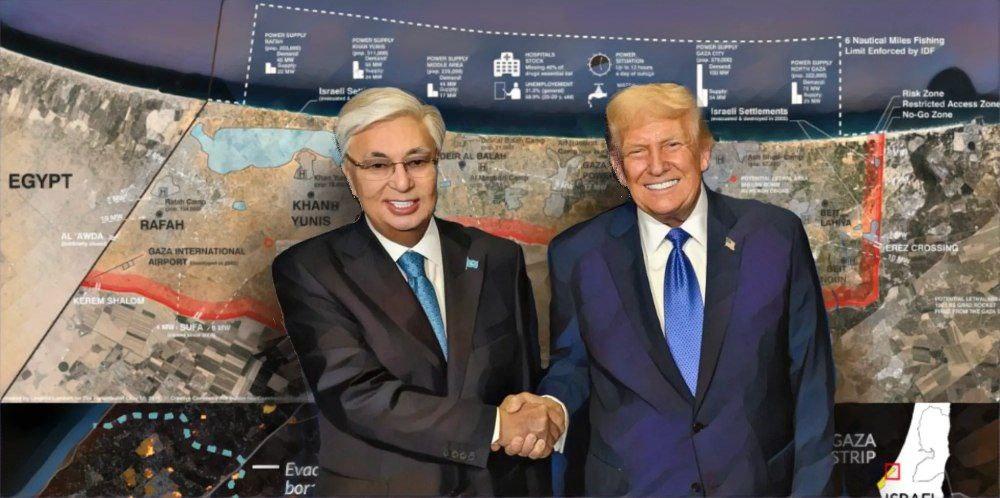
Kazakhstan Backs Trump’s Gaza Peace Initiative

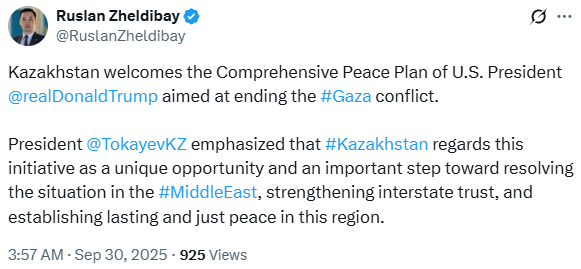
Kazakhstan has expressed support for President Donald Trump’s Comprehensive Peace Plan aimed at ending the conflict in Gaza. In a statement on X, Presidential Press Secretary Ruslan Zheldibay wrote that President Kassym-Jomart Tokayev considers the initiative a “unique opportunity” and “an important step toward resolving the situation in the Middle East, strengthening interstate trust, and establishing lasting and just peace in this region.”

By describing the initiative as an “important step” rather than a definitive solution, Kazakhstan leaves room for diplomatic flexibility and avoids alienating partners that hold divergent views on Gaza. At the same time, the public endorsement is a clear gesture of support for the Trump administration’s leadership in addressing the central conflict of the Middle East, marking a notable moment where Astana aligns itself with Washington’s effort to shape the regional peace agenda.

Ruslan Zheldibay, President Tokayev’s press secretary, announced the position in a post on X

Trump’s Comprehensive Peace  Plan, released by the White House on September 29, 2025, ties Gaza’s governance to the broader framework of the Abraham Accords, proposing regional security guarantees, economic reconstruction measures, and expanded Arab participation as part of an effort to extend the accords’ realignment across the Middle East. Trump has repeatedly urged world leaders to expand the Abraham Accords, including appeals to Saudi Arabia, discussions with Israel’s Netanyahu, and even suggesting that Iran could join.

At the 80th United Nations General Assembly (UNGA) last week, President Kassym-Jomart Tokayev pointed to the Abraham Accords as proof that reconciliation is possible in the Middle East. This endorsement is consistent with Tokayev’s broader diplomatic messaging and positions Kazakhstan as the only Central Asian state publicly backing the accords as a pathway to normalization at the UN meeting.

Separately, UNGA week also saw Wabtec announce a $4.2 billion order from Kazakhstan’s national railway, a deal in line with Trump’s ‘America First’ policy that underscored the commercial dimension of U.S. engagement.

The Gaza statement follows Tokayev’s remarks last week about the United Nations after technical failures during Trump’s UNGA appearance. Tokayev described the incident as “an extremely dangerous incident” and “a most serious shortcoming — one might even say a failure — of the UN Secretariat and the relevant services and departments.” He noted that, “The decision to conduct an investigation has already been made and is correct.” He linked the investigation into the failure to broader questions about the UN’s credibility, echoing Trump’s frustrations with the institution.

Alongside these public remarks, Tokayev has made changes to Kazakhstan’s diplomatic team, recalling the ambassador to Washington and appointing a new foreign minister. While the reshuffle followed Tokayev’s return from New York, it also appears to reflect a deliberate recalibration of Kazakhstan’s diplomatic apparatus, with the new team brought in to carry forward these emerging foreign policy priorities.

Taken together, these moves highlight Kazakhstan’s shift toward a more visible diplomacy, with Astana’s decisions increasingly aligned with Washington. By endorsing Trump’s Comprehensive Peace Plan, Tokayev has signaled a convergence with the former U.S. president’s vision, lending broader international legitimacy to Arab–Israeli normalization and reinforcing its viability as a pathway toward Israeli–Palestinian reconciliation.

Investment in Kyrgyzstan’s Economy Rises by 20 Percent

In the first eight months of 2025, several sectors of Kyrgyzstan’s economy experienced substantial growth, particularly in finance, manufacturing, hospitality, and food services.

According to the National Statistical Committee of Kyrgyzstan, domestic investment surged most notably in the hospitality and food service sectors, which saw a 170 percent increase. The manufacturing sector reported a 110 percent rise, driven largely by state funding for new industrial facilities. Officials emphasized that the primary sources of investment were allocations from the state budget and enterprises’ internal funds.

“The implementation of government investment programs is creating conditions for accelerating growth in sectors such as construction, transport, energy, and irrigation,” the Ministry of Finance of Kyrgyzstan stated.

Foreign investment was concentrated in financial intermediation and insurance, particularly in Bishkek. Between January and July 2025, nearly $94 million was invested in this sector, an 80 percent increase. Finance and insurance accounted for 40 percent of all foreign investment received by Kyrgyzstan during this period.

The Eurasian Development Bank (EDB) also released its analysis of investment trends in Kyrgyzstan. According to EDB analysts, the country achieved double-digit economic growth this year, largely due to increased investment in industry, transport, and construction. Kyrgyzstan’s GDP expanded by 11.5 percent between January and July 2025.

“Investment growth is driven both by domestic resources and external financing, including foreign direct investment. This demonstrates the region’s strong adaptability to the new realities of the global economy,” said EDB Chief Economist Evgeny Vinokurov.

New Highway Links Kyrgyzstan’s Issyk-Kul with Almaty in Kazakhstan

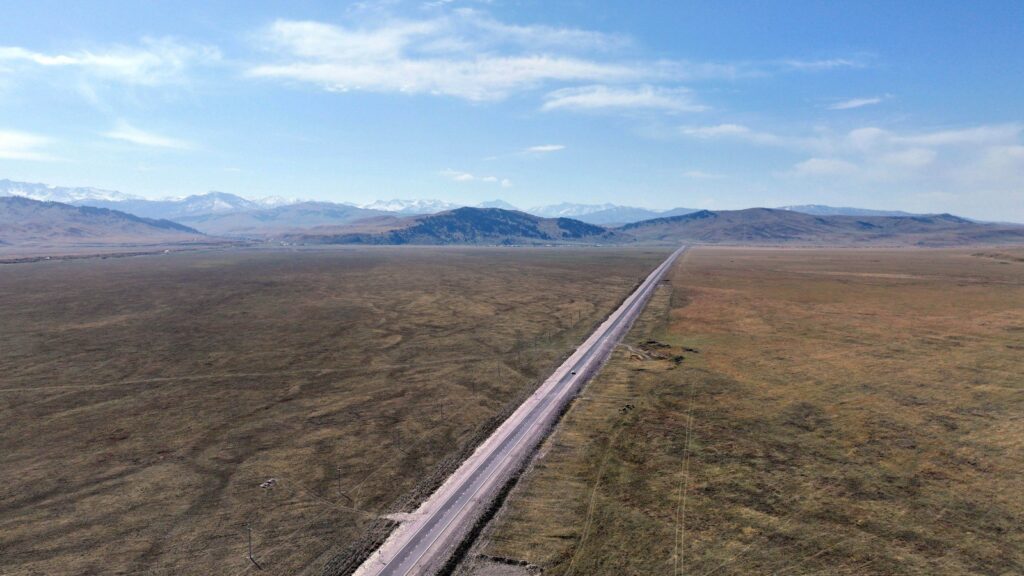
On September 29, a new highway was opened connecting the village of Tyup, in the northeastern part of Lake Issyk-Kul, with Kegen in Kazakhstan’s Almaty region.

The 52-kilometer Tyup-Kegen road is of strategic significance, linking Kyrgyzstan’s most prominent tourist destination, Lake Issyk-Kul, with Kazakhstan’s largest city, Almaty, via the existing route through Kegen.

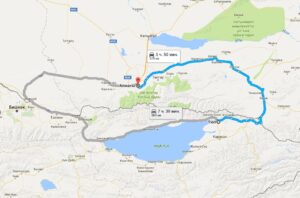
This new corridor creates a direct 280-kilometer connection between Almaty and the northeastern shore of Issyk-Kul, significantly shortening the previous route to the lake’s northern edge. While the straight-line distance between Almaty and Issyk-Kul is only about 80 kilometers, travelers were previously forced to detour through Bishkek due to mountainous terrain. The journey to Cholpon-Ata, the largest resort town on the lake’s northern shore, used to span 460 kilometers and could take up to eight hours.

Lake Issyk-Kul remains a top summer getaway for the region, particularly for Almaty residents seeking short weekend retreats.

@president.kg

The Times of Central Asia previously reported on the progress of long-standing plans to establish a more direct road between Almaty and Issyk-Kul. Kazakhstan and Kyrgyzstan signed a memorandum of understanding in 2007 for a route bypassing Bishkek, running through Uzynagash and Kemin and connecting directly to Cholpon-Ata. That project, however, stalled in its early stages. If completed, it would have reduced the travel distance to roughly 260 kilometers and substantially cut travel time.

In June, Asman Airlines launched regular passenger flights from Almaty to Tamchy Airport on the northern shore of Issyk-Kul, further strengthening cross-border travel links.

Experts believe the opening of the Tyup-Kegen highway will benefit not only tourism but also trade and cross-border cooperation between Kyrgyzstan and Kazakhstan. Enhanced transport accessibility is expected to stimulate small and medium-sized enterprises, boost agricultural trade and food supply chains, and create new employment opportunities for local communities.

In addition, the new route offers expanded opportunities for logistics companies and the tourism sector, paving the way for deeper regional engagement between the two neighboring countries.

Afghanistan Absent, Not Forgotten – Central Asia’s UNGA Strategy

From September 23–29, 2025, the UN General Assembly’s general debate unfolded without an Afghan delegation addressing those assembled amid the unresolved UN seat issue. Yet Afghanistan was hardly absent. Central Asian presidents used their platform to project a collective stance that stopped short of recognition while rejecting isolation. Their message reflected a regional doctrine of managed engagement: keep the neighbor connected enough to limit collapse, through corridors, energy grids, and humanitarian channels.

President Shavkat Mirziyoyev of Uzbekistan offered the clearest blueprint, urging the international community to “prevent [Afghanistan’s] isolation,” and calling for support to develop transport and energy corridors across Afghan territory. That language aligns with initiatives already underway: a multilateral framework signed in Kabul on July 17 to move the Trans-Afghan railway toward feasibility, and fresh agreements on the 500 kV Surkhan–Pul-i-Khumri line designed to stabilize Afghanistan’s power supply while linking it to a regional grid. Mirziyoyev’s message was a bid to convert geography into risk management.

Kazakhstan struck a technocratic note. Kassym-Jomart Tokayev told the Assembly that “inclusive development in Afghanistan” is the basis for long-term regional peace and stability. This phrasing matches Almaty’s UN-backed hub for the Sustainable Development Goals and Astana’s self-image as the region’s administrative center. The goal is to stabilize the weakest link so trade and transit do not fracture.

Kyrgyz President Sadyr Japarov used part of his brief UN address to demand that roughly $9 billion in Afghan central-bank assets frozen in Western jurisdictions be returned to “the Afghan people,” and called isolation “unacceptable.” In a remittance-dependent economy like Kyrgyzstan’s, collapse next door risks hunger, displacement, and crime. His remarks were both moral and practical, and marked the sharpest public challenge to Western policy voiced by any Central Asian leader this week.

Traditionally, Tajikistan has taken the hardest line on the Taliban. This time, Emomali Rahmon emphasized humanitarian assistance, citing drought-hit regions and areas devastated by the August 31 eastern Afghanistan earthquake, and said Dushanbe supports peace, stability, and socio-economic development next door. The quake killed more than 2,000 people and destroyed thousands of homes across Kunar, Nangarhar, and Laghman just as aid budgets were shrinking.

Turkmenistan took a different approach. President Serdar Berdimuhamedov did not mention Afghanistan, instead promoting Ashgabat’s permanent neutrality as a proposed UN agenda item, “Neutrality for Peace and Security,” along with broad transport and energy initiatives. This approach preserved flexibility on projects like TAPI without committing to specifics in New York.

What makes these speeches consequential is how closely they mirror work on the ground. The Trans-Afghan railway, long dismissed as only a plan, now has a political framework and a declared security pledge from Kabul. Whether it moves forward depends on both capital and security, but for Tashkent, a southern outlet to Pakistani ports is the difference between landlocked and land-linked. The Surkhan–Pul-i-Khumri line is more conventional and urgent: a 200-kilometer fix to keep the lights on and the revenues flowing. The long-troubled CASA-1000 power corridor is also inching back into view after being paused post-2021, with Tajik and Kyrgyz segments advancing and outside actors re-examining the Afghan section’s feasibility.

The humanitarian situation adds urgency. The World Food Programme cut general emergency distributions in May and says it can now reach only about one million people a month, in a country where summer projections put nearly ten million at risk of hunger.

Security concerns also shaped the week. Mirziyoyev’s call to transform Central Asia’s Regional Council on Rehabilitation and Reintegration into an international competence center highlighted where threat management is heading: more social policy and reintegration capacity, informed by years of repatriations from Syria and Iraq.

None of this resolves the core dilemma: Central Asia has little appetite to formally recognize the Taliban, but no wish to live next to an imploding neighbor. Leaders are balancing pragmatism with principle. The shared goal is clear: refuse to let Afghanistan fall off the map simply because its government sits outside the UN system.

UNGA-80 clarified a Central Asian doctrine: managed engagement without recognition. The next quarter will show whether it holds. Four key markers stand out. First, Tashkent tables a UN corridors draft with credible co-sponsors. Second, procurement and site work begin on Surkhan–Pul-i-Khumri. Third, the Trans-Afghan railway posts its first surveyed legs alongside security guarantees. Fourth, a supervised Termez channel moves food, fuel, and limited finance at scale. If these proceed, the stabilization of Afghanistan shifts from words to infrastructure, and the region sets the terms. If not, scarcity and blackouts could deepen, cross-border leakage rises, and outside powers would need to write the script while Afghanistan’s neighbors pay the price.

Uzbekistan Plans Full Launch of Large Nuclear Power Plant by 2035

Uzbekistan plans to fully launch a high-capacity nuclear power plant by 2035, according to Azim Akhmedkhadjaev, director of the “Uzatom” agency. Speaking on September 25 at World Atomic Week in Moscow, Akhmedkhadjaev said the first small modular reactor is expected to begin operations in 2029 in the Jizzakh region, followed by a second unit six months later. The large-scale plant will see its first reactor come online in 2033, with full capacity expected by 2035. He noted, however, that final timelines depend on the conclusion of outstanding contract agreements.

Akhmedkhadjaev confirmed that production of reactor equipment is already underway and that the project is proceeding on schedule. Responding to a question from a Spot correspondent, he reiterated the target dates for the larger reactors and emphasized that the timeline will be refined once contracts are finalized.

The announcement aligns with Uzbekistan’s broader nuclear energy strategy. As previously reported by The Times of Central Asia, the country plans to build both small modular and larger reactors at a single integrated nuclear facility. Under a revised agreement with Russia, Uzbekistan intends to construct two large VVER-1000 reactors alongside two smaller RITM-200N units. The initial framework for the project was established in 2018 and updated in 2024.

Earlier this year, The Times of Central Asia reported that Rosatom had begun manufacturing reactor components for the smaller units, with the first steel castings for the RITM-200N already produced in Saint Petersburg.

Uzbekistan’s pivot to nuclear energy is part of its strategy to meet rapidly increasing electricity demand, which is projected to reach 135 billion kWh by 2035, nearly double current consumption levels. To address this, the government is expanding generation capacity and modernizing the national grid.

While the plans are ambitious, challenges remain. As Akhmedkhadjaev acknowledged, the full implementation timeline depends heavily on contract finalization. Nevertheless, Uzbekistan’s dual-track approach, combining scalable small reactors with large base-load units, suggests a strategic commitment to energy security and diversification.