Only two people in Turkmenistan, the chairman of the Halk Maslahaty (People’s Council) and the president, have what could be considered job security.
Everyone else is expendable, at a moment’s notice, and that extends to the country’s top clergy.
Turkmenistan has replaced the country’s top mufti, and while the reasons for the sudden move are not clear, the removal process is very familiar for Turkmenistan.
Frantic Friday
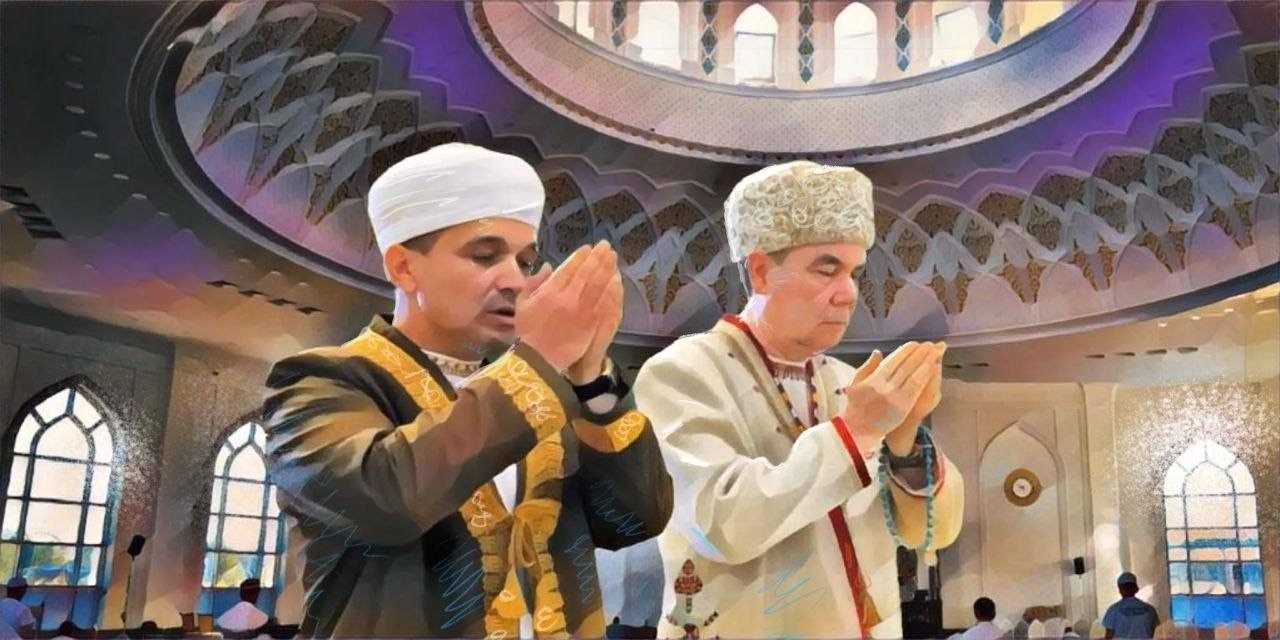
On June 19, the mufti of all Turkmenistan, Yalkap Hojagulyyev, led Friday prayers at the Turkmenbashi Ruhy Mosque in Gypjak, some 11 kilometers from the capital, Ashgabat.
Saparmurat “Turkmenbashi” Niyazov was Turkmenistan’s first president. The country’s compliant parliament and Halk Maslahaty bestowed the title of “Turkmenbashi,” meaning head of the Turkmen, on Niyazov.
Gypjak was Niyazov’s home village, and when he was alive, he spent $100 million building a mosque that could accommodate 10,000 worshipers. After he died in late 2006, he was laid to rest at the nearby mausoleum built specially for him and his family.
The June 19 Friday prayers were attended by a special visitor, Malaysian Prime Minister Anwar Ibrahim, who also paid his respects at Niyazov’s mausoleum.
After prayers ended, the top figures from the muftiate, the spiritual board overseeing Islamic affairs in Turkmenistan, and select elders from around Turkmenistan met at the mosque for a discussion.
That discussion included the announcement that the muftiate had appointed a new chief mufti.
That person was Rahman Gurbanmyradov.
Gurbanmyradov, who had been the head mufti for Ahal Region, was not at the meeting in Gypjak. He was saying prayers at the Seyit Jemaleddin Mosque in Ak Bugday District, Ahal Region, for a sadaqah (voluntary giving of charity) organized by Halk Maslahaty Chairman Gurbanguly Berdimuhamedov.
Berdimuhamedov was marking the first Friday of the Islamic year 1448, which started on June 16.
Back in Gypjak, senior clerics and elders were also considering what to name the new mosque being built in the newly built city of Arkadag, some 30 kilometers outside Ashgabat.
Berdimuhamedov succeeded Turkmenbashi as president and held the office for roughly 15 years. During that period, government officials and state media gave him the title “Arkadag,” or “Protector.”
Not surprisingly, when one of the elders at the Gypjak meeting proposed naming the new mosque in Arkadag city the Arkadag Spiritual Mosque, there was unanimous support.
Why Hojagulyyev was fired is unclear, though there is speculation that Berdimuhamedov had been angry with the mufti since 2023, when Hojagulyyev brought his wife to make the Hajj at state expense. Hojagulyyev had been the head mufti since 2019.
Turkmenbashi Tames the Clergy
First President Niyazov is credited with bringing the entire state apparatus under his full control in the first years after Turkmenistan’s 1991 independence.
However, it took him longer to achieve the total submission of Islamic clergy.
Toward the end of 1999, leading Islamic cleric and scholar Khoja Ahmed Orazgylych criticized Niyazov’s public support for the traditional New Year celebration that included dancing around a Christmas tree.”
The practice dated back to the Soviet period, though then, of course, no religious connection was given to setting up the “yolka” (pine tree) for New Year festivities.
Orazgylych was interviewed by a Western media outlet about the yolka.
“To speak about the relationship of Islam to the Christmas tree,” Orazgylych said, “I have been studying Islam for 24 years and from the first to the last writings of the Koran I have never come across anything about greeting the New Year with a Christmas tree.
Shortly after making these comments, Orazgylych was dismissed, then arrested, jailed, and, after receiving a presidential pardon in 2001, sent into internal exile.
Niyazov criticized Orazgylych’s translation of the Quran from Uzbek into Turkmen. Niyazov actually said, “This translation of the Koran is evil,” and ordered all copies of it to be collected and burned.
In 2001, Niyazov accused chief mufti Nasrullah ibn Ibadullah of nepotism. Niyazov said the mufti gave jobs at the Dashoguz theological seminary to relatives. The seminary was quickly closed.
Ibn Ibadullah kept his position, but later, he started opposing Niyazov’s cult of personality, particularly orders to display Niyazov’s book, Rukhnama, prominently in mosques and use quotations from the book in sermons.
In November 2002, there was an assassination attempt on Niyazov in Ashgabat.
On December 16, 2002, Turkmenistan’s security service raided Uzbekistan’s Embassy, and the Turkmen prosecutor general accused embassy staff of having harbored the leader of a group of assassins.
Ibn Ibadullah was an ethnic Uzbek, and northern Dashoguz Province, where the seminary once was, had a sizable Uzbek population, as it borders Uzbekistan proper.
He was dismissed in January 2003 and, at a closed trial in March 2004, was convicted of treason for his alleged role in the assassination attempt and sentenced to 22 years in prison.
In August 2007, after Berdimuhamedov became president, ibn Ibadullah was freed and reportedly given an unspecified state post.
State-Controlled Religion
Ibn Ibadullah was the last Islamic cleric to publicly challenge the Turkmen president’s authority.
The clergy had learned from the cases of Orazgylych and ibn Ibadullah that resistance to the whims of the president, no matter how valid according to Islamic teachings, was useless and dangerous.
Again, why Hojagulyyev was fired is still not clear, though the pattern in Turkmenistan suggests official accusations, or charges, are probably coming soon.
Niyazov had the power to dismiss and appoint chief muftis and other top clergy. Gurbanguly Berdimuhamedov appears to retain similar authority, even though his son, Serdar Berdimuhamedov, is now president.
Officially, the muftiate made the announcement.
But Gurbanmyradov’s presence on the day he was appointed new head mufti at an event organized by the elder Berdimuhamedov indicates that Berdimuhamedov knew about the impending change.
Officials are regularly shuffled or dismissed, and it has been that way since the early days of Turkmenistan’s independence. The pattern fits Turkmenistan’s wider system of domestic control, where officials, institutions, and public figures remain vulnerable to sudden changes from above.