Kazakhstan plans to create tens of thousands of jobs at new factories, but lacks qualified workers. Around 200 industrial projects are scheduled to be launched in 2026, followed by new metallurgical, engineering, and chemical plants. The facilities can be built within a few years, but training the staff needed to operate them may take significantly longer. A 2025 estimate suggested the shortage of qualified workers in manufacturing, construction, and engineering-related fields could exceed 100,000.
The projects planned for 2026 are worth a combined 1.7 trillion tenge, or approximately $3.6 billion, and are expected to create around 18,000 permanent jobs. The next wave of projects will require several thousand more workers. Seven new projects in ferrous metallurgy are planned for 2027–2028, creating more than 3,500 permanent jobs. Another six facilities in non-ferrous metallurgy are planned for the same period, creating more than 800 jobs.
Behind those plans are facilities producing steel and ferroalloys, copper and aluminum products, trucks, road machinery, and chemicals. Kazakhstan is seeking to process more of its own raw materials domestically and export products with higher added value.
For an economy that remains heavily dependent on oil, metals, and other commodities, the success of that policy will shape its prospects for further diversification. The Asian Development Bank has identified higher productivity and stronger human capital as important conditions for that transition.
In March 2025, National Engineering Academy President Bakytzhan Zhumagulov said the shortage of qualified workers in construction, manufacturing, engineering and technical fields could exceed 100,000. Meanwhile, in April 2026, Science and Higher Education Minister Sayasat Nurbek warned that the gap between the specialists being trained and the needs of the economy was widening.
The Ministry of Labor has pointed to another imbalance: on the Enbek electronic labor exchange in May 2025, demand for workers with mid-level qualifications exceeded supply by 16%.
Tomorrow’s Factories and Today’s Labor Market
The government is already trying to reshape vocational education. In 2025, 70% of state-funded college places were allocated to technical fields, including mechanical engineering, transportation, energy, IT, and construction.
Kazakhstan operates a system for forecasting the economy’s labor needs, estimating demand by occupation, region, and industry several years ahead, taking into account both newly created jobs and the need to replace people leaving the labor market. These projections are intended to guide state-funded education and vocational training.
The potential scale of future demand is substantial. A forecast published in 2025 estimated that the economy would require around 1.6 million workers over the following six years, including about 900,000 people with technical and vocational education. Demand for workers in skilled trades alone was estimated at more than 400,000. Construction, agriculture, and manufacturing were expected to be among the main employers.
Yet the current labor market still reflects a fairly traditional pattern. Kazakhstan has a short-term vocational training program for unemployed people. Employers submit requests for the specialists they need and guarantee employment, while the state pays for their training. More than 11 billion tenge, approximately $23 million, was allocated to the program between 2024 and 2026.
In 2025, the most common occupations among those finding work after training were seamstresses, cooks, tractor operators, hairdressers, boiler operators, and confectioners. The same six occupations also dominated in 2024.
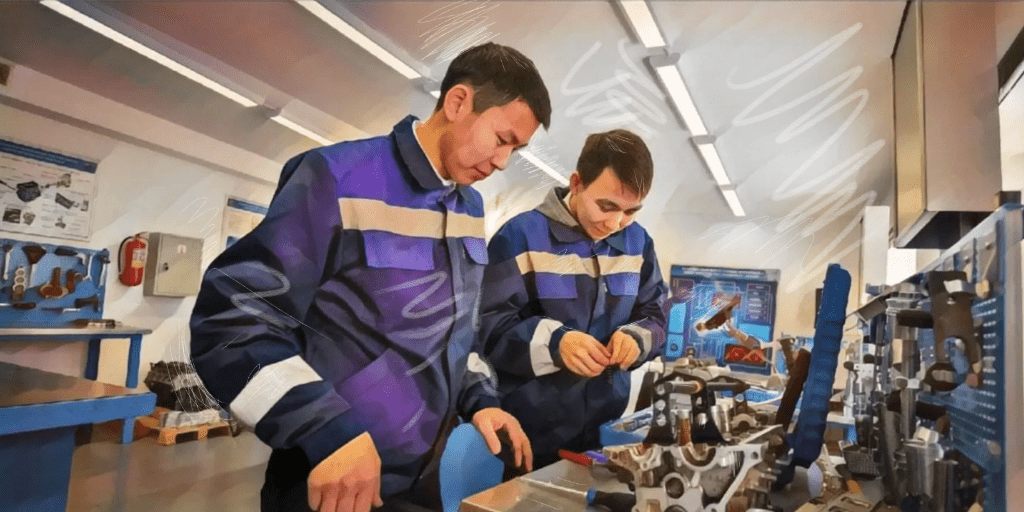
That data reflects only one segment of the labor market. An analysis of vacancies posted on Kazakhstan’s electronic labor exchange in 2023–2024 also showed substantial industrial demand – around 20% of vacancies for manual workers were in manufacturing, 13% in construction, and 8% in electricity and energy supply. Among the most sought-after professions were industrial equipment mechanics, metalworkers using gas-cutting torches, construction fitters, plumbers, and power plant operators.
Many of the new plants are still being designed or built, with large-scale recruitment yet to begin. Preparing enough workers with the skills to operate them will require training well before the plants open.
For foreign investors, the availability of skilled labor is becoming part of the question surrounding production localization. International companies are opening plants in Kazakhstan in the automotive industry, mechanical engineering, chemicals, and metallurgy, with a significant share of jobs expected to go to local workers. In non-ferrous metallurgy alone, eight projects worth around $174 million were planned to launch in 2026, creating more than 1,500 jobs.
Staffing the Balkhash Smelter
A new copper smelter planned for Balkhash illustrates the challenge ahead. Construction is due to begin in 2027, with commissioning scheduled for 2030. The plant is expected to create around 1,200 permanent jobs, with Kazakhstani specialists expected to account for 90% of its workforce when it opens.
The investor has also committed to training 50 students at educational institutions in the Karaganda region. How it plans to recruit and prepare the wider workforce has not been detailed in the announcement.
The same challenge is emerging simultaneously across multiple sectors. Kazakhstan is expanding higher-value metals processing, mechanical engineering, chemicals, and energy. Kazakhstan will also need to train technical specialists for its first new nuclear power plant well before the plant begins generating electricity.
The labor pool cannot simply be expanded by producing more graduates. The World Bank has previously pointed to a significant mismatch between education and employment, with many people working outside the field in which they were trained or holding qualifications above those required for their jobs. The bank has linked economic diversification to the country’s ability to retrain workers as demand changes.
For Kazakhstan, the issue also has a regional dimension. The country competes for qualified workers with Russia and other labor markets while simultaneously trying to lure back some labor migrants and attract specialists from abroad. Changing migration patterns across Central Asia are already intensifying competition for workers.